
R
Robert Bau20247 Jul 2023 17:44Hello dear house building forum,
I registered today because I applied for a building plot in my community and I am hopeful to get it.
Development Plan / Restrictions
Plot size = 700 sqm (8,900 sq ft)
Slope = No
Floor area ratio = 0.4
Floor space index = 1 story (bungalow - no basement)
Building window, building line and boundary = Building boundary according to § 23 Land Use Ordinance (garage on boundary, house set back 3 m (10 ft))
Edge development = No
Number of parking spaces = 2
Number of stories = 1 story (bungalow)
Roof type
Style = Gable roof
Orientation = South
Maximum height / limits = 6.5 m (21 ft)
Additional requirements
Homeowners’ Requirements
Style, roof type, building type = open, gable roof or hip roof, bungalow
Basement, stories = No
Number of people, age = 2 people, 40 and 38 years old
Room requirements on ground floor, upper floor = Entrance hall, WC, utility room, pantry; bathroom, office; kitchen; dining-living room and 1 bedroom
Office: family use or home office? = family use
Guests per year = none (maximum 1)
Open or closed architecture = open
Conservative or modern design = rather modern
Open kitchen, kitchen island = open kitchen
Number of dining seats = 4
Fireplace = No
Music / stereo wall = wall for large TV
Balcony, roof terrace = No
Garage, carport = garage for 1 car
Vegetable garden, greenhouse = garden
Additional wishes / special features / daily routine, also reasons why this or that should or should not be = open design because I might use several air-to-air heat pumps instead of one air-to-water heat pump (still at the beginning of heating planning)
[U]House Design
Who created the plan:
- Builder’s planner = currently me
- Architect = currently none
- Do-it-yourself = Yes, everything possible and permitted
What do you particularly like? Why? = currently unsure
What don’t you like? Why? = currently unsure
Price estimate from architect/planner: no price available
Personal price limit for the house including equipment: €220,000
Preferred heating technology: air-to-air heat pumps (split air conditioning units)
If you have to give up, which details / extensions
- can you give up: pantry
- can’t you give up: office
Why was the design created as it is now? For example
Standard design from the planner? No
Which wishes were implemented by the architect? all wishes implemented, no architect
A mix of many examples from various magazines? No
What makes it particularly good or bad in your opinion? The design is just an idea, I am looking forward to criticism and suggestions
What is the most important / fundamental question about the floor plan summarized in 130 characters?
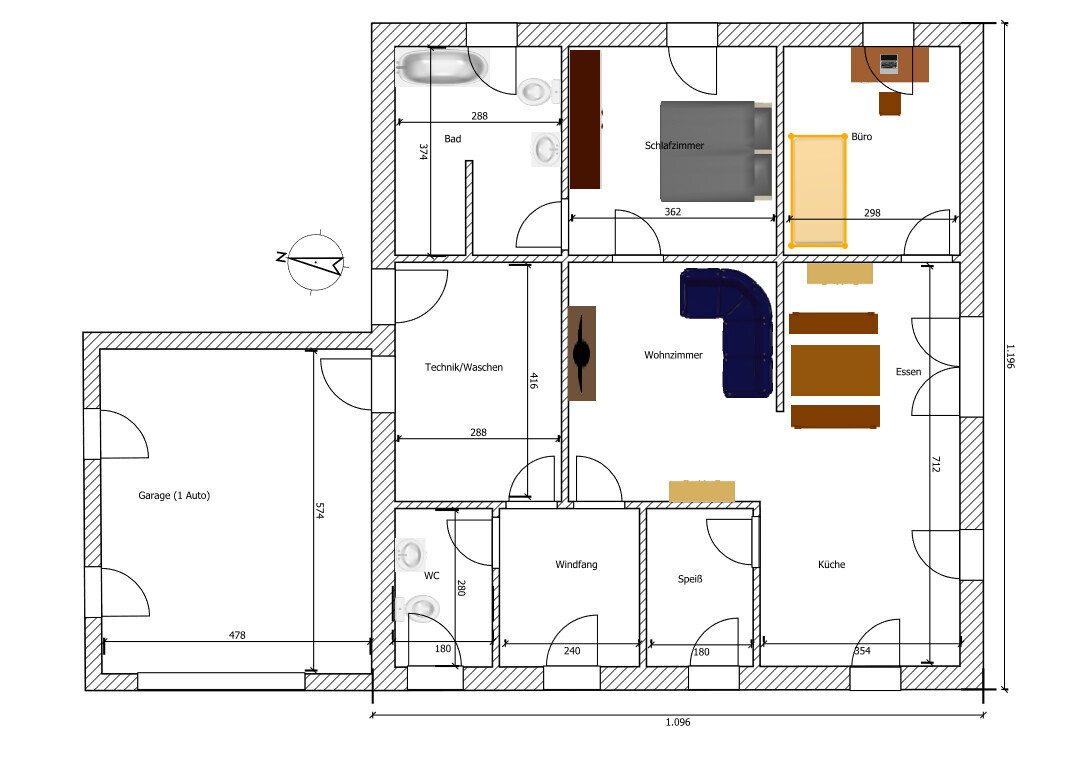
I want to minimize square meters wasted on hallways and use the bungalow’s space effectively.
I registered today because I applied for a building plot in my community and I am hopeful to get it.
Development Plan / Restrictions
Plot size = 700 sqm (8,900 sq ft)
Slope = No
Floor area ratio = 0.4
Floor space index = 1 story (bungalow - no basement)
Building window, building line and boundary = Building boundary according to § 23 Land Use Ordinance (garage on boundary, house set back 3 m (10 ft))
Edge development = No
Number of parking spaces = 2
Number of stories = 1 story (bungalow)
Roof type
Style = Gable roof
Orientation = South
Maximum height / limits = 6.5 m (21 ft)
Additional requirements
Homeowners’ Requirements
Style, roof type, building type = open, gable roof or hip roof, bungalow
Basement, stories = No
Number of people, age = 2 people, 40 and 38 years old
Room requirements on ground floor, upper floor = Entrance hall, WC, utility room, pantry; bathroom, office; kitchen; dining-living room and 1 bedroom
Office: family use or home office? = family use
Guests per year = none (maximum 1)
Open or closed architecture = open
Conservative or modern design = rather modern
Open kitchen, kitchen island = open kitchen
Number of dining seats = 4
Fireplace = No
Music / stereo wall = wall for large TV
Balcony, roof terrace = No
Garage, carport = garage for 1 car
Vegetable garden, greenhouse = garden
Additional wishes / special features / daily routine, also reasons why this or that should or should not be = open design because I might use several air-to-air heat pumps instead of one air-to-water heat pump (still at the beginning of heating planning)
[U]House Design
Who created the plan:
- Builder’s planner = currently me
- Architect = currently none
- Do-it-yourself = Yes, everything possible and permitted
What do you particularly like? Why? = currently unsure
What don’t you like? Why? = currently unsure
Price estimate from architect/planner: no price available
Personal price limit for the house including equipment: €220,000
Preferred heating technology: air-to-air heat pumps (split air conditioning units)
If you have to give up, which details / extensions
- can you give up: pantry
- can’t you give up: office
Why was the design created as it is now? For example
Standard design from the planner? No
Which wishes were implemented by the architect? all wishes implemented, no architect
A mix of many examples from various magazines? No
What makes it particularly good or bad in your opinion? The design is just an idea, I am looking forward to criticism and suggestions
What is the most important / fundamental question about the floor plan summarized in 130 characters?
I want to minimize square meters wasted on hallways and use the bungalow’s space effectively.

Robert Bau2024 schrieb:
The design is just an idea; I welcome criticism and suggestions.I basically have only two points: 1. Recognize your level of skill and consult an architect; 2. Although having no desire for children makes a nursery unnecessary and there is certainly a market for homes for couples without children, I do not see your house design as an attractive offer in that market either. Even if you build your own home to keep it long-term, you should never completely lose sight of the possibility of selling or repurposing it. A purely custom-designed house tends to have worse financing conditions.Robert Bau2024 schrieb:
I want to waste as little floor area as possible on hallways and instead use the space in the bungalow efficiently.You’ve actually achieved almost the exact opposite: generously wasted circulation areas that paradoxically arise precisely because you try to avoid hallways.Unfortunately, your design is not improvable (because you cannot simply fix failed parameter settings – design skills are not learned by infinite random attempts or phone jokes or the like). Just for fun, compare the dimensions of what I’ll call the "TV corner" and the pantry (examples can be exchanged almost arbitrarily). You probably have strengths in other areas ;-)
By the way, a single-storey building as defined by building regulations does not necessarily have to be a bungalow (and a bungalow is always on a different cost level than a house of the same size with one-and-a-half or two floors). Non-slope basements (i.e., purely underground cellars) do not count as a storey either.
https://www.instagram.com/11antgmxde/
https://www.linkedin.com/company/bauen-jetzt/
11ant schrieb:
I actually only had two questions:P.S.: I missed the crucial lineRobert Bau2024 schrieb:
Personal price limit for the house, including equipment: €220,000so I’ll add: 0. buy a plot and hope for the best.https://www.instagram.com/11antgmxde/
https://www.linkedin.com/company/bauen-jetzt/
R
Robert Bau20247 Jul 2023 22:00Hi, thanks for your reply.
We do have children, two of them, and live with them in our own detached house (built in 2003). The probably amateur floor plan comes from the desire that my wife and I want to move into a single-story bungalow in about 12 years.
- The floor plan will of course NOT be implemented as shown; as mentioned at the beginning, it’s just an idea -
Regarding costs, I would try to build like this:
- Excavate topsoil (depth about 30cm (12 inches) until bedrock)
- Bedrock prevents basement construction
- Install and compact a capillary-breaking gravel layer
- Separation layer, then pour the ground slab
- Insulation (only under the slab??)
- After that, build the exterior walls with Poroton Plan bricks T9 42.5cm (17 inches) thick (aiming for KfW 55 standard, maybe thicker)
- Interior walls with Poroton soundproof bricks Plan-T1.4 12.5cm (5 inches) thick
- For the roof, an open visible rafter roof structure. Shape: gable roof (about 15°)
- Two side purlins left and right, one middle purlin at the top
- Visible rafters
- On these, I would install sandwich panels (thickness 220mm (8.7 inches)) with red tile appearance (U-value better than 0.15?)
- Metal roof covering is allowed
- Interior lighting on the walls because of the open roof structure
- Heating with 2-3 split air conditioning units (installation and consulting by a refrigeration specialist company)
- Hot water via instantaneous water heaters directly at the points of use
- Photovoltaic panels will of course be installed on the roof
This is — like the floor plan — just an idea... I’m not a professional.
The costs for concrete, bricks, roof panels, and timber can be asked for and added up; I have access to an excavator, bricklayers, and electricians.
Best regards
Robert (who has other talents)
We do have children, two of them, and live with them in our own detached house (built in 2003). The probably amateur floor plan comes from the desire that my wife and I want to move into a single-story bungalow in about 12 years.
- The floor plan will of course NOT be implemented as shown; as mentioned at the beginning, it’s just an idea -
Regarding costs, I would try to build like this:
- Excavate topsoil (depth about 30cm (12 inches) until bedrock)
- Bedrock prevents basement construction
- Install and compact a capillary-breaking gravel layer
- Separation layer, then pour the ground slab
- Insulation (only under the slab??)
- After that, build the exterior walls with Poroton Plan bricks T9 42.5cm (17 inches) thick (aiming for KfW 55 standard, maybe thicker)
- Interior walls with Poroton soundproof bricks Plan-T1.4 12.5cm (5 inches) thick
- For the roof, an open visible rafter roof structure. Shape: gable roof (about 15°)
- Two side purlins left and right, one middle purlin at the top
- Visible rafters
- On these, I would install sandwich panels (thickness 220mm (8.7 inches)) with red tile appearance (U-value better than 0.15?)
- Metal roof covering is allowed
- Interior lighting on the walls because of the open roof structure
- Heating with 2-3 split air conditioning units (installation and consulting by a refrigeration specialist company)
- Hot water via instantaneous water heaters directly at the points of use
- Photovoltaic panels will of course be installed on the roof
This is — like the floor plan — just an idea... I’m not a professional.
The costs for concrete, bricks, roof panels, and timber can be asked for and added up; I have access to an excavator, bricklayers, and electricians.
Best regards
Robert (who has other talents)

Hello Robert and welcome. This is all very immature and falls under the category of a snap idea. Neither the budget, design, nor schedule demonstrate any expertise. However, 12 years would be a reasonable time to acquire it. Is there a build obligation for the plot in the coming years?
If meaningful results are to be achieved here, I would strongly recommend consulting a professional or pursuing architectural studies.
If meaningful results are to be achieved here, I would strongly recommend consulting a professional or pursuing architectural studies.
Robert Bau2024 schrieb:
-Do-it-Yourself = Yes, everything possible and permitted Do I understand correctly that you want to build everything entirely by yourself or together with your wife?
The foolish idea unfortunately starts where you want to toil on the site as amateurs after an 8-hour workday, possibly even 9 hours including commuting, in all kinds of weather. While this can be managed on a patient schedule, I can say from personal experience that after just 5 weeks of painting and flooring work, you start to feel physically strained and would have preferred to spend your annual vacation differently. Some tasks you might still do on weekends, but even with a full-time 40-hour workweek as an employee, after a few weekends of heavy work you will be completely exhausted.
An alternative is offered by Ytong kit houses, where you can handle the shell construction yourself.
For the installation of electrical work, plumbing, and heating, it is advisable to get professional assistance.
Robert Bau2024 schrieb:
You can calculate the costs for concrete, blocks, roof tiles, and wood, I have access to excavators, masons, and electricians. Feel free to calculate the material costs, but what about delivery, storage, and equipment? And then, of course, a third additional amount for consumables like screws and such, which you might not yet be aware of as a consumption factor.
Robert Bau2024 schrieb:
Personal price limit for the house, including fittings: €220,000 But however you look at it: you can save quite a bit, but it also takes much longer. See above. You risk your job and your health.
Let’s assume you save €50,000 on labor costs and deduct that later—still, the house will cost around €3,000 per square meter, so for 100m² (1,076 sq ft) about €300,000 for a compact construction plus additional incidental building costs of roughly €50,000, totaling €350,000 minus your saved labor costs of €50,000, bringing it back to €300,000.
That does not even include a garage, paving stones, or small trees for the outdoor areas.
Robert Bau2024 schrieb:
Photovoltaic panels will of course be installed on the roof. I would advise starting with more modest plans and leave out the “self-evident” extras that cause high costs in the calculation (and of course in implementation).
That also applies to extravagant design features like an open gable. That doesn’t come for free, as it requires more insulated roof area and the structural engineering is more challenging.
Robert Bau2024 schrieb:
The design is just an idea; I welcome criticism and suggestions Criticism, suggestions…
Robert Bau2024 schrieb:
What do you particularly like? Why? = currently unsure
What do you dislike? Why? = currently unsure … is of course difficult when you yourself can’t yet say what you like and what you don’t.
Maybe like this: if you want an open gable, it should be clearly visible in the design. That means you also need to consider the open gable’s structural engineering in the planning and plan the walls accordingly so that the gable functions properly.
Robert Bau2024 schrieb:
I want to minimize square meters wasted on corridors and instead use the bungalow’s space efficiently. I understand that. But you can’t achieve this simply by removing corridors and placing doors randomly. The house will have no real privacy. Residents will disturb each other. If you have friends over to watch TV, where is your wife supposed to go? She won’t be able to move around the house without either standing in front of the TV screen or interfering with you. You are essentially designing traffic areas throughout the house that cannot be used as proper living space and waste even more room than a small, well-designed corridor. Additionally, the doors are arbitrarily placed, which limits sensible furniture arrangements and storage solutions.
It’s not worth going into more detail here.
My advice is to thoroughly inform yourself about construction and additional building costs and not to overestimate your own planning and execution skills.
Why exactly is only €220,000 budgeted when apparently a 20-year-old house could be sold and the capital value should be higher?! What portion of that house is financed by external loans, and what is its actual value?
Similar topics