
ᐅ Floor plan of an urban villa with a hip roof, approximately 170 square meters
Created on: 18 May 2019 15:35
D
Danvane
Hello everyone,
My wife and I have been considering building a house for quite some time now. As a result, I have been reading this forum for a while. First of all, thank you very much for your many helpful tips, which have already helped us tremendously. Many compliments to the numerous users who actively participate here and share their knowledge with others.
Now the time has come for us as well. We have purchased a plot of land in Lower Saxony and are currently working with an architect to develop an optimal floor plan for us.
We have now received a draft, which we think could still be improved in some areas. For this reason, I have decided to share the floor plan here for discussion and hope to get some suggestions or ideas on what we can improve. Perhaps you will also spot things that “just don’t work” or are not practical for everyday use.
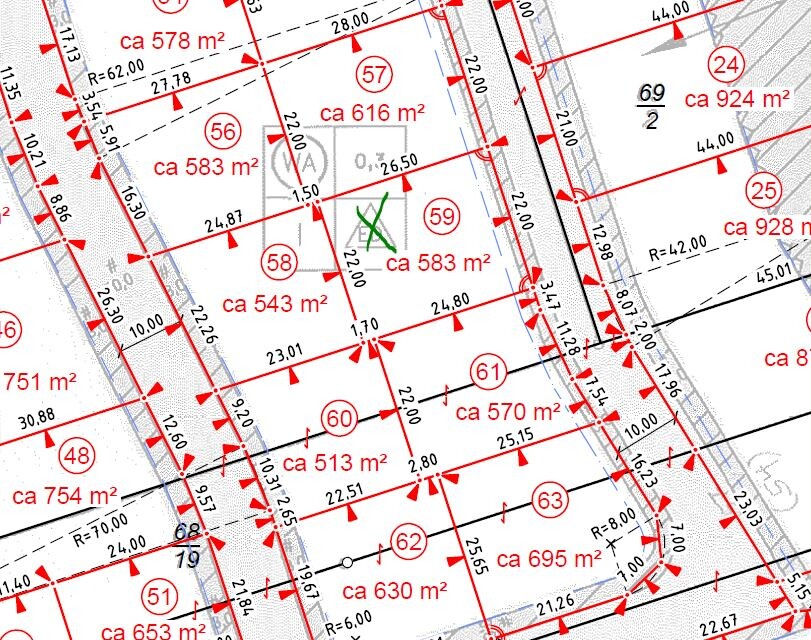
Note: The subdivision plan showing the plot (green cross) is oriented to north.
I look forward to any feedback! Here is the questionnaire:
Development plan/restrictions
Plot size: 583 sqm
Slope: no
Floor area ratio (FAR): 0.3
Plot coverage ratio (site occupancy): no requirement
Building envelope, building line, and boundaries:
The plot is 22 m wide and 24.8 m to 26.5 m deep depending on the side. The house should ideally extend more in width than in depth to leave as much garden space as possible on the southwest side. Maximum house width: 22 m (plot width) – 6 m (width of double carport) – 3 m (building boundary where the carport is not located) = 13 m. As for depth, depending on the layout, we are considering between 9 m and a maximum of 11 m.
Setback/building margin: 3 m
Number of parking spaces: no requirement
Number of floors: one full floor
Roof pitch: minimum 15 degrees
Architectural style: no requirement
Orientation: no requirement
Maximum height/limitations: no requirement
Homeowners' requirements
Architectural style, roof type, building type:
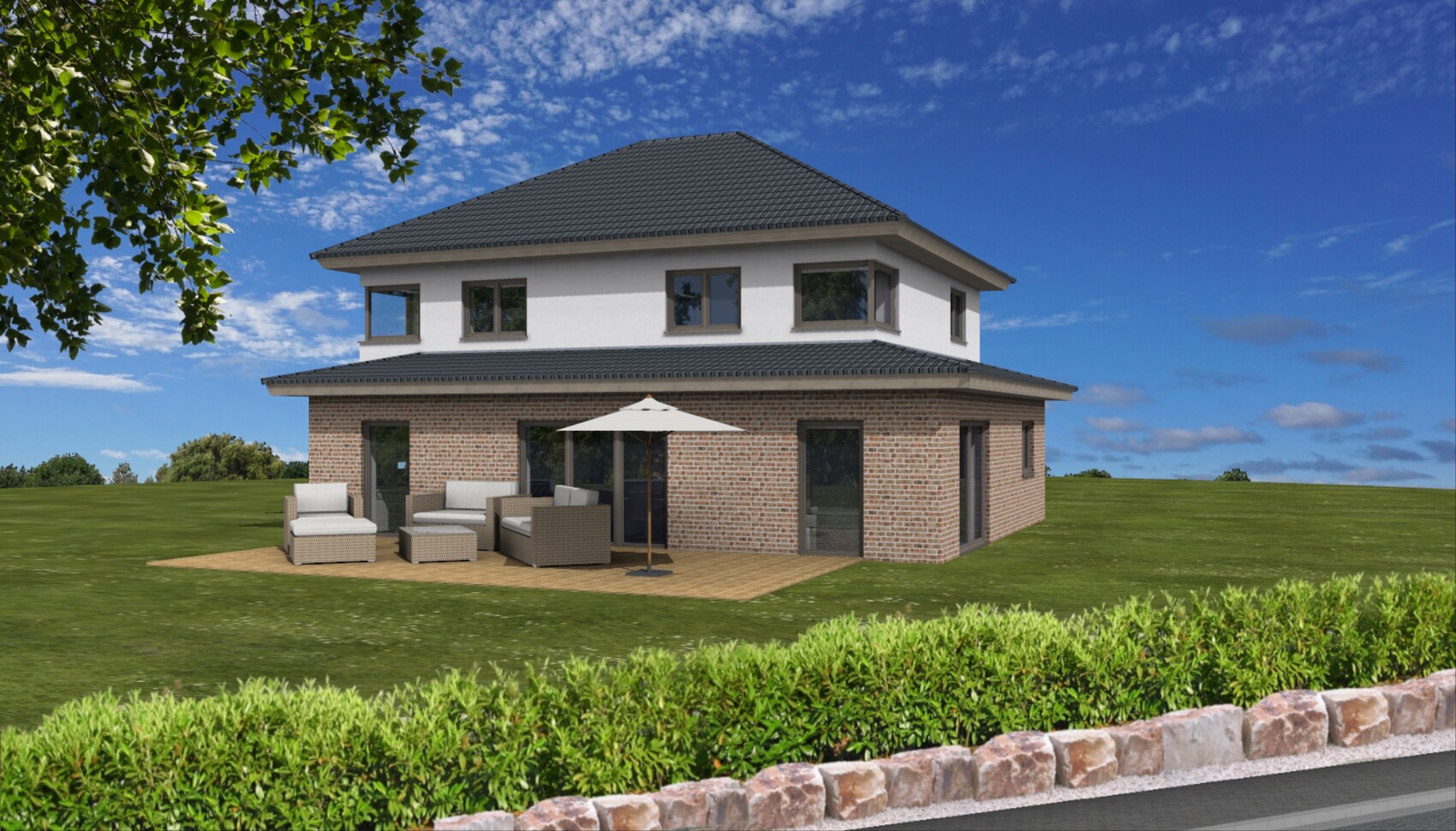
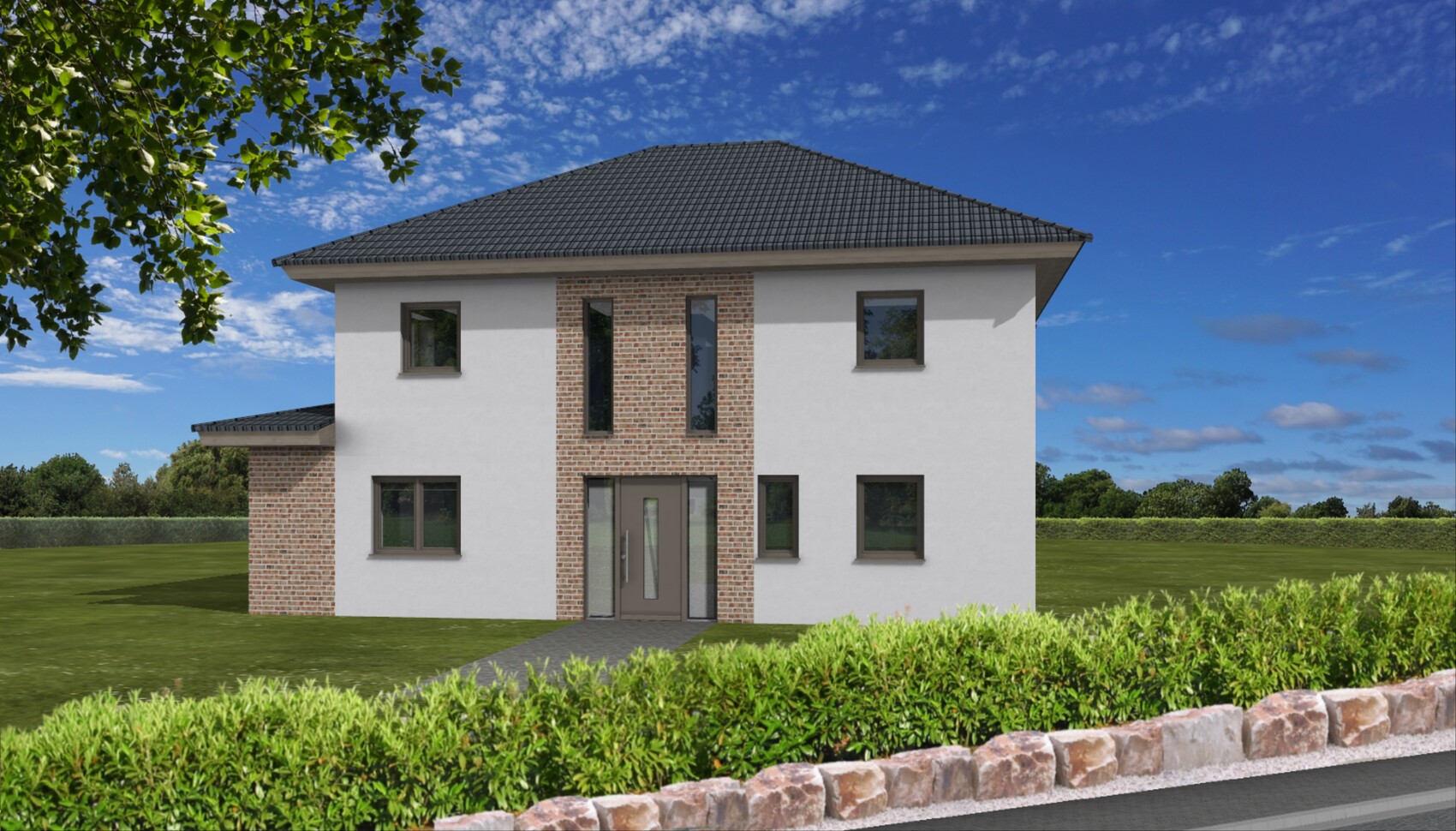
Preferred style: townhouse villa with only one full floor (ground floor) and a hip roof on the upper floor; the upper floor may only cover 2/3 of the ground floor area to meet the full-floor condition; whether the ground floor has a projection on two sides or a symmetrical projection on all four sides is initially not decisive and should result from the floor plan; the ground floor projection should be covered with a roof like the upper floor — no balconies or similar.
Basement, floors:
No basement, ground floor is full floor + upper floor as a recessed floor with a maximum of 2/3 of the ground floor area
Number of occupants, ages:
3 people aged 30 (female), 29 (male), and 8 months (child)
Space requirements on ground floor and upper floor:
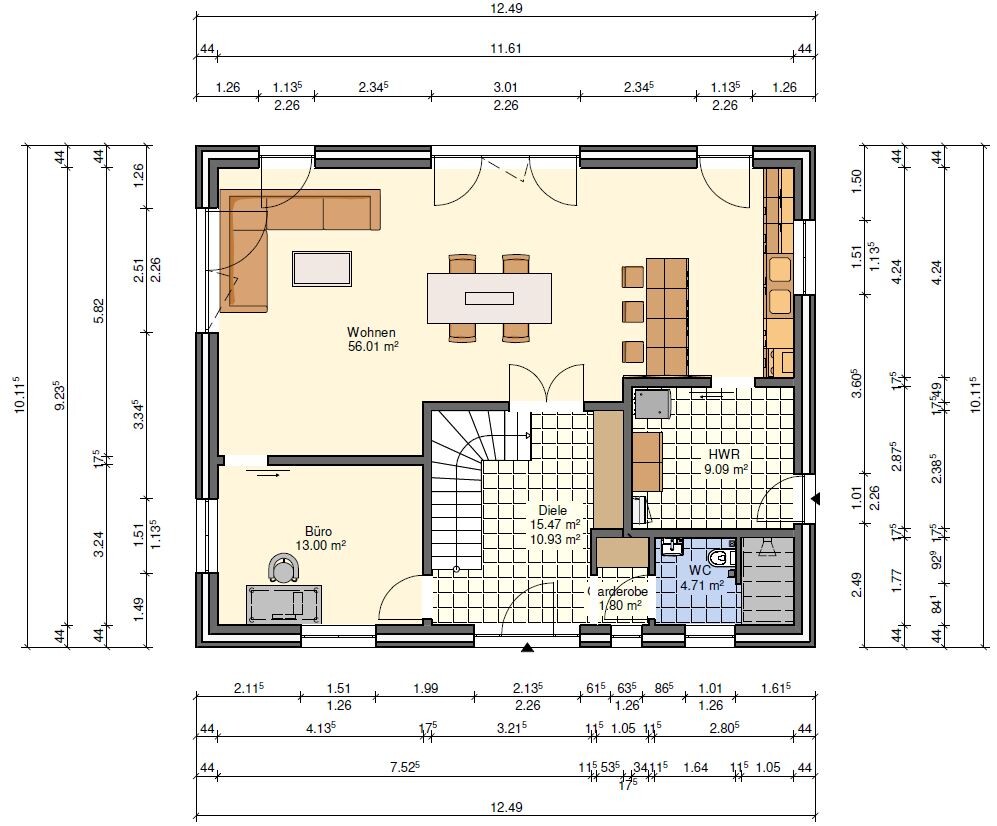
Ground floor: living/dining/kitchen as one room, utility room, guest WC with shower, office/guest room, entrance hallway with wardrobe
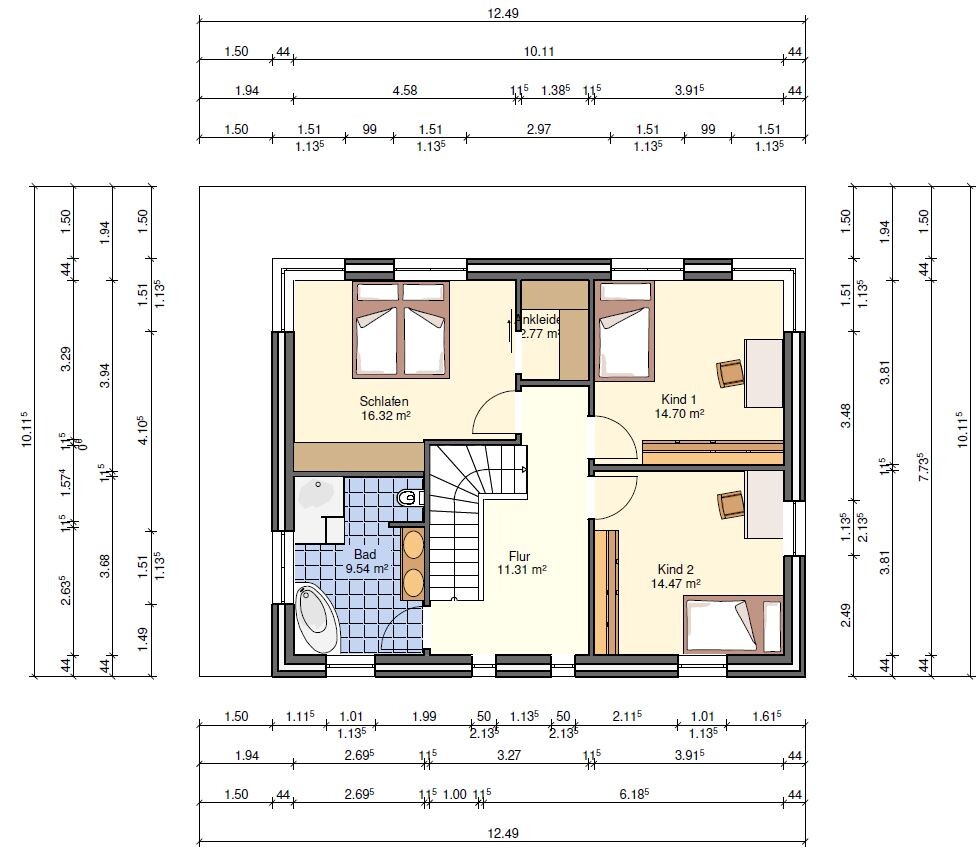
Upper floor: bedroom, dressing room, 2 x children’s rooms, gallery (hallway)
Office: family use or home office:
Primarily home office, but must also provide sleeping space for guests; in younger years, possibly used as a playroom for children on the ground floor
Number of overnight guests per year: <5
Open or closed architecture:
Open concept in the main living area on the ground floor; however, the staircase to the upper floor should be closed off — in other words, we definitely do not want a staircase in the main living space leading upstairs (although stylish, it is not ideal with children’s rooms upstairs)
Conservative or modern construction: modern
Open kitchen, kitchen island: open kitchen with island
Number of dining seats: 6 with option for up to 12 (for visitors, etc.)
Fireplace: no
Music/stereo wall: no, only a sideboard or similar for TV
Balcony, roof terrace: no
Garage, carport:
Double carport with storage room (6 m x 9 m) on the northeast side of the plot at the building boundary
Utility garden, greenhouse: no
Additional wishes/special features/daily routine, also reasons why certain things should or should not be included:
It is important for us to have a generous wardrobe near the front door that allows jackets, shoes, etc., to be dropped off immediately upon entering the house — this keeps dirt from spreading further inside and prevents tripping over shoes, bags, etc., all the time.
House design
Planning by:
The design was created by an architect.
What do you particularly like? Why?
What do you dislike? Why?
Preferred heating system: gas
If you have to do without, which details/extras can you live without / which can you not live without?
Basically, we would very reluctantly deviate from the presented architectural style (“concealed” townhouse villa).
Why did the design turn out the way it is now?
Our wish was a house without sloped ceilings on the upper floor, which of course has to comply with the development plan. Accordingly, the architect designed a form of townhouse villa with a sufficiently large projection on the ground floor as the basic concept. Regarding the room program, it’s probably standard for a house of this size, and we have no special demands in this regard. Some ideas, like connecting the office to the main living area, also came from this forum. In particular, the floor plans by kaho674 have always been very inspiring for new ideas (many thanks for that!).
What is the main/basic question about the floor plan summed up in 130 characters?
We are looking for ideas on how to improve the floor plan and better tailor it to our requirements (e.g., room orientation upstairs, see generally “dislikes”) without increasing the house’s footprint.
My wife and I have been considering building a house for quite some time now. As a result, I have been reading this forum for a while. First of all, thank you very much for your many helpful tips, which have already helped us tremendously. Many compliments to the numerous users who actively participate here and share their knowledge with others.
Now the time has come for us as well. We have purchased a plot of land in Lower Saxony and are currently working with an architect to develop an optimal floor plan for us.
We have now received a draft, which we think could still be improved in some areas. For this reason, I have decided to share the floor plan here for discussion and hope to get some suggestions or ideas on what we can improve. Perhaps you will also spot things that “just don’t work” or are not practical for everyday use.
Note: The subdivision plan showing the plot (green cross) is oriented to north.
I look forward to any feedback! Here is the questionnaire:
Development plan/restrictions
Plot size: 583 sqm
Slope: no
Floor area ratio (FAR): 0.3
Plot coverage ratio (site occupancy): no requirement
Building envelope, building line, and boundaries:
The plot is 22 m wide and 24.8 m to 26.5 m deep depending on the side. The house should ideally extend more in width than in depth to leave as much garden space as possible on the southwest side. Maximum house width: 22 m (plot width) – 6 m (width of double carport) – 3 m (building boundary where the carport is not located) = 13 m. As for depth, depending on the layout, we are considering between 9 m and a maximum of 11 m.
Setback/building margin: 3 m
Number of parking spaces: no requirement
Number of floors: one full floor
Roof pitch: minimum 15 degrees
Architectural style: no requirement
Orientation: no requirement
Maximum height/limitations: no requirement
Homeowners' requirements
Architectural style, roof type, building type:
Preferred style: townhouse villa with only one full floor (ground floor) and a hip roof on the upper floor; the upper floor may only cover 2/3 of the ground floor area to meet the full-floor condition; whether the ground floor has a projection on two sides or a symmetrical projection on all four sides is initially not decisive and should result from the floor plan; the ground floor projection should be covered with a roof like the upper floor — no balconies or similar.
Basement, floors:
No basement, ground floor is full floor + upper floor as a recessed floor with a maximum of 2/3 of the ground floor area
Number of occupants, ages:
3 people aged 30 (female), 29 (male), and 8 months (child)
Space requirements on ground floor and upper floor:
Ground floor: living/dining/kitchen as one room, utility room, guest WC with shower, office/guest room, entrance hallway with wardrobe
Upper floor: bedroom, dressing room, 2 x children’s rooms, gallery (hallway)
Office: family use or home office:
Primarily home office, but must also provide sleeping space for guests; in younger years, possibly used as a playroom for children on the ground floor
Number of overnight guests per year: <5
Open or closed architecture:
Open concept in the main living area on the ground floor; however, the staircase to the upper floor should be closed off — in other words, we definitely do not want a staircase in the main living space leading upstairs (although stylish, it is not ideal with children’s rooms upstairs)
Conservative or modern construction: modern
Open kitchen, kitchen island: open kitchen with island
Number of dining seats: 6 with option for up to 12 (for visitors, etc.)
Fireplace: no
Music/stereo wall: no, only a sideboard or similar for TV
Balcony, roof terrace: no
Garage, carport:
Double carport with storage room (6 m x 9 m) on the northeast side of the plot at the building boundary
Utility garden, greenhouse: no
Additional wishes/special features/daily routine, also reasons why certain things should or should not be included:
It is important for us to have a generous wardrobe near the front door that allows jackets, shoes, etc., to be dropped off immediately upon entering the house — this keeps dirt from spreading further inside and prevents tripping over shoes, bags, etc., all the time.
House design
Planning by:
The design was created by an architect.
What do you particularly like? Why?
- The entrance hall does not feel narrow but opens comparatively wide
- The wardrobe provides enough space to store jackets, shoes, etc.
- Connection between kitchen and utility room
- Connection between living area and office — the office is not isolated but integrated into the main living area (also usable as a play area for children, for example)
What do you dislike? Why?
- Staircase located in the “dirty” area is not optimal
- Utility room only accessible through the kitchen — potentially inconvenient in everyday life
- Kitchen might be difficult to furnish (storage space issue)
- The entire upper floor needs improvement:
- Both children’s rooms should face southwest with a view of the garden
- Bedroom should be in the north / east
- Dressing room is integrated as requested but is not really usable due to its size
- Bathroom on the upper floor is not connected to the bathroom on the ground floor — probably not ideal
Preferred heating system: gas
If you have to do without, which details/extras can you live without / which can you not live without?
Basically, we would very reluctantly deviate from the presented architectural style (“concealed” townhouse villa).
Why did the design turn out the way it is now?
Our wish was a house without sloped ceilings on the upper floor, which of course has to comply with the development plan. Accordingly, the architect designed a form of townhouse villa with a sufficiently large projection on the ground floor as the basic concept. Regarding the room program, it’s probably standard for a house of this size, and we have no special demands in this regard. Some ideas, like connecting the office to the main living area, also came from this forum. In particular, the floor plans by kaho674 have always been very inspiring for new ideas (many thanks for that!).
What is the main/basic question about the floor plan summed up in 130 characters?
We are looking for ideas on how to improve the floor plan and better tailor it to our requirements (e.g., room orientation upstairs, see generally “dislikes”) without increasing the house’s footprint.

kaho674 schrieb:
How is that defined?Nowadays, it’s probably specified in the residential floor area regulation, although I was more familiar with the DIN standard:kaho674 schrieb:
Is it enough to roof a terrace in order to count it fully in the calculation of square meters?If I remember correctly, a roofed area counts as half of the open space, and an uncovered area counts as only a quarter.https://www.instagram.com/11antgmxde/
https://www.linkedin.com/company/bauen-jetzt/
kaho674 schrieb:
Oh really!
I find the new ground floor more appealing. The open space/void is included again in the upper floors—I thought that was visible.
I find it hard to imagine that I’m forcing anything on you that you’d like. In my opinion, your priorities are still somewhat outside what I can relate to. For example, square rooms are only nice for dancing. They are completely unsuitable for furnishing and arranging. Especially a utility room needs as long walls as possible for installations. But beds, wardrobes, and sinks usually also need to be placed against a wall. That’s why it’s best to design rectangular rooms.
Looking from the front door all the way into the garden is actually a disadvantage for terrace coziness when the postal worker rings the bell. But okay.
If I feel like it, I’d be happy to sketch a bit more again. But I already find the last draft with the changes quite good. Sorry, I completely overlooked the open space/void! My mistake!
Please don’t misunderstand. Just because I like the things listed in the current design doesn’t mean we absolutely have to have them. At the moment, the individual rooms come together in a composition that appeals to us. I was just explaining why that is.
You are absolutely right about square rooms. I also never said we generally love them. But I find certain rooms work “better” as square, like the living room or the office. In particular, I already mentioned that we really like the more elongated rather than wide shape for the utility room, since—as you said—we need a lot of wall space and less room in the center, which would otherwise be wasted. This became very clear to us after visiting several show homes; it’s actually quite logical.
The view corridor was/is a big wish of my wife’s to create a certain depth inside the house.
I hope you feel inspired to join in—that would definitely make us happy!
11ant schrieb:
At least for a carport that extends into the annex, I would generally assume no exceptions here.
This means, conversely: Ground floor (GF) = 3/2 of the upper floor (UF) = 3/5 of the total area => at least 20% must first be deducted from the total floor area before it can be evenly distributed. My approach would therefore be to identify, within the room program, relatively large rooms that will be assigned to the lower level. This means that, until this measure is fulfilled, rooms like utility room, office, and guest room will likely be on the ground floor; ground floor terrace areas will mostly be roofed over, while upper floor terraces are practically excluded from the start. You can also be creative with the roof: just as, for example, dormers the size of an entire bathroom are often built on gable roofs, you can also partially lower areas under sloped ceilings below the 230cm (7 ft 7 in) mark.
I have reattached the excerpt from the development plan. Maybe it will help...
There are indeed houses where the roof pitch is designed in such a way that the upper floor qualifies as a full story, even though the exterior appearance is that of a completely cubic urban villa. Just as you mentioned, this is achieved by ensuring the 230cm (7 ft 7 in) height limit is not exceeded in enough places on the upper floor. However, we were not at all satisfied with these houses during our exploration of options.
It is not only that we benefit from having no sloped ceilings upstairs when we make the ground floor significantly larger than the upper floor, but also that rooms naturally shift to where they serve us best. I would find having the office on the upper floor inconvenient, and my wife would be less than happy with the utility room upstairs (although I am actually a fan of having the washing machine on the upper floor, but oh well). So, for us, the variant with a setback upper floor would also be the most appealing in terms of room layout. Another aspect is that with just one full story above, it becomes possible to keep the upper walls straight.

Similar topics