
Hello everyone,
We are currently reviewing whether to make any changes to the standard floor plan from our home builder for our end-of-terrace house. There are stricter guidelines that I’m already sure will disappoint some forum members. Roughly, we’ve been told that exterior walls and the façade, including windows and exterior doors, cannot be altered, and load-bearing walls cannot be moved. This mainly concerns the staircase and stair wall. Most other interior walls, as far as we know, are movable. In principle, we could also move in with the unmodified standard layout, but we do see 1-2 points with potential for improvement (though maybe in the end this just fuels the Spec House Building - Small Changes, Unintended Consequences thread).
I will still fill out the questionnaire, even though most of it cannot be changed for us (in particular Section 1 on the development plan is more the home builder’s area).
Development Plan / Restrictions
Plot size – 207 m² (2,230 sq ft)
Slope – slight incline, I don’t have exact survey data, but we can’t change anything at the house entrances anyway.
Site coverage ratio – 0.4
Floor area ratio – 0.8
Building envelope, building line, and setback – not relevant since we cannot change the external shell
Edge development – not relevant since we cannot change the external shell
Number of parking spaces (already included) – garage plus parking space in front
Number of storeys – 2
Roof type – gable roof
Architectural style –
Orientation – north/south
Maximum heights / limits – not relevant
Other conditions: Hornbeam hedge along the cul-de-sac on our property (on the west side; in the floor plans it appears on the right because they are not north-oriented)
Homeowners’ Requirements
Architectural style, roof type, building type: fixed by the home builder
Basement, floors: usable basement + 2 full stories + converted attic (already determined by the builder)
Number of occupants, ages: currently 2 (31 and 32); planning for 1-2 children
Space needs on ground and upper floors:
Office: family use or home office? Home office, both partly working remotely. Ideally, a separate space for each would be great, but if that’s not possible with potentially 2 children, it’s manageable.
Guest bedrooms per year: about 3-4 times a year
Open or closed layout: medium? Open transition between kitchen and living area is a must, but overall, some walls are okay.
Conservative or modern building style: –
Open kitchen, kitchen island: tends to “not fully closed” (see above), but we don’t necessarily need an island if something else is more practical or cost-effective.
Number of dining seats: for 4 people
Fireplace: no
Music / stereo wall: no
Balcony / roof terrace: no
Garage / carport: garage included
Utility garden / greenhouse: no (maybe a small bed later we’d do ourselves)
Additional wishes / special features / daily routine, also reasons why certain things should or shouldn’t be included:
We are both partly working remotely. Currently, we have an office and a desk in the living room. If possible, I’d prefer not to keep working in the living room. If two adults move in, it’s absolutely no problem; with one child it’s probably still fine, with two children… well, by then things might have changed anyway. I feel we’ll find a solution, and if someone locks themselves away in the 4 m² (43 sq ft) closet on the first floor (where the walls are still adjustable) or gets a desk in the bedroom, that might work.
House Design
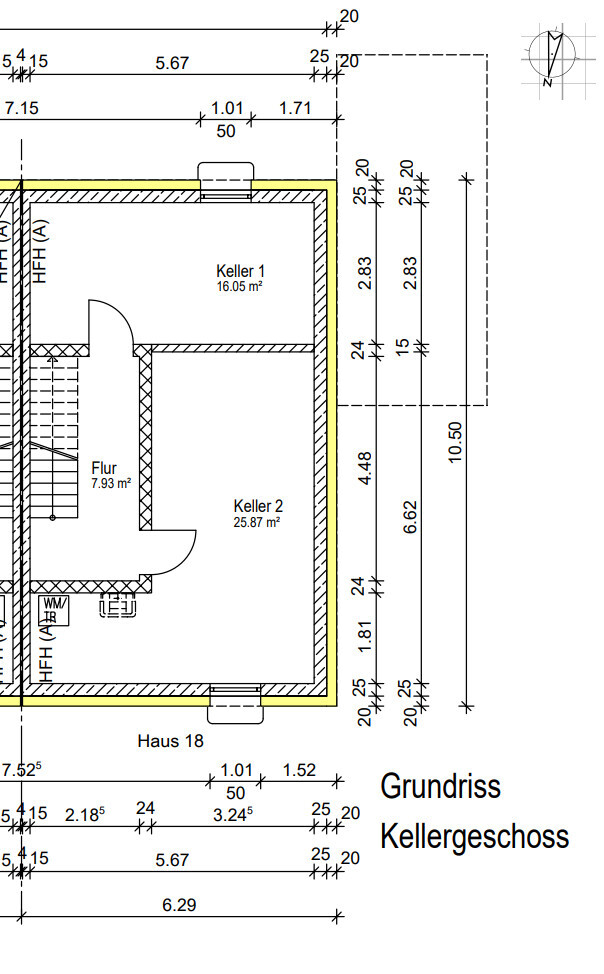
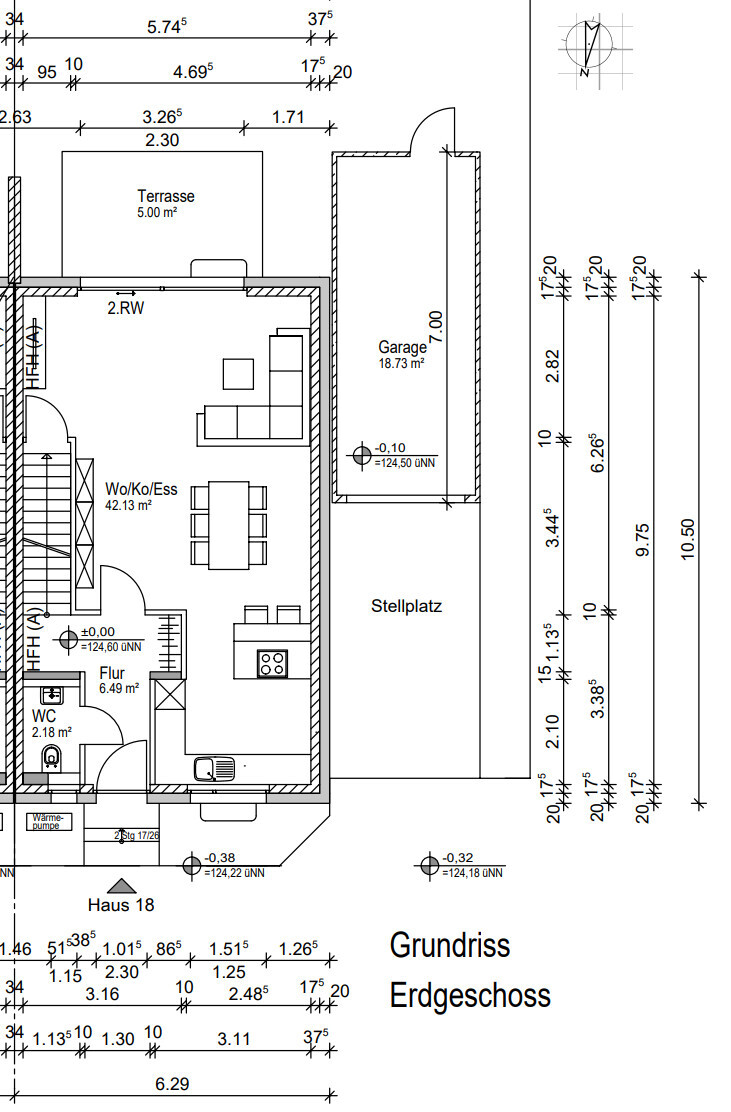
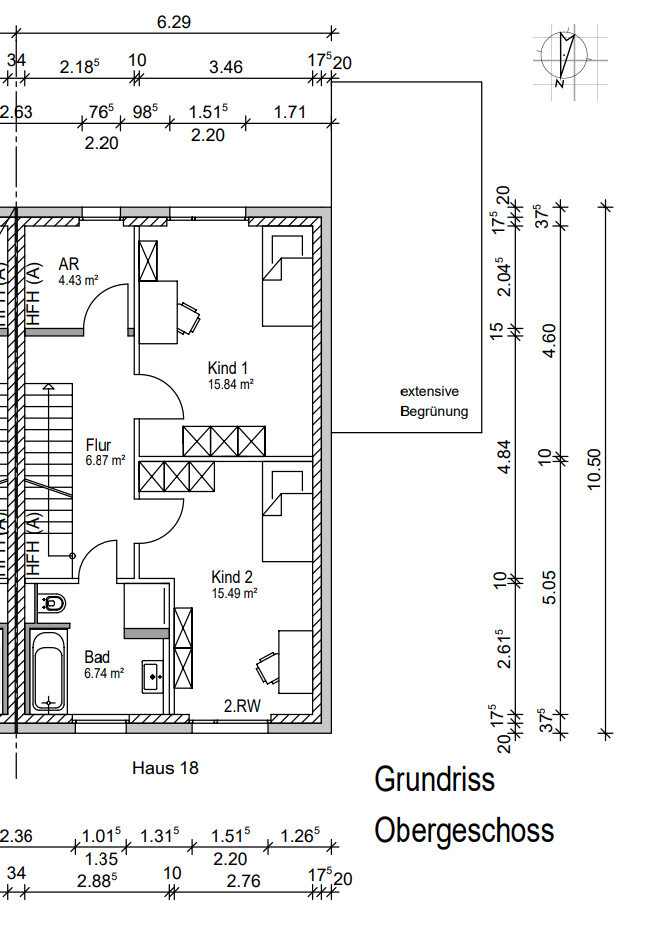
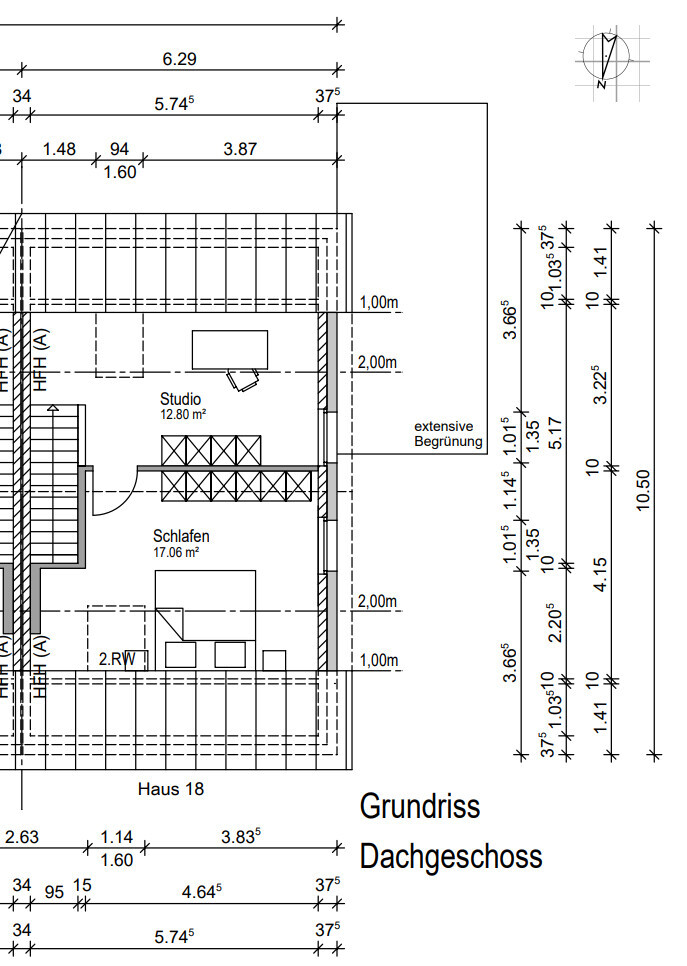
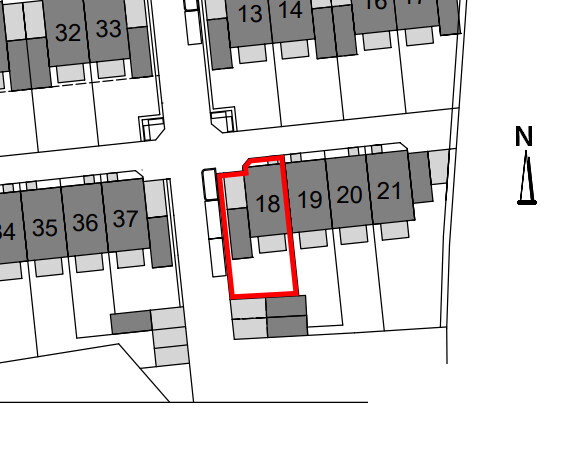
Surroundings: To the south are garages for neighboring terrace houses, then a turning area (end of the cul-de-sac), followed by some individual trees and other detached houses. To the east is our block. Then a few small trees and a railway line (several meters lower). To the west, on our property, there is a city-required hornbeam hedge. We will try to negotiate a passage to the street (for bikes and so on). Since the second escape route on the ground floor is via the terrace, I see some chances, but city officials aren’t always easy.
Planning by:
- Home builder
What do you like especially? Why?
- I see the plan working for us both if the family plan doesn’t happen (then it’s very generous) and with 1-2 children as well.
What don’t you like? Why?
- Ground floor: (main pain point) Entrance is relatively narrow with little cloakroom space. The peninsula kitchen feels too small to work well (and probably requires an expensive extractor in the peninsula). The distance from the sofa to the TV is huge. The basement access is in the living room. We’ll probably manage some kind of furnishing on the ground floor, but right now it doesn’t exactly feel “yes, this is perfect.”
- Upper floor: We’ve debated whether to enlarge the 4 m² (43 sq ft) closet slightly to potentially use it later as an overflow office, but actually we find it as planned not bad at all (and initially more practical).
- Attic: The “landing” could be another possible office space if children come; we considered whether to separate it right away with a wall and door or leave it as shown.
So actually: except for the ground floor, we are quite satisfied; everything else is in the range of “if we want the jack-of-all-trades, maybe some changes could be made – or we keep it as is and see if the need arises.”
If you had to give up something, which details/extensions:
- We can give up: changes to the upper floor and attic
- We cannot give up: at least 1 office
Why is the design as it is now? e.g.
Standard plan from the home builder
What do you think makes it particularly good or bad?
I think it’s a solid floor plan for young families, but the ground floor worries me a bit. I feel maybe a different staircase shape would have helped, but as far as I’ve been told, that cannot be changed.
What is the most important/basic question about the floor plan in 130 characters?
How do we best arrange the ground floor? Should we still make some changes here?
Ideas for potential changes to the ground floor
Maybe reduce the kitchen size and straighten the hallway wall? (We’ve discussed this idea in the kitchen forum but haven’t talked to the planner yet.) The scale is off here (I think my cabinets are too large). The rough structural width in the kitchen at the narrowest point is 248 cm (98 inches), so roughly 240 cm (94 inches) minus about 130 cm (51 inches) for both kitchen sides would leave 110 cm (43 inches) aisle width. Also, the window would be moved to the corner. In return, there would be more cloakroom space in the hallway. Bad idea? Opinions?
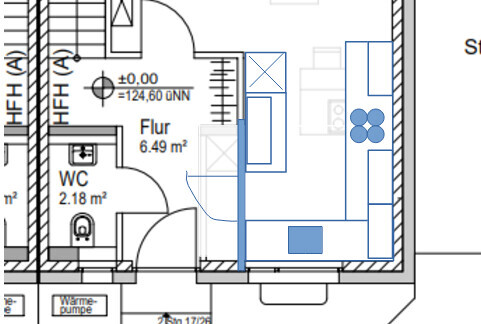
Another question is a bit… can we reduce the distance between sofa and TV? I’ve just sketched in our current furniture; it would look roughly like this (sofa 275 x 220 cm (108 x 87 inches)).
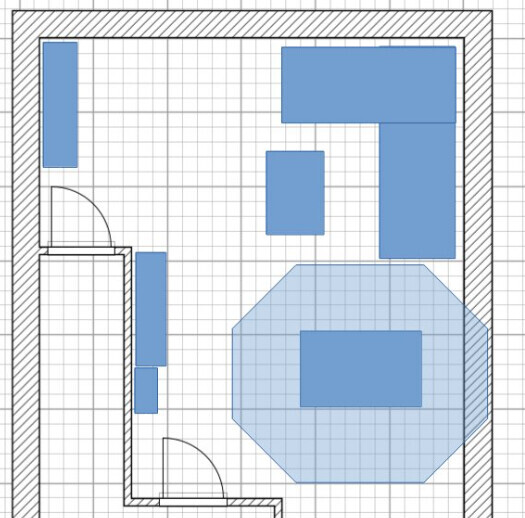
Ideas so far include putting a shelf behind the sofa (but that blocks the terrace door more). Any other ideas?
Best regards
We are currently reviewing whether to make any changes to the standard floor plan from our home builder for our end-of-terrace house. There are stricter guidelines that I’m already sure will disappoint some forum members. Roughly, we’ve been told that exterior walls and the façade, including windows and exterior doors, cannot be altered, and load-bearing walls cannot be moved. This mainly concerns the staircase and stair wall. Most other interior walls, as far as we know, are movable. In principle, we could also move in with the unmodified standard layout, but we do see 1-2 points with potential for improvement (though maybe in the end this just fuels the Spec House Building - Small Changes, Unintended Consequences thread).
I will still fill out the questionnaire, even though most of it cannot be changed for us (in particular Section 1 on the development plan is more the home builder’s area).
Development Plan / Restrictions
Plot size – 207 m² (2,230 sq ft)
Slope – slight incline, I don’t have exact survey data, but we can’t change anything at the house entrances anyway.
Site coverage ratio – 0.4
Floor area ratio – 0.8
Building envelope, building line, and setback – not relevant since we cannot change the external shell
Edge development – not relevant since we cannot change the external shell
Number of parking spaces (already included) – garage plus parking space in front
Number of storeys – 2
Roof type – gable roof
Architectural style –
Orientation – north/south
Maximum heights / limits – not relevant
Other conditions: Hornbeam hedge along the cul-de-sac on our property (on the west side; in the floor plans it appears on the right because they are not north-oriented)
Homeowners’ Requirements
Architectural style, roof type, building type: fixed by the home builder
Basement, floors: usable basement + 2 full stories + converted attic (already determined by the builder)
Number of occupants, ages: currently 2 (31 and 32); planning for 1-2 children
Space needs on ground and upper floors:
Office: family use or home office? Home office, both partly working remotely. Ideally, a separate space for each would be great, but if that’s not possible with potentially 2 children, it’s manageable.
Guest bedrooms per year: about 3-4 times a year
Open or closed layout: medium? Open transition between kitchen and living area is a must, but overall, some walls are okay.
Conservative or modern building style: –
Open kitchen, kitchen island: tends to “not fully closed” (see above), but we don’t necessarily need an island if something else is more practical or cost-effective.
Number of dining seats: for 4 people
Fireplace: no
Music / stereo wall: no
Balcony / roof terrace: no
Garage / carport: garage included
Utility garden / greenhouse: no (maybe a small bed later we’d do ourselves)
Additional wishes / special features / daily routine, also reasons why certain things should or shouldn’t be included:
We are both partly working remotely. Currently, we have an office and a desk in the living room. If possible, I’d prefer not to keep working in the living room. If two adults move in, it’s absolutely no problem; with one child it’s probably still fine, with two children… well, by then things might have changed anyway. I feel we’ll find a solution, and if someone locks themselves away in the 4 m² (43 sq ft) closet on the first floor (where the walls are still adjustable) or gets a desk in the bedroom, that might work.
House Design
Surroundings: To the south are garages for neighboring terrace houses, then a turning area (end of the cul-de-sac), followed by some individual trees and other detached houses. To the east is our block. Then a few small trees and a railway line (several meters lower). To the west, on our property, there is a city-required hornbeam hedge. We will try to negotiate a passage to the street (for bikes and so on). Since the second escape route on the ground floor is via the terrace, I see some chances, but city officials aren’t always easy.
Planning by:
- Home builder
What do you like especially? Why?
- I see the plan working for us both if the family plan doesn’t happen (then it’s very generous) and with 1-2 children as well.
What don’t you like? Why?
- Ground floor: (main pain point) Entrance is relatively narrow with little cloakroom space. The peninsula kitchen feels too small to work well (and probably requires an expensive extractor in the peninsula). The distance from the sofa to the TV is huge. The basement access is in the living room. We’ll probably manage some kind of furnishing on the ground floor, but right now it doesn’t exactly feel “yes, this is perfect.”
- Upper floor: We’ve debated whether to enlarge the 4 m² (43 sq ft) closet slightly to potentially use it later as an overflow office, but actually we find it as planned not bad at all (and initially more practical).
- Attic: The “landing” could be another possible office space if children come; we considered whether to separate it right away with a wall and door or leave it as shown.
So actually: except for the ground floor, we are quite satisfied; everything else is in the range of “if we want the jack-of-all-trades, maybe some changes could be made – or we keep it as is and see if the need arises.”
If you had to give up something, which details/extensions:
- We can give up: changes to the upper floor and attic
- We cannot give up: at least 1 office
Why is the design as it is now? e.g.
Standard plan from the home builder
What do you think makes it particularly good or bad?
I think it’s a solid floor plan for young families, but the ground floor worries me a bit. I feel maybe a different staircase shape would have helped, but as far as I’ve been told, that cannot be changed.
What is the most important/basic question about the floor plan in 130 characters?
How do we best arrange the ground floor? Should we still make some changes here?
Ideas for potential changes to the ground floor
Maybe reduce the kitchen size and straighten the hallway wall? (We’ve discussed this idea in the kitchen forum but haven’t talked to the planner yet.) The scale is off here (I think my cabinets are too large). The rough structural width in the kitchen at the narrowest point is 248 cm (98 inches), so roughly 240 cm (94 inches) minus about 130 cm (51 inches) for both kitchen sides would leave 110 cm (43 inches) aisle width. Also, the window would be moved to the corner. In return, there would be more cloakroom space in the hallway. Bad idea? Opinions?
Another question is a bit… can we reduce the distance between sofa and TV? I’ve just sketched in our current furniture; it would look roughly like this (sofa 275 x 220 cm (108 x 87 inches)).
Ideas so far include putting a shelf behind the sofa (but that blocks the terrace door more). Any other ideas?
Best regards
One thing I really don’t understand is why the staircase isn’t wound at each landing. This would make the left wall after the stairs on the ground floor better usable, create an additional storage corner on the upper floor, and in the attic ensure that you don’t have to bump into the sloping roof when coming up. It would also provide a better space for a desk area there.
K a t j a schrieb:
I have to admit, I don’t see it that way. Strict zoning plans, sure. Changes to existing buildings are also a reason for limited flexibility. But a new build? Why not? Personally, I prefer having constraints when planning because it requires more thoughtful work than allowing a bit of extra space everywhere or unnecessary extensions of the building footprint. The same applies to the budget. It creates challenges for the designer, not arbitrary decisions.
In this case: I had this exact floor plan on the ground floor myself, just a bit narrower; the entrance area was too tight, and many things would be planned differently if possible… if it were a single-family house. But we managed very well with this layout, and I don’t know anyone (and I know quite a few with this type of residential structure) who ever questioned dissatisfaction with the ground floor. Even the staircase layout was never disputed.
Still, the request for optimization before construction:
@mayglow Is rotating the staircase completely off the table? What about a spiral staircase? With a spiral, for example, you can create more usable space in the upper corner of the plan.

ypg schrieb:
Why not? Personally, I prefer having constraints when planning because it requires more thinking...Well, the goal is to maximize the implemented wishes of the original poster, not the puzzle-solving fun. I have no idea why the developer decided to install a straight staircase in a house only 10.5m (34.4 ft) deep. The missing windows on the west side are also a mistake that is not easily fixed.
And yes, I also lived in a similarly designed house with that narrow entrance. We never got used to it and thought it was awkward the entire time.

K a t j a schrieb:
Your satisfaction is also something valuable that you don’t want to risk. If neither the staircase nor the windows can be changed, in my opinion, the scope for adjustments is limited to the interior design. Yes, probably not much more than that. The business of a developer is not to fulfill dreams shattered at the gap between wishes and feasibility but to transform building materials into affordable approximations of those dreams. The compromises are as tough as the market of potential customers is large. If low-income people at all, and middle-income people earlier, are to have access to home ownership, costs must unfortunately be kept very tight. In that sense, I don’t see a developer here as an enemy of a "beautiful" solution, but rather as a friend of a "feasible at all" realization.
In the broader Düsseldorf / Cologne / Rhine-Ruhr / Rhine-Main region (as currently discussed in https://www.hausbau-forum.de/threads/altbau-sanieren-oder-neubau-erfahrungen.45282/ also with Wilma at Krausbaum near CGN), even a "small" paradise like this is a comparable effort to Tomek’s hipped-roof bungalow in the Brandenburg area of Jottwedeh.
kbt09 schrieb:
One thing I really don’t understand is why the staircase isn’t turned at each floor exit. That would make the left wall of the ground floor more usable after the stairs, [...] and on the top floor mean you don’t have to bump into the sloped roof when coming up [...] K a t j a schrieb:
What the developer was thinking installing a straight staircase in a house only about 10.5m (34 feet) deep is a mystery to me. The missing windows on the west side are also a mistake that can’t easily be remedied. Regarding the staircase, the developer indeed deviates from most comparable solutions here, but I consider the proposed additional window on the gable side an unproblematic and desirable option.
ypg schrieb:
Is turning the staircase completely out of the question? Even a spiral or winding staircase? I immediately looked for the possibility to reverse the staircase direction (even before I wondered why there is "quasi non-standard" not just no second flight but no winding staircase at all). However, this is prevented by a load-bearing wall in the basement, which is integral to the structural system of the house and cannot be altered. A winding staircase would require a custom solution here, which in this case would probably be a "logistics-disruptive factor" as well. Apparently, the developer uses the same staircase model three times in ProHaus designs, and I interpret the landing between the first and second floors as a clue indicating the combination of underfloor heating on the ground floor with a low ceiling height. Middle years of a house are not golden years, one might say ;-)
https://www.instagram.com/11antgmxde/
https://www.linkedin.com/company/bauen-jetzt/

11ant schrieb:
I would place it (floor-to-ceiling) "in the gap between the gable windows." Is that for technical construction reasons or just for aesthetic purposes? 🙂
The lady from the special requests department (great title) said I should sketch the window so they can review it again. So, I guess we need to think about it 😱
If I transfer "the gap between the gable windows" down to the ground floor, it looks something like this:
The view might not be the nicest (beside the parking space there will be the mandatory hedge imposed by the city 😉) but I think it would help? The light will probably be rather diffuse and not hit directly (just to remind: north is at the bottom of the plan, the window faces almost exactly west), but that also has its advantages.
K a t j a schrieb:
Well, the aim is to maximize the implemented wishes of the original poster, less about the puzzle-solving fun. Well, that’s what I was referring to here 😉
mayglow schrieb:
which I am already sure will upset some forum members. By the way: always bigger and more only leads to nothing being built here in the forum in the end. That, to me, is just playing around.
But I have made my suggestions.
mayglow schrieb:
but I do think that would help? Definitely.
mayglow schrieb:
The lady from the custom requests department (great name) said I should sketch the window so they can review it again. So we probably need to think about that 😱 I would still include the upper floor in the planning.
What about the staircase now? Can it be changed in this position or not?
Similar topics