
Hello everyone,
We are currently reviewing whether to make any changes to the standard floor plan from our home builder for our end-of-terrace house. There are stricter guidelines that I’m already sure will disappoint some forum members. Roughly, we’ve been told that exterior walls and the façade, including windows and exterior doors, cannot be altered, and load-bearing walls cannot be moved. This mainly concerns the staircase and stair wall. Most other interior walls, as far as we know, are movable. In principle, we could also move in with the unmodified standard layout, but we do see 1-2 points with potential for improvement (though maybe in the end this just fuels the Spec House Building - Small Changes, Unintended Consequences thread).
I will still fill out the questionnaire, even though most of it cannot be changed for us (in particular Section 1 on the development plan is more the home builder’s area).
Development Plan / Restrictions
Plot size – 207 m² (2,230 sq ft)
Slope – slight incline, I don’t have exact survey data, but we can’t change anything at the house entrances anyway.
Site coverage ratio – 0.4
Floor area ratio – 0.8
Building envelope, building line, and setback – not relevant since we cannot change the external shell
Edge development – not relevant since we cannot change the external shell
Number of parking spaces (already included) – garage plus parking space in front
Number of storeys – 2
Roof type – gable roof
Architectural style –
Orientation – north/south
Maximum heights / limits – not relevant
Other conditions: Hornbeam hedge along the cul-de-sac on our property (on the west side; in the floor plans it appears on the right because they are not north-oriented)
Homeowners’ Requirements
Architectural style, roof type, building type: fixed by the home builder
Basement, floors: usable basement + 2 full stories + converted attic (already determined by the builder)
Number of occupants, ages: currently 2 (31 and 32); planning for 1-2 children
Space needs on ground and upper floors:
Office: family use or home office? Home office, both partly working remotely. Ideally, a separate space for each would be great, but if that’s not possible with potentially 2 children, it’s manageable.
Guest bedrooms per year: about 3-4 times a year
Open or closed layout: medium? Open transition between kitchen and living area is a must, but overall, some walls are okay.
Conservative or modern building style: –
Open kitchen, kitchen island: tends to “not fully closed” (see above), but we don’t necessarily need an island if something else is more practical or cost-effective.
Number of dining seats: for 4 people
Fireplace: no
Music / stereo wall: no
Balcony / roof terrace: no
Garage / carport: garage included
Utility garden / greenhouse: no (maybe a small bed later we’d do ourselves)
Additional wishes / special features / daily routine, also reasons why certain things should or shouldn’t be included:
We are both partly working remotely. Currently, we have an office and a desk in the living room. If possible, I’d prefer not to keep working in the living room. If two adults move in, it’s absolutely no problem; with one child it’s probably still fine, with two children… well, by then things might have changed anyway. I feel we’ll find a solution, and if someone locks themselves away in the 4 m² (43 sq ft) closet on the first floor (where the walls are still adjustable) or gets a desk in the bedroom, that might work.
House Design
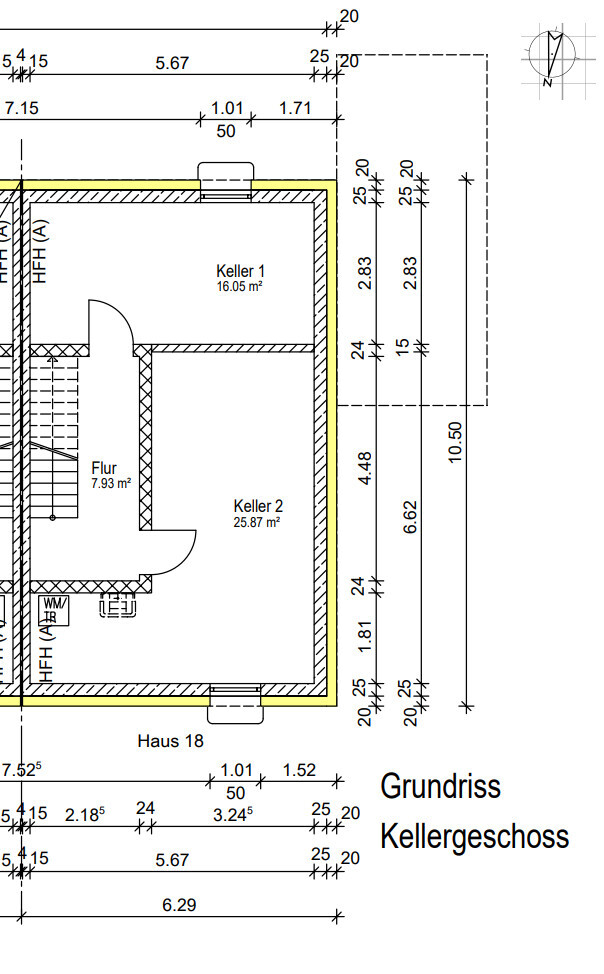
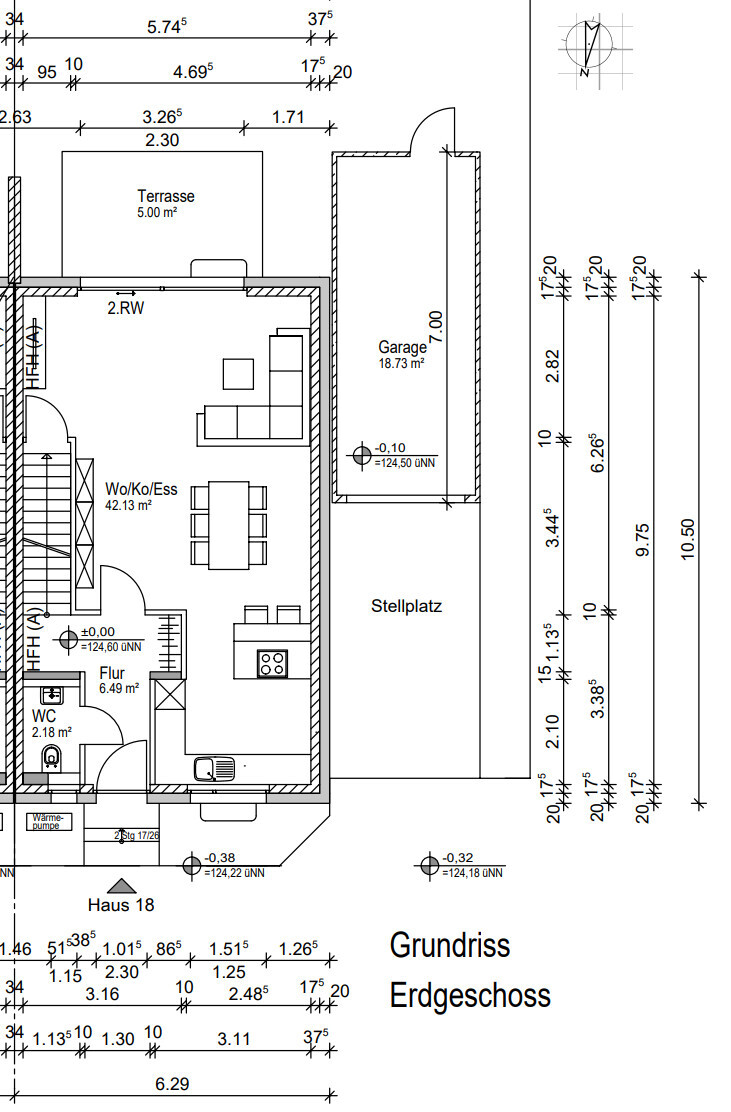
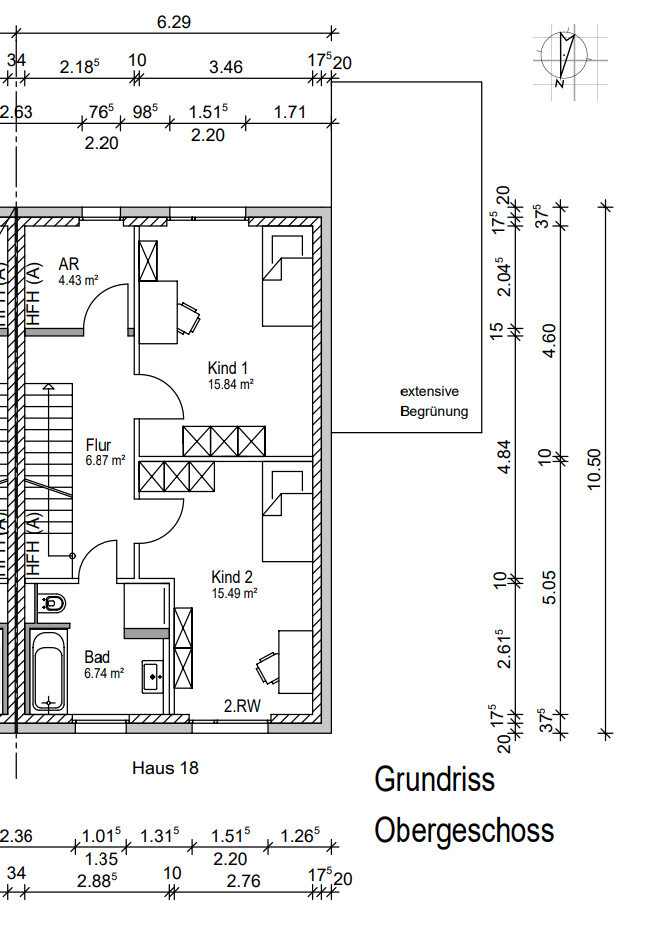
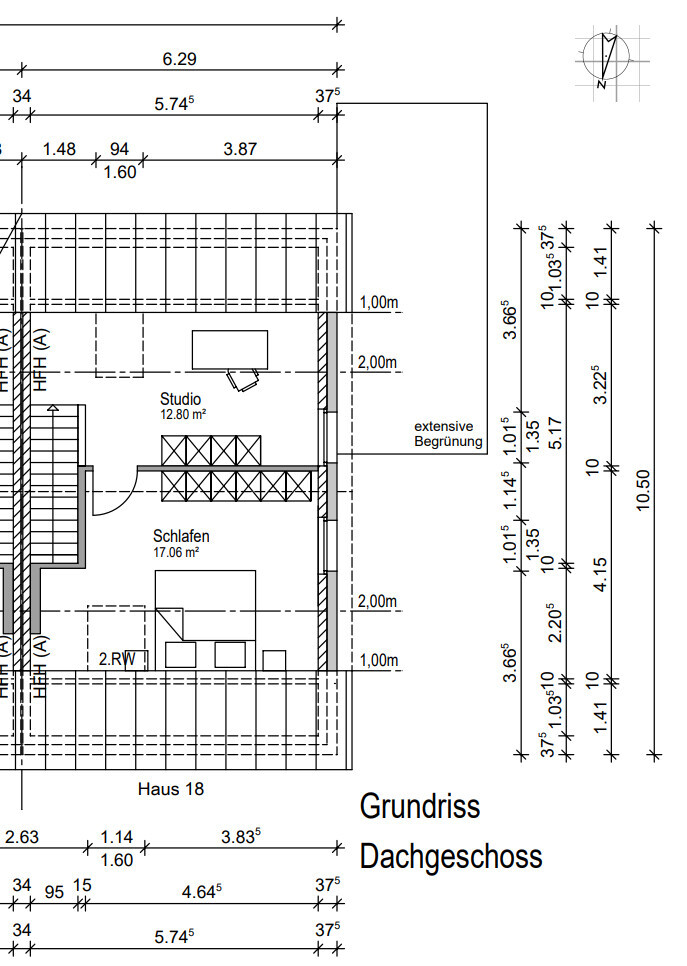
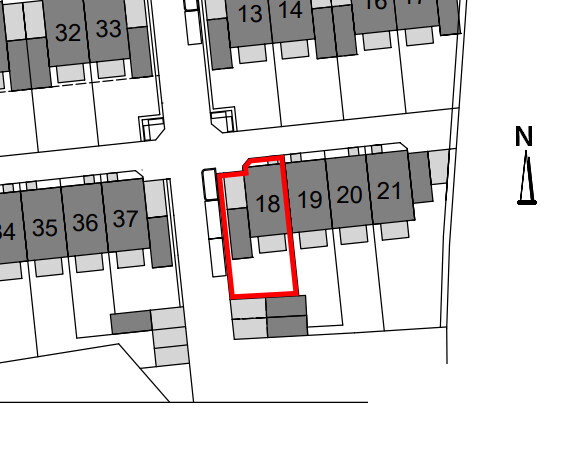
Surroundings: To the south are garages for neighboring terrace houses, then a turning area (end of the cul-de-sac), followed by some individual trees and other detached houses. To the east is our block. Then a few small trees and a railway line (several meters lower). To the west, on our property, there is a city-required hornbeam hedge. We will try to negotiate a passage to the street (for bikes and so on). Since the second escape route on the ground floor is via the terrace, I see some chances, but city officials aren’t always easy.
Planning by:
- Home builder
What do you like especially? Why?
- I see the plan working for us both if the family plan doesn’t happen (then it’s very generous) and with 1-2 children as well.
What don’t you like? Why?
- Ground floor: (main pain point) Entrance is relatively narrow with little cloakroom space. The peninsula kitchen feels too small to work well (and probably requires an expensive extractor in the peninsula). The distance from the sofa to the TV is huge. The basement access is in the living room. We’ll probably manage some kind of furnishing on the ground floor, but right now it doesn’t exactly feel “yes, this is perfect.”
- Upper floor: We’ve debated whether to enlarge the 4 m² (43 sq ft) closet slightly to potentially use it later as an overflow office, but actually we find it as planned not bad at all (and initially more practical).
- Attic: The “landing” could be another possible office space if children come; we considered whether to separate it right away with a wall and door or leave it as shown.
So actually: except for the ground floor, we are quite satisfied; everything else is in the range of “if we want the jack-of-all-trades, maybe some changes could be made – or we keep it as is and see if the need arises.”
If you had to give up something, which details/extensions:
- We can give up: changes to the upper floor and attic
- We cannot give up: at least 1 office
Why is the design as it is now? e.g.
Standard plan from the home builder
What do you think makes it particularly good or bad?
I think it’s a solid floor plan for young families, but the ground floor worries me a bit. I feel maybe a different staircase shape would have helped, but as far as I’ve been told, that cannot be changed.
What is the most important/basic question about the floor plan in 130 characters?
How do we best arrange the ground floor? Should we still make some changes here?
Ideas for potential changes to the ground floor
Maybe reduce the kitchen size and straighten the hallway wall? (We’ve discussed this idea in the kitchen forum but haven’t talked to the planner yet.) The scale is off here (I think my cabinets are too large). The rough structural width in the kitchen at the narrowest point is 248 cm (98 inches), so roughly 240 cm (94 inches) minus about 130 cm (51 inches) for both kitchen sides would leave 110 cm (43 inches) aisle width. Also, the window would be moved to the corner. In return, there would be more cloakroom space in the hallway. Bad idea? Opinions?
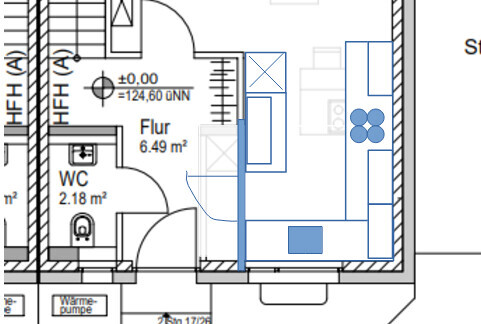
Another question is a bit… can we reduce the distance between sofa and TV? I’ve just sketched in our current furniture; it would look roughly like this (sofa 275 x 220 cm (108 x 87 inches)).
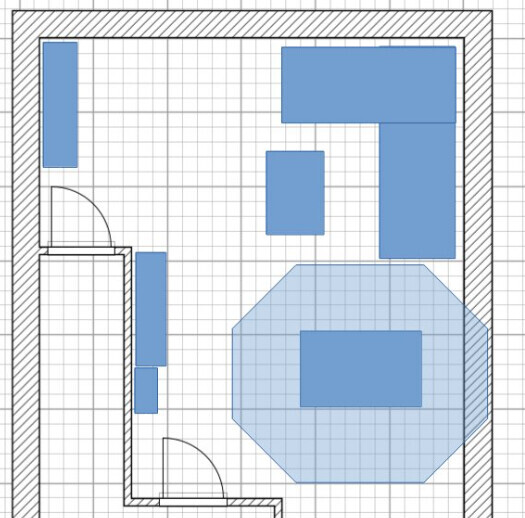
Ideas so far include putting a shelf behind the sofa (but that blocks the terrace door more). Any other ideas?
Best regards
We are currently reviewing whether to make any changes to the standard floor plan from our home builder for our end-of-terrace house. There are stricter guidelines that I’m already sure will disappoint some forum members. Roughly, we’ve been told that exterior walls and the façade, including windows and exterior doors, cannot be altered, and load-bearing walls cannot be moved. This mainly concerns the staircase and stair wall. Most other interior walls, as far as we know, are movable. In principle, we could also move in with the unmodified standard layout, but we do see 1-2 points with potential for improvement (though maybe in the end this just fuels the Spec House Building - Small Changes, Unintended Consequences thread).
I will still fill out the questionnaire, even though most of it cannot be changed for us (in particular Section 1 on the development plan is more the home builder’s area).
Development Plan / Restrictions
Plot size – 207 m² (2,230 sq ft)
Slope – slight incline, I don’t have exact survey data, but we can’t change anything at the house entrances anyway.
Site coverage ratio – 0.4
Floor area ratio – 0.8
Building envelope, building line, and setback – not relevant since we cannot change the external shell
Edge development – not relevant since we cannot change the external shell
Number of parking spaces (already included) – garage plus parking space in front
Number of storeys – 2
Roof type – gable roof
Architectural style –
Orientation – north/south
Maximum heights / limits – not relevant
Other conditions: Hornbeam hedge along the cul-de-sac on our property (on the west side; in the floor plans it appears on the right because they are not north-oriented)
Homeowners’ Requirements
Architectural style, roof type, building type: fixed by the home builder
Basement, floors: usable basement + 2 full stories + converted attic (already determined by the builder)
Number of occupants, ages: currently 2 (31 and 32); planning for 1-2 children
Space needs on ground and upper floors:
Office: family use or home office? Home office, both partly working remotely. Ideally, a separate space for each would be great, but if that’s not possible with potentially 2 children, it’s manageable.
Guest bedrooms per year: about 3-4 times a year
Open or closed layout: medium? Open transition between kitchen and living area is a must, but overall, some walls are okay.
Conservative or modern building style: –
Open kitchen, kitchen island: tends to “not fully closed” (see above), but we don’t necessarily need an island if something else is more practical or cost-effective.
Number of dining seats: for 4 people
Fireplace: no
Music / stereo wall: no
Balcony / roof terrace: no
Garage / carport: garage included
Utility garden / greenhouse: no (maybe a small bed later we’d do ourselves)
Additional wishes / special features / daily routine, also reasons why certain things should or shouldn’t be included:
We are both partly working remotely. Currently, we have an office and a desk in the living room. If possible, I’d prefer not to keep working in the living room. If two adults move in, it’s absolutely no problem; with one child it’s probably still fine, with two children… well, by then things might have changed anyway. I feel we’ll find a solution, and if someone locks themselves away in the 4 m² (43 sq ft) closet on the first floor (where the walls are still adjustable) or gets a desk in the bedroom, that might work.
House Design
Surroundings: To the south are garages for neighboring terrace houses, then a turning area (end of the cul-de-sac), followed by some individual trees and other detached houses. To the east is our block. Then a few small trees and a railway line (several meters lower). To the west, on our property, there is a city-required hornbeam hedge. We will try to negotiate a passage to the street (for bikes and so on). Since the second escape route on the ground floor is via the terrace, I see some chances, but city officials aren’t always easy.
Planning by:
- Home builder
What do you like especially? Why?
- I see the plan working for us both if the family plan doesn’t happen (then it’s very generous) and with 1-2 children as well.
What don’t you like? Why?
- Ground floor: (main pain point) Entrance is relatively narrow with little cloakroom space. The peninsula kitchen feels too small to work well (and probably requires an expensive extractor in the peninsula). The distance from the sofa to the TV is huge. The basement access is in the living room. We’ll probably manage some kind of furnishing on the ground floor, but right now it doesn’t exactly feel “yes, this is perfect.”
- Upper floor: We’ve debated whether to enlarge the 4 m² (43 sq ft) closet slightly to potentially use it later as an overflow office, but actually we find it as planned not bad at all (and initially more practical).
- Attic: The “landing” could be another possible office space if children come; we considered whether to separate it right away with a wall and door or leave it as shown.
So actually: except for the ground floor, we are quite satisfied; everything else is in the range of “if we want the jack-of-all-trades, maybe some changes could be made – or we keep it as is and see if the need arises.”
If you had to give up something, which details/extensions:
- We can give up: changes to the upper floor and attic
- We cannot give up: at least 1 office
Why is the design as it is now? e.g.
Standard plan from the home builder
What do you think makes it particularly good or bad?
I think it’s a solid floor plan for young families, but the ground floor worries me a bit. I feel maybe a different staircase shape would have helped, but as far as I’ve been told, that cannot be changed.
What is the most important/basic question about the floor plan in 130 characters?
How do we best arrange the ground floor? Should we still make some changes here?
Ideas for potential changes to the ground floor
Maybe reduce the kitchen size and straighten the hallway wall? (We’ve discussed this idea in the kitchen forum but haven’t talked to the planner yet.) The scale is off here (I think my cabinets are too large). The rough structural width in the kitchen at the narrowest point is 248 cm (98 inches), so roughly 240 cm (94 inches) minus about 130 cm (51 inches) for both kitchen sides would leave 110 cm (43 inches) aisle width. Also, the window would be moved to the corner. In return, there would be more cloakroom space in the hallway. Bad idea? Opinions?
Another question is a bit… can we reduce the distance between sofa and TV? I’ve just sketched in our current furniture; it would look roughly like this (sofa 275 x 220 cm (108 x 87 inches)).
Ideas so far include putting a shelf behind the sofa (but that blocks the terrace door more). Any other ideas?
Best regards
When I redesigned the small garden of my end-terrace house, I borrowed books from the library such as "Small Gardens," "Terrace Gardens," etc., for inspiration. Nowadays, people probably use Pinterest?!
I would leave a strip on one side for some herbs, possibly also for a raised bed, which would fit well. However, I would only finalize the detailed planning once you can sit there and experience the space directly.
Isn't a carport a better option to make better use of the width?
I would leave a strip on one side for some herbs, possibly also for a raised bed, which would fit well. However, I would only finalize the detailed planning once you can sit there and experience the space directly.
Isn't a carport a better option to make better use of the width?
C
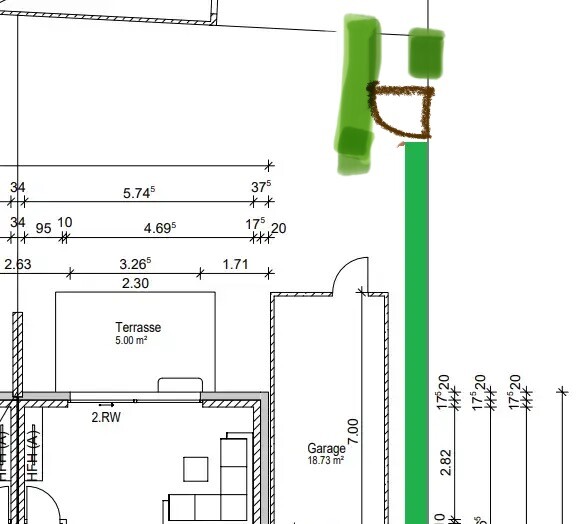
Costruttrice28 Aug 2023 22:09I meant the door directly in the hedge, at least that’s how it was for us. I have marked it on the plan. On the area between the gate and the recessed hedge, we used stepping stones set in decorative gravel as a base. I prefer not to share a photo since the house has already been sold. Whether something similar would work for you with your slope, I’m not sure.
We installed the gate later on. At first, we had a continuous hedge including a fence and regretted the effort it took to change that. It also takes time for the plants to grow back to provide privacy again. If you already know that you want this, it’s best to plan for it from the start.
At the time (and again now), we made the terrace as large as possible, as it is the area we use most in the garden. However, we had a border strip around the edge.
We installed the gate later on. At first, we had a continuous hedge including a fence and regretted the effort it took to change that. It also takes time for the plants to grow back to provide privacy again. If you already know that you want this, it’s best to plan for it from the start.
At the time (and again now), we made the terrace as large as possible, as it is the area we use most in the garden. However, we had a border strip around the edge.

A quick update:
Outside wasn’t a priority at first, so we haven’t really progressed much there. However, when we recently spoke with the developer, I asked again about access from the garden to the street. They basically said it’s not covered by the development plan (or something like that – I need to check again). So, if we want access, we’d have to arrange it ourselves, and it will likely be more of a “we’ll take a look when we’re there” situation.
Otherwise, there were lots of decisions to make – bathroom fittings were somewhat split between tiles and sanitary ware. The sanitary part is more or less finalized (there’s just one thing left, which I’ll come to shortly). We didn’t really like the standard tile selection, but we were given the name of a tile showroom to check out further. Electrical planning is also underway 🙂 The standard package was already really good, but (nerd alert) we added some network connections and a few extra outlets here and there. Ideally, I would have liked a few empty conduits all the way up to the roof, since cables will be laid from the technical room up to the roof in preparation for photovoltaics anyway. But the electrician didn’t want to install additional empty conduits because he couldn’t guarantee homeowners could later pull cables through them (due to bends and the risk that something might block them during the ongoing construction). I think in a direct conversation I might have explored alternatives, but after passing messages through the developer, we just left it at “no additional conduits,” even though I was a bit grumpy about it.
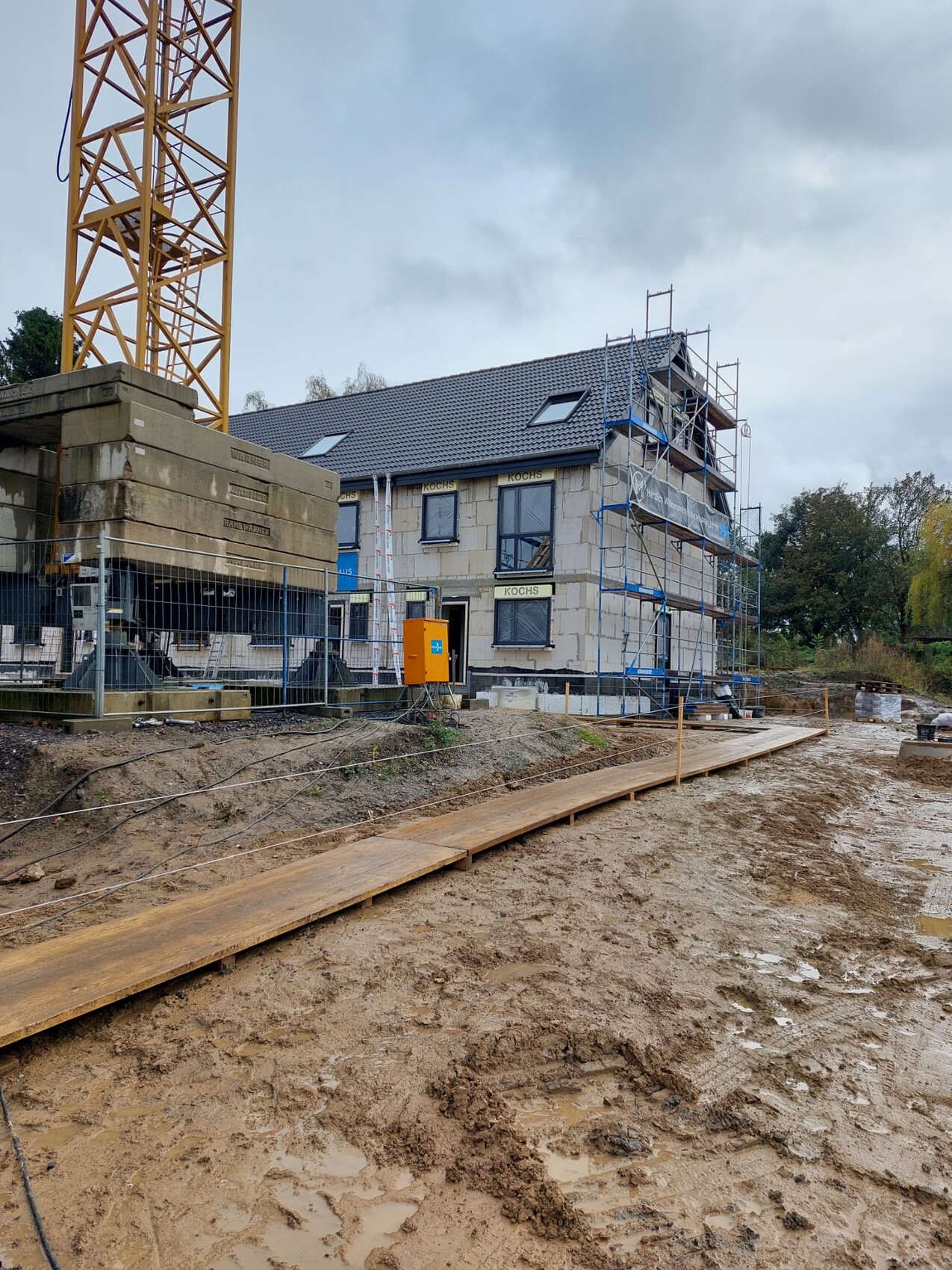
Overall, things are moving along really well! We had the topping-out ceremony over the weekend, but that was for the semi-detached houses in front of us, and our townhouse had actually already gone quite a bit beyond the topping-out stage 😉 I don’t mind though, because just in time for the weather changing to rainy, the roof and windows were already finished <3
Regarding the bathroom, I mentioned I still had a question. We had originally picked an alternative heated towel rail, but there was some confusion at the bathroom studio (our developer was quite frustrated as well; for us it was only this one issue, but we heard from some co-buyers that various changes got mixed up between houses or that they were told some options were feasible when they weren’t, and so on). Anyway, we suddenly received several different versions in the offer and are trying to figure out what is what. In theory, the bathroom studio should answer this at some point, but I’m not entirely confident in them anyway...
So, in any case, we were offered these three alternatives:
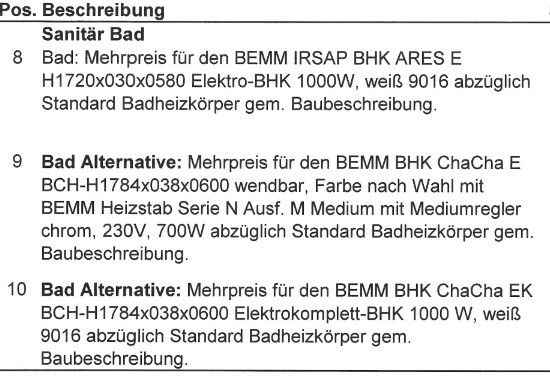
The first one (number 8) seems to simply be a mistake and doesn’t relate to what we had looked at. But I’m also a bit confused about the other two, since they are two different models (BEMM BHK ChaCha E and the Eigenkapital model). I think this is because the Eigenkapital version only comes in white, and the bathroom consultant wanted to offer us both (one white, one colored) – but they also differ technically? When I search online, the Eigenkapital is described as “Operating mode: fully electric, pure electric operation,” whereas the “E” version has “Operating mode: bivalent operation, central heating” (with an optional electric set, which apparently is included here). The standard was a purely electric heated towel rail, and presumably the alternative would also be described as fully electric. So the “9,” which is for bivalent operation, doesn’t really make sense, does it? It’s also almost twice as expensive (and I think white would be fine for us anyway). But I thought the forum would probably know this stuff very well 😉
Outside wasn’t a priority at first, so we haven’t really progressed much there. However, when we recently spoke with the developer, I asked again about access from the garden to the street. They basically said it’s not covered by the development plan (or something like that – I need to check again). So, if we want access, we’d have to arrange it ourselves, and it will likely be more of a “we’ll take a look when we’re there” situation.
Otherwise, there were lots of decisions to make – bathroom fittings were somewhat split between tiles and sanitary ware. The sanitary part is more or less finalized (there’s just one thing left, which I’ll come to shortly). We didn’t really like the standard tile selection, but we were given the name of a tile showroom to check out further. Electrical planning is also underway 🙂 The standard package was already really good, but (nerd alert) we added some network connections and a few extra outlets here and there. Ideally, I would have liked a few empty conduits all the way up to the roof, since cables will be laid from the technical room up to the roof in preparation for photovoltaics anyway. But the electrician didn’t want to install additional empty conduits because he couldn’t guarantee homeowners could later pull cables through them (due to bends and the risk that something might block them during the ongoing construction). I think in a direct conversation I might have explored alternatives, but after passing messages through the developer, we just left it at “no additional conduits,” even though I was a bit grumpy about it.
Overall, things are moving along really well! We had the topping-out ceremony over the weekend, but that was for the semi-detached houses in front of us, and our townhouse had actually already gone quite a bit beyond the topping-out stage 😉 I don’t mind though, because just in time for the weather changing to rainy, the roof and windows were already finished <3
Regarding the bathroom, I mentioned I still had a question. We had originally picked an alternative heated towel rail, but there was some confusion at the bathroom studio (our developer was quite frustrated as well; for us it was only this one issue, but we heard from some co-buyers that various changes got mixed up between houses or that they were told some options were feasible when they weren’t, and so on). Anyway, we suddenly received several different versions in the offer and are trying to figure out what is what. In theory, the bathroom studio should answer this at some point, but I’m not entirely confident in them anyway...
So, in any case, we were offered these three alternatives:
The first one (number 8) seems to simply be a mistake and doesn’t relate to what we had looked at. But I’m also a bit confused about the other two, since they are two different models (BEMM BHK ChaCha E and the Eigenkapital model). I think this is because the Eigenkapital version only comes in white, and the bathroom consultant wanted to offer us both (one white, one colored) – but they also differ technically? When I search online, the Eigenkapital is described as “Operating mode: fully electric, pure electric operation,” whereas the “E” version has “Operating mode: bivalent operation, central heating” (with an optional electric set, which apparently is included here). The standard was a purely electric heated towel rail, and presumably the alternative would also be described as fully electric. So the “9,” which is for bivalent operation, doesn’t really make sense, does it? It’s also almost twice as expensive (and I think white would be fine for us anyway). But I thought the forum would probably know this stuff very well 😉
Quick update.
The radiator issue is resolved 🙂 (Yes, number 1 was a mistake and is the standard radiator, number 2 is the one we wanted, and number 3 is the alternative in case something colored was desired, since the second model is not available in color.)
The garden and hedge are within the area where the developer said they won’t make any changes (the hedge is specified in the urban development agreement, I believe), so this topic is postponed until after the house handover.
Otherwise, progress is being made here, there, and everywhere! We were just allowed to select flooring samples. There was a funny mix-up because I wrote “Allraum” (for the kitchen/dining/living area) and we then received an offer for the “Abstellraum” (storage room) upstairs, but this is now being corrected. Upsell prices always seem quite steep. Apart from that, we struggled a lot with the bathrooms. Basically, we had to choose sanitary fixtures (toilet/bathtub/fittings, etc.) and tiles separately. It’s already difficult to get an overall picture. There was a visualization of the standard proposal, and although I agreed with the basic layout (if it were up to my husband, we would have totally left out the bathtub), the standard tile selection was not at all to our taste. That wasn’t a fundamental problem since we could choose alternative tiles, but it basically took place at a building materials yard that also has a tile showroom, and we were a bit overwhelmed... We wanted to include a few decorative tiles, but it was mostly “yes, you can do this and that,” and as laypeople it was extremely difficult for us to judge what would actually look good in our bathroom 🤨
And here we missed some support. For example, we look at tiles, find them nice, then later realize “wait, I don’t think this will work in our bathroom” (because of the room size awkwardness, or because the standard only includes a 120 cm (47 inch) tiled splashback), and well, those thoughts always had to come from us… Especially with the many different standard build-up heights already in our bathroom, I’m unsure whether what we have now planned makes it better or worse 🤨
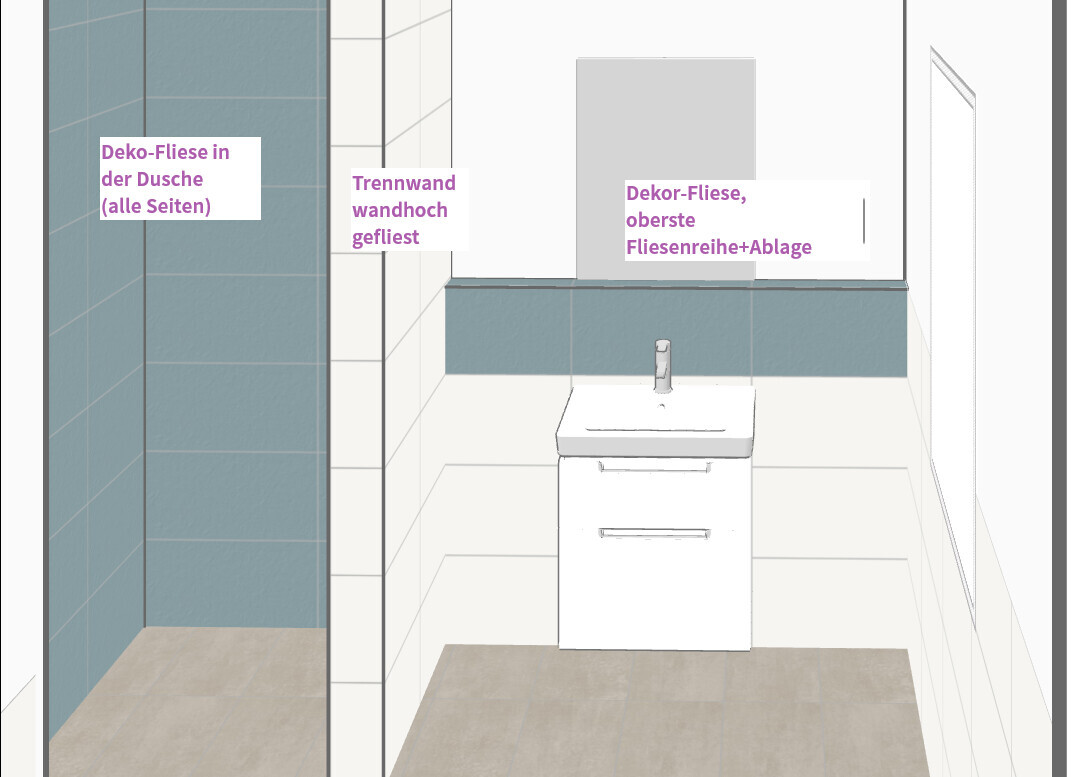
Our current design roughly looks like this (there is a towel radiator on the dividing wall, the washbasin probably isn’t the right one either, and the tile selection shown here is only an example that the designer provided. But yeah, the decorative tiles we just requested are bluish).
Other side (the block there is actually the bathtub)
The radiator issue is resolved 🙂 (Yes, number 1 was a mistake and is the standard radiator, number 2 is the one we wanted, and number 3 is the alternative in case something colored was desired, since the second model is not available in color.)
The garden and hedge are within the area where the developer said they won’t make any changes (the hedge is specified in the urban development agreement, I believe), so this topic is postponed until after the house handover.
Otherwise, progress is being made here, there, and everywhere! We were just allowed to select flooring samples. There was a funny mix-up because I wrote “Allraum” (for the kitchen/dining/living area) and we then received an offer for the “Abstellraum” (storage room) upstairs, but this is now being corrected. Upsell prices always seem quite steep. Apart from that, we struggled a lot with the bathrooms. Basically, we had to choose sanitary fixtures (toilet/bathtub/fittings, etc.) and tiles separately. It’s already difficult to get an overall picture. There was a visualization of the standard proposal, and although I agreed with the basic layout (if it were up to my husband, we would have totally left out the bathtub), the standard tile selection was not at all to our taste. That wasn’t a fundamental problem since we could choose alternative tiles, but it basically took place at a building materials yard that also has a tile showroom, and we were a bit overwhelmed... We wanted to include a few decorative tiles, but it was mostly “yes, you can do this and that,” and as laypeople it was extremely difficult for us to judge what would actually look good in our bathroom 🤨
And here we missed some support. For example, we look at tiles, find them nice, then later realize “wait, I don’t think this will work in our bathroom” (because of the room size awkwardness, or because the standard only includes a 120 cm (47 inch) tiled splashback), and well, those thoughts always had to come from us… Especially with the many different standard build-up heights already in our bathroom, I’m unsure whether what we have now planned makes it better or worse 🤨
Our current design roughly looks like this (there is a towel radiator on the dividing wall, the washbasin probably isn’t the right one either, and the tile selection shown here is only an example that the designer provided. But yeah, the decorative tiles we just requested are bluish).
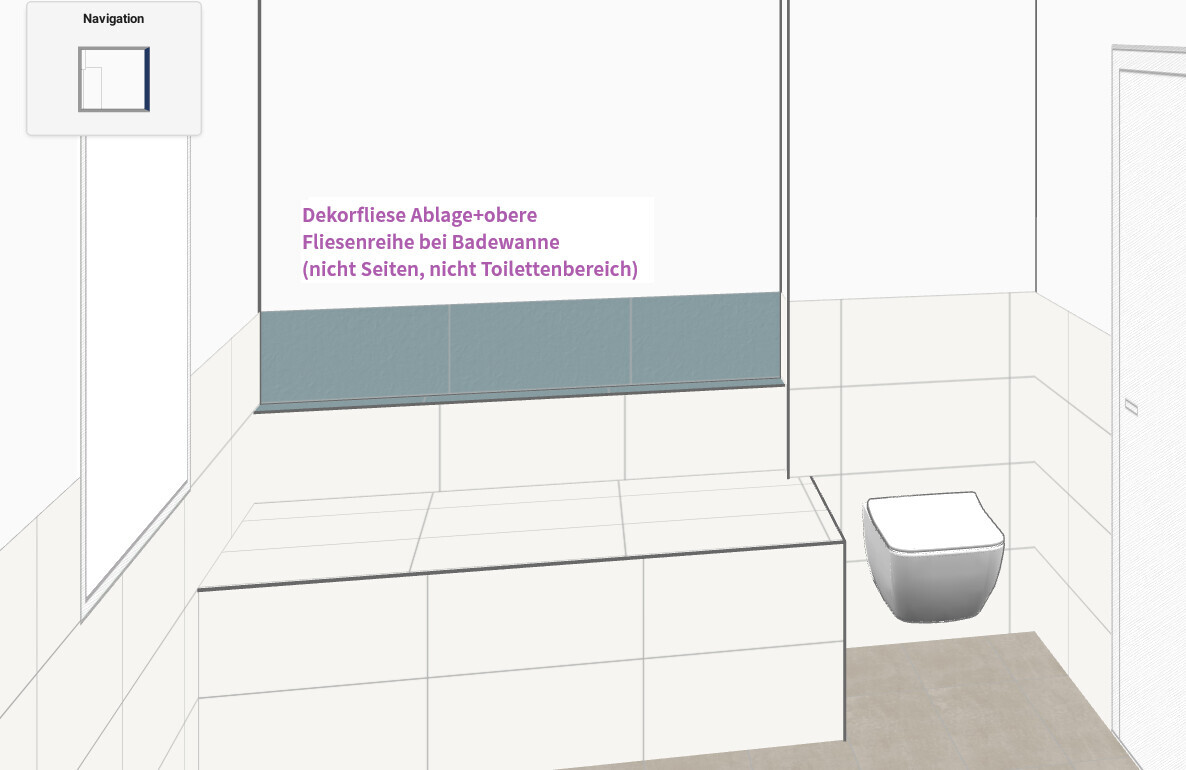
Other side (the block there is actually the bathtub)
I would cover the entire pre-wall frame of the washbasin with decorative tiles and then install a board running from wall to wall, on which the sink would be placed or built in. This way, the washbasin is concealed and doesn’t look inviting. I would also apply decorative tiles just above the bathtub and on the sides, so it appears framed visually.
@ypg Thanks for the suggestions 🙂 The sink here is more of a placeholder; we actually only have a sink without a vanity cabinet (this wasn’t available in the program), which should be a bit larger than shown here. A vanity cabinet or washstand through the developer was initially too expensive for us. What you described, with the countertop potentially running to the wall for framing, is something we’ve also considered. It might not be possible to extend it to the left because of the heated towel rail, so we’ll have to check that. But it’s noted in the back of our minds that we’ll generally need to look for solutions there 🙂 though it will probably only happen after we move in.
I’ll discuss the tile suggestion with my husband. We had a similar idea before but felt that it might make the decorative tiles too dominant. Of course, it also depends on how much it contrasts with the rest (whether the contrast is strong or rather subtle). Later, I’ll see if I can find our selection. Basically, at the sink, if the countertop is extended, the visual difference probably won’t be that big, whether you only do the top row or the entire area. (Which means one decision depends on another, yay.) The difference at the bathtub will definitely be greater. I’ll definitely keep that in mind again 🙂
I’ll discuss the tile suggestion with my husband. We had a similar idea before but felt that it might make the decorative tiles too dominant. Of course, it also depends on how much it contrasts with the rest (whether the contrast is strong or rather subtle). Later, I’ll see if I can find our selection. Basically, at the sink, if the countertop is extended, the visual difference probably won’t be that big, whether you only do the top row or the entire area. (Which means one decision depends on another, yay.) The difference at the bathtub will definitely be greater. I’ll definitely keep that in mind again 🙂
Similar topics