
Hello,
Here is my next question.
The floor structure is as follows:
- No insulation under the slab
- 20 cm (8 inches) concrete
- Torch-on membrane G 200 S4
- 13 cm (5 inches) insulation
- 6.5 cm (2.5 inches) screed
- 1 cm (0.4 inches) floor covering
I have agreed with the plumbing company that we will handle the insulation design for the floor ourselves.
The contractor’s quote included 6 cm (2.4 inches) WLG 035 + 5 cm (2 inches) WLG 035 + 3 cm (1.2 inches) Rolljet 045.
The Rolljet 045 was already supplied by the contractor. I will source the insulation boards myself since it is significantly more cost-effective.
Here are the options I have checked using the U-value calculator (ubakus):
- General purpose EPS insulation board 035 DEO/WAB General purpose insulation board for €1,305.71 including VAT
Calculated U-value 0.265
- Austrotherm insulation board XPS-Top 30 SF WLS 032 for €1,590.78 including VAT
Calculated U-value 0.247 (additional €285.07)
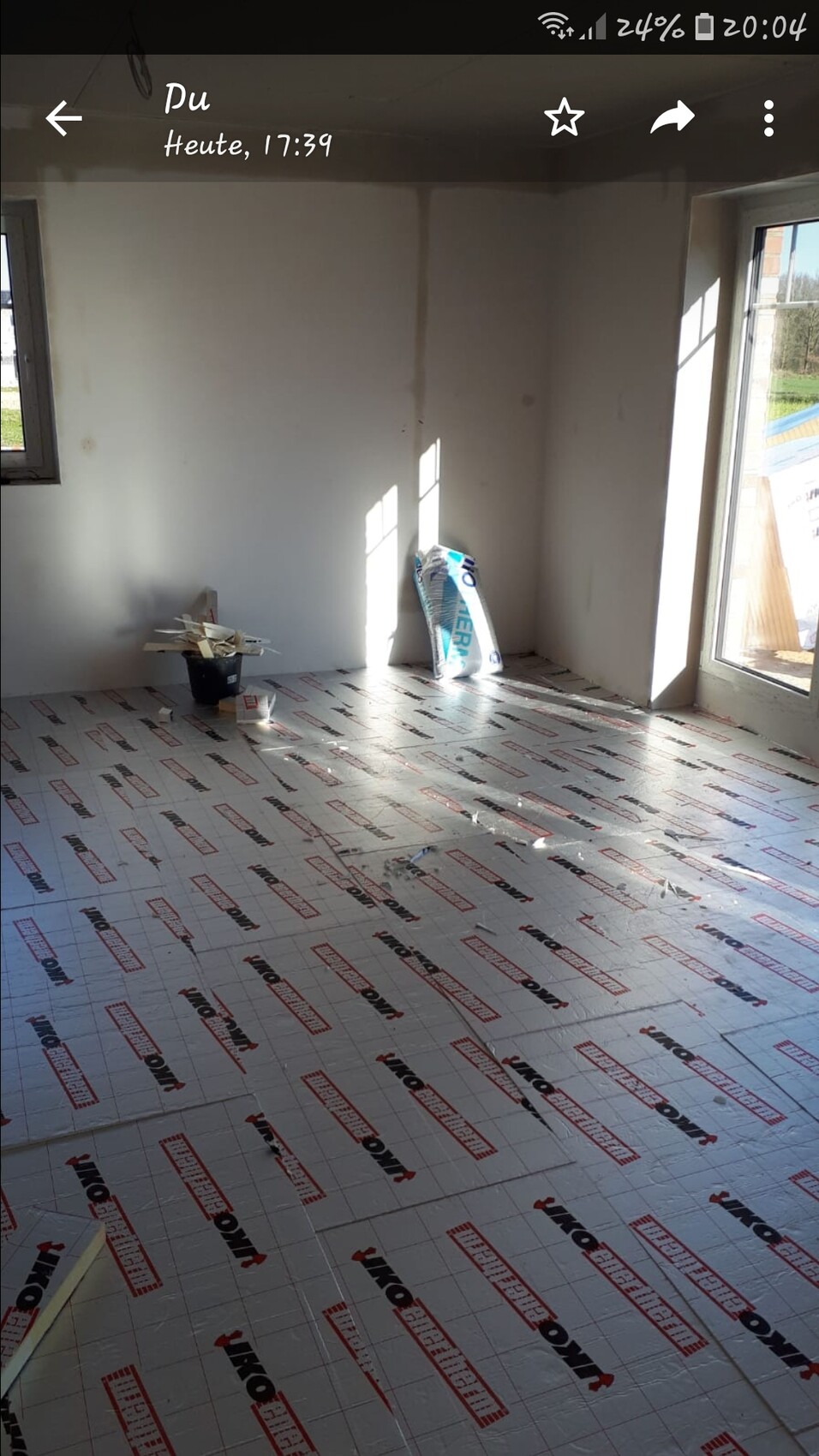
- IKO Aluminum PIR insulation board Enertherm WLS 023 for €2,065.45 including VAT
Calculated U-value 0.19 (additional €474.67 or €759.74)
Is the following calculation for comparing U-values 0.265 versus 0.19 correct?
0.075 W/m²K (difference in U-value) x 84 kKH (annual heating degree hours) x 100 m² = 630 kWh annual savings x €0.065/kWh = €40.95 heating cost savings per year
This would mean the additional cost is amortized after 18.5 years. Less if gas prices rise.
How would you decide? Since we are doing this ourselves, the extra cost would be affordable, but if it is not necessary, naturally we'd spend the money on something more sensible.
PS: My buddy recommends laying a PE foil under the insulation and on top of the torch-on membrane. My plumbing company says this is not necessary. What do you think?
Here is my next question.
The floor structure is as follows:
- No insulation under the slab
- 20 cm (8 inches) concrete
- Torch-on membrane G 200 S4
- 13 cm (5 inches) insulation
- 6.5 cm (2.5 inches) screed
- 1 cm (0.4 inches) floor covering
I have agreed with the plumbing company that we will handle the insulation design for the floor ourselves.
The contractor’s quote included 6 cm (2.4 inches) WLG 035 + 5 cm (2 inches) WLG 035 + 3 cm (1.2 inches) Rolljet 045.
The Rolljet 045 was already supplied by the contractor. I will source the insulation boards myself since it is significantly more cost-effective.
Here are the options I have checked using the U-value calculator (ubakus):
- General purpose EPS insulation board 035 DEO/WAB General purpose insulation board for €1,305.71 including VAT
Calculated U-value 0.265
- Austrotherm insulation board XPS-Top 30 SF WLS 032 for €1,590.78 including VAT
Calculated U-value 0.247 (additional €285.07)
- IKO Aluminum PIR insulation board Enertherm WLS 023 for €2,065.45 including VAT
Calculated U-value 0.19 (additional €474.67 or €759.74)
Is the following calculation for comparing U-values 0.265 versus 0.19 correct?
0.075 W/m²K (difference in U-value) x 84 kKH (annual heating degree hours) x 100 m² = 630 kWh annual savings x €0.065/kWh = €40.95 heating cost savings per year
This would mean the additional cost is amortized after 18.5 years. Less if gas prices rise.
How would you decide? Since we are doing this ourselves, the extra cost would be affordable, but if it is not necessary, naturally we'd spend the money on something more sensible.
PS: My buddy recommends laying a PE foil under the insulation and on top of the torch-on membrane. My plumbing company says this is not necessary. What do you think?
P
pffreestyler13 Apr 2019 00:29The PE foil is no longer necessary. At the bottom, it’s unnecessary because nowadays nothing damages the insulation anymore; it used to be different in the past. At the top, it’s also unnecessary since there is a Rolljet installed. The waterproof membrane already provides the moisture barrier.
I read in this house-building forum that they managed it with a utility knife. Cut the aluminum, break off the rest, then cut the other side of the aluminum. I also have a circular hand saw, which worked well for me with the Wedi boards. Otherwise, I could try using an alligator shears. Trial and error will teach me; somehow it will work out.
I read in this house-building forum that they managed it with a utility knife. Cut the aluminum, break off the rest, then cut the other side of the aluminum. I also have a circular hand saw, which worked well for me with the Wedi boards. Otherwise, I could try using an alligator shears. Trial and error will teach me; somehow it will work out.

You can manage that with a utility knife, but you probably won’t like it when working with thicker materials.
A circular hand saw should also work, but first check the cutting depth of your tool. It would be inconvenient to have to trim the lower aluminum layer every time on the 60mm (2.4 inch) panels.
However, if you need to cut around cables on the floor and/or have many offsets in the floor plan, I would reconsider using a jigsaw or reciprocating saw. A circular saw is great for long, straight cuts but quite unsuitable for notching small corners or making curved cuts.
Good luck!
A circular hand saw should also work, but first check the cutting depth of your tool. It would be inconvenient to have to trim the lower aluminum layer every time on the 60mm (2.4 inch) panels.
However, if you need to cut around cables on the floor and/or have many offsets in the floor plan, I would reconsider using a jigsaw or reciprocating saw. A circular saw is great for long, straight cuts but quite unsuitable for notching small corners or making curved cuts.
Good luck!
P
pffreestyler15 Apr 2019 20:07Just as feedback in case others are in the same situation: cutting works perfectly with a utility knife and a long blade.
Similar topics