
Hello everyone,
I am planning to rebuild the floor of our older house.
The floor itself, meaning the basement ceiling, consists of 12 cm (5 inches) thick B 160 reinforced concrete. On top of that, 6x8 cm (2.4x3.2 inches) squared timbers were laid floating, and wooden floorboards were nailed on.
I have now completely removed the old wooden structure. However, since I have two extensions on the house, there is a height difference of almost 11 cm (4.3 inches) compared to the screed in the extensions.
Leveling with new screed is not an option due to structural and cost reasons.
My planned new build-up is as follows:
- Perimeter insulation strip along the walls
- (new) 6x8 cm (2.4x3.2 inches) squared timbers laid floating
- 22 mm (0.9 inches) OSB 3 board
The main question I have now is whether I should also lay the OSB boards floating or screw them down and glue tongue and groove joints? I want to avoid creaking noises and have already received many different recommendations.
Has anyone here perhaps already carried out a similar build-up or has any other tips?
Thanks in advance.
Kind regards,
Marc
I am planning to rebuild the floor of our older house.
The floor itself, meaning the basement ceiling, consists of 12 cm (5 inches) thick B 160 reinforced concrete. On top of that, 6x8 cm (2.4x3.2 inches) squared timbers were laid floating, and wooden floorboards were nailed on.
I have now completely removed the old wooden structure. However, since I have two extensions on the house, there is a height difference of almost 11 cm (4.3 inches) compared to the screed in the extensions.
Leveling with new screed is not an option due to structural and cost reasons.
My planned new build-up is as follows:
- Perimeter insulation strip along the walls
- (new) 6x8 cm (2.4x3.2 inches) squared timbers laid floating
- 22 mm (0.9 inches) OSB 3 board
The main question I have now is whether I should also lay the OSB boards floating or screw them down and glue tongue and groove joints? I want to avoid creaking noises and have already received many different recommendations.
Has anyone here perhaps already carried out a similar build-up or has any other tips?
Thanks in advance.
Kind regards,
Marc
 Marcinho14057 Nov 2016 18:37
@jan2110: I prefer the mineral wool option because of its better insulation value and easier handling. The point about the decoupling mat is probably correct if an expert says so. However, in our first house, tiles were glued directly onto a 22 mm (about 7/8 inch) OSB board with only a reinforcement mesh underneath, and that has held up for 10 years since the previous owners installed it... I plan to try it the same way again.
@nelly190: I’ve asked myself the same question and received different answers here. The question is whether 25 mm (about 1 inch) boards would provide significantly more stability. Maybe @KlaRa, as an expert, has an answer for this.
@KlaRa: I don’t think anyone is "complaining" here; it’s more about finding a good balance between cost and performance. No one likes to spend more money than necessary. Also, there were no complaints about the cost of mineral wool as insulation—I just found Fermacell panels too expensive for my situation and not offering enough added value.
Nowhere was it said that there is no budget or willingness to spend money... Also, I mentioned in my first post that the old structure (including old floorboards) was already removed, and now the 12 cm (about 4 3/4 inches) reinforced concrete slab below is exposed. Otherwise, I wouldn’t even have the 11 cm (about 4 1/4 inches) height difference.
My original question (and it still is) is whether I should screw and glue the OSB boards onto the 6 x 8 cm (about 2 1/2 x 3 inch) joists or not?
Perhaps you have an answer for that without addressing non-existent issues. Thanks.
@nelly190: I’ve asked myself the same question and received different answers here. The question is whether 25 mm (about 1 inch) boards would provide significantly more stability. Maybe @KlaRa, as an expert, has an answer for this.
@KlaRa: I don’t think anyone is "complaining" here; it’s more about finding a good balance between cost and performance. No one likes to spend more money than necessary. Also, there were no complaints about the cost of mineral wool as insulation—I just found Fermacell panels too expensive for my situation and not offering enough added value.
Nowhere was it said that there is no budget or willingness to spend money... Also, I mentioned in my first post that the old structure (including old floorboards) was already removed, and now the 12 cm (about 4 3/4 inches) reinforced concrete slab below is exposed. Otherwise, I wouldn’t even have the 11 cm (about 4 1/4 inches) height difference.
My original question (and it still is) is whether I should screw and glue the OSB boards onto the 6 x 8 cm (about 2 1/2 x 3 inch) joists or not?
Perhaps you have an answer for that without addressing non-existent issues. Thanks.
 Marcinho14058 Nov 2016 08:36
Thank you for the response, that is exactly what I wanted to know. I also found something interesting on Google, which shows almost the exact construction I planned and what @KlaRa confirmed.
I have attached two screenshots related to this.
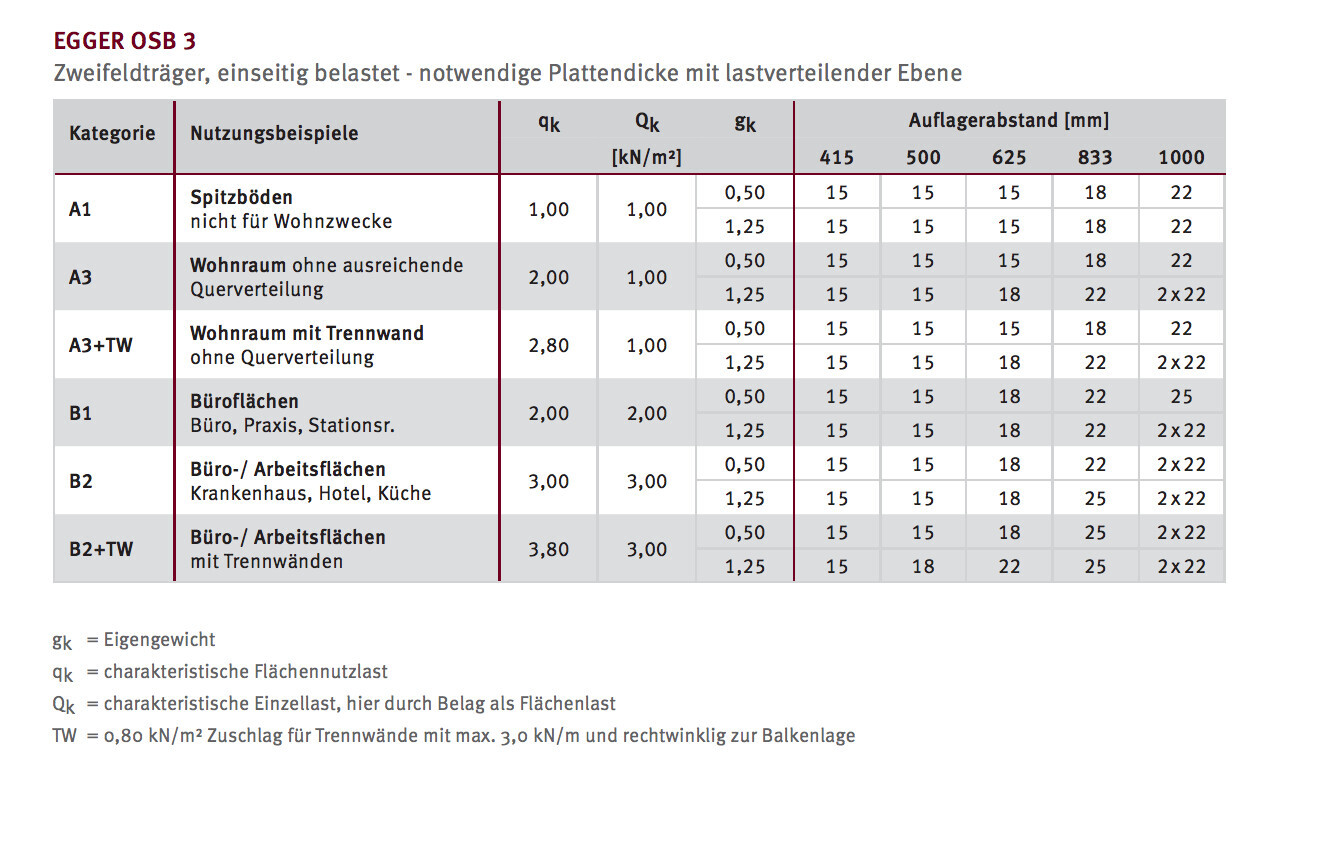
Additionally, I found a table on the website of an OSB board manufacturer regarding the spacing of the substructure; I have also attached this. According to it, my spacing combined with the 22 mm (7/8 inch) thickness should be sufficient.
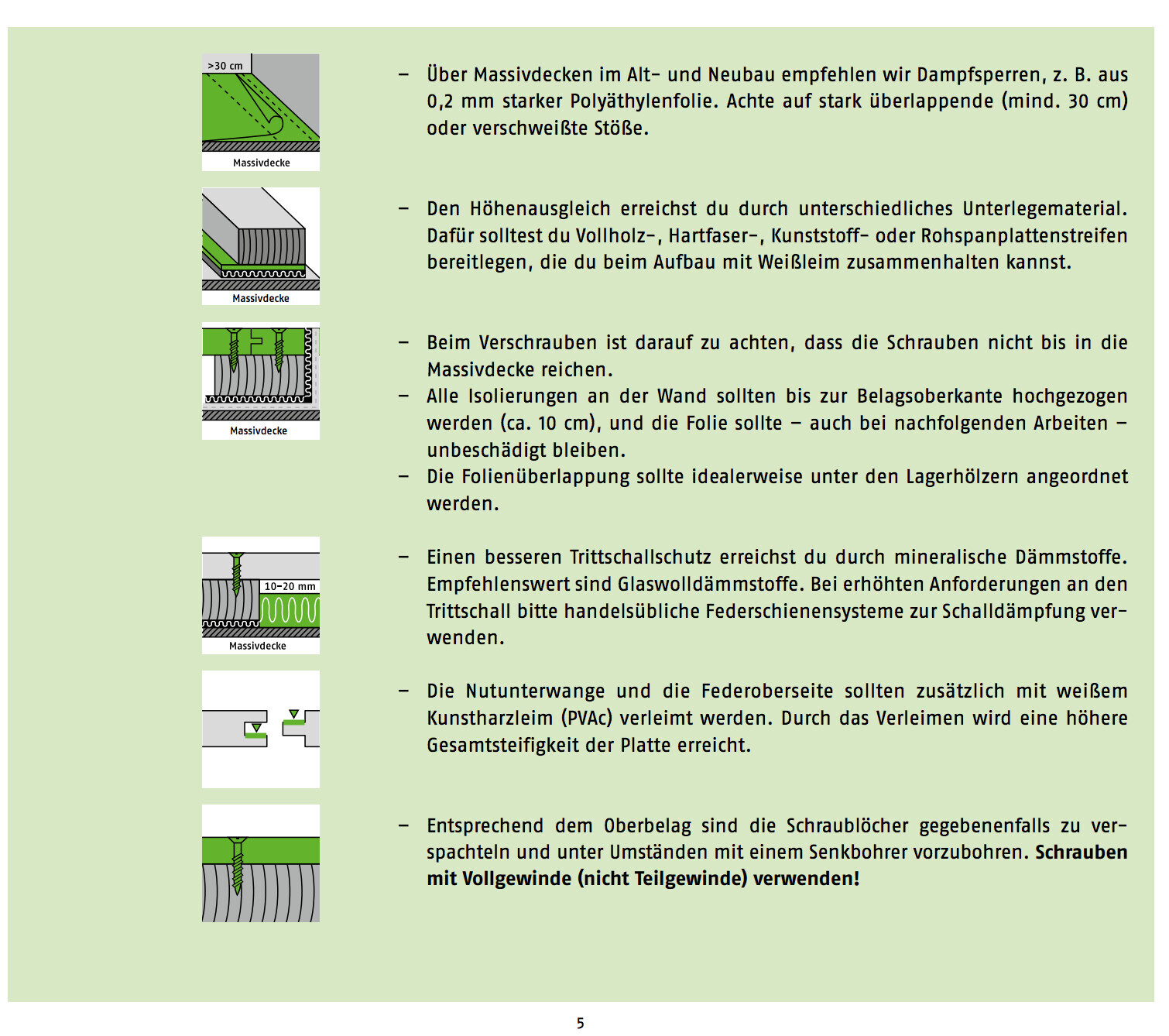
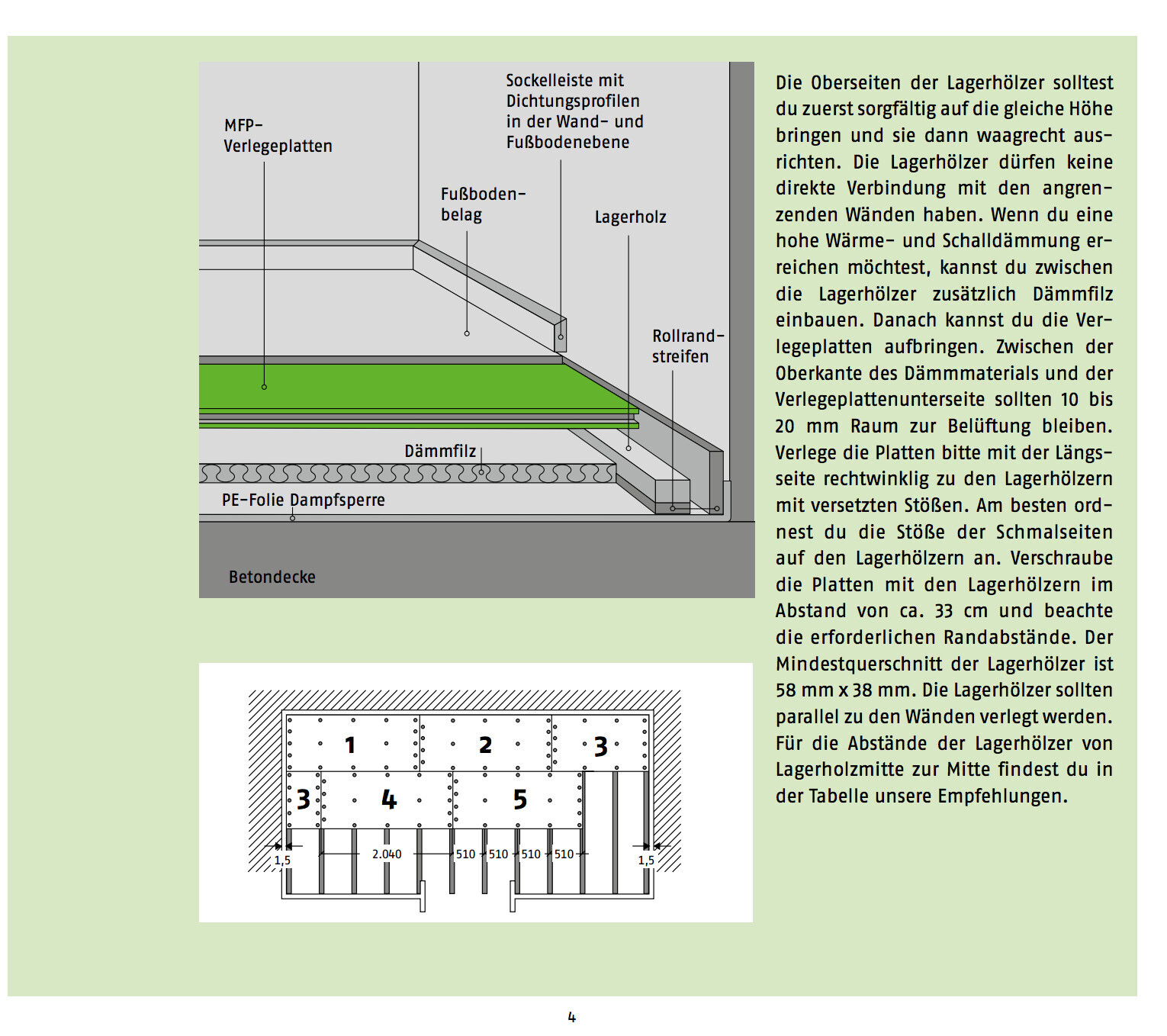
I have attached two screenshots related to this.
Additionally, I found a table on the website of an OSB board manufacturer regarding the spacing of the substructure; I have also attached this. According to it, my spacing combined with the 22 mm (7/8 inch) thickness should be sufficient.
D
Deliverer9 Nov 2016 11:32Hello everyone.
I asked a similar question elsewhere before, but unfortunately didn’t get much feedback.
By now, I have almost made up my mind.
Are the sleepers really not screwed to the subfloor underneath? I have a tiled floor below. That’s why I was thinking of leaving out the vapor barrier foil – the tiles should actually serve that purpose. (And if I screw them down, it doesn’t matter anyway.)
Or is it better to install them floating on both tiles AND foil?
I have planned to use 50 x 38 mm (2 x 1.5 inches) squared timber sleepers under a 25 mm (1 inch) OSB board, with insulation wool in between.
I asked a similar question elsewhere before, but unfortunately didn’t get much feedback.
By now, I have almost made up my mind.
Are the sleepers really not screwed to the subfloor underneath? I have a tiled floor below. That’s why I was thinking of leaving out the vapor barrier foil – the tiles should actually serve that purpose. (And if I screw them down, it doesn’t matter anyway.)
Or is it better to install them floating on both tiles AND foil?
I have planned to use 50 x 38 mm (2 x 1.5 inches) squared timber sleepers under a 25 mm (1 inch) OSB board, with insulation wool in between.
Marcinho14059 Nov 2016 12:14Hey,
regarding your question about the vapor barrier, I’m unfortunately unable to help. But as far as I understand, the decoupling is prevented by screwing the floor down, since you are basically "anchoring" it. This causes all impact sound to be transmitted directly through the screws into the tile floor.
In the installation guide screenshot already posted above, it is also shown to glue an edge insulation strip under the floating-installed joists. Together with a continuous perimeter edge insulation strip, this ensures maximum decoupling.
It is also important that you do not use screws to fix the OSB panels to the joists that are so long they potentially penetrate through the joist and reach the tile floor.
regarding your question about the vapor barrier, I’m unfortunately unable to help. But as far as I understand, the decoupling is prevented by screwing the floor down, since you are basically "anchoring" it. This causes all impact sound to be transmitted directly through the screws into the tile floor.
In the installation guide screenshot already posted above, it is also shown to glue an edge insulation strip under the floating-installed joists. Together with a continuous perimeter edge insulation strip, this ensures maximum decoupling.
It is also important that you do not use screws to fix the OSB panels to the joists that are so long they potentially penetrate through the joist and reach the tile floor.
D
Deliverer9 Nov 2016 12:20Thank you. My concern is less about noise (it has worked fine before, and usually no one lives below, plus the finished floor includes impact sound insulation), and more about potential issues with water and mold...
Similar topics