
T
tadeus32114 Jan 2022 11:21Hello,
I am currently looking into the topic of floor construction for a new build with a basement. A KfW40 solid wood house with a concrete basement and concrete ceiling is being built. Although the basement is insulated, it is kept cold in practice, meaning it is not heated. My question is, what is the typical thickness of the floor build-up on the ground floor? The entire floor has underfloor heating. The floor covering will be 1.5cm (0.6 inches) natural stone or wood. The architect has planned for 15cm (6 inches) in both the basement and ground floor. However, I have heard from others that I should add a few centimeters more insulation to prevent the floor from getting cold quickly.
How is this typically handled nowadays in this situation?
Thanks in advance
Best regards
I am currently looking into the topic of floor construction for a new build with a basement. A KfW40 solid wood house with a concrete basement and concrete ceiling is being built. Although the basement is insulated, it is kept cold in practice, meaning it is not heated. My question is, what is the typical thickness of the floor build-up on the ground floor? The entire floor has underfloor heating. The floor covering will be 1.5cm (0.6 inches) natural stone or wood. The architect has planned for 15cm (6 inches) in both the basement and ground floor. However, I have heard from others that I should add a few centimeters more insulation to prevent the floor from getting cold quickly.
How is this typically handled nowadays in this situation?
Thanks in advance
Best regards

Actually, the architect usually plans the basement within the thermal envelope, but you don’t want to heat it. Is the architect aware of this?
This means you will need to increase the floor construction height on the ground floor as well, since in addition to leveling height differences, you will also require a bit more thermal insulation.
However, not as much as if the basement were uninsulated.
My floor construction is as follows (on a slab-on-grade against the earth):
2mm (0.08 inches) bitumen membrane (probably not necessary for you)
0.2mm (0.008 inches) PE foil (likely unnecessary for you)
2cm (1 inch) EPS 040 as a layer for leveling cables and other components
4cm (1.6 inches) PUR insulation
4cm (1.6 inches) PUR insulation
3cm (1.2 inches) EPS 045 (roller screed for underfloor heating)
7cm (2.8 inches) screed
So, before the floor covering, that’s a 20cm (8 inches) floor construction height.
You might be able to skip one layer of insulation, so 15-16 cm (6 to 6.3 inches) could be sufficient. This can all be calculated precisely.
Just inform your architect, or better yet, ask your energy consultant what they recommend…
This means you will need to increase the floor construction height on the ground floor as well, since in addition to leveling height differences, you will also require a bit more thermal insulation.
However, not as much as if the basement were uninsulated.
My floor construction is as follows (on a slab-on-grade against the earth):
2mm (0.08 inches) bitumen membrane (probably not necessary for you)
0.2mm (0.008 inches) PE foil (likely unnecessary for you)
2cm (1 inch) EPS 040 as a layer for leveling cables and other components
4cm (1.6 inches) PUR insulation
4cm (1.6 inches) PUR insulation
3cm (1.2 inches) EPS 045 (roller screed for underfloor heating)
7cm (2.8 inches) screed
So, before the floor covering, that’s a 20cm (8 inches) floor construction height.
You might be able to skip one layer of insulation, so 15-16 cm (6 to 6.3 inches) could be sufficient. This can all be calculated precisely.
Just inform your architect, or better yet, ask your energy consultant what they recommend…

We also have 20cm (8 inches) above the insulated but unheated basement:
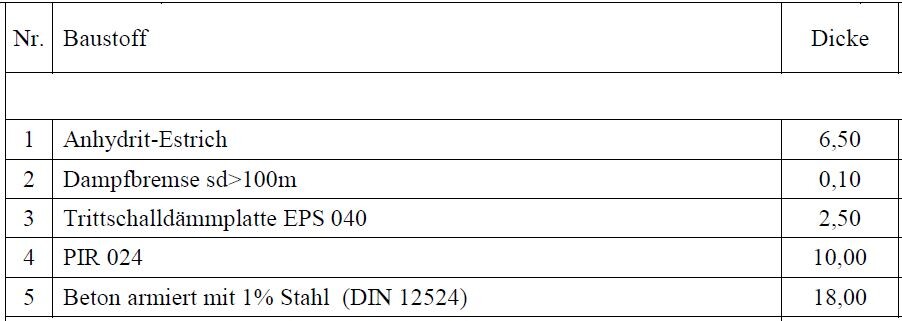
If the basement is unheated, you may also need to consider that the stairwell allows cold air to pass through. In short:
If the basement is unheated, you may also need to consider that the stairwell allows cold air to pass through. In short:
Tolentino schrieb:
better ask the energy consultant what they say about it...
Probably went a bit overboard. We didn’t calculate it precisely for KfW standard limits, and the final thermal transmission loss is significantly better than KfW 40.

In the initial planning, we were somewhere between KfW 55 and 40, and I then requested cost estimates for better insulation on several building components. The additional costs were each so low that I simply opted for all of them 😳 Maybe a bit impulsive, but these were all things you can’t really change later on. And since it was about 3,500-4,000 euros in total, I didn’t want to bother figuring out the ‘optimal’ combination. According to the documents, we probably have a KfW 20 house 😉 However, I don’t think this will make a noticeable difference in practice.
In the initial planning, we were somewhere between KfW 55 and 40, and I then requested cost estimates for better insulation on several building components. The additional costs were each so low that I simply opted for all of them 😳 Maybe a bit impulsive, but these were all things you can’t really change later on. And since it was about 3,500-4,000 euros in total, I didn’t want to bother figuring out the ‘optimal’ combination. According to the documents, we probably have a KfW 20 house 😉 However, I don’t think this will make a noticeable difference in practice.
B
Benutzer20014 Jan 2022 15:22tadeus321 schrieb:
The architect planned for 15cm (6 inches) in the basement and ground floor. Now I’ve heard from another source that I should add a few centimeters more insulation so that my floor doesn’t get cold so quickly.Who says that and why? With underfloor heating, the floor won’t get cold, but you are also heating the basement. What construction layers did the architect specify? Which materials with what insulation values? Maybe more insulation makes sense, or maybe less with better thermal performance.
All of this can be calculated.
No one can answer your question as it is. If the red car is driving at 150 km/h (93 mph), how fast is the blue car?
Similar topics