
ᐅ Height of floor construction with Vallox HRV ducting questionable
Created on: 7 Jul 2020 07:19
S
Subwkloofer
Good morning,
Yesterday, I was able to inspect the first pipes and distribution boxes of our Vallox controlled residential ventilation system.
What I definitely hadn't realized is that there is hardly any space left for the screed. Until now, I thought flat ducts would be used.
The current distribution boxes are about 17-18 cm (7-7 inches) high, and if the underfloor heating and screed are added on top, the planned total height of 20 cm (8 inches) won't be achievable.
Does anyone have benchmark values? What is the minimum thickness required for the screed layer including underfloor heating?
I attached a photo from the bathroom on the upper floor. The two distribution boxes are quite close to each other. Is there still enough space above the box and piping for underfloor heating pipes including the screed, or will there be no underfloor heating installed there?
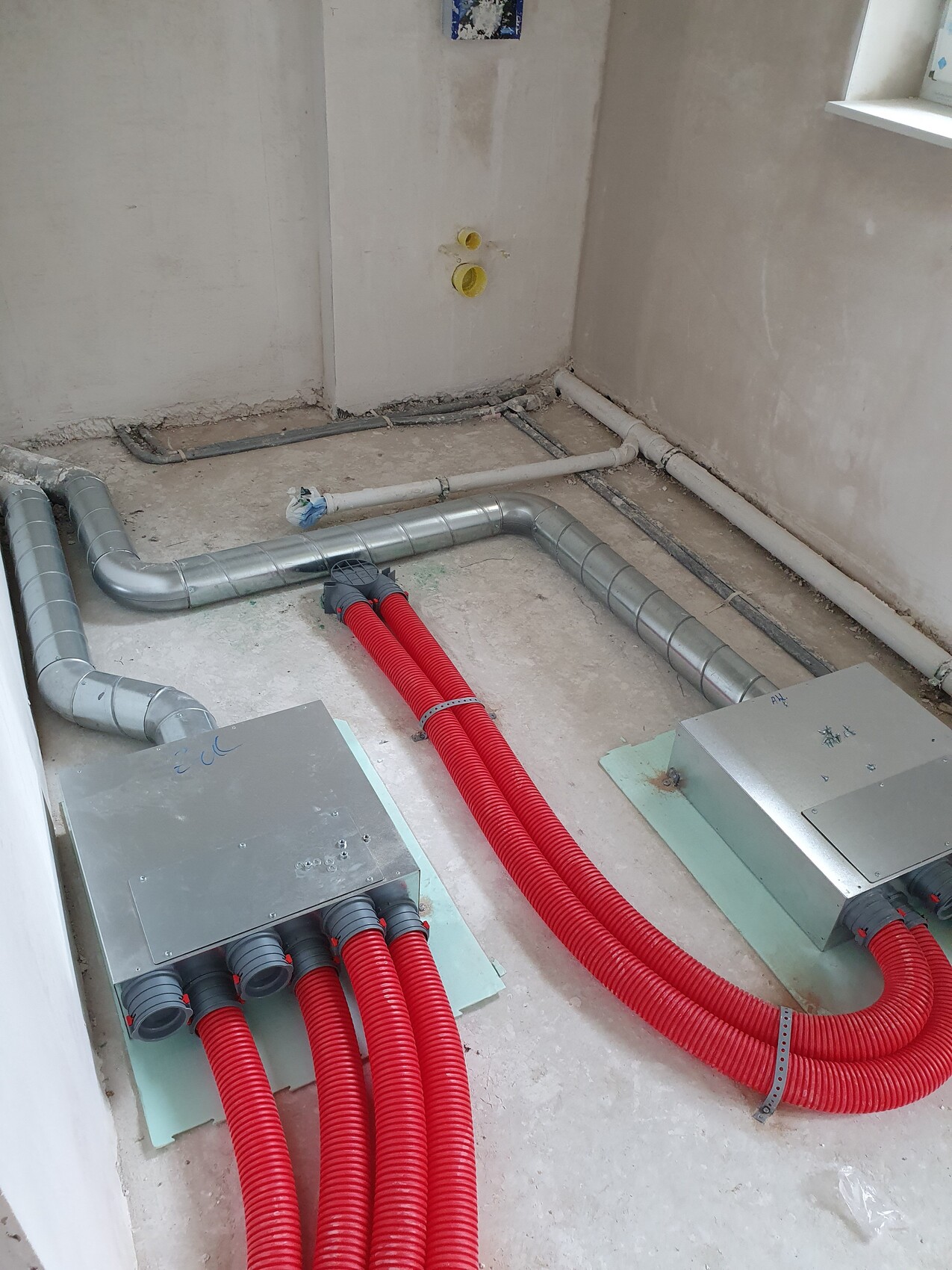
Yesterday, I was able to inspect the first pipes and distribution boxes of our Vallox controlled residential ventilation system.
What I definitely hadn't realized is that there is hardly any space left for the screed. Until now, I thought flat ducts would be used.
The current distribution boxes are about 17-18 cm (7-7 inches) high, and if the underfloor heating and screed are added on top, the planned total height of 20 cm (8 inches) won't be achievable.
Does anyone have benchmark values? What is the minimum thickness required for the screed layer including underfloor heating?
I attached a photo from the bathroom on the upper floor. The two distribution boxes are quite close to each other. Is there still enough space above the box and piping for underfloor heating pipes including the screed, or will there be no underfloor heating installed there?
N
nordanney7 Jul 2020 09:12Subwoofer schrieb:
How high did the build-up turn out to be?17 cm (6.7 inches) including the flooring.
Subwoofer schrieb:
There will be a standard hydronic underfloor heating system. There are more than 50 different options. Nothing is really standard when it comes to underfloor heating. But that’s just a side note. I also suspect that no one has thoroughly reviewed the plans, or there is a planning error.

Hello,
In the floor construction, you can hide a maximum of 5-6 cm (about 2-2.5 inches) for technical installations, no more.
For screed including underfloor heating pipes, you need about 7 cm (about 2 cm (0.8 inches) for piping and 5 cm (2 inches) minimum covering).
Those boxes have no business being there at all. Could it be that the "expert" is handling a controlled residential ventilation system for the very first time?
Ask to see the complete plans with ALL calculations—I'm not trying to be pessimistic, but I fear a major issue is coming your way.
It looks to me like someone completely messed up the planning.
Best regards and good luck,
Andreas
In the floor construction, you can hide a maximum of 5-6 cm (about 2-2.5 inches) for technical installations, no more.
For screed including underfloor heating pipes, you need about 7 cm (about 2 cm (0.8 inches) for piping and 5 cm (2 inches) minimum covering).
Subwoofer schrieb:
The current distribution boxes are about 17-18 cm (7-7¼ inches) high; if underfloor heating and screed are added on top, the planned total height of 20 cm (8 inches) would not be achievable.
Those boxes have no business being there at all. Could it be that the "expert" is handling a controlled residential ventilation system for the very first time?
Ask to see the complete plans with ALL calculations—I'm not trying to be pessimistic, but I fear a major issue is coming your way.
It looks to me like someone completely messed up the planning.
Best regards and good luck,
Andreas
 Subwkloofer7 Jul 2020 09:54
After a brief consultation with the site manager, it was said that flat ducts are currently not available.
At those points, it seems that only 4cm (1.5 inches) of screed will be applied, and the underfloor heating will be omitted. Since the boxes are now placed so close together, I'm a bit concerned that the bathroom might not warm up properly without the underfloor heating.
We have an on-site appointment at 4 PM, looking forward to it.
At those points, it seems that only 4cm (1.5 inches) of screed will be applied, and the underfloor heating will be omitted. Since the boxes are now placed so close together, I'm a bit concerned that the bathroom might not warm up properly without the underfloor heating.
We have an on-site appointment at 4 PM, looking forward to it.

K
knalltüte7 Jul 2020 10:05Flat ducts cost significantly more than round pipes for mechanical ventilation with heat recovery, but they also do not solve the issue of air distributors in the floor structure (lack of protective covering).
Installing lower-quality materials with the excuse of "unavailable" strikes me as very questionable. Above all, such actions can or must only take place after prior agreement with the client.
I honestly cannot imagine this being compliant with standards. Before further irreversible damage occurs (such as the screed being poured), I would recommend discussing this not only with the contractor but also with an independent building services engineer or expert. There is clearly an urgent need for immediate action. A 40mm (1.5 inch) screed is theoretically sufficient, but not on top of an air distributor for mechanical ventilation with heat recovery, since the cover is made of thin zinc sheet metal (is it even allowed to be embedded in the screed?) and is not load-bearing. It has already been noted that a stable board for load distribution must be placed on top of it.
P.S.: The picture also lacks acoustic decoupling of the pipes and distributors...
Installing lower-quality materials with the excuse of "unavailable" strikes me as very questionable. Above all, such actions can or must only take place after prior agreement with the client.
I honestly cannot imagine this being compliant with standards. Before further irreversible damage occurs (such as the screed being poured), I would recommend discussing this not only with the contractor but also with an independent building services engineer or expert. There is clearly an urgent need for immediate action. A 40mm (1.5 inch) screed is theoretically sufficient, but not on top of an air distributor for mechanical ventilation with heat recovery, since the cover is made of thin zinc sheet metal (is it even allowed to be embedded in the screed?) and is not load-bearing. It has already been noted that a stable board for load distribution must be placed on top of it.
P.S.: The picture also lacks acoustic decoupling of the pipes and distributors...
Similar topics