
ᐅ Floor Construction and Height Adjustment in Renovations (Underfloor Heating)
Created on: 13 Jan 2020 21:04
A
Arons
Hello dear community,
we have been renovating our house (an old building) for about a year and have created a granny flat. This is completely on the upper floor and extends over the main house (marked in green, see attachment) and an extension (marked in yellow, see attachment). In the yellow-marked extension, there is no screed, only the raw concrete ceiling. In the main house, screed has already been installed. Therefore, there is already a height difference of about 2–4 cm (1–2 inches) between the two areas. In the extension, at the lowest point we have a build-up of 16 cm (6.3 inches) (so the reference line is currently at 116 cm (46 inches)), other points in the extension are at 14 cm (5.5 inches). In the main house, the highest point is at 12 cm (4.7 inches) (reference line at 112 cm (44 inches)).
It is now planned to install underfloor heating in both areas with new screed on top. We are wondering the best way to proceed. Fundamentally, I have two questions: one regarding the height adjustment between the two areas and the other about the general build-up.
[Height adjustment]: Since the floor in the old building is very uneven (partly a difference of 2–3 cm (about 1 inch)), we initially wanted to use a leveling fill to create a flat surface between the extension and the main house. This way, we have a consistent height everywhere.
[Build-up]: We now have about 12 cm (4.7 inches) of floor build-up. The studs plates for the underfloor heating are 32 mm (1.3 inches), plus screed and the floor covering. We will probably install vinyl flooring, but we still need to determine the thickness. In any case, something needs to be installed under the studs plates of the underfloor heating so that we reach the required 12 cm (4.7 inches). In the extension, we planned to place EPS (expanded polystyrene) on the leveling fill and then the studs plates (which also have about 10 mm (0.4 inches) of insulation). The EPS panels also make it easier to walk on during the installation of the underfloor heating than directly on the leveling fill.
For the main house, we have two options. Either we also place EPS panels on the old screed and then the underfloor heating, or we put the underfloor heating directly on the old screed, which would require a thicker screed layer.
[Summary]:
1. Is the leveling fill (e.g., Fermacell) suitable for height adjustment?
2. Can we lay EPS panels under the studs plates of the underfloor heating in the extension? Which panels are recommended or what should be considered? I recall that only one type of insulation or only one layer of impact sound insulation is allowed under the underfloor heating (to avoid compressibility issues). The studs plates themselves also have a type of insulation. Which EPS panels (or something completely different) can we use here?
3. Should we also place EPS panels under the underfloor heating in the main house or is it better to use more screed?
We are under some time pressure, which might influence the options (e.g., more screed takes much longer to dry). But regarding the screed, I will start a separate thread anyway. Time pressure or not, it should be done properly.
Also, since the granny flat is located on the upper floor, our main house is underneath. Therefore, better to have somewhat more (impact) sound insulation than too little.
Thank you very much!
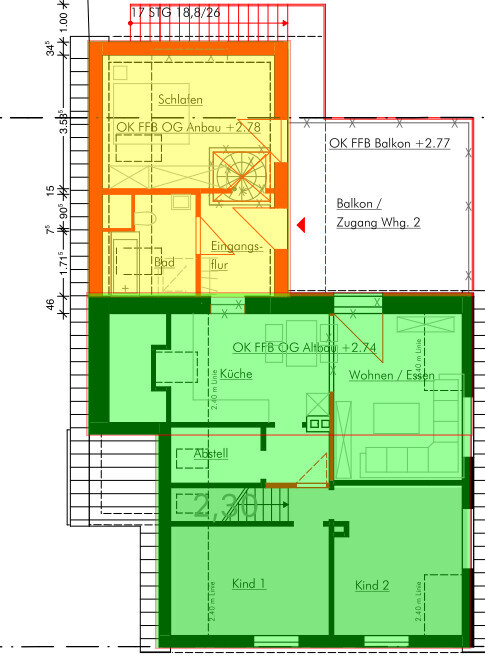
we have been renovating our house (an old building) for about a year and have created a granny flat. This is completely on the upper floor and extends over the main house (marked in green, see attachment) and an extension (marked in yellow, see attachment). In the yellow-marked extension, there is no screed, only the raw concrete ceiling. In the main house, screed has already been installed. Therefore, there is already a height difference of about 2–4 cm (1–2 inches) between the two areas. In the extension, at the lowest point we have a build-up of 16 cm (6.3 inches) (so the reference line is currently at 116 cm (46 inches)), other points in the extension are at 14 cm (5.5 inches). In the main house, the highest point is at 12 cm (4.7 inches) (reference line at 112 cm (44 inches)).
It is now planned to install underfloor heating in both areas with new screed on top. We are wondering the best way to proceed. Fundamentally, I have two questions: one regarding the height adjustment between the two areas and the other about the general build-up.
[Height adjustment]: Since the floor in the old building is very uneven (partly a difference of 2–3 cm (about 1 inch)), we initially wanted to use a leveling fill to create a flat surface between the extension and the main house. This way, we have a consistent height everywhere.
[Build-up]: We now have about 12 cm (4.7 inches) of floor build-up. The studs plates for the underfloor heating are 32 mm (1.3 inches), plus screed and the floor covering. We will probably install vinyl flooring, but we still need to determine the thickness. In any case, something needs to be installed under the studs plates of the underfloor heating so that we reach the required 12 cm (4.7 inches). In the extension, we planned to place EPS (expanded polystyrene) on the leveling fill and then the studs plates (which also have about 10 mm (0.4 inches) of insulation). The EPS panels also make it easier to walk on during the installation of the underfloor heating than directly on the leveling fill.
For the main house, we have two options. Either we also place EPS panels on the old screed and then the underfloor heating, or we put the underfloor heating directly on the old screed, which would require a thicker screed layer.
[Summary]:
1. Is the leveling fill (e.g., Fermacell) suitable for height adjustment?
2. Can we lay EPS panels under the studs plates of the underfloor heating in the extension? Which panels are recommended or what should be considered? I recall that only one type of insulation or only one layer of impact sound insulation is allowed under the underfloor heating (to avoid compressibility issues). The studs plates themselves also have a type of insulation. Which EPS panels (or something completely different) can we use here?
3. Should we also place EPS panels under the underfloor heating in the main house or is it better to use more screed?
We are under some time pressure, which might influence the options (e.g., more screed takes much longer to dry). But regarding the screed, I will start a separate thread anyway. Time pressure or not, it should be done properly.
Also, since the granny flat is located on the upper floor, our main house is underneath. Therefore, better to have somewhat more (impact) sound insulation than too little.
Thank you very much!


Dr Hix schrieb:
In this case, you might also consider an impact sound insulation made of stone wool. Or do you not live underneath? No, we don’t live there. The building is not approved for residential use—only for offices. I would like to change that, but the effort would be enormous and the return close to zero. So far, the demand for small offices is quite good.
However, we could still install anything that doesn’t cost a fortune and improves the comfort level.