
ᐅ Floating solid hardwood flooring installation—any experiences?
Created on: 19 Sep 2020 12:14
P
pagoni2020
Hello,
since we have screwed solid wood planks on joists in almost the entire house for many years and really liked it, we are now considering whether to choose solid wood planks again in the new house, but this time with underfloor heating and therefore directly on the screed.
We do not want an adhesive floor, so we are looking for experiences with floating solid wood plank installations.
since we have screwed solid wood planks on joists in almost the entire house for many years and really liked it, we are now considering whether to choose solid wood planks again in the new house, but this time with underfloor heating and therefore directly on the screed.
We do not want an adhesive floor, so we are looking for experiences with floating solid wood plank installations.
Of course, that’s not a problem. In the area of multi-layer parquet (2 or 3 layers), there is a huge selection in the 10-15mm (0.4-0.6 inches) range, leaving enough space for impact sound insulation.
I was very impressed with the Bauwerk products in this category; that probably would have been my choice if I hadn’t gone with solid wood planks!
Also, when it comes to parquet, I would reconsider whether to glue it down. The feeling underfoot is completely different!
I was very impressed with the Bauwerk products in this category; that probably would have been my choice if I hadn’t gone with solid wood planks!
Also, when it comes to parquet, I would reconsider whether to glue it down. The feeling underfoot is completely different!
B
Bertram10025 Sep 2020 13:39HarvSpec schrieb:
I would reconsider gluing the parquet! The feel underfoot is completely different!Yes, I currently have glued multi-layer parquet flooring in my apartment (x mm real wood top layer, lacquered, with some kind of layered core. I’m not sure exactly how the plank is constructed). It does feel like wood, but it’s hard and not springy. From the posts by @pagoni2020, I thought that floating parquet does have a bit of give. And that’s something I would really like to achieve. With underfloor heating in the screed and a total build-up height of 17 mm (0.67 inches).
P
pagoni202025 Sep 2020 14:37Bertram100 schrieb:
I thought, based on the posts from @pagoni2020, that floating parquet flooring does have a bit of give. And I would really like that if I could manage it.@Scout describes at the beginning how he experiences it himself and mentions a possible source of information/reference. As far as I know, I never directly wrote about "give," but it is true that we really liked this 28mm (1 inch) screwed floor, maybe precisely because we insisted on it despite differing opinions from homeowners and some craftsmen, and also because it didn’t feel so hard. I once slipped while wearing socks and landed sideways two steps down on the floor; nothing happened. I think that was lucky, but on a tiled or glued floor, it would have felt different, at least that’s my opinion.
At that time, our natural stone supplier had such wooden planks screwed in his showroom and poured gravel on them so customers could first give the raw floor a certain "patina" by walking on it. Another example that many things are possible if you like it that way, and he liked it very much—great!
Our screwed floor didn’t creak, and small gaps or scratches were only noticed in the first few weeks. Other floors in the house were replaced twice in 30 years, but the wooden floor remained and only received its covering color after 20 years, applied directly with a great result, for the next 10 years.
@Bertram100 if you like this so much, you will also find someone (see info from Scout) who offers it, even if it generally doesn’t correspond to the usual construction method; I found further providers online. You might not get a warranty for it, but there are plenty of examples here in the forum about how much value some warranties really have.
The versions from @Steffi33 (that’s how we had it) and @HarvSpec seem the most suitable to me, but since you already have screed in place and want it so badly, there are options and suppliers (see @Scout) that allow you to do it anyway (for example, with clips or this special adhesive foil).
Whether you will get general approval here is another matter… I really believe that, depending on your local situation, it is still a feasible solution, and if you like it, you can live with some conditions, perhaps also with a rail to bridge 4mm (0.16 inch) for a 21mm (0.83 inch) wooden plank.
Currently, we have nice 3-layer oak parquet installed floating on screed here, and everything is fine; nevertheless, we are also considering solid wood planks for a new build—but that is purely out of a personal feeling or interest, not because one is better or worse. Therefore, I don’t want or can convince anyone of it.
HarvSpec schrieb:
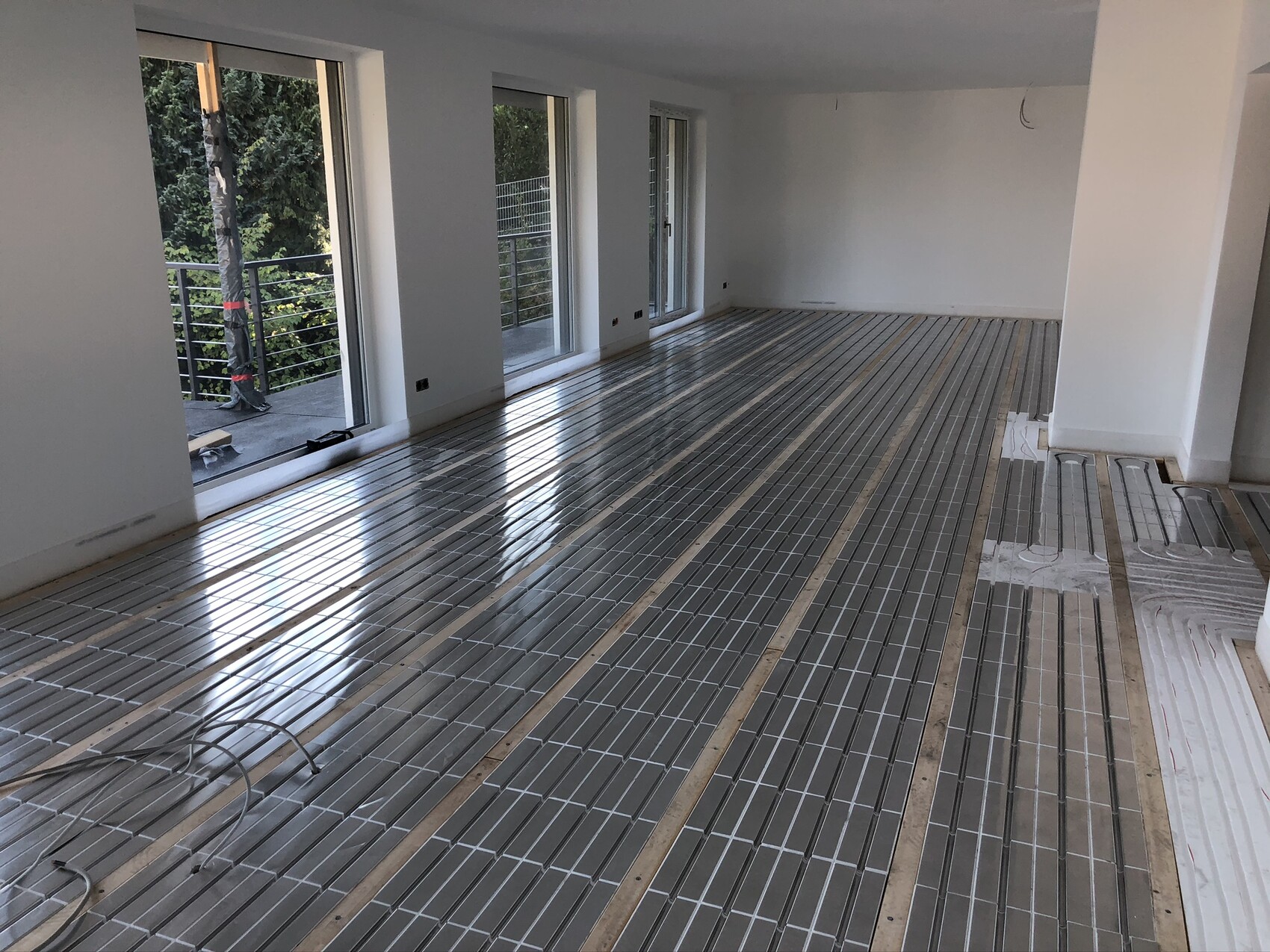
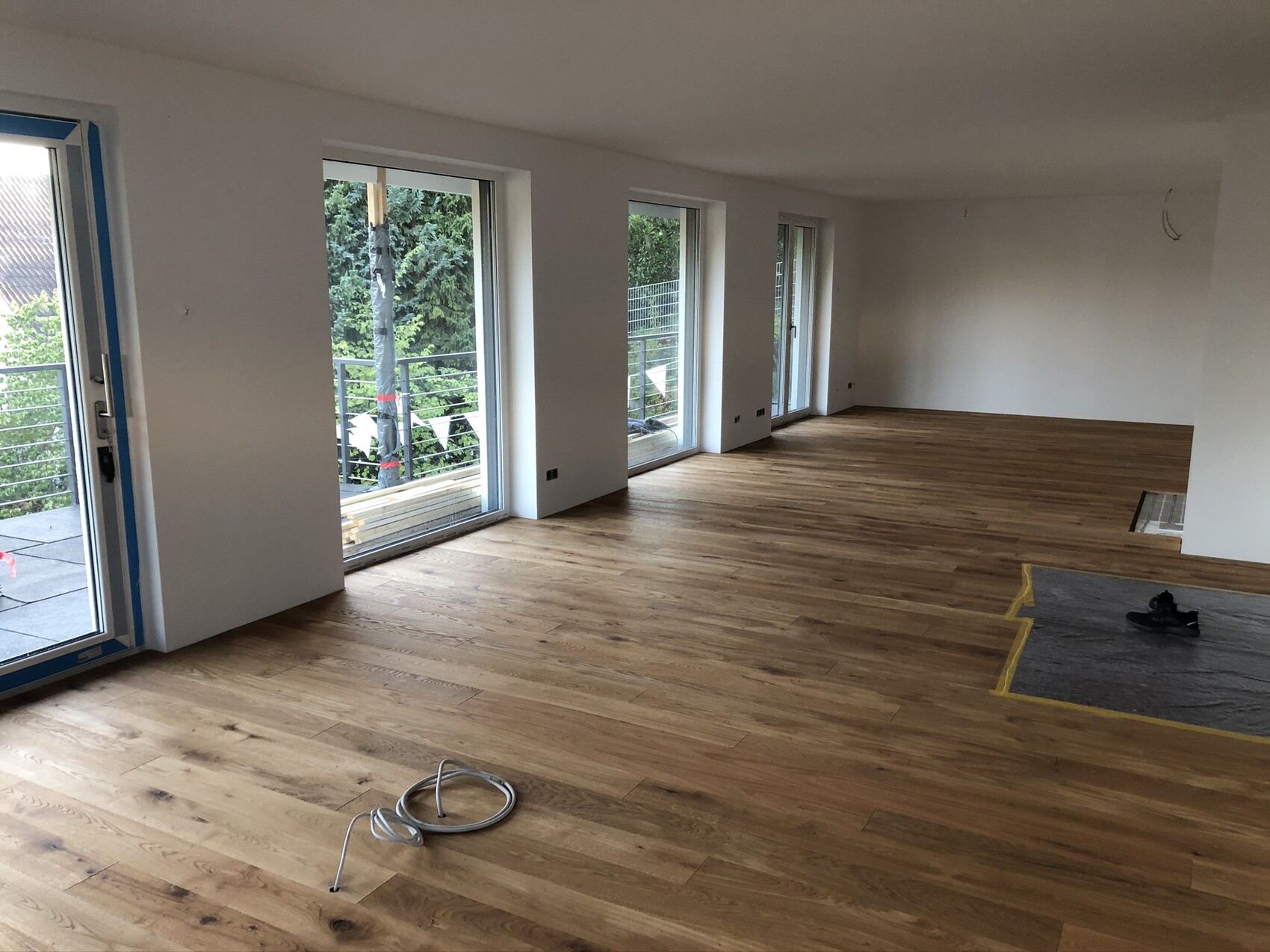
Here are some construction photos: screwed solid wood planks (oak) with underfloor heating without screed
Hello everyone,
@Scout @pagoni2020 @HarvSpec perfectly express my preference for a slightly springy step, the smell of wood, ideally also the acoustic feedback when walking on wood, and especially no adhesive used over the entire living area.
We are planning to install large areas of solid wood flooring in a newly built single-family house. Due to the combination with a photovoltaic system and an air-source heat pump, we ideally want to combine this with a surface heating system—preferably underfloor heating or floor tempering.
In our search for a dry floor construction, we came across various systems using lava aggregate panels or wood fiber panels with aluminum rails—like the system shown in the post by @HarvSpec—and would consider these options.
A few questions and experience reports would be very helpful:
1. Does this system require a significantly higher supply temperature than a conventional build-up? Is the concept of floor tempering instead of heating feasible with this setup (putting aside the building’s necessary heating load)?
2. Are there any noises when walking caused by contact between the planks and the aluminum rails?
3. Is the step feel as elastically springy as hoped?
4. Can you give a rough estimate of the cost? Approximately XX% more expensive than a standard floor construction?
Best regards and many thanks!
P
pagoni202027 Nov 2020 22:321. I didn’t consider underfloor heating, and we are planning the new house without it as well. However, I believe that with a plank floor construction, there is no need to choose a different vapor control layer (VCL). With screed, it has to be heated completely, often with impact sound insulation below, plus about 15mm (0.6 inches) of parquet on top. Therefore, I don’t see any issues or additional requirements. But @HarvSpec might already have some recent experience with this.
2. I can’t imagine that……
3. Well, it’s probably not really elastic. I like to use an example: I once slipped and fell down two steps onto a wooden floor. Of course, I was lucky not to break anything, but falling on a fully glued parquet floor would have definitely felt different afterward. We know people who have fully glued parquet floors, and to me, that feels like a stone floor. I had it that way before and want it like that again. Besides, there is (for whatever reason) a good feeling in knowing you can take up the floor in an emergency, unlike with screed.
4. Depending on how your slab is insulated and how much insulation you need or want to add underneath, the floor structure might not be significantly more expensive if you calculate from the raw floor to the final floor covering. What type of planks are you planning to install?
2. I can’t imagine that……
3. Well, it’s probably not really elastic. I like to use an example: I once slipped and fell down two steps onto a wooden floor. Of course, I was lucky not to break anything, but falling on a fully glued parquet floor would have definitely felt different afterward. We know people who have fully glued parquet floors, and to me, that feels like a stone floor. I had it that way before and want it like that again. Besides, there is (for whatever reason) a good feeling in knowing you can take up the floor in an emergency, unlike with screed.
4. Depending on how your slab is insulated and how much insulation you need or want to add underneath, the floor structure might not be significantly more expensive if you calculate from the raw floor to the final floor covering. What type of planks are you planning to install?
S
Smialbuddler28 Nov 2020 00:37HarvSpec schrieb:
I would reconsider gluing down the parquet! The feeling when walking on it is completely different! During our renovation, we also installed parquet flooring as a floating floor—I love the springy feel; it’s a clear contrast to the glued-down parquet we had in our old apartment. I like the comparison to walking on a forest floor; you literally walk more flexibly.
An important point that was explained to us: be careful if you plan to sand the parquet later! Regardless of the thickness of the wear layer, it is apparently difficult to impossible because the usual heavy sanding machines cause vibrations and simultaneously press down lightly, which can cause parts of the wear layer to crack or flake off. Since we have parquet with an old plank look (planed, slightly uneven, etc.), sanding isn’t an option for us aesthetically anyway. But I think it’s important to be aware of this.
Similar topics