
ᐅ Engineered wood flooring was unintentionally installed in a patterned layout using the floating method.
Created on: 29 May 2024 13:10
H
harkonsenH
harkonsen29 May 2024 13:10Hello everyone,
As the title says, we now have floating parquet flooring installed with an unintended pattern, basically all in one direction.
The rest of the house is great, but here at the final stages of installation, the flooring installer decided to lay the boards in this way in the dressing room, apparently because he did not have many boards left and was concerned about waste.
I understand that tongue and groove boards cannot be turned and rearranged endlessly. However, since we still had 3 full packs of boards left at the end, I find this installation quite strange.
Is it possible to request a correction here? In other words, do you have the right to demand a fix for such "patterns"?
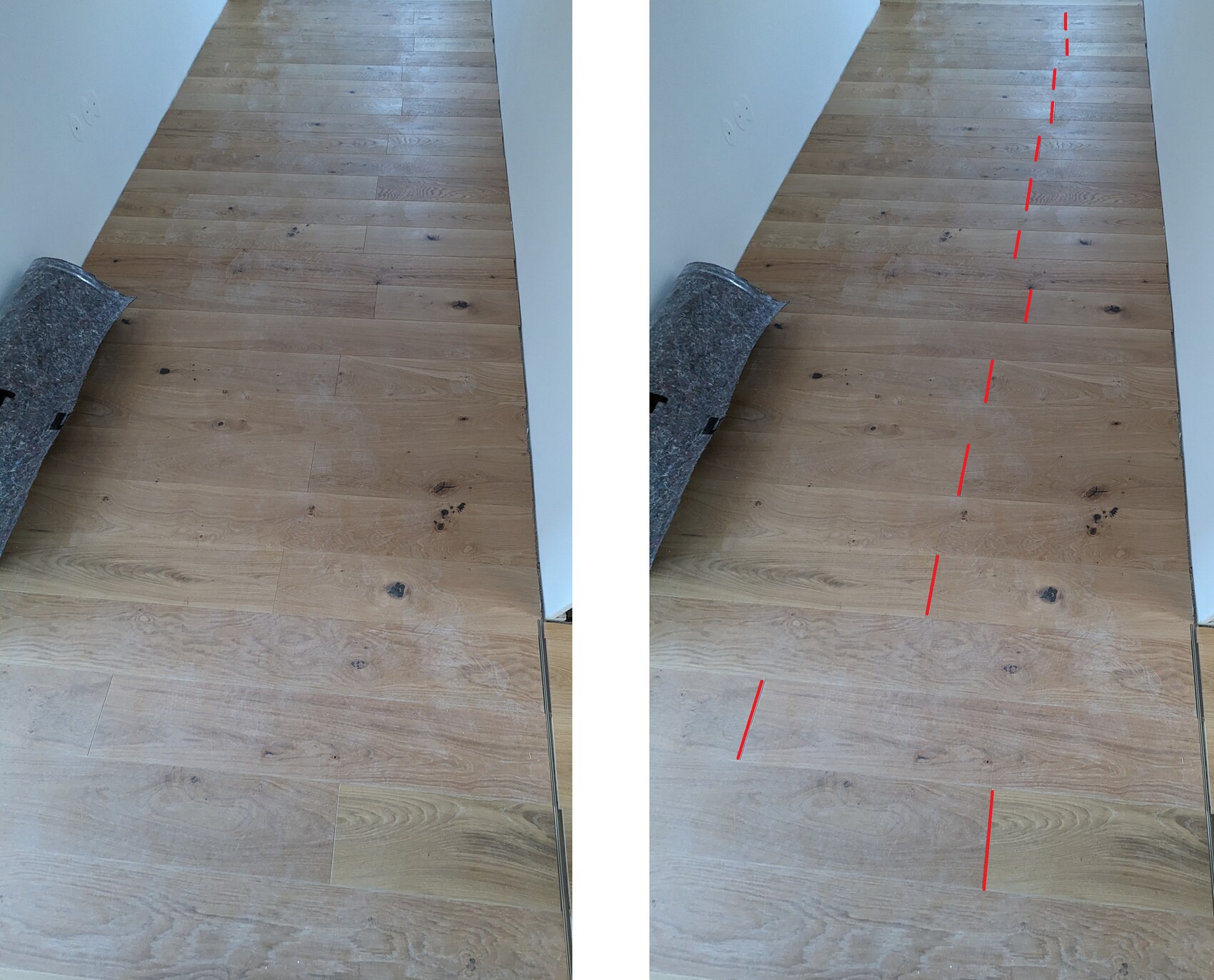
As the title says, we now have floating parquet flooring installed with an unintended pattern, basically all in one direction.
The rest of the house is great, but here at the final stages of installation, the flooring installer decided to lay the boards in this way in the dressing room, apparently because he did not have many boards left and was concerned about waste.
I understand that tongue and groove boards cannot be turned and rearranged endlessly. However, since we still had 3 full packs of boards left at the end, I find this installation quite strange.
Is it possible to request a correction here? In other words, do you have the right to demand a fix for such "patterns"?

H
harkonsen29 May 2024 13:24It was agreed to use a simple random pattern, or what some might call a herringbone. It worked well throughout the whole house, just not here.
Well, strictly speaking, this is also a random pattern, just a very regular one. It’s difficult when the room is exactly the right width so that you always have to cut each board the same way. In theory, he would have needed to deliberately make a different cut one to three times and calculate in advance whether it would work out.
It’s not pretty, but I doubt you have any grounds for requesting a correction here.
If the floor is installed as a floating floor and no baseboards or transition strips have been glued yet, you could try talking to him about cutting every second row differently with the leftover boards, and you could share the extra work. That should actually be manageable.
It’s not pretty, but I doubt you have any grounds for requesting a correction here.
If the floor is installed as a floating floor and no baseboards or transition strips have been glued yet, you could try talking to him about cutting every second row differently with the leftover boards, and you could share the extra work. That should actually be manageable.

Let’s put it this way:
the installer almost achieved a running bond pattern.
The image shown here illustrates an aesthetic aspect, as we experts in the field like to describe it.
I would argue from the left side, however, that the work is far below what is technically feasible, since there was definitely a way to install parquet elements with the same length dimension starting from one wall.
This would have resulted in a consistent alignment of the end joints.
Demanding a correction (including legally) seems unlikely to succeed.
We assess necessary measures or defects, which are then submitted to the judge (and usually accepted by them), based on location and visibility (here greatly simplified).
A walk-in closet is always considered less important in evaluating workmanship than an entrance area or living room.
From a technical standpoint, therefore, I see no chance for correction or compensation here.
Craftsmanship-wise, I agree with you, this execution was not a masterpiece!
In construction, there have always been many unsatisfactory situations where the client could only grit their teeth…
---------------------
Regards, KlaRa
the installer almost achieved a running bond pattern.
The image shown here illustrates an aesthetic aspect, as we experts in the field like to describe it.
I would argue from the left side, however, that the work is far below what is technically feasible, since there was definitely a way to install parquet elements with the same length dimension starting from one wall.
This would have resulted in a consistent alignment of the end joints.
Demanding a correction (including legally) seems unlikely to succeed.
We assess necessary measures or defects, which are then submitted to the judge (and usually accepted by them), based on location and visibility (here greatly simplified).
A walk-in closet is always considered less important in evaluating workmanship than an entrance area or living room.
From a technical standpoint, therefore, I see no chance for correction or compensation here.
Craftsmanship-wise, I agree with you, this execution was not a masterpiece!
In construction, there have always been many unsatisfactory situations where the client could only grit their teeth…
---------------------
Regards, KlaRa
Similar topics