
Hello everyone,
We are currently having a single-family house built and have two small flat roofs. After some rain, I noticed that water remained on the flat roofs, as seen in the photos.
My father-in-law is a civil engineer and said that this should not be the case.
Our construction manager said it depends on the height of the standing water. He wanted to take a look himself but apparently hasn't had time in the last two weeks. :\
From the pictures and in person, it seems like the roofs slope slightly uphill towards the drains, which would mean that a bit of water stays there permanently during the rainy months. It doesn’t dry off quickly either. :\
This sounds a bit worrying to me...
How do you see this? Is there any guidance or standards to rely on? I only found a recommendation of 2% slope.
Thanks and best regards 🙂
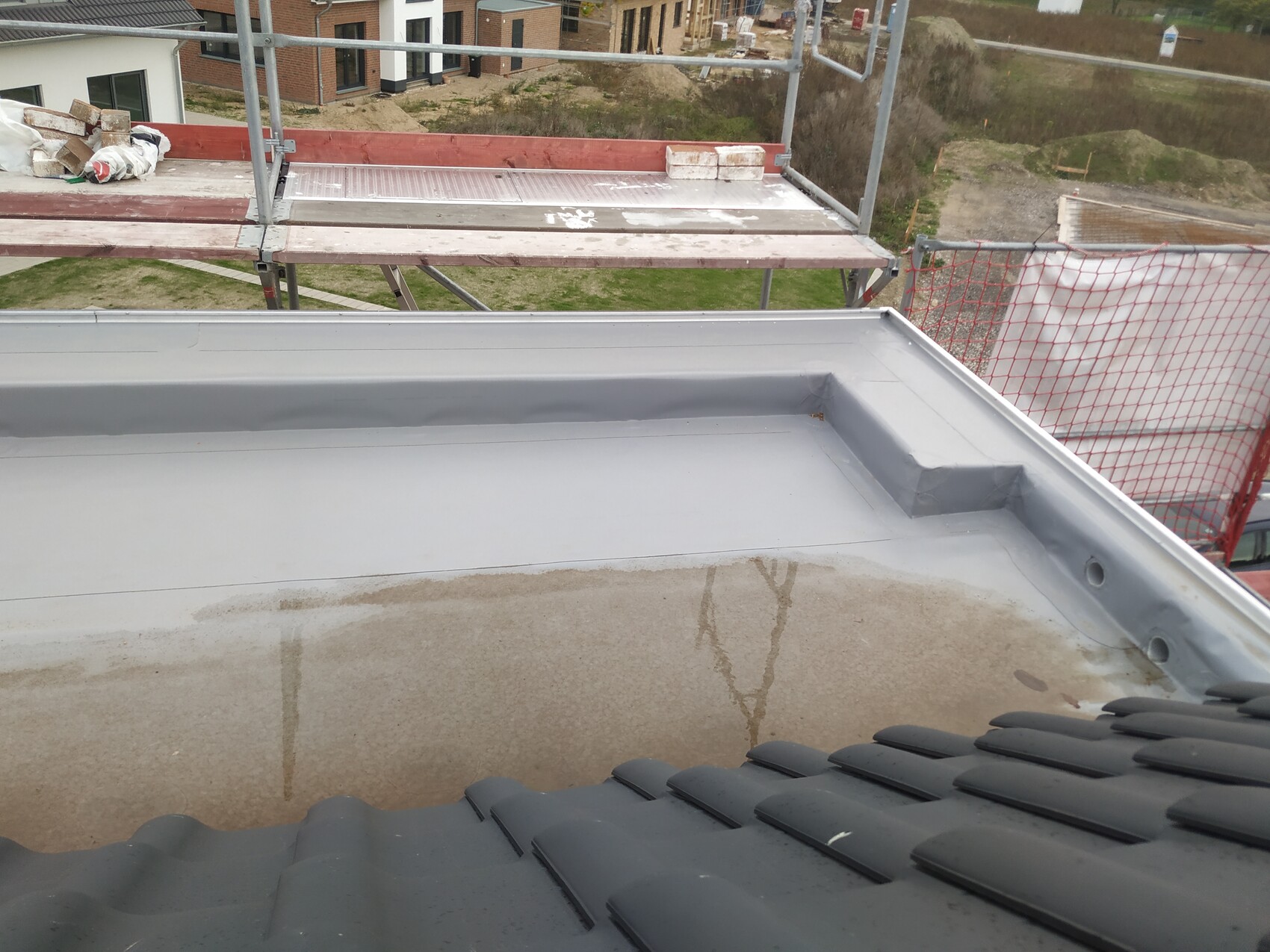

We are currently having a single-family house built and have two small flat roofs. After some rain, I noticed that water remained on the flat roofs, as seen in the photos.
My father-in-law is a civil engineer and said that this should not be the case.
Our construction manager said it depends on the height of the standing water. He wanted to take a look himself but apparently hasn't had time in the last two weeks. :\
From the pictures and in person, it seems like the roofs slope slightly uphill towards the drains, which would mean that a bit of water stays there permanently during the rainy months. It doesn’t dry off quickly either. :\
This sounds a bit worrying to me...
How do you see this? Is there any guidance or standards to rely on? I only found a recommendation of 2% slope.
Thanks and best regards 🙂

BertTheNerd schrieb:
Hmm... how does the roof warranty work if I add vegetation on it myself? If water leaks through after 3 years due to a construction defect, won’t they just refuse to cover it? That might be the case. We moved in September 2018, but I only added the greenery in June 2022, after it became clear that the flat roof of the extension (shown on the right in the picture) was hardly suitable for the photovoltaic system that had meanwhile been commissioned and installed.
guckuck2 schrieb:
The main drawback of roof loads, whatever type they are (gravel, green roofs, photovoltaic panels, etc.), is that the roofer will always complain, for example, when leak detection is needed. In case of doubt, you should remove the vegetation before they start.I cannot fully agree with that. For a building I am professionally involved with, we had a leak in the flat roof after several years. The roofer arrived with special probes and was able to locate the leak precisely. Only the damaged section had to be cleared for sealing. Just try searching for flat roof leak detection on Google.B
Benutzer 100118 Oct 2022 10:36In fact, 40mm (1.6 inches) is sufficient; I always thought that secondary drains had to be higher. Mi
I saw something similar at a neighbor’s place: the garage was filled with a gas, and the roof was checked with a sniffing sensor. Then the gravel was removed from an area of 2m² (21.5 sq ft). The cost was about 700 euros for one day of inspection including travel and so on.
AxelH. schrieb:
I cannot confirm that. We had a building I work with professionally where, after several years, there was a leak in the flat roof. The roofer used special sensors to locate the leak. Only the damaged section needed to be cleared for sealing. Just try searching for flat roof leak detection online.
I saw something similar at a neighbor’s place: the garage was filled with a gas, and the roof was checked with a sniffing sensor. Then the gravel was removed from an area of 2m² (21.5 sq ft). The cost was about 700 euros for one day of inspection including travel and so on.
AxelH. schrieb:
I cannot confirm that. We had a building I work with professionally where, after several years, a leak appeared in the flat roof. The roofer used special detectors to locate the leak. Only the damaged section needed to be cleared for sealing. Just try searching “flat roof leak detection” on Google. With the right coin inserted, a lot is possible 🙂
And you need someone who has the equipment and is also available.
guckuck2 schrieb:
And you need someone who has the equipment and is available.This wisdom, of course, applies to almost all areas of life ... 😉Similar topics