
ᐅ Flat roof leaking: repair or build a pitched roof structure over it?
Created on: 11 Feb 2021 06:58
R
Rolexianer
The flat roof on the wooden decking of a 55-year-old single-family house is leaking. Rainwater drains through seepage pipes inside the house. I suspect the cause of the leak is at one of these seepage pipes, as discoloration can be seen on the ceiling of the upper floor about 1.5m (5 feet) away from it. This issue was already addressed by professionals eight years ago, with stones removed locally and a membrane installed.
To avoid another limited repair, I would prefer to take decisive action and add a low pitched roof on top, similar to the neighboring house. This would direct rainwater to the outside, which is an advantage, as the downpipes can also show leaks at the basement access covers.
The carpenter has already visited and estimated the costs at €40,000 plus VAT (house dimensions 7 x 13m (23 x 43 feet)). The earliest possible execution date he can offer is August. A meeting at the local building authority is planned soon to discuss the project roughly, for example regarding a gable roof, shed roof, roof overhang, etc. Afterwards, a concrete quote could be prepared and an architect (recommended by the carpenter) involved. The building authority will likely prefer a gable roof, since that is visible on the neighboring house.
I am concerned about the house’s structural stability since a gable roof would add load to the center of the building, while the main load-bearing wall along the longitudinal axis is located about 1.5m (5 feet) off-center. This will need to be calculated by a structural engineer and likely cannot be ideal.
Another issue is that after adding a roof truss, the current flat roof assembly will probably become difficult to access if repairs are needed in the future.
Am I heading in the right direction? Is adding a roof truss really a worry-free solution, as the carpenter claims?
Perhaps I should just carry out a comprehensive renovation of the flat roof, probably at about half the cost of the carpenter’s proposal, but then it will likely leak again at some point.
Which solution should be aimed for? What else should I keep in mind?
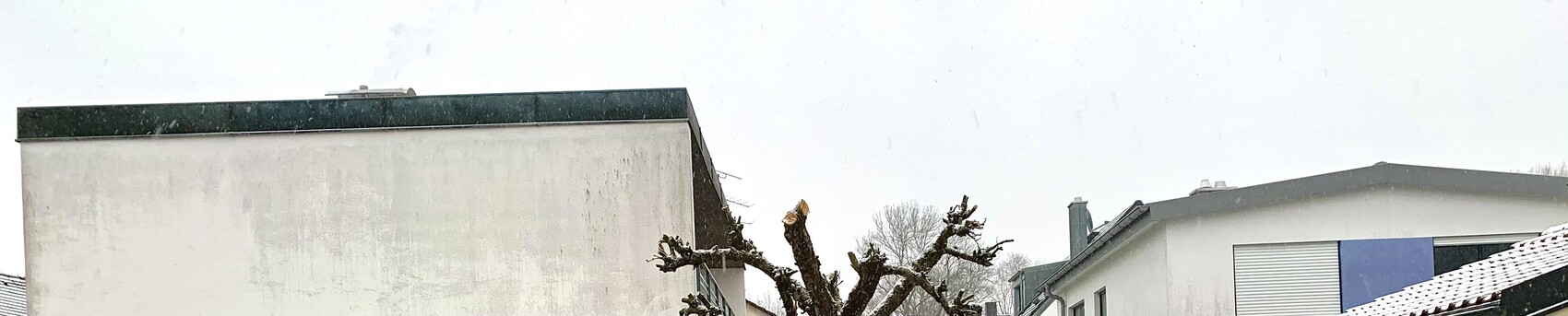
To avoid another limited repair, I would prefer to take decisive action and add a low pitched roof on top, similar to the neighboring house. This would direct rainwater to the outside, which is an advantage, as the downpipes can also show leaks at the basement access covers.
The carpenter has already visited and estimated the costs at €40,000 plus VAT (house dimensions 7 x 13m (23 x 43 feet)). The earliest possible execution date he can offer is August. A meeting at the local building authority is planned soon to discuss the project roughly, for example regarding a gable roof, shed roof, roof overhang, etc. Afterwards, a concrete quote could be prepared and an architect (recommended by the carpenter) involved. The building authority will likely prefer a gable roof, since that is visible on the neighboring house.
I am concerned about the house’s structural stability since a gable roof would add load to the center of the building, while the main load-bearing wall along the longitudinal axis is located about 1.5m (5 feet) off-center. This will need to be calculated by a structural engineer and likely cannot be ideal.
Another issue is that after adding a roof truss, the current flat roof assembly will probably become difficult to access if repairs are needed in the future.
Am I heading in the right direction? Is adding a roof truss really a worry-free solution, as the carpenter claims?
Perhaps I should just carry out a comprehensive renovation of the flat roof, probably at about half the cost of the carpenter’s proposal, but then it will likely leak again at some point.
Which solution should be aimed for? What else should I keep in mind?
I sealed my flat roof of 120 sqm (1292 sq ft) myself, and the material costs alone added up to around 10,000 euros, including wood, bitumen primer, 4mm (0.16 inch) torch-applied elastomeric bitumen vapor barrier membrane, 240mm (9.4 inch) EPS 035 insulation board, a 3.5mm (0.14 inch) cold self-adhesive elastomeric bitumen underlayment membrane applied on top of the insulation board, and then a high-quality torch-applied membrane, and so on. I’m not going to advertise any manufacturers here. I only purchased high-quality products because I am a roofer myself 😉
If you add the labor costs from a company, you quickly end up spending around 20,000 euros or more. Flat roofs with bitumen membranes now last 30 years or longer, as long as you use good materials 😉
About 32 years ago, I also welded the flat roof on my first house myself, and it is still watertight today 🙂 We sold that house two years ago and built a new, accessible home with a flat roof and roofing felt.
If you add the labor costs from a company, you quickly end up spending around 20,000 euros or more. Flat roofs with bitumen membranes now last 30 years or longer, as long as you use good materials 😉
About 32 years ago, I also welded the flat roof on my first house myself, and it is still watertight today 🙂 We sold that house two years ago and built a new, accessible home with a flat roof and roofing felt.
caspar.1 schrieb:
with a flat roof and roofing felt. I’d like to ask the expert about the roof construction. Roofing felt sounds inexpensive.

caspar.1 schrieb:
3.5mm (0.14 inches) cold self-adhesive elastomeric bitumen underlayment that is applied on top of the insulation board, Does it have to be cold-applied to avoid damaging the insulation board by heat?
https://www.instagram.com/11antgmxde/
https://www.linkedin.com/company/bauen-jetzt/

11ant schrieb:
Does it have to be cold-applied because otherwise you would burn the insulation board?Yes, that’s how it’s done in new constructions, for example on tapered insulation. But only for the first layer.
Similar topics