
Hello everyone,
I have a question regarding our planned fireplace and the related regulations. Unfortunately, reading through the various requirements has not made things any clearer. We purchased a fireplace from Hark, model "mamorkamin 1/222.0," about six months ago (before construction started), based on our floor plan designs. We were only told that our electrician needs to install a cable to the range hood. The installation would be handled by the seller. They also said that, with our floor plan, the location of the fireplace would not be a problem.
Now that the shell of the building is complete, and we are about to begin electrical, plumbing, and underfloor heating work, the fireplace supplier is talking about a partition wall behind the fireplace. They want to know who will build it. Nothing about this was mentioned in the past six months. Of course, we received this email just before the end of their working day, so we couldn’t ask for clarification today about what exactly is meant.
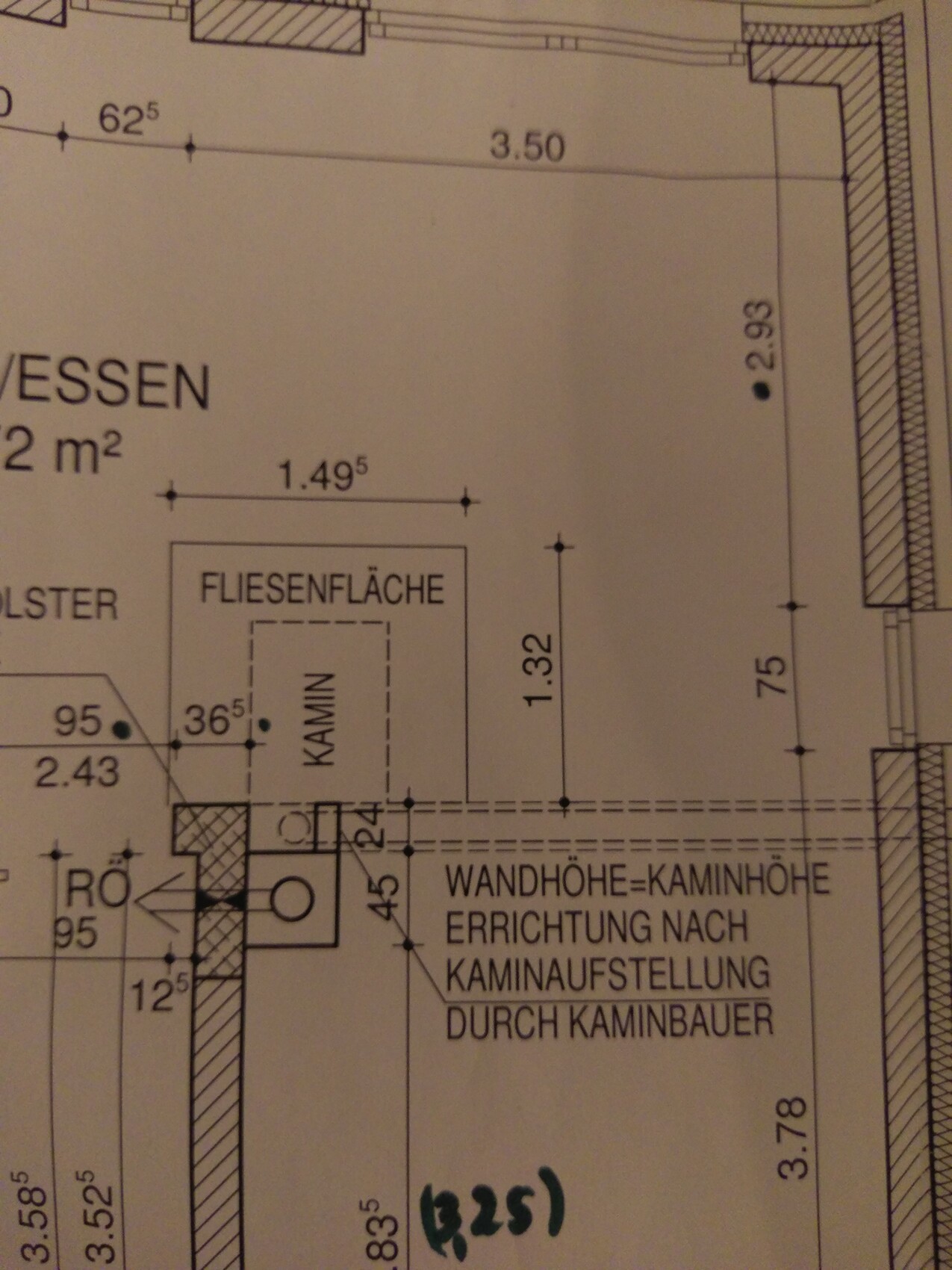
Our fireplace is planned in the center of a room, near the corner of a wall. So it is hardly touching any wall. Behind the fireplace is an air supply duct for the fireplace, and behind that is the chimney. Side clearances for tiles have been planned. I will try to upload a photo excerpt of the ground floor plan. Can someone explain if, in this situation, an additional fireproof partition wall is really necessary or what we should consider?
Thanks in advance for any help.
Best regards,
Paule
I have a question regarding our planned fireplace and the related regulations. Unfortunately, reading through the various requirements has not made things any clearer. We purchased a fireplace from Hark, model "mamorkamin 1/222.0," about six months ago (before construction started), based on our floor plan designs. We were only told that our electrician needs to install a cable to the range hood. The installation would be handled by the seller. They also said that, with our floor plan, the location of the fireplace would not be a problem.
Now that the shell of the building is complete, and we are about to begin electrical, plumbing, and underfloor heating work, the fireplace supplier is talking about a partition wall behind the fireplace. They want to know who will build it. Nothing about this was mentioned in the past six months. Of course, we received this email just before the end of their working day, so we couldn’t ask for clarification today about what exactly is meant.
Our fireplace is planned in the center of a room, near the corner of a wall. So it is hardly touching any wall. Behind the fireplace is an air supply duct for the fireplace, and behind that is the chimney. Side clearances for tiles have been planned. I will try to upload a photo excerpt of the ground floor plan. Can someone explain if, in this situation, an additional fireproof partition wall is really necessary or what we should consider?
Thanks in advance for any help.
Best regards,
Paule
P
PaulohnePlan5 Feb 2019 22:41Hope this is enough
P
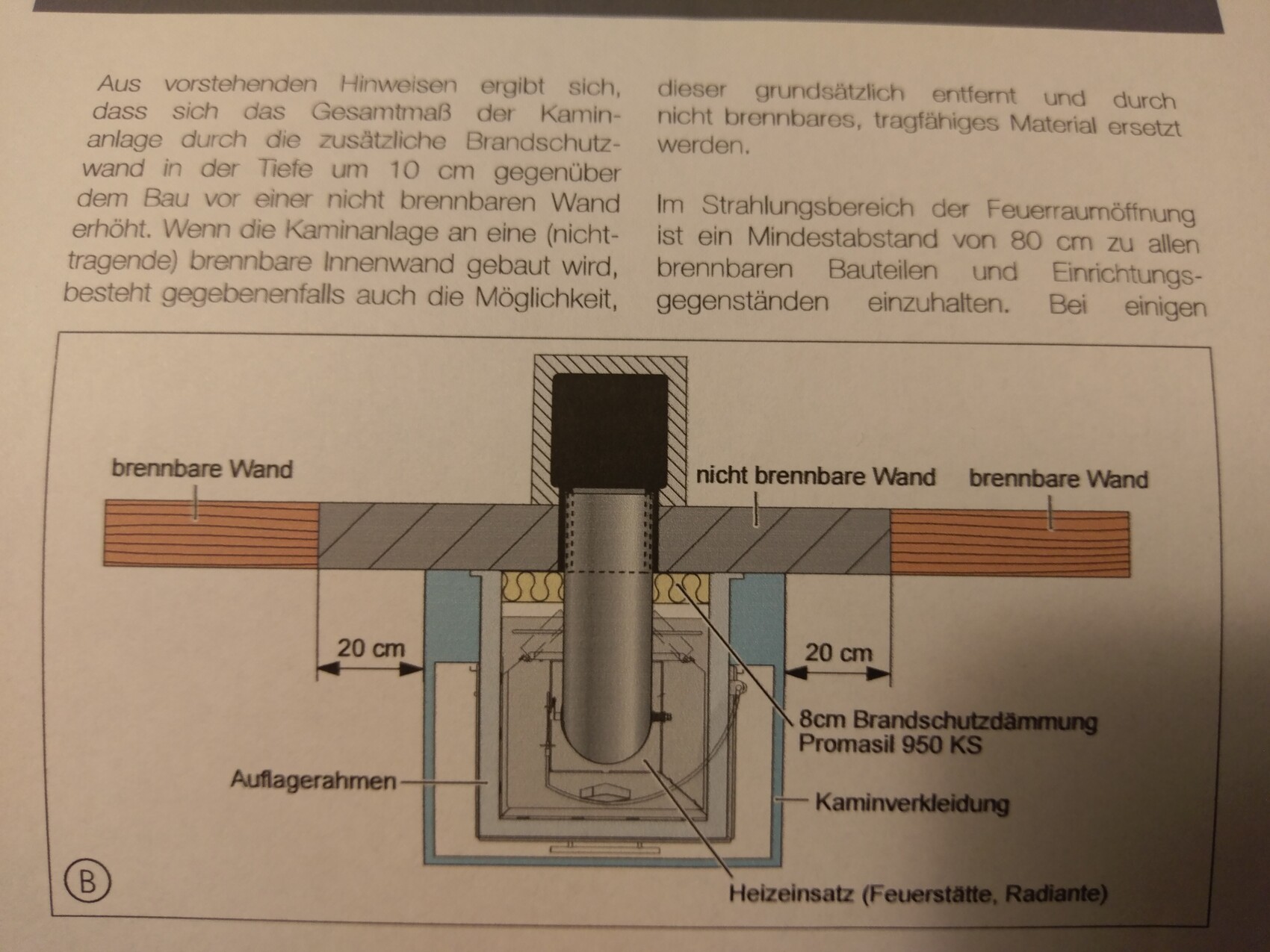
PaulohnePlan5 Feb 2019 22:46The chimney sweep came by once and inspected the shell construction and the chimney. It was already clear where the air supply is, and the inspection was approved without any issues. I will visit the stove installer tomorrow to ask about it anyway. After that, the chimney sweep will probably hear from us again. It’s really frustrating because, if it had been necessary, a wall like this could have been planned and built over the past few months.
P
PaulohnePlan10 Feb 2019 19:40We spoke with two different fireplace installers about two main issues. First, the cladding of the fireplace’s back wall, and primarily its structural stability. The fireplace has a so-called cantilever support, but it cannot fully bear the weight of the upper part of the fireplace. The cantilever is attached to the base plate on the back of the fireplace and pulls it downward. The now additionally required and commissioned 10 cm (4 inches) thick wall (same width and height as the fireplace) will be connected to the room wall. Additionally, the fireplace will be anchored in this new wall. This is based on experience from recent fireplace installations. A smaller cantilever would have been sufficient, but due to the design of our fireplace, the extra reinforcement is necessary. If the cantilever had been enough, we could have alternatively used a 4 cm (1.5 inches) thick fire-resistant Promat cladding. In the end, the price was still reasonable, but it’s a shame this was only noticed so late. I just wanted to share this answer since you all always help with tips and advice.
Regards
Paule
Regards
Paule
Hello Paule,
thank you for your post. It really helps us a lot with the planning! Do you have any issues concerning room air independence / ventilation system / extractor hood? I’m curious about that. Here, everyone says something different. Sometimes a pipe for outside air is needed from the floor, other times the indoor air is sufficient.
Thank you very much
thank you for your post. It really helps us a lot with the planning! Do you have any issues concerning room air independence / ventilation system / extractor hood? I’m curious about that. Here, everyone says something different. Sometimes a pipe for outside air is needed from the floor, other times the indoor air is sufficient.
Thank you very much
N
nordanney27 May 2020 07:35Moriarty schrieb:
Sometimes room air is sufficient.I would dare to doubt that.
Similar topics