
ᐅ Freestanding stove, room air-independent (sealed combustion system)
Created on: 2 Dec 2011 13:56
T
Tatze
Hello stove experts and experienced users,
We are scheduled to start with the foundation slab next week.
A question has come back to our minds that we considered some time ago and now need to clarify before we begin. We want to prepare everything during construction for the later installation of a wood stove. Since we are also installing a ventilation system, the stove must be room-air independent, meaning it should draw fresh air directly from outside rather than from the indoor air.
As far as we know, there are two solutions for this. One option is to install a pipe directly within the foundation slab that connects the stove to the outside. This is the solution for which we need to decide now how to address the “fresh air” question. The second option would be to install a chimney flue with two ducts—one for exhaust air and one for fresh air.
We have already heard some negative comments about both options. For instance, the chimney sweep told us that a pipe in the foundation slab might create a cold spot. On the other hand, some people pointed out that a two-duct chimney might cause problems if, under certain weather conditions, the exhaust air is drawn back inside through the fresh air openings. My father-in-law also suggested (although he is not familiar with the system) that there could be issues with fresh air supply through the chimney itself, as it seems unclear to him why fresh air should “sink” down into the stove. He thinks that might cause difficulties when lighting the fire. Additionally, the supply and exhaust pipe connecting the chimney and stove would have a 90-degree bend sideways in our layout.
To cut a long story short... have you had experience with either system (both positive and negative)? Can you also provide some information about costs? Does the 90-degree bend cause any problems?
Thanks in advance for your responses.
Best regards,
Tatze
We are scheduled to start with the foundation slab next week.
A question has come back to our minds that we considered some time ago and now need to clarify before we begin. We want to prepare everything during construction for the later installation of a wood stove. Since we are also installing a ventilation system, the stove must be room-air independent, meaning it should draw fresh air directly from outside rather than from the indoor air.
As far as we know, there are two solutions for this. One option is to install a pipe directly within the foundation slab that connects the stove to the outside. This is the solution for which we need to decide now how to address the “fresh air” question. The second option would be to install a chimney flue with two ducts—one for exhaust air and one for fresh air.
We have already heard some negative comments about both options. For instance, the chimney sweep told us that a pipe in the foundation slab might create a cold spot. On the other hand, some people pointed out that a two-duct chimney might cause problems if, under certain weather conditions, the exhaust air is drawn back inside through the fresh air openings. My father-in-law also suggested (although he is not familiar with the system) that there could be issues with fresh air supply through the chimney itself, as it seems unclear to him why fresh air should “sink” down into the stove. He thinks that might cause difficulties when lighting the fire. Additionally, the supply and exhaust pipe connecting the chimney and stove would have a 90-degree bend sideways in our layout.
To cut a long story short... have you had experience with either system (both positive and negative)? Can you also provide some information about costs? Does the 90-degree bend cause any problems?
Thanks in advance for your responses.
Best regards,
Tatze
 tecker201015 Aug 2015 20:11
We are currently in the middle of this topic (fireplace, controlled residential ventilation) as well as the preparation and gathering of information.
For example, this is not clear to us. We actually don’t necessarily want to have a pressure switch in the house. Is it generally true that controlled residential ventilation (whether central or decentralized) plus a fireplace (whether room air-dependent or independent) always requires a pressure switch? We thought it mainly depends on the kitchen extractor hood, since these often extract around 600–800 cubic meters per hour (350–470 cubic feet per hour), and since we will be choosing a recirculating hood (and also have a room air-dependent fireplace), in our opinion, a pressure switch is not required.
I am open to clarification, as I naturally only have limited knowledge in this area.
With a room air-dependent fireplace, the issue of cold air sources related to the supply air duct would also not apply.
taxpayer schrieb:
We understand that we won’t be able to avoid a pressure switch, but that’s not the question.
For example, this is not clear to us. We actually don’t necessarily want to have a pressure switch in the house. Is it generally true that controlled residential ventilation (whether central or decentralized) plus a fireplace (whether room air-dependent or independent) always requires a pressure switch? We thought it mainly depends on the kitchen extractor hood, since these often extract around 600–800 cubic meters per hour (350–470 cubic feet per hour), and since we will be choosing a recirculating hood (and also have a room air-dependent fireplace), in our opinion, a pressure switch is not required.
I am open to clarification, as I naturally only have limited knowledge in this area.
With a room air-dependent fireplace, the issue of cold air sources related to the supply air duct would also not apply.
N
nordanney15 Aug 2015 21:23That mainly depends on the chimney technician. Controlled residential ventilation combined with a fireplace almost always requires a pressure sensor. It was the same for us; despite having a recirculation hood and a certified chimney, we still needed the pressure sensor.
S
Sebastian7917 Aug 2015 20:21According to my chimney expert, fresh air supply through the flue is always a bit tricky – first of all, the flue is expensive, and often it doesn’t work that well, depending on the chimney and flue length.
I have an air supply pipe that opens into a small light well – it creates a thermal bridge, but honestly? I don’t care – I’m not going to starve or overheat myself because of that. If needed, you can also install an automatic combustion control that closes the fresh air duct.
Insulating the pipe is only important if it runs through a heated room.
We also have to use pressure monitors – but I don’t find that a problem. It saves you from having to look for and pay for a chimney approved by DIBT.
I have an air supply pipe that opens into a small light well – it creates a thermal bridge, but honestly? I don’t care – I’m not going to starve or overheat myself because of that. If needed, you can also install an automatic combustion control that closes the fresh air duct.
Insulating the pipe is only important if it runs through a heated room.
We also have to use pressure monitors – but I don’t find that a problem. It saves you from having to look for and pay for a chimney approved by DIBT.
M
Mischmasch2 Dec 2015 23:20We are also planning a central ventilation system with heat recovery, as well as a room-air-independent fireplace on the ground floor with supply air in the chimney jacket.
Has anyone had experience with installing a wood-fired sauna in the basement in addition to the above-mentioned system?
My idea is to channel the exhaust air from the wood stove into the same chimney. However, it is most likely that a separate flue will be required. Accordingly, the chimney will be quite large, extending through all three floors. An alternative for me would be to forgo the wood stove and install an electric sauna instead.
Has anyone had experience with installing a wood-fired sauna in the basement in addition to the above-mentioned system?
My idea is to channel the exhaust air from the wood stove into the same chimney. However, it is most likely that a separate flue will be required. Accordingly, the chimney will be quite large, extending through all three floors. An alternative for me would be to forgo the wood stove and install an electric sauna instead.
V
Volker198017 Nov 2016 08:42Hello dear community,
Over the past few months, I have also been dealing with the topic of house construction. We finally moved into the house in late summer. The house is a KfW 70 standard building with a gas condensing boiler and a mechanical ventilation system with heat recovery.
We also decided to install a fireplace. Combustion air supply was routed under the slab using a 200mm (8 inch) PVC pipe. A corresponding shaft was installed on the exterior wall. The fireplace connection is planned for next year.
Due to the weather conditions in recent days, the shaft repeatedly filled with water. The water also flowed into the corresponding fresh air supply pipe. At first, I assumed rain was the cause. However, after removing the water and checking again the next day, I noticed the water level rising again. I realized that the shaft is not sealed at the bottom. I suspect that water is being pushed up from below.
I am now interested in an expert opinion regarding the installation of the fresh air supply pipe before I address the issue with the contractor. How can this problem be resolved? It seems odd to me that the pipe leads outside without a flap or similar, as well as the water issue.
Thank you in advance for your feedback.
I have attached 2 photos.
Best regards
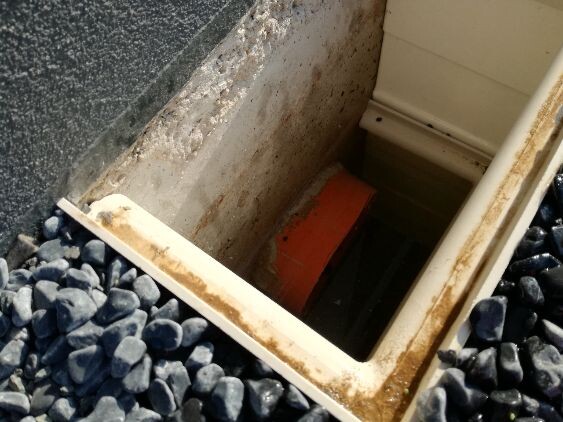
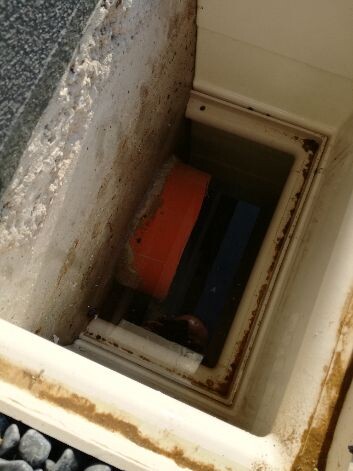
Over the past few months, I have also been dealing with the topic of house construction. We finally moved into the house in late summer. The house is a KfW 70 standard building with a gas condensing boiler and a mechanical ventilation system with heat recovery.
We also decided to install a fireplace. Combustion air supply was routed under the slab using a 200mm (8 inch) PVC pipe. A corresponding shaft was installed on the exterior wall. The fireplace connection is planned for next year.
Due to the weather conditions in recent days, the shaft repeatedly filled with water. The water also flowed into the corresponding fresh air supply pipe. At first, I assumed rain was the cause. However, after removing the water and checking again the next day, I noticed the water level rising again. I realized that the shaft is not sealed at the bottom. I suspect that water is being pushed up from below.
I am now interested in an expert opinion regarding the installation of the fresh air supply pipe before I address the issue with the contractor. How can this problem be resolved? It seems odd to me that the pipe leads outside without a flap or similar, as well as the water issue.
Thank you in advance for your feedback.
I have attached 2 photos.
Best regards

If water pressure comes from below, you need to extend the fresh air intake pipe upward out of the water-prone area using a 90° bend (the length cannot be unlimited; there are restrictions. Consult the chimney sweep).
The cross-section must not be reduced (the shaft will likely have to be modified).
For a separate fresh air intake pipe with a nominal diameter of 100 mm (4 inches), the maximum pipe length is about 3 m (10 feet).
These details must be agreed upon with the local chimney sweep before construction.
The cross-section must not be reduced (the shaft will likely have to be modified).
For a separate fresh air intake pipe with a nominal diameter of 100 mm (4 inches), the maximum pipe length is about 3 m (10 feet).
These details must be agreed upon with the local chimney sweep before construction.
Similar topics