
Hello everyone,
in our newly built house, we have a concrete staircase with glued parquet flooring on top. The edge of the staircase or step follows the shape of the stairs. Adjacent to this, the parquet is installed as a floating floor.
The carpenter has resolved this with a transition strip, which not only looks unattractive but also has sharp edges at the ends, making it dangerous (see photo). Is this correct?
Are there any other possible solutions?
Thank you very much for your help!
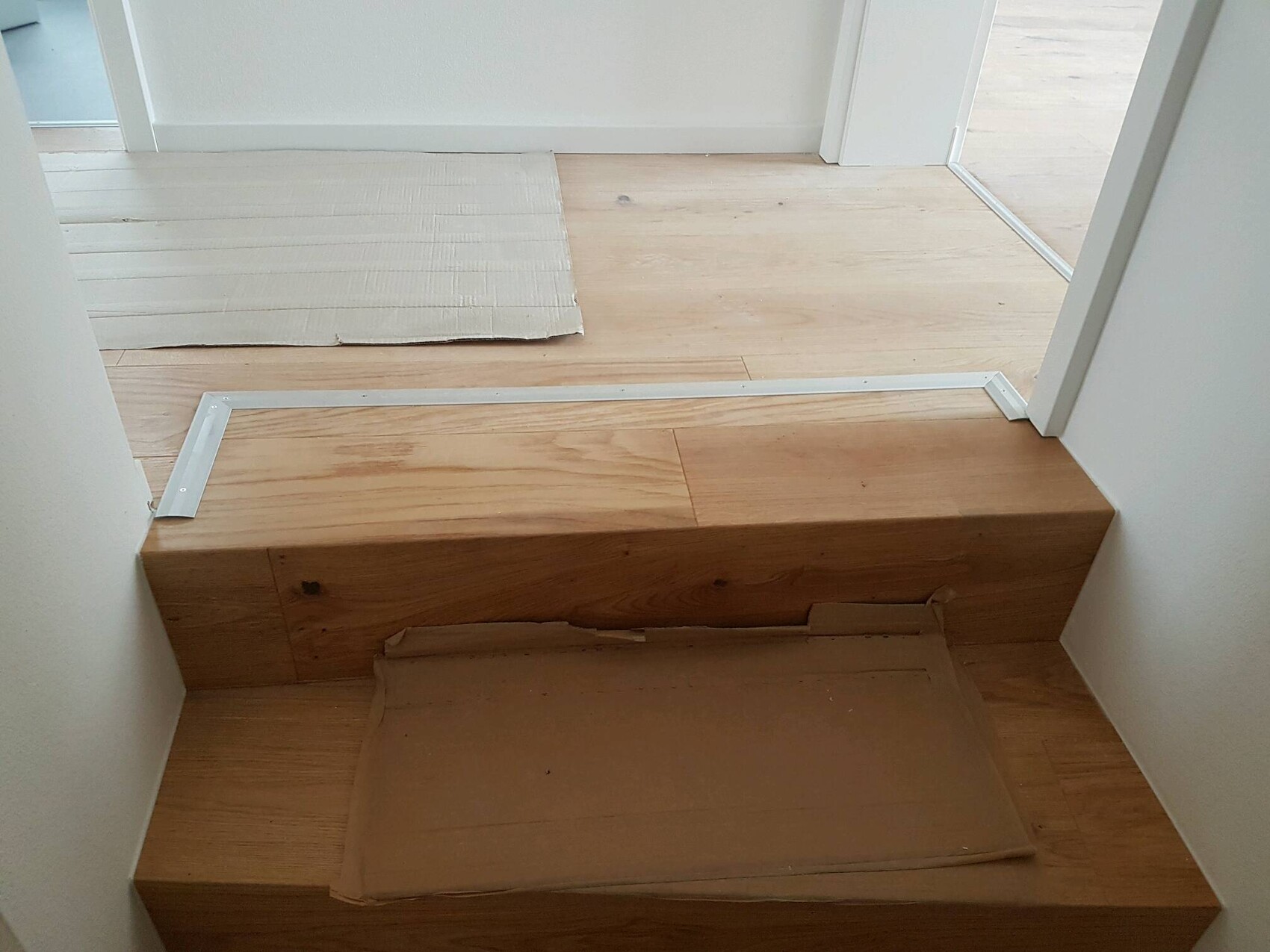
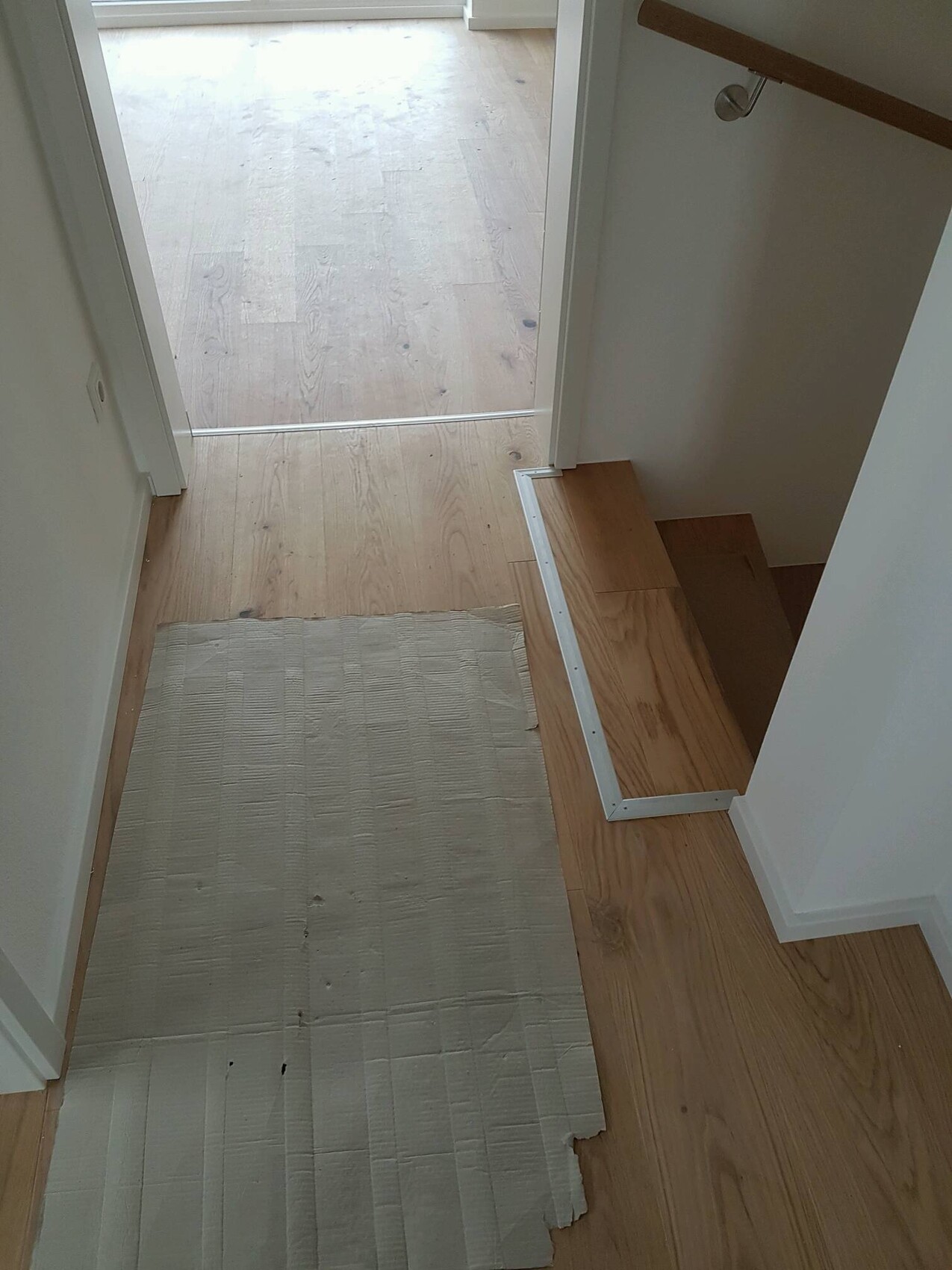
in our newly built house, we have a concrete staircase with glued parquet flooring on top. The edge of the staircase or step follows the shape of the stairs. Adjacent to this, the parquet is installed as a floating floor.
The carpenter has resolved this with a transition strip, which not only looks unattractive but also has sharp edges at the ends, making it dangerous (see photo). Is this correct?
Are there any other possible solutions?
Thank you very much for your help!
C
Christa_7419 Feb 2017 13:46KlaRa schrieb:
I would have recommended to the parquet installer to also glue the parquet near the staircase and to install the transition strip in a straight line running parallel to the staircase.
This could be done with a profile that has a narrower visible flange of only 10mm to 15mm (0.4 to 0.6 inches) width.
In your described case, this can still be done afterwards. It would only require reinstallation of about 2 to 3 m² (22 to 32 sq ft).
--------------------
Best regards, KlaRa Thank you very much for the detailed response!
If we had known it would turn out this way, we would have actually had the small area in the hallway glued as well... unfortunately, we were not informed about this.


Christa_74 schrieb:
And you don’t need this transition strip to compensate for the height difference [...] The parquet is the same, but with the floating installation there is about a 2mm (0.08 inch) thick impact sound insulation underneath... so there actually is a (minimal) height difference. 2mm (0.08 inch) can be managed by planing, milling, etc. It’s cheaper to do it beforehand, but with hard woods it might still be possible now. A transition strip will always add some height.
The issue at points like this is that users instinctively focus their attention on the step edge rather than the technical joint between building components. Approaching from above, any tripping has likely already happened (even before reaching for the handrail). Where planners don’t anticipate, builders have to deal with the consequences.
https://www.instagram.com/11antgmxde/
https://www.linkedin.com/company/bauen-jetzt/
C
Christa_743 Mar 2017 22:37Hello again and many thanks for all your advice!
We have now reached an acceptable solution for us. You just have to wonder: Why wasn’t it done like this from the start?
The hardwood flooring is now almost fully floating up to the edge, and the transition strip is perfectly straight. Visually much better and no longer a safety hazard.
We are satisfied!
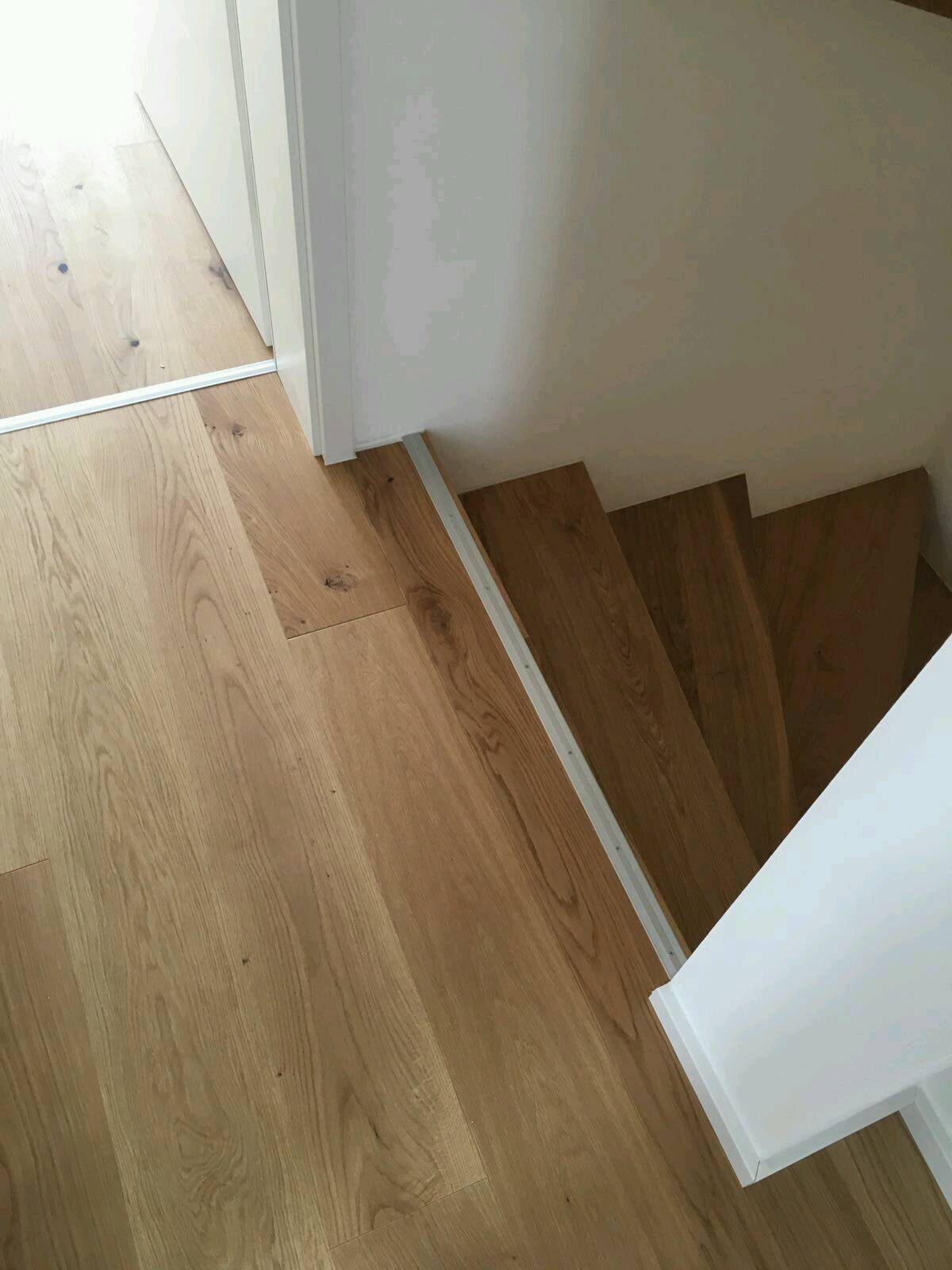
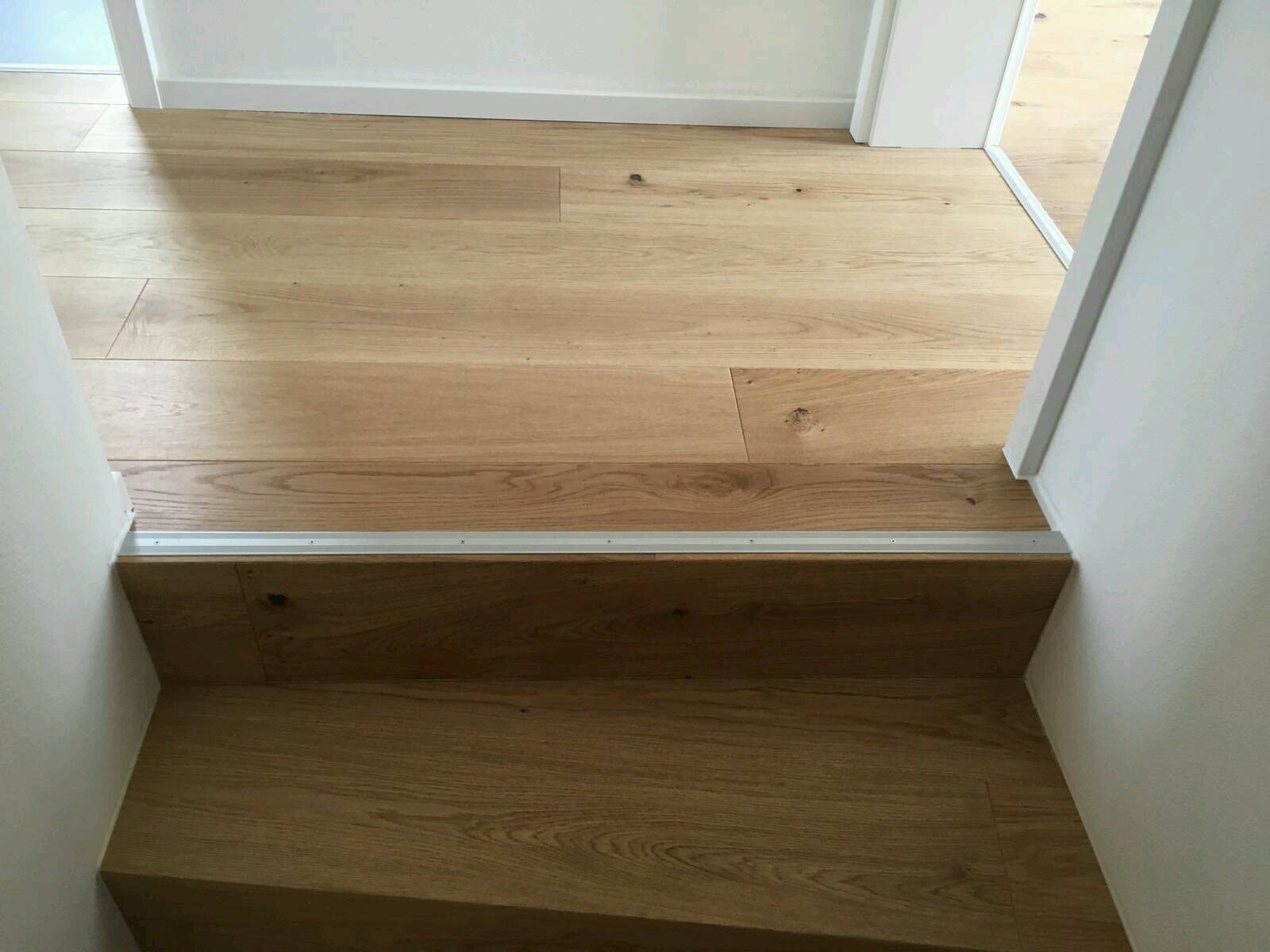
We have now reached an acceptable solution for us. You just have to wonder: Why wasn’t it done like this from the start?
The hardwood flooring is now almost fully floating up to the edge, and the transition strip is perfectly straight. Visually much better and no longer a safety hazard.
We are satisfied!
C
Christa_743 Mar 2017 22:50...and luckily, the ugly hallway that was on the right has also disappeared in this way!
I still don’t consider a transition strip there the ultimate solution. However, it now looks much more harmonious, and if you are satisfied, that is a significant improvement.
https://www.instagram.com/11antgmxde/
https://www.linkedin.com/company/bauen-jetzt/
https://www.instagram.com/11antgmxde/
https://www.linkedin.com/company/bauen-jetzt/