
Hello everyone,
in our newly built house, we have a concrete staircase with glued parquet flooring on top. The edge of the staircase or step follows the shape of the stairs. Adjacent to this, the parquet is installed as a floating floor.
The carpenter has resolved this with a transition strip, which not only looks unattractive but also has sharp edges at the ends, making it dangerous (see photo). Is this correct?
Are there any other possible solutions?
Thank you very much for your help!
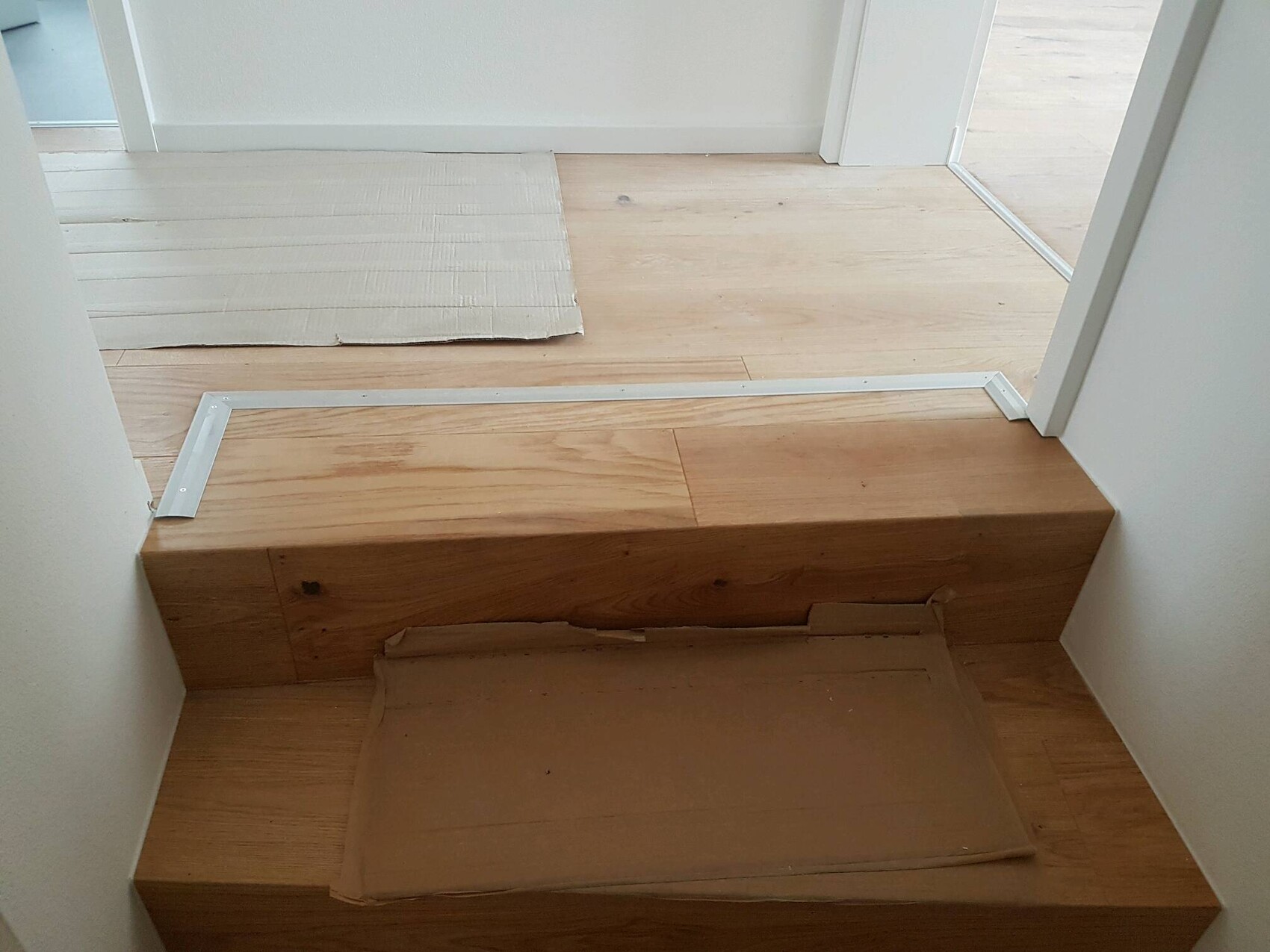
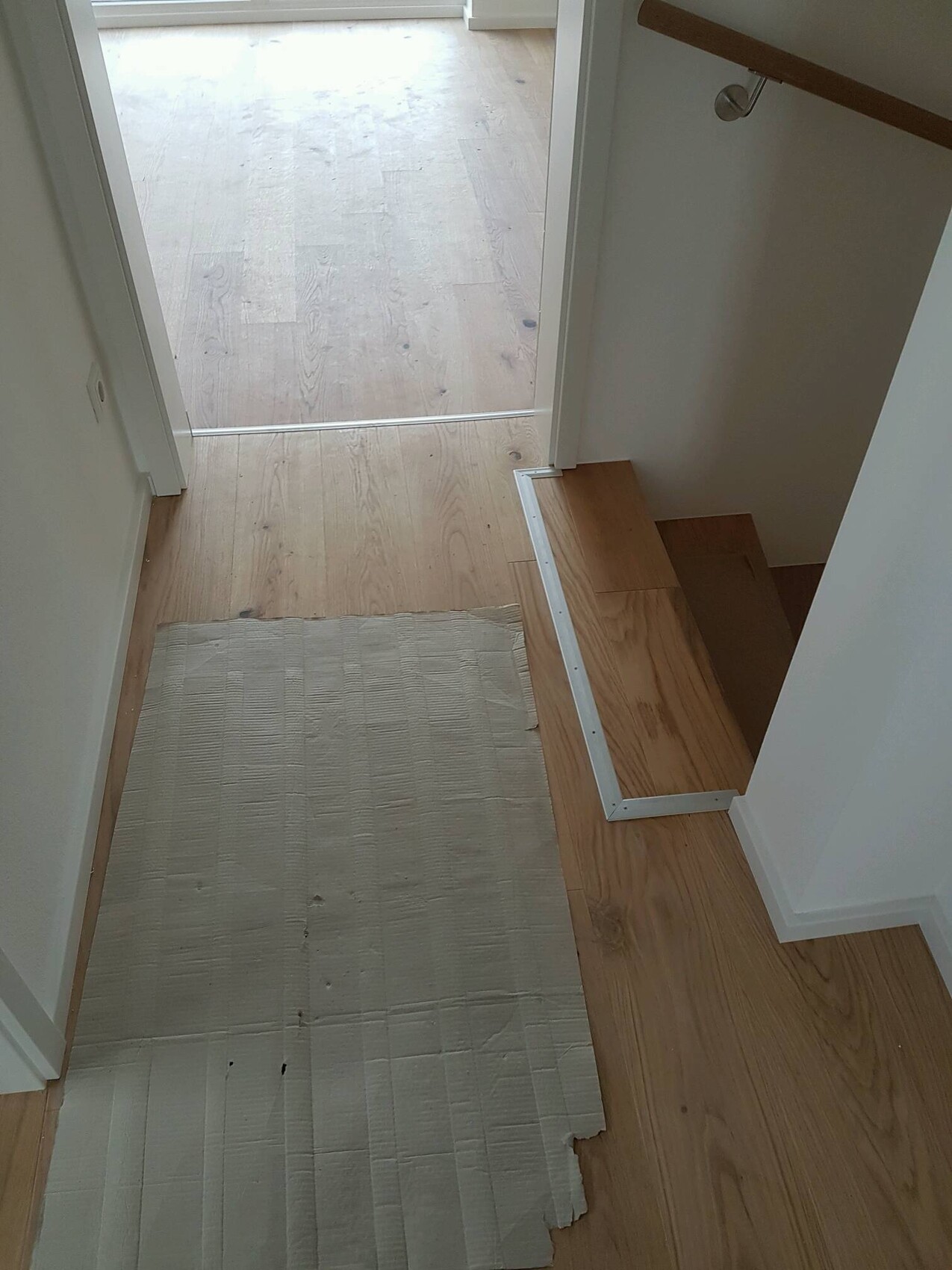
in our newly built house, we have a concrete staircase with glued parquet flooring on top. The edge of the staircase or step follows the shape of the stairs. Adjacent to this, the parquet is installed as a floating floor.
The carpenter has resolved this with a transition strip, which not only looks unattractive but also has sharp edges at the ends, making it dangerous (see photo). Is this correct?
Are there any other possible solutions?
Thank you very much for your help!
C
Christa_7418 Feb 2017 23:0511ant schrieb:
The track is from the horror cabinet and definitely not intended for this purpose. In a commercial building, any safety authority would kick it out immediately. Thank you for your explanations!
The track is a standard transition strip – we also have these between rooms, for example to separate tiles and hardwood flooring, which certainly are not designed to be placed in a U-shape anywhere.
This is how it looked before without the track. Maybe the gap between the stairs and the floor should have been smaller overall?

Christa_74 schrieb:
The strip is just a standard transition stripNo, this is an extremely dangerous trip hazard in this case. At worst, it could cause involuntary manslaughter, since people sometimes go down stairs...
Christa_74 schrieb:
we also use it between rooms, for example to separate tiles and parquet flooring,That is the only proper use for it, and then it would be just a normal transition strip.
Christa_74 schrieb:
This is how it looked before without the strip. Perhaps the gap between the stairs and the floor should have been smaller overall?That was the right approach, just not quite finished – this is explained in post #12.
So: remove the strip, fill the gap with cork or silicone. And: keep the parquet flooring on that level as a floating floor. Even if it doesn’t want payment or vacation: wood expands and contracts!
https://www.instagram.com/11antgmxde/
https://www.linkedin.com/company/bauen-jetzt/
C
Christa_7419 Feb 2017 06:25Many thanks for all your answers and tips!
We will now discuss the cork or silicone solution with the carpenter.
And you don’t actually need this transition strip to level out the height difference (that was the carpenter’s reason for the strip; we had no idea it could be such a tripping hazard, otherwise we would have questioned it right away...)?
The parquet is the same, but the floating installation includes about 2mm (0.08 inches) of impact sound insulation underneath… so there really is a (minimal) height difference.
11ant schrieb:
So: remove the transition strip, insert cork or silicone. And: leave the parquet floating on the floor. Even if it doesn’t ask for payment or vacation: wood expands and contracts!
We will now discuss the cork or silicone solution with the carpenter.
And you don’t actually need this transition strip to level out the height difference (that was the carpenter’s reason for the strip; we had no idea it could be such a tripping hazard, otherwise we would have questioned it right away...)?
The parquet is the same, but the floating installation includes about 2mm (0.08 inches) of impact sound insulation underneath… so there really is a (minimal) height difference.
K
Knallkörper19 Feb 2017 07:53I would install a strip of cork there to fix that. That’s how our expansion joints in the door thresholds are done, and it looks fine.
B
Bieber081519 Feb 2017 13:01Christa_74 schrieb:
Is the floor glued down or installed as a floating floor? In our case, it is glued down; both the wooden stair treads and the floor on the heated screed are glued. We don’t have hardwood flooring but cork instead. Your hardwood flooring looks really nice, I like it!

Hello "Christa_74".
Visually, this is not well executed, but technically, this or a similar solution was necessary. The problem is that a glued hardwood floor, which forms a strong bond with the subfloor, meets a loosely laid (floating) wooden structure. It is simply unavoidable here that the hardwood floor tends to change in length and develop edge cupping due to moisture absorption or loss.
To counteract this, the edges of the hardwood floor on the floating construction must be kept at the same height to prevent tripping hazards or chipping at the edges of the flooring.
As a floorer, I would have recommended gluing the hardwood floor near the staircase as well and installing the transition profile straight (running parallel to the staircase).
By the way, this could be done with a profile that has a narrower (visible) flange only 10mm to 15mm (about 0.4 to 0.6 inches) wide.
In your described case, this can still be done afterward. It would only require reinstallation of about 2-3 m² (22-32 sq ft).
Regards, KlaRa
Visually, this is not well executed, but technically, this or a similar solution was necessary. The problem is that a glued hardwood floor, which forms a strong bond with the subfloor, meets a loosely laid (floating) wooden structure. It is simply unavoidable here that the hardwood floor tends to change in length and develop edge cupping due to moisture absorption or loss.
To counteract this, the edges of the hardwood floor on the floating construction must be kept at the same height to prevent tripping hazards or chipping at the edges of the flooring.
As a floorer, I would have recommended gluing the hardwood floor near the staircase as well and installing the transition profile straight (running parallel to the staircase).
By the way, this could be done with a profile that has a narrower (visible) flange only 10mm to 15mm (about 0.4 to 0.6 inches) wide.
In your described case, this can still be done afterward. It would only require reinstallation of about 2-3 m² (22-32 sq ft).
Regards, KlaRa
Similar topics