
Hello everyone,
in our newly built house, we have a concrete staircase with glued parquet flooring on top. The edge of the staircase or step follows the shape of the stairs. Adjacent to this, the parquet is installed as a floating floor.
The carpenter has resolved this with a transition strip, which not only looks unattractive but also has sharp edges at the ends, making it dangerous (see photo). Is this correct?
Are there any other possible solutions?
Thank you very much for your help!
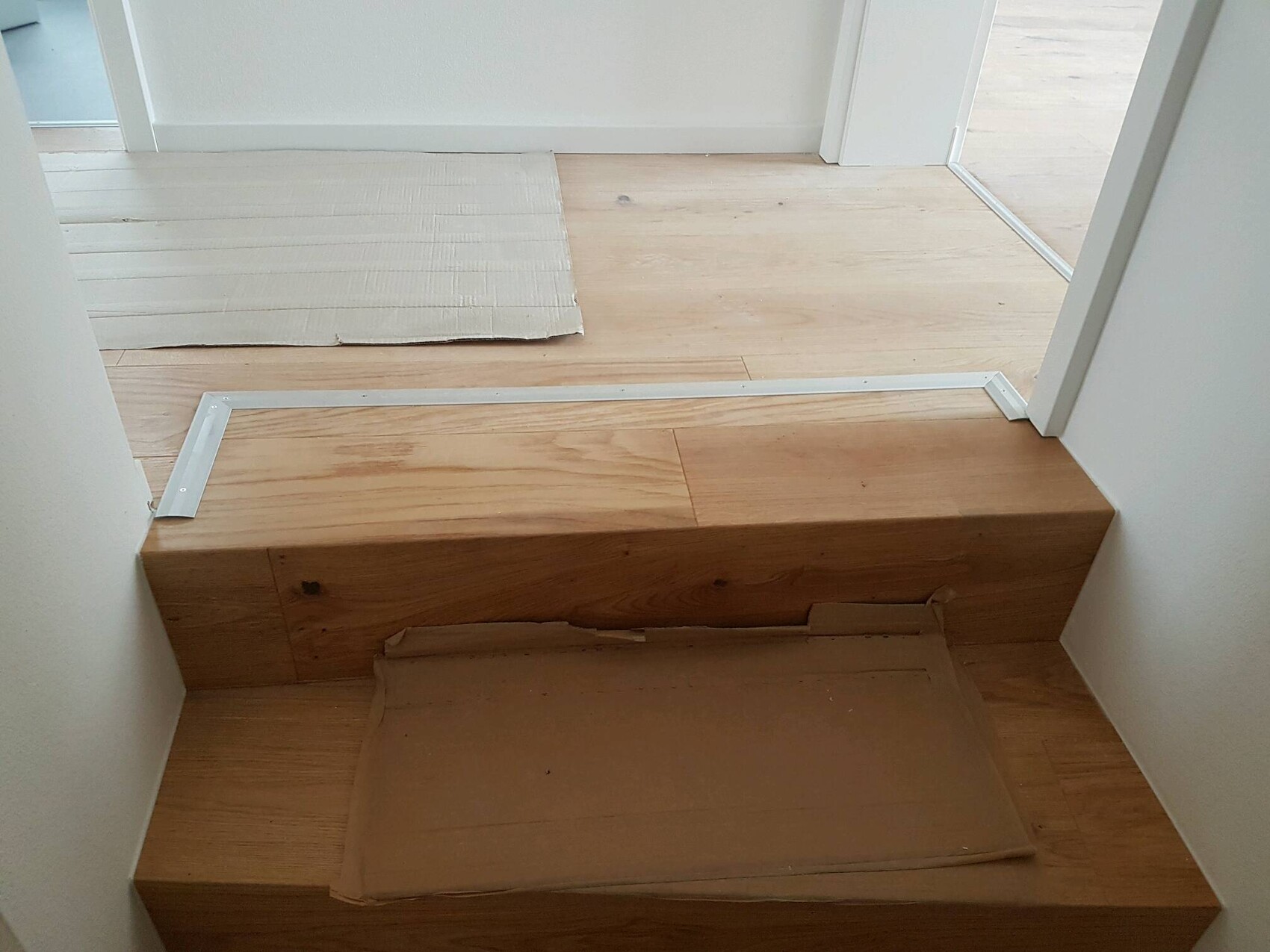
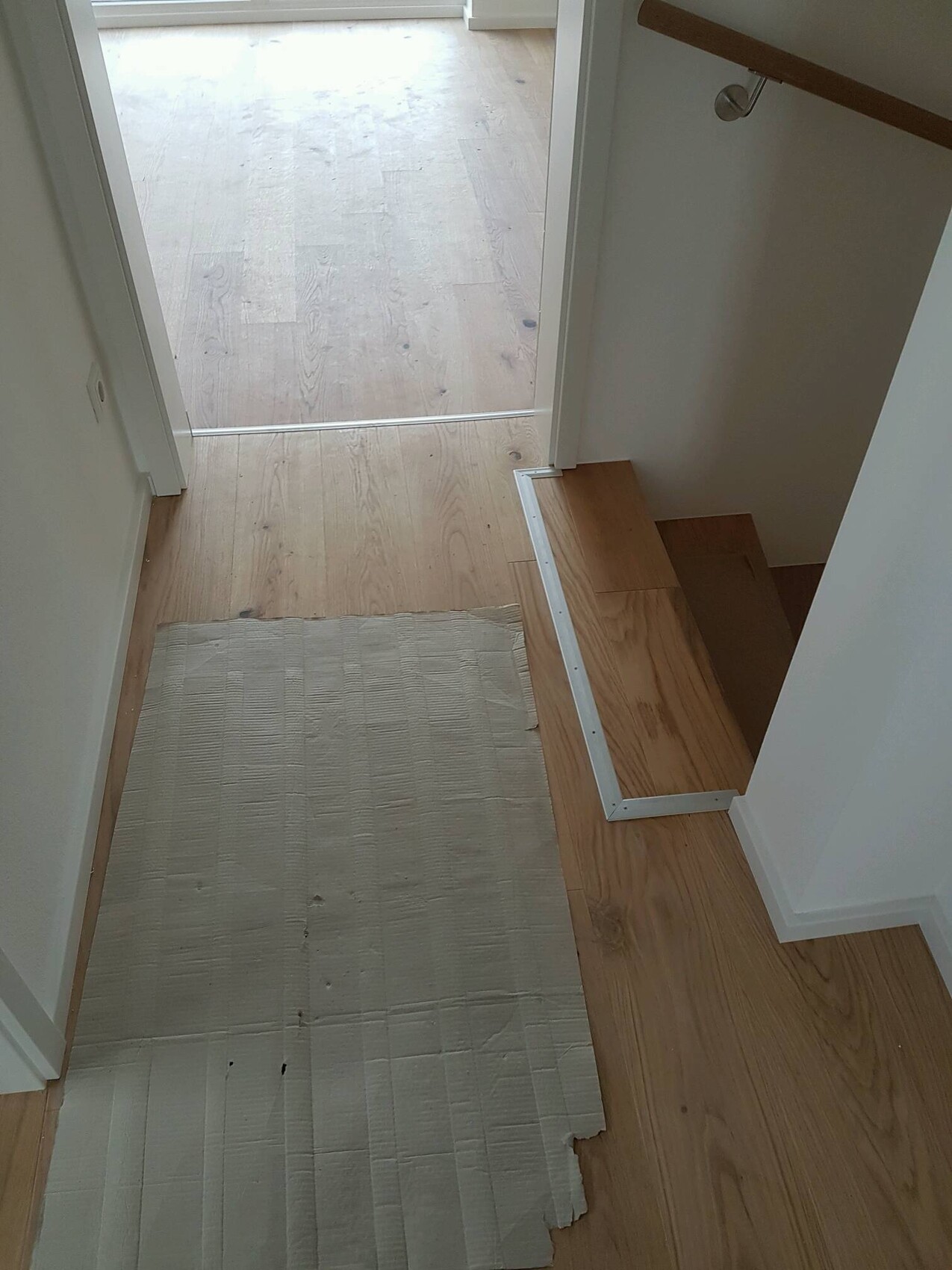
in our newly built house, we have a concrete staircase with glued parquet flooring on top. The edge of the staircase or step follows the shape of the stairs. Adjacent to this, the parquet is installed as a floating floor.
The carpenter has resolved this with a transition strip, which not only looks unattractive but also has sharp edges at the ends, making it dangerous (see photo). Is this correct?
Are there any other possible solutions?
Thank you very much for your help!
Oh, that doesn’t look very good.
Shouldn’t the parquet have been continued from the step? Of course, taking the expansion joint into account, but it could definitely have been done better. I also find the choice of the parquet piece on the right side of the staircase to be aesthetically unappealing.
Regards, Yvonne
Shouldn’t the parquet have been continued from the step? Of course, taking the expansion joint into account, but it could definitely have been done better. I also find the choice of the parquet piece on the right side of the staircase to be aesthetically unappealing.
Regards, Yvonne
C
Christa_7418 Feb 2017 20:29RobsonMKK schrieb:
But I think the bonding can definitely be done afterwards.That might be the solution... Is it possible to bond them later even if the doors are already installed? Baseboards should be relatively easy to remove again, right?C
Christa_7418 Feb 2017 20:35ypg schrieb:
Oh, that doesn’t look very nice.
Shouldn’t the parquet flooring have been carried through from the step? Of course, taking the expansion joint into account, but it could definitely have been done better. I also don’t find the choice of the right parquet piece on the stairs aesthetically pleasing.
Regards, YvonneThe joint of the stairs is located under the rail. Unfortunately, I’m not sure if the stair tread necessarily has to end there. A straight rail as a finish wouldn’t have bothered us at all, but like this…
And yes, the right plank isn’t particularly attractive :-(. But we could have lived with that.
B
Bieber081518 Feb 2017 21:44In our case, the expansion joint between the staircase and the floor (cork in this area) is filled with colored silicone. This means that on the floor side, a metal profile finishes the edge (a narrow strip is visible from above), then there is a small gap, followed by the stair tread. Silicone fills the gap. Alternatively, a cork strip can be installed.
C
Christa_7418 Feb 2017 22:15Bieber0815 schrieb:
In our case, the expansion joint between the staircase and the floor (which is cork here) is filled with colored silicone. This means that on the floor side, there is a metal profile finishing the edge (a narrow strip is visible from above), then there is a tiny gap followed by the stair tread. Silicone fills the gap. Alternatively, you can insert a cork strip. That would definitely be much more compatible. Thanks for the tip!
Is the floor glued down or installed as a floating floor?

The staircase is made of concrete, a separate structural element, especially since it connects two floors. An expansion joint makes sense in this case. It is also logical to glue onto it without bridging the expansion joint. Installing the parquet flooring in the living areas as a floating floor is, in my opinion, the proper method and the one I would prefer. The profile is outdated and definitely not intended for this purpose. In a commercial building, any safety inspector would immediately reject it.
Otherwise, I simply agree with the statements made by ypg (#9) and Bieber0815 (#12) instead of repeating them here.
https://www.instagram.com/11antgmxde/
https://www.linkedin.com/company/bauen-jetzt/
Otherwise, I simply agree with the statements made by ypg (#9) and Bieber0815 (#12) instead of repeating them here.
https://www.instagram.com/11antgmxde/
https://www.linkedin.com/company/bauen-jetzt/
Similar topics