
ᐅ Fiber optic connection is being installed – should the existing multi-utility conduit be used?
Created on: 9 May 2022 16:39
V
Vrumfondel
Hello everyone,
Our village will be connected with fiber optic this year, and I’m wondering where the cable should best enter our house.
To explain: on the left side of the house, there is directly the street (a 40cm (16 inches) splash protection strip, edged with concreted curbs, then a 1-meter (39 inches) gravel road surface, followed by the single-lane street). At the bottom side is the paved driveway/parking space.
According to the fiber provider, the connection should be done as follows:
House connections are very often installed using a so-called no-dig method, so that no trenching is necessary. This means that an underground drilling machine or a directional boring (mole or flush pipe) is used to “shoot” or drill under the ground to the house in order to lay an empty conduit. This only requires two access pits: one at the street to connect the house connection to the main line and one directly at the house. If this trenchless method is not possible, in rare cases open trenching is used. All work is done at a depth of about 60cm (24 inches). Later, the fiber cable is blown into this empty conduit in a separate step.
No worries! The front garden or paved driveway usually will not be affected. If they are, everything will be restored to its original condition.
In the basement or ground floor, a small hole will be drilled through the outer wall so the fiber cable can enter the house interior. This hole will be properly sealed.
From initial reports in neighboring villages, it seems more likely that the construction workers arrive suddenly and never use directional boring ;-)
So here’s my consideration:
Can or may the workers use the still unused element of the multi-utility house entry point? Since that is the standard way to get utility lines into the house, that would seem obvious, right?
Alternatively, they could drill directly from the street side, above the sink on the bottom wall — as long as they manage it precisely enough not to hit any water pipes :-8
In the technical room, both positions would be fine for us. On the bottom wall there are the multi-utility box, water meter, armored box, and telephone connection installed. So there is still plenty of space for the house transfer point and network termination device—assuming the fiber provider has no further requirements regarding the distance to these installations.
What are the pros and cons of each option?
Thank you very much!
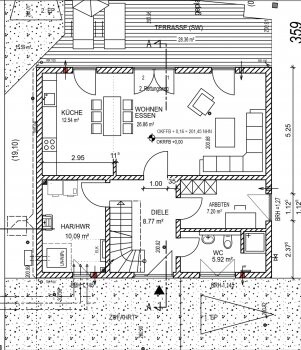
Our village will be connected with fiber optic this year, and I’m wondering where the cable should best enter our house.
To explain: on the left side of the house, there is directly the street (a 40cm (16 inches) splash protection strip, edged with concreted curbs, then a 1-meter (39 inches) gravel road surface, followed by the single-lane street). At the bottom side is the paved driveway/parking space.
According to the fiber provider, the connection should be done as follows:
House connections are very often installed using a so-called no-dig method, so that no trenching is necessary. This means that an underground drilling machine or a directional boring (mole or flush pipe) is used to “shoot” or drill under the ground to the house in order to lay an empty conduit. This only requires two access pits: one at the street to connect the house connection to the main line and one directly at the house. If this trenchless method is not possible, in rare cases open trenching is used. All work is done at a depth of about 60cm (24 inches). Later, the fiber cable is blown into this empty conduit in a separate step.
No worries! The front garden or paved driveway usually will not be affected. If they are, everything will be restored to its original condition.
In the basement or ground floor, a small hole will be drilled through the outer wall so the fiber cable can enter the house interior. This hole will be properly sealed.
From initial reports in neighboring villages, it seems more likely that the construction workers arrive suddenly and never use directional boring ;-)
So here’s my consideration:
Can or may the workers use the still unused element of the multi-utility house entry point? Since that is the standard way to get utility lines into the house, that would seem obvious, right?
Alternatively, they could drill directly from the street side, above the sink on the bottom wall — as long as they manage it precisely enough not to hit any water pipes :-8
In the technical room, both positions would be fine for us. On the bottom wall there are the multi-utility box, water meter, armored box, and telephone connection installed. So there is still plenty of space for the house transfer point and network termination device—assuming the fiber provider has no further requirements regarding the distance to these installations.
What are the pros and cons of each option?
Thank you very much!
M
motorradsilke10 Aug 2022 08:59Neubau2022 schrieb:
That’s the question. For us, the telecommunications, electricity, and sewage/water connections run from the start of the property to the house. Now, electrical cables still need to be laid for the gate and the wicket gate. How is the landscaping contractor (who does the digging; the electrician lays the cables) supposed to know where which cables have been installed? Sewage and water shouldn’t be a problem since they are installed deeper underground. But the electricity and telecom cables… Is there a drawing available showing where each cable has been laid?I made notes about this during the construction phase. There should always be a warning tape (I can’t quite remember the name right now, one of those yellow or red-and-white plastic tapes) placed above underground electrical cables at the required distance.
Yes, normally they use a slightly thicker plastic tape.
The tradespeople on our site took photos, and I believe the electrical and cabling specialists also made drawings (but did not provide copies). In some cases, you can also request utility route information somewhere. However, I am not sure if this includes private property.
I also took photos.
The tradespeople on our site took photos, and I believe the electrical and cabling specialists also made drawings (but did not provide copies). In some cases, you can also request utility route information somewhere. However, I am not sure if this includes private property.
I also took photos.
D
DaGoodness10 Aug 2022 09:27I took a lot of photos at the time when the pipes were being installed through the multi-duct into the house. When the fiber optic cable was added later, I was able to show the workers the photos right away and say, "You need to dig here to find the empty conduit." It wasn’t a problem at all. They were also glad they could go through the multi-duct, as it meant less work for them.

It was the same for me. When laying the main power connection, I had an empty conduit installed alongside the power cable in the trench.
The fiber optic cable ran along the property boundary parallel to the power cable. This made it easy for the fiber installation team. They could dig with a spade and reached my empty conduit within three minutes. It then led directly to the multi-service entry point.
Blowing in the cable took less than five minutes. Everyone was happy that it went so quickly and without complications. The subcontractor made some quick money this time.
However, at my neighbor’s place, they actually cut through the main power line. That’s how things can go sometimes... 😳
The fiber optic cable ran along the property boundary parallel to the power cable. This made it easy for the fiber installation team. They could dig with a spade and reached my empty conduit within three minutes. It then led directly to the multi-service entry point.
Blowing in the cable took less than five minutes. Everyone was happy that it went so quickly and without complications. The subcontractor made some quick money this time.
However, at my neighbor’s place, they actually cut through the main power line. That’s how things can go sometimes... 😳
V
Vrumfondel10 Aug 2022 11:52I think the decision will be made on site when standing with the contractors. If the reaction from the craftsmen to the proposal of running a multi-duct system does not feel like "no problem, we’ve done this on the last 20 houses too, we know what we’re doing," then I will skip it and rather have them drill and install it the way they do with all other houses.
What use is it to me if it’s actually not difficult to use and seal the multi-duct system, but the contractors don’t do it often and therefore lack routine? After all, I want a sealed entry into the house, not to have to win a court case later like “the contractors should have known how to do it, so now they have to fix it.”
A brief side note: Fiber optic installation is carried out by a local provider. The DG company also started marketing three years ago but then withdrew (that’s a whole different story). I think the subcontractors executing the installation probably don’t differ much in quality, but I still feel that with such a small provider, there is not much expertise for special requests in case of problems. Ultimately, none of the two options (regardless of what we decide) is a disaster for me...
What use is it to me if it’s actually not difficult to use and seal the multi-duct system, but the contractors don’t do it often and therefore lack routine? After all, I want a sealed entry into the house, not to have to win a court case later like “the contractors should have known how to do it, so now they have to fix it.”
A brief side note: Fiber optic installation is carried out by a local provider. The DG company also started marketing three years ago but then withdrew (that’s a whole different story). I think the subcontractors executing the installation probably don’t differ much in quality, but I still feel that with such a small provider, there is not much expertise for special requests in case of problems. Ultimately, none of the two options (regardless of what we decide) is a disaster for me...
M
motorradsilke10 Aug 2022 12:05Tolentino schrieb:
The contractors on our site took photos, and I believe the electricians and cable technicians also made drawings (but didn’t provide copies). In some cases, you can request utility line information somewhere. Although I’m not sure if that covers private property.
At least it does here. We did that before construction for electricity and water since we had purchased the property finished. At least for the water, we then knew they didn’t know where it was on our land 😉. They did know at the neighbor’s place. They had to search for it.
Similar topics