
ᐅ Fiber optic connection is being installed – should the existing multi-utility conduit be used?
Created on: 9 May 2022 16:39
V
Vrumfondel
Hello everyone,
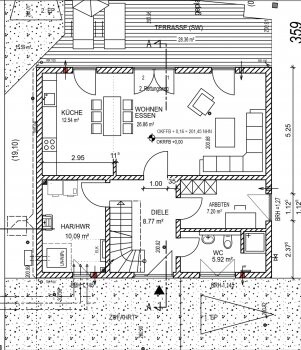
Our village will be connected with fiber optic this year, and I’m wondering where the cable should best enter our house.
To explain: on the left side of the house, there is directly the street (a 40cm (16 inches) splash protection strip, edged with concreted curbs, then a 1-meter (39 inches) gravel road surface, followed by the single-lane street). At the bottom side is the paved driveway/parking space.
According to the fiber provider, the connection should be done as follows:
House connections are very often installed using a so-called no-dig method, so that no trenching is necessary. This means that an underground drilling machine or a directional boring (mole or flush pipe) is used to “shoot” or drill under the ground to the house in order to lay an empty conduit. This only requires two access pits: one at the street to connect the house connection to the main line and one directly at the house. If this trenchless method is not possible, in rare cases open trenching is used. All work is done at a depth of about 60cm (24 inches). Later, the fiber cable is blown into this empty conduit in a separate step.
No worries! The front garden or paved driveway usually will not be affected. If they are, everything will be restored to its original condition.
In the basement or ground floor, a small hole will be drilled through the outer wall so the fiber cable can enter the house interior. This hole will be properly sealed.
From initial reports in neighboring villages, it seems more likely that the construction workers arrive suddenly and never use directional boring ;-)
So here’s my consideration:
Can or may the workers use the still unused element of the multi-utility house entry point? Since that is the standard way to get utility lines into the house, that would seem obvious, right?
Alternatively, they could drill directly from the street side, above the sink on the bottom wall — as long as they manage it precisely enough not to hit any water pipes :-8
In the technical room, both positions would be fine for us. On the bottom wall there are the multi-utility box, water meter, armored box, and telephone connection installed. So there is still plenty of space for the house transfer point and network termination device—assuming the fiber provider has no further requirements regarding the distance to these installations.
What are the pros and cons of each option?
Thank you very much!
Our village will be connected with fiber optic this year, and I’m wondering where the cable should best enter our house.
To explain: on the left side of the house, there is directly the street (a 40cm (16 inches) splash protection strip, edged with concreted curbs, then a 1-meter (39 inches) gravel road surface, followed by the single-lane street). At the bottom side is the paved driveway/parking space.
According to the fiber provider, the connection should be done as follows:
House connections are very often installed using a so-called no-dig method, so that no trenching is necessary. This means that an underground drilling machine or a directional boring (mole or flush pipe) is used to “shoot” or drill under the ground to the house in order to lay an empty conduit. This only requires two access pits: one at the street to connect the house connection to the main line and one directly at the house. If this trenchless method is not possible, in rare cases open trenching is used. All work is done at a depth of about 60cm (24 inches). Later, the fiber cable is blown into this empty conduit in a separate step.
No worries! The front garden or paved driveway usually will not be affected. If they are, everything will be restored to its original condition.
In the basement or ground floor, a small hole will be drilled through the outer wall so the fiber cable can enter the house interior. This hole will be properly sealed.
From initial reports in neighboring villages, it seems more likely that the construction workers arrive suddenly and never use directional boring ;-)
So here’s my consideration:
Can or may the workers use the still unused element of the multi-utility house entry point? Since that is the standard way to get utility lines into the house, that would seem obvious, right?
Alternatively, they could drill directly from the street side, above the sink on the bottom wall — as long as they manage it precisely enough not to hit any water pipes :-8
In the technical room, both positions would be fine for us. On the bottom wall there are the multi-utility box, water meter, armored box, and telephone connection installed. So there is still plenty of space for the house transfer point and network termination device—assuming the fiber provider has no further requirements regarding the distance to these installations.
What are the pros and cons of each option?
Thank you very much!
C
Chris251118 May 2022 14:38Usually, there are overview plans available for something like this. Of course, it’s inconvenient if you have to tear up the finished yard for it.
I had the builder install an additional empty conduit, marked at the kerbstone, which I can access relatively easily.
I had the builder install an additional empty conduit, marked at the kerbstone, which I can access relatively easily.
X
xMisterDx8 Aug 2022 00:2011ant schrieb:
The fiber optic cable is an optical fiber. It does not heat up and does not have any electromagnetic interference with TV or telephone cables made of copper or fiber optic as well. Therefore, I see no reason against having house entries immediately adjacent in the same utility conduit. Correct. However, the multi-utility duct is gas-tight sealed by the energy provider with a closure specifically designed for that cable or pipe. If the fiber optic technicians add a cable there without authorization, you lose any claims against the energy provider if something goes wrong with the multi-utility duct...
Besides that, every multi-utility duct I know of has 4 pipes... electrical, gas, water... telecom...
V
Vrumfondel9 Aug 2022 10:17For clarification: there is no gas line in our house; the multi-utility conduit includes water, electricity, and telecommunications. We have an air-to-water heat pump, so the idea that the free conduit would eventually be used for gas is now more than unrealistic.
But according to several reports from houses already connected, it seems that workers are unlikely or unwilling to run cables through the multi-utility conduit, so it looks like drilling will be necessary in our case as well....
But according to several reports from houses already connected, it seems that workers are unlikely or unwilling to run cables through the multi-utility conduit, so it looks like drilling will be necessary in our case as well....
Vrumfondel schrieb:
To clarify: we do not have gas in the house; the multi-duct contains water, electricity, and telecommunications. We have an air-to-water heat pump, so the idea that the free duct would ever be needed for gas is now more than unrealistic.
However, based on several reports from houses already connected, it seems there really won’t be any workers willing or able to work through the multi-duct, so drilling will probably be necessary for us as well.... My 4 multi-ducts are fully and optimally occupied.
1. Electricity
2. Water
3. Cistern for the domestic water system
4. Telecommunications – both fiber optic and Vodafone cable shared within a single multi-duct.
Of course, they do whatever the builder and client instruct.
M
motorradsilke9 Aug 2022 12:12Vrumfondel schrieb:
To clarify: we don’t have gas in the house. The multi-utility duct contains water, electricity, and telecommunications. Since we have an air-to-water heat pump, it’s now more than unlikely that the spare duct would ever be needed for gas.
However, based on several reports from other connected houses, it seems unlikely that workers will be willing or able to use the multi-utility duct, so they will probably have to drill in our case as well....It’s really up to you to tell them where to go. Ideally, you should already expose the multi-utility connection for them.
Similar topics