
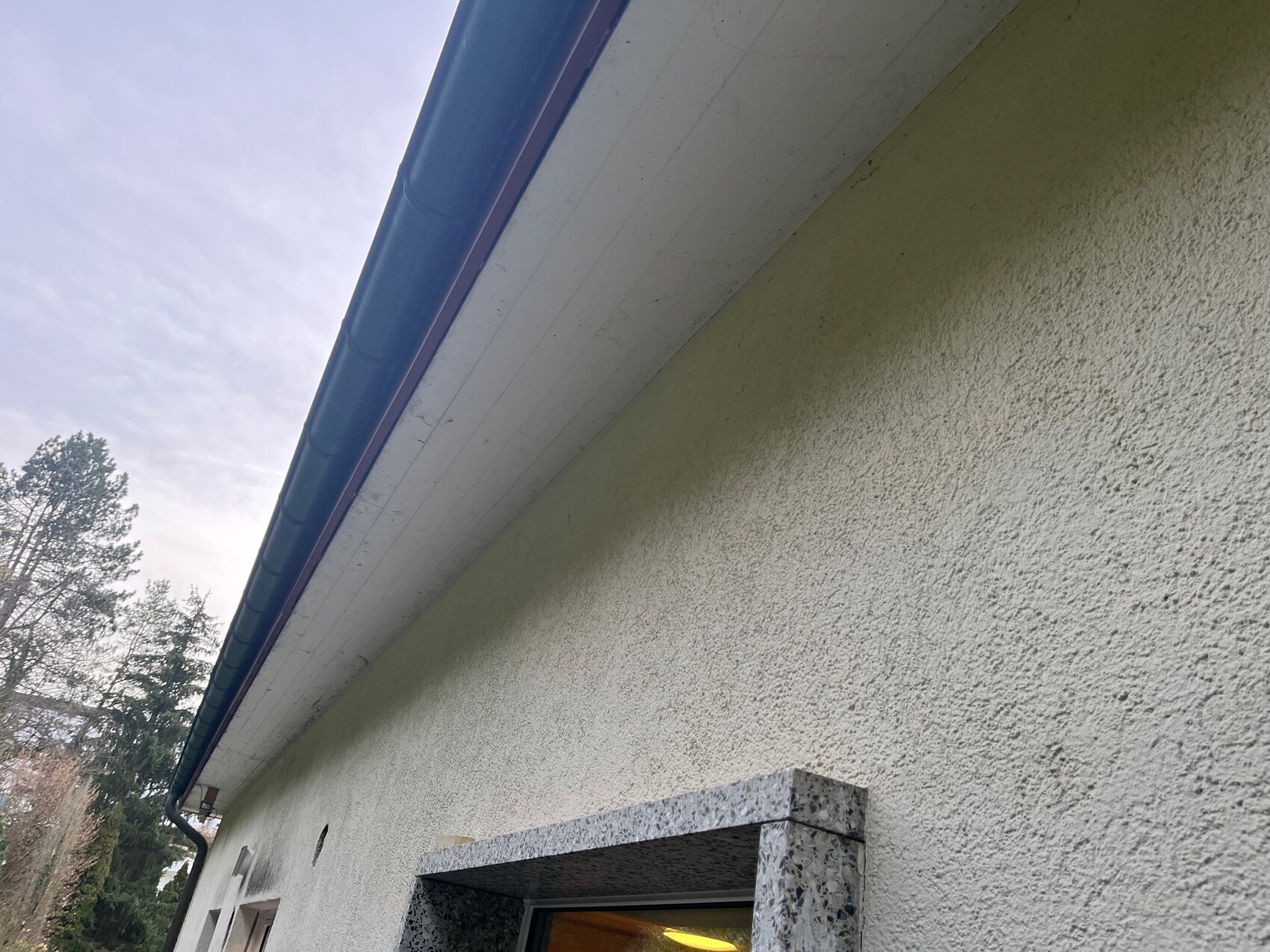
Hello everyone, how should a new ventilated facade with 20 cm (wood fiber, fiber cement panels) be connected to the existing cold roof (hip roof, 11-degree pitch, ventilated) without thermal bridges? I am concerned that the knee wall remains uninsulated, which could lead to mold in the inhabited ground floor below. Is it necessary to remove the eaves? The attic/floor of the old building (1970) was insulated from the inside and is not inhabited (storage room).
Thank you
Thank you

paulch7 schrieb:
It is really hard to find a practical expertI found ours through a homebuyers' protection association website. He was supposed to be local to reduce travel costs.paulch7 schrieb:
I have my doubts about the expertise and practical skills of such people.paulch7 schrieb:
Okay, I’m looking for a building physicist. So my concerns are justified.Yes, all energy consultants are incompetent quacks.
Just the basic training alone—about a 5-year degree in engineering related to construction or energy technology—plus 320 hours of continuing education with further exams and proof of work every 3 years for recertification, as well as mandatory participation in further training to maintain BAFA and KfW listing.
That’s all nonsense. I’d rather listen to anonymous tipsters from this forum who have watched 3 YouTube videos as their only reference.
Joking aside:
Not every energy consultant is equally knowledgeable in all areas. This is due to the wide range of original professions, where further training cannot cover all gaps. The key point is: only those who are truly interested in the topic will go beyond the mandatory (mostly basic) continuing education to educate themselves and dig deeper.
You also need to consider which type of energy consultant you are consulting. I wouldn’t hire a chimney sweep—no matter how good their further training—to plan my curtain wall, but when it comes to heating, they know what they’re doing. Conversely, some architects quickly reach the limit of their knowledge with room-by-room heat load calculations or heating issues in general.
There were also times when “energy consultant certificates” were practically handed out with very few hours of instruction to chimney sweeps and some tradespeople who did not have the necessary basic knowledge of building physics or had only a thin theoretical background. Behind the scenes of the KfW calculation software, little detailed knowledge of construction execution was available, and on-site construction support was not covered. As far as I know, the requirements have since become stricter.
Not every service provider fits your request, and some are simply not “good.” But just because McDonald’s tastes bad, burgers can still be delicious.
paulch7 schrieb:
The carpenter has planned without opening the cornice. This means the exterior insulation and finish system (EIFS) would only extend up to the underside of the roof, and that worries me.As mentioned, it can work depending on the knee wall height, the height of the underside compared to the floor ceiling, and the existing wall construction. The safest option is to go all around, but it might not be necessary or the effort might be too great compared to the benefit.
paulch7 schrieb:
I measured, knee wall about 70 cm (28 inches) high plus insulation, so 85 cm (33 inches) from the concrete floor/ground floor ceiling. So the formwork below the overhang is probably level with the insulation layer.
As an ineffective energy consultant speaking off the cuff, I would suggest extending the insulation on the inside up to the base plates, for example with 10–14 cm (4–6 inches) wood fiber insulation boards with a compressed surface for the floor slab. This saves plastering and is still impact resistant.
On the outside, raise it to roughly the same height, meaning removing the formwork.
B
Buschreiter4 Jan 2023 07:23When searching for an energy (efficiency) consultant, I paid attention to their references, their main area of expertise, how long they had been working in the field, and whether they were a civil engineer. I found this information on the websites or asked directly during the first phone call. Additionally, it was important for me that the consultant was located close to my home. I found a competent contact person who answered my questions patiently and whom I trust. The site visit took about 4 hours, during which it was thoroughly explained why certain measures make sense and others do not (from an economic perspective).
Similar topics