
Hello everyone. We are currently planning our kitchen, and certain points about the range hood keep bothering me. So, I would like to share some information upfront.
We have space for a kitchen run about 4 meters (13 feet) long and an island. The island must not be too large—maximum 140 cm (55 inches) wide. We also want to fit a few bar stools there. We decided to place the cooktop on the long run and use the island purely as a preparation area. With a 90 cm (35 inch) cooktop, there would only be a little space to the right and left, and the small table function, where you might enjoy your coffee, is lost if it’s mostly the cooktop.
Since we have a nearly open living and dining area, the first view from the entrance and throughout the living room is directly onto the long kitchen run, so it should look nice. What bothers me is the interruption of the cabinets by the range hood, and even worse, this chimney pipe. We have very uniform, smooth, straight-edged fronts. So, a hood integrated into the cabinet is an option for us.
Do you have experience with how the white fronts look after several years of use? The cabinets are right next to the exhaust. With a regular angled chimney hood, there is always some space on the right and left next to the adjacent cabinets. I’m also attaching a picture so you can better imagine it.
Oh, and a cooktop-integrated downdraft extractor is not an option because several kitchen consultants have pointed out that their performance cannot match hanging range hoods. Steam naturally rises, and we cook a lot, not just warming water. (No judgment intended here.)
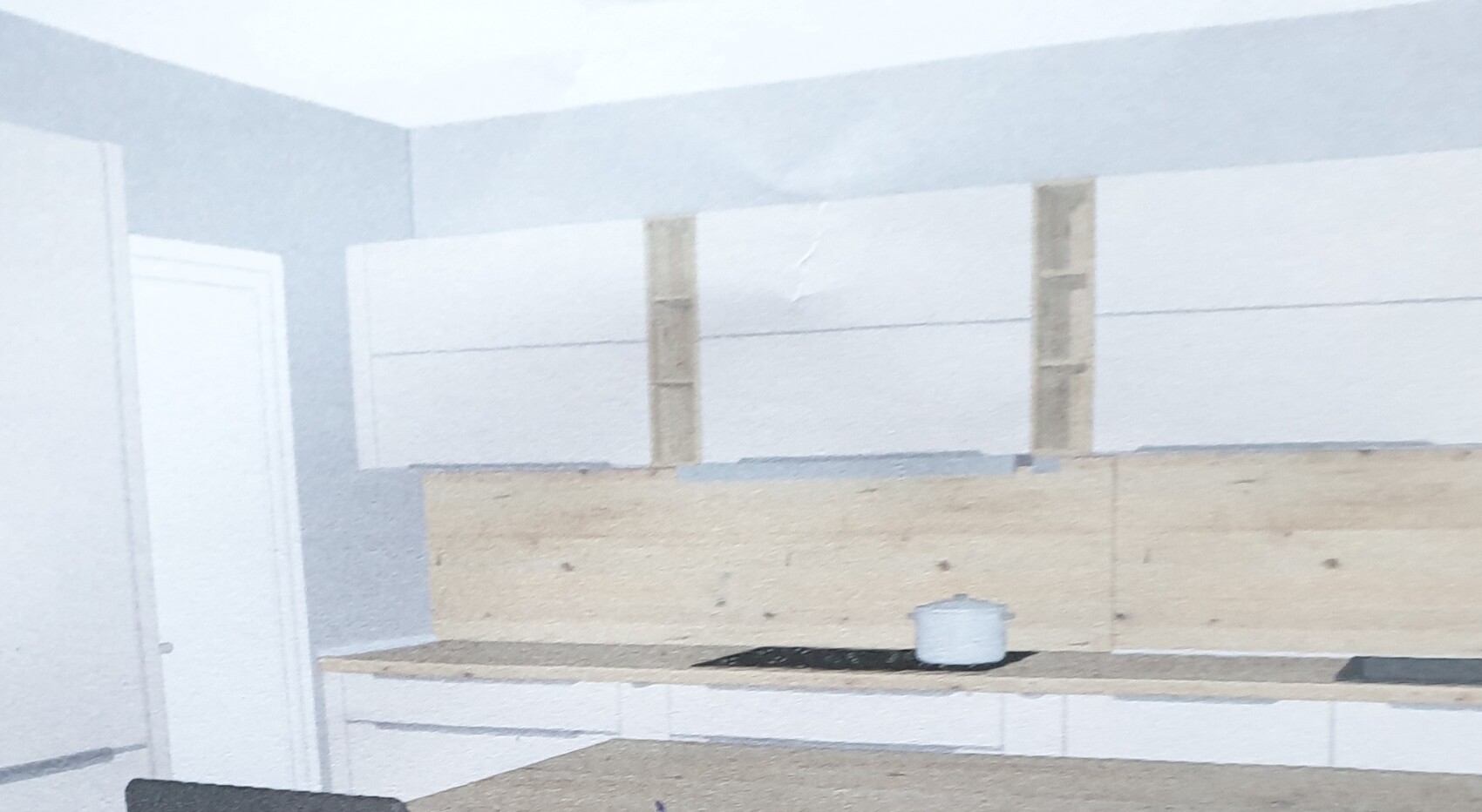
We have space for a kitchen run about 4 meters (13 feet) long and an island. The island must not be too large—maximum 140 cm (55 inches) wide. We also want to fit a few bar stools there. We decided to place the cooktop on the long run and use the island purely as a preparation area. With a 90 cm (35 inch) cooktop, there would only be a little space to the right and left, and the small table function, where you might enjoy your coffee, is lost if it’s mostly the cooktop.
Since we have a nearly open living and dining area, the first view from the entrance and throughout the living room is directly onto the long kitchen run, so it should look nice. What bothers me is the interruption of the cabinets by the range hood, and even worse, this chimney pipe. We have very uniform, smooth, straight-edged fronts. So, a hood integrated into the cabinet is an option for us.
Do you have experience with how the white fronts look after several years of use? The cabinets are right next to the exhaust. With a regular angled chimney hood, there is always some space on the right and left next to the adjacent cabinets. I’m also attaching a picture so you can better imagine it.
Oh, and a cooktop-integrated downdraft extractor is not an option because several kitchen consultants have pointed out that their performance cannot match hanging range hoods. Steam naturally rises, and we cook a lot, not just warming water. (No judgment intended here.)
B
benutzer 10045 Aug 2019 17:42If you are willing to spend some money, there are also ventilation units for the upper cabinets that no longer require a pull-out hood.
You can simply push vigorously boiling pasta toward the back, placing one directly above is also better. But it is probably comparable to ceiling-mounted range hoods.
You can simply push vigorously boiling pasta toward the back, placing one directly above is also better. But it is probably comparable to ceiling-mounted range hoods.
Unfortunately, we were never able to test them and have also considered that it might be a disturbance. Currently, we have one—I’m not sure what it’s called—that is not angled and where you can place oil or something similar on top, and that doesn’t bother us at all. However, it is installed somewhat higher than where the cabinet will be in the future.
Exactly, that was also one of the reasons why I decided against it.
Built-in hoods are installed quite deep, while wall-mounted ones are positioned significantly higher.
Especially if you cook a lot, ergonomics should take priority over appearance, so make sure to see it live again at the kitchen showroom.
Built-in hoods are installed quite deep, while wall-mounted ones are positioned significantly higher.
Especially if you cook a lot, ergonomics should take priority over appearance, so make sure to see it live again at the kitchen showroom.
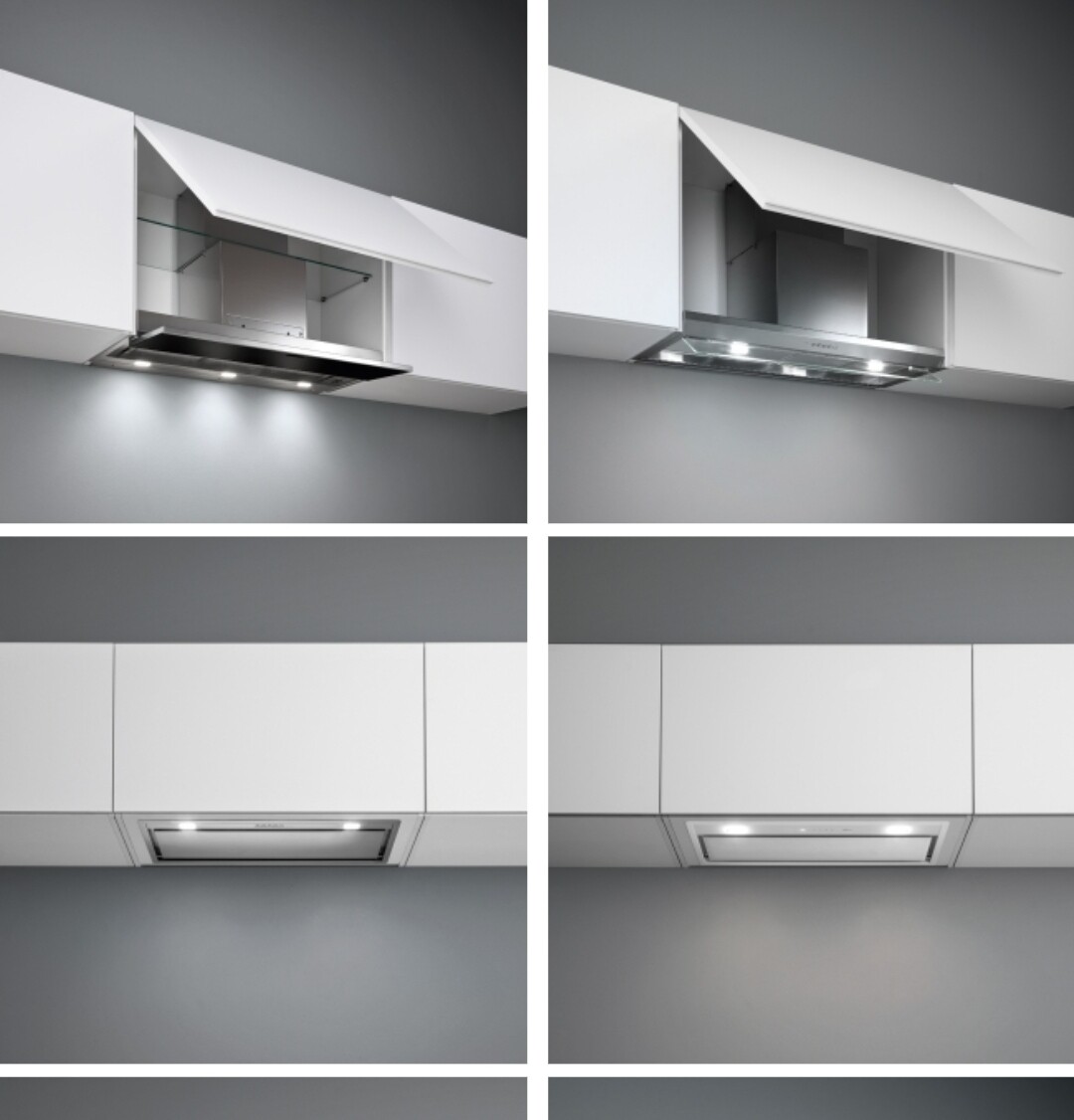
@BigFoot I’ve also looked into the vent blocks but honestly, I’m not quite sure what the exact difference is. I’ve attached a picture. At the moment, we’ve planned with a hood like the one in the top row, and I thought the advantage was that you still have a bit of storage space behind the door for the most commonly used spices while cooking. Because in terms of depth, these blocks are just as deep as a cabinet, right?
B
benutzer 10045 Aug 2019 22:51I’m not a professional either. This is just what I heard from our kitchen planner, who in my opinion knows their stuff: the ventilation modules leave some space in the wall cabinet, sometimes none at all, so you don’t really gain anything. However, your range hoods probably need to be installed a bit forward and/or are not as visually integrated.
It mainly depends on how important function (do I cook once a week for 24 hours to make broth?), appearance (should nothing be visible at all?), and cost are.
At the end of the day, a proper, deep, and wide extractor hood is probably still the best option. But it’s neither headroom-friendly nor visually integrated.
It mainly depends on how important function (do I cook once a week for 24 hours to make broth?), appearance (should nothing be visible at all?), and cost are.
At the end of the day, a proper, deep, and wide extractor hood is probably still the best option. But it’s neither headroom-friendly nor visually integrated.
Similar topics