
Maybe someone here can help us. Thanks in advance.
About a year ago, we bought a house from the mid-1990s, with a ground floor plus an attic featuring a half-hipped roof. It’s located on a quiet suburban street in a small town in the north, generally peaceful except for commuter traffic (sometimes annoying in the mornings) and nightlife traffic (especially on Friday and Saturday nights).
For the building, we have since replaced all windows and doors with triple-glazed units (well, the bathrooms and the utility room still have the original windows and doors). The cavity between the masonry and the brick veneer is now insulated as well. The roof was already insulated with insulation between the rafters.
Unfortunately, engine noise seems to be poorly insulated from reaching the bedrooms in the attic, in my opinion. On the ground floor, the new windows have completely solved this issue.
There are large knee walls at the roof eaves. No additional insulation there besides the existing insulation between the rafters.
How could I find out WHERE the sound enters my attic?
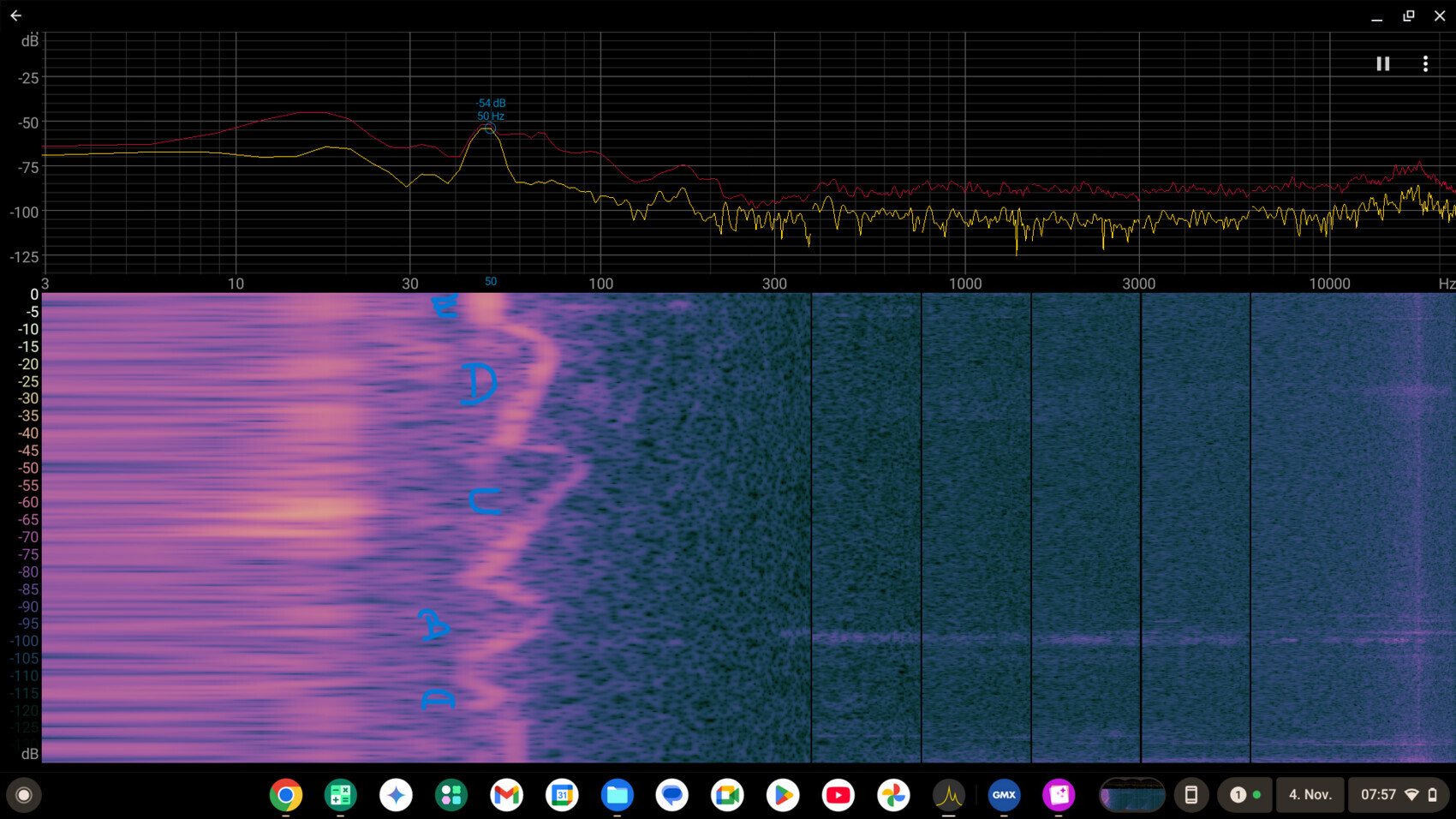
Initial recordings upstairs already show this quite clearly: the car slows down before the intersection (A), then accelerates through the gears (B, C, D) until it finally reaches its normal speed again (E). This pattern occurs with ordinary cars driven normally. No cut-off exhaust pipes, at most high-revving engines, or speeding...
We also removed the existing paneling on the sloped ceiling in the stairwell and were very surprised how large the air gaps towards the knee wall were (we had already suspected something due to the cold interior wall).
About a year ago, we bought a house from the mid-1990s, with a ground floor plus an attic featuring a half-hipped roof. It’s located on a quiet suburban street in a small town in the north, generally peaceful except for commuter traffic (sometimes annoying in the mornings) and nightlife traffic (especially on Friday and Saturday nights).
For the building, we have since replaced all windows and doors with triple-glazed units (well, the bathrooms and the utility room still have the original windows and doors). The cavity between the masonry and the brick veneer is now insulated as well. The roof was already insulated with insulation between the rafters.
Unfortunately, engine noise seems to be poorly insulated from reaching the bedrooms in the attic, in my opinion. On the ground floor, the new windows have completely solved this issue.
There are large knee walls at the roof eaves. No additional insulation there besides the existing insulation between the rafters.
How could I find out WHERE the sound enters my attic?
Initial recordings upstairs already show this quite clearly: the car slows down before the intersection (A), then accelerates through the gears (B, C, D) until it finally reaches its normal speed again (E). This pattern occurs with ordinary cars driven normally. No cut-off exhaust pipes, at most high-revving engines, or speeding...
We also removed the existing paneling on the sloped ceiling in the stairwell and were very surprised how large the air gaps towards the knee wall were (we had already suspected something due to the cold interior wall).

What does the "large" picture with the drywall panels and textured wallpaper show, and what kind of drain is connected from above?
What you call the knee wall is actually the space beyond the knee wall. This area is also a resonant cavity and could benefit from soundproofing (covering the knee wall on the side beyond the knee wall with corrugated or pyramid foam panels, similar to those used in recording studios).
https://www.instagram.com/11antgmxde/
https://www.linkedin.com/company/bauen-jetzt/
What you call the knee wall is actually the space beyond the knee wall. This area is also a resonant cavity and could benefit from soundproofing (covering the knee wall on the side beyond the knee wall with corrugated or pyramid foam panels, similar to those used in recording studios).
https://www.instagram.com/11antgmxde/
https://www.linkedin.com/company/bauen-jetzt/
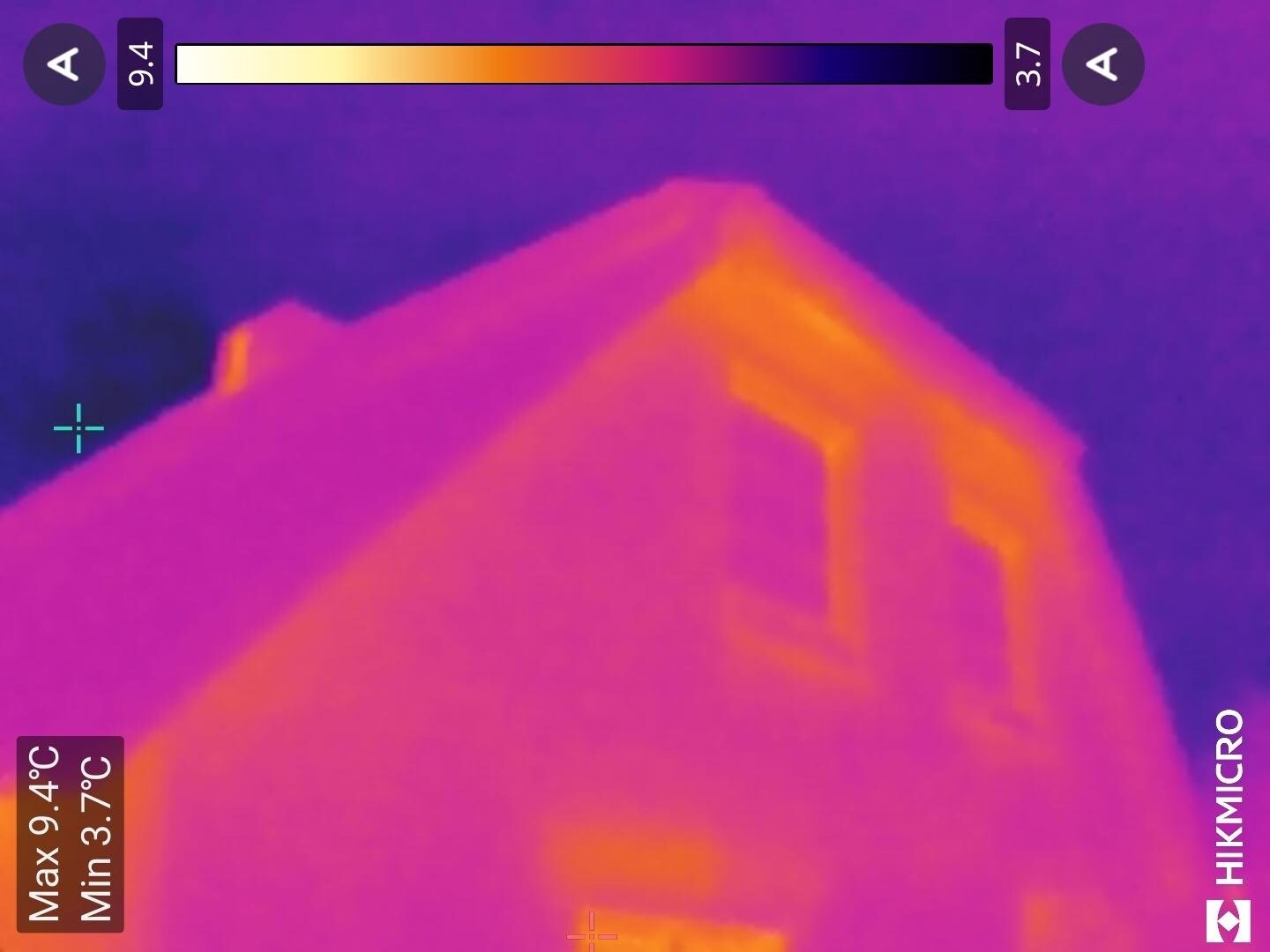
When I look at the junctions between the sloped roof and the masonry in thermographic images, it appears to me that there is more heat there than on the roof surface itself.
For this reason, and because of the large gaps at the transition between the stairwell and the knee wall, I suspect there are even bigger weak points in the roof structure through which sound can travel almost unhindered.
For this reason, and because of the large gaps at the transition between the stairwell and the knee wall, I suspect there are even bigger weak points in the roof structure through which sound can travel almost unhindered.
Similar topics