
Hello,
we are planning to replace the existing conservatory at our house with a new extension in the medium term. We already have some ideas but still have some time. However, we want to keep the goal in mind in order to complete necessary preliminary work or avoid blocking future options.
For the introduction, I am using the questionnaire for standard floor plan planning as far as possible, although many answers naturally reflect the current situation:
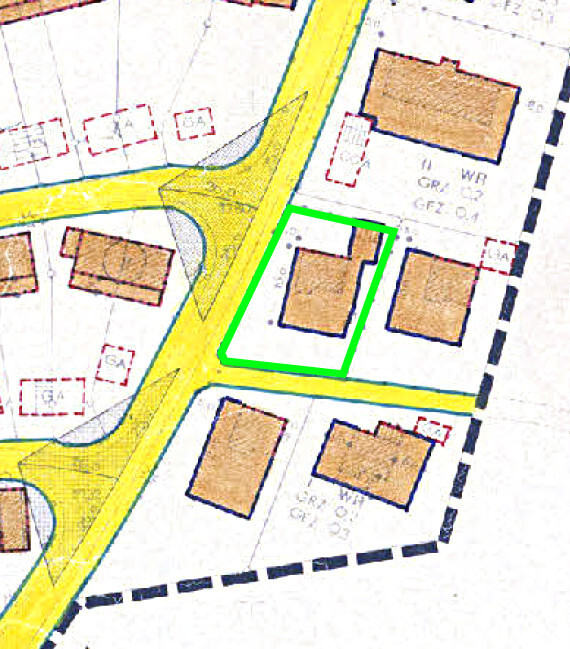
Development Plan / Restrictions
Client Requirements
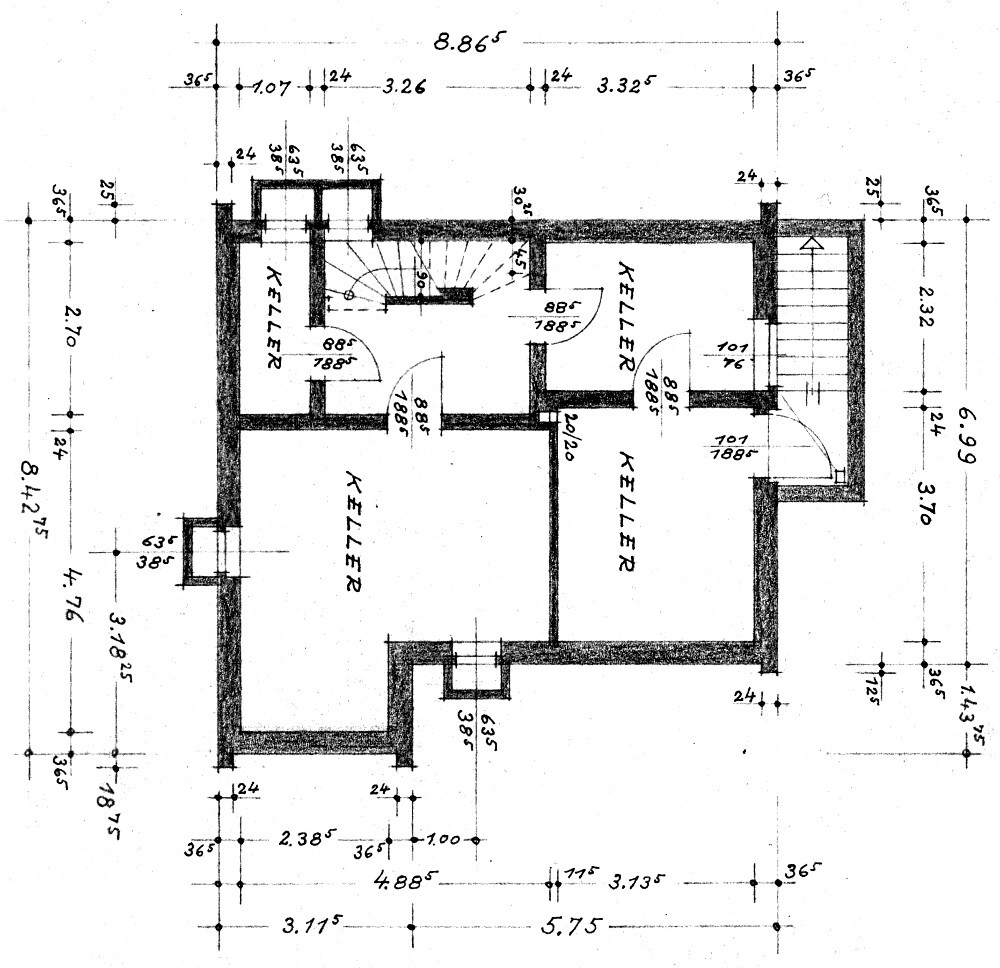
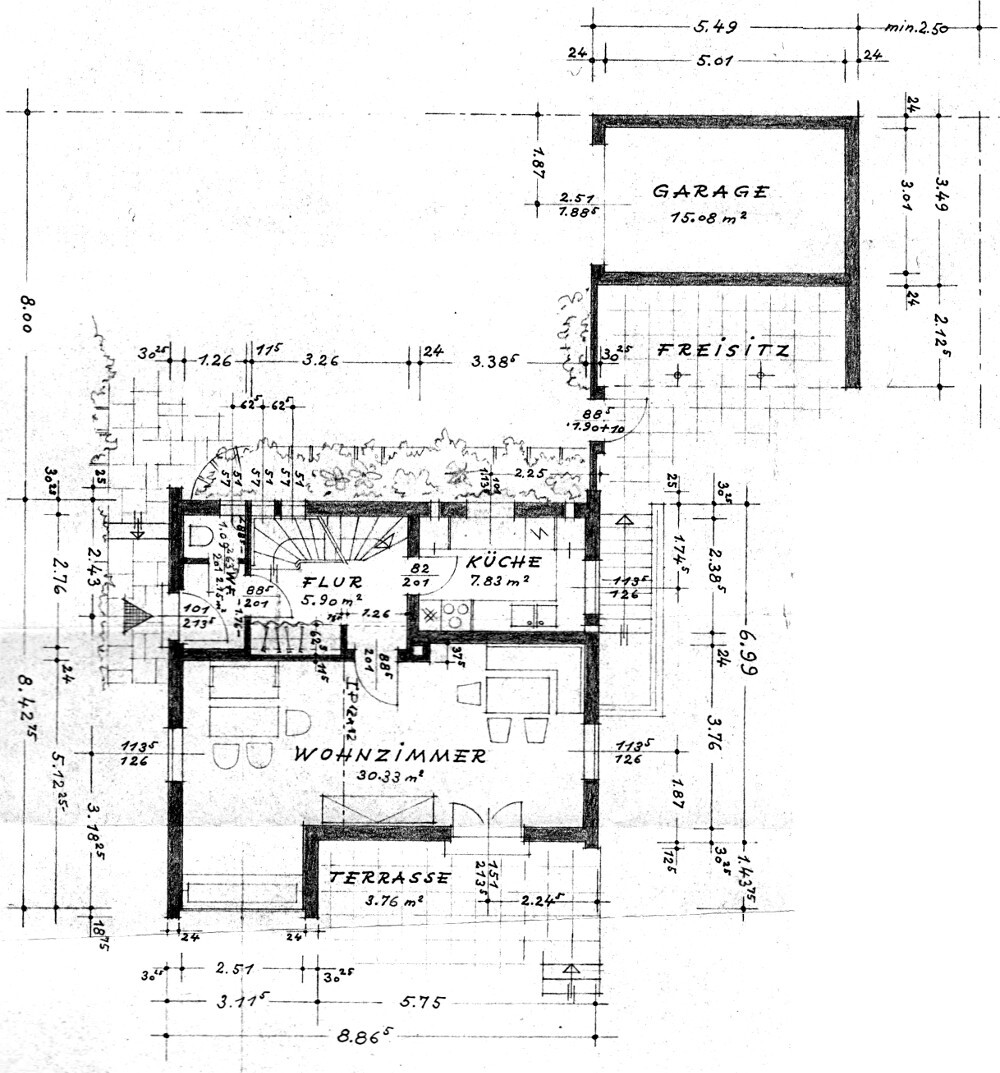
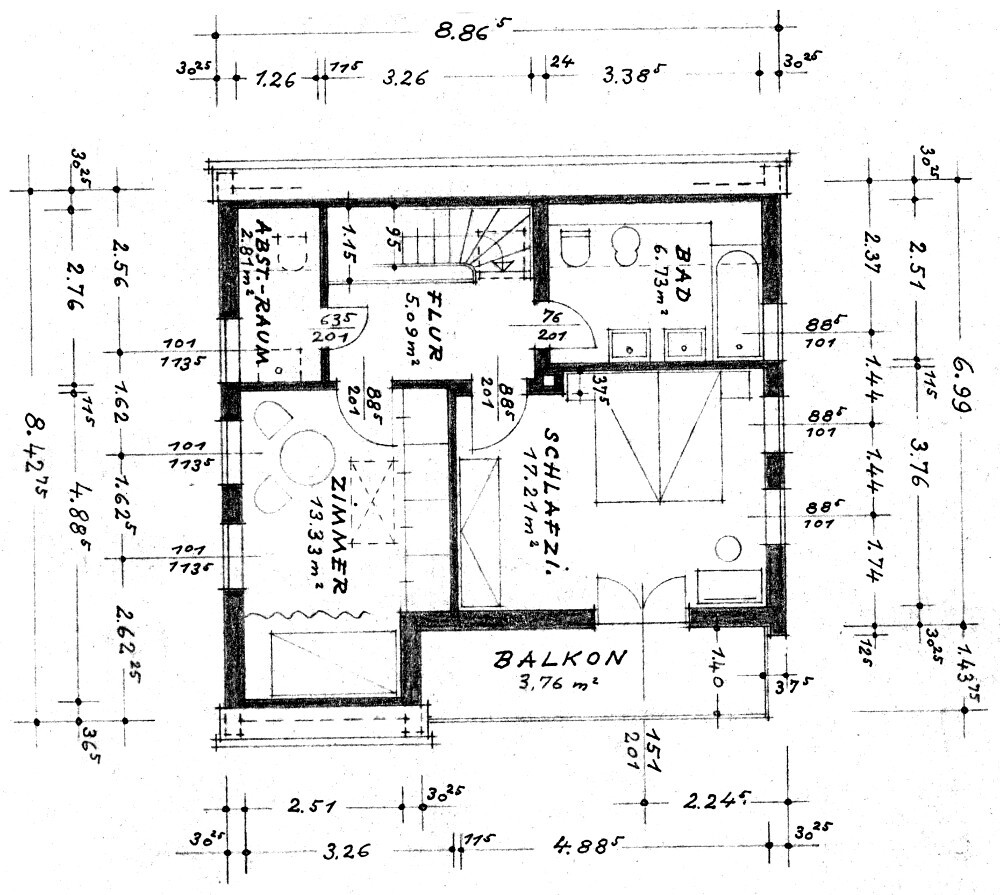
House Design
Order: basement, ground floor, upper floor, cross-section
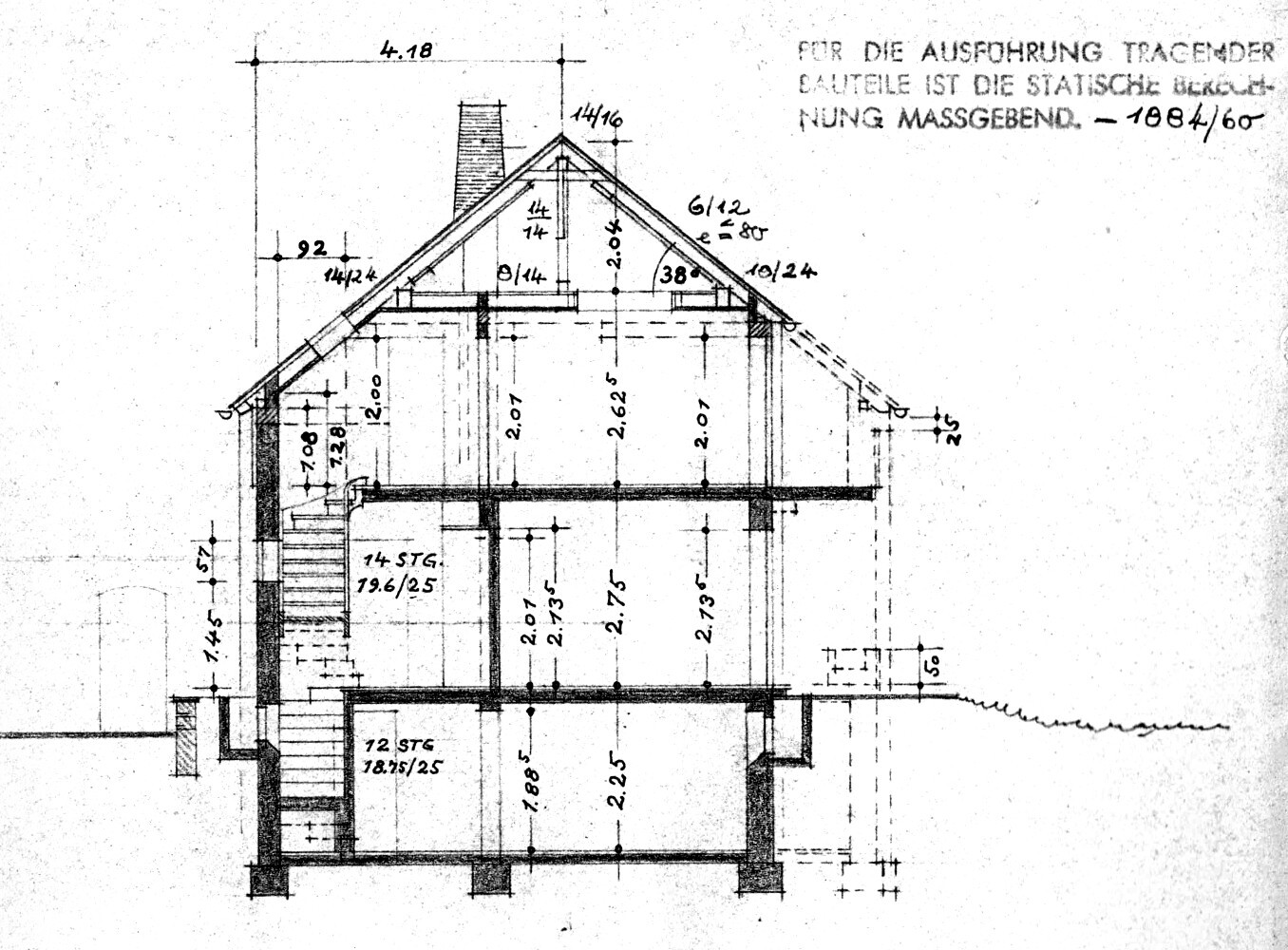
Exterior views:

3D drawing comparing original (with old terrace) and conservatory extension (including new terrace):
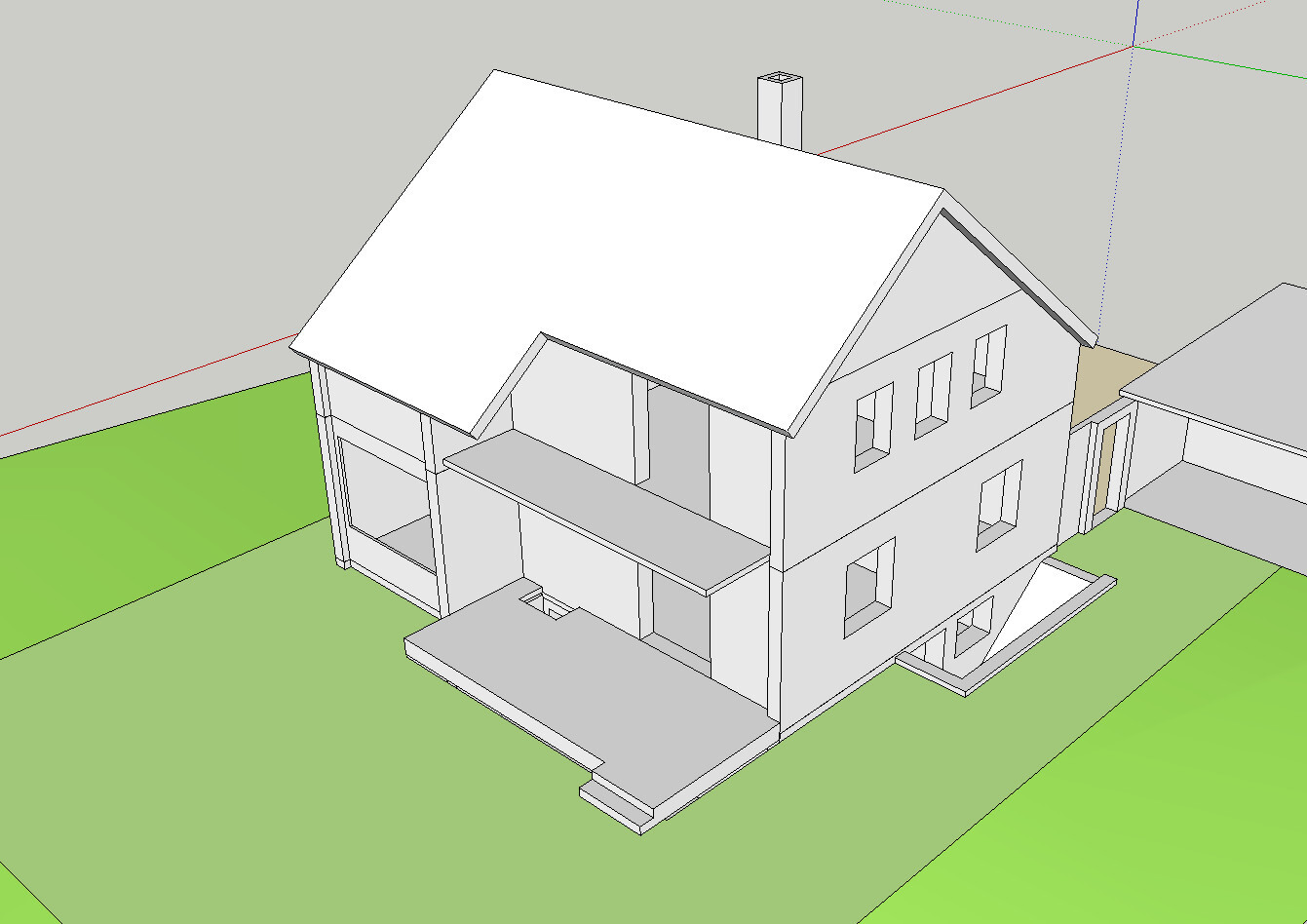
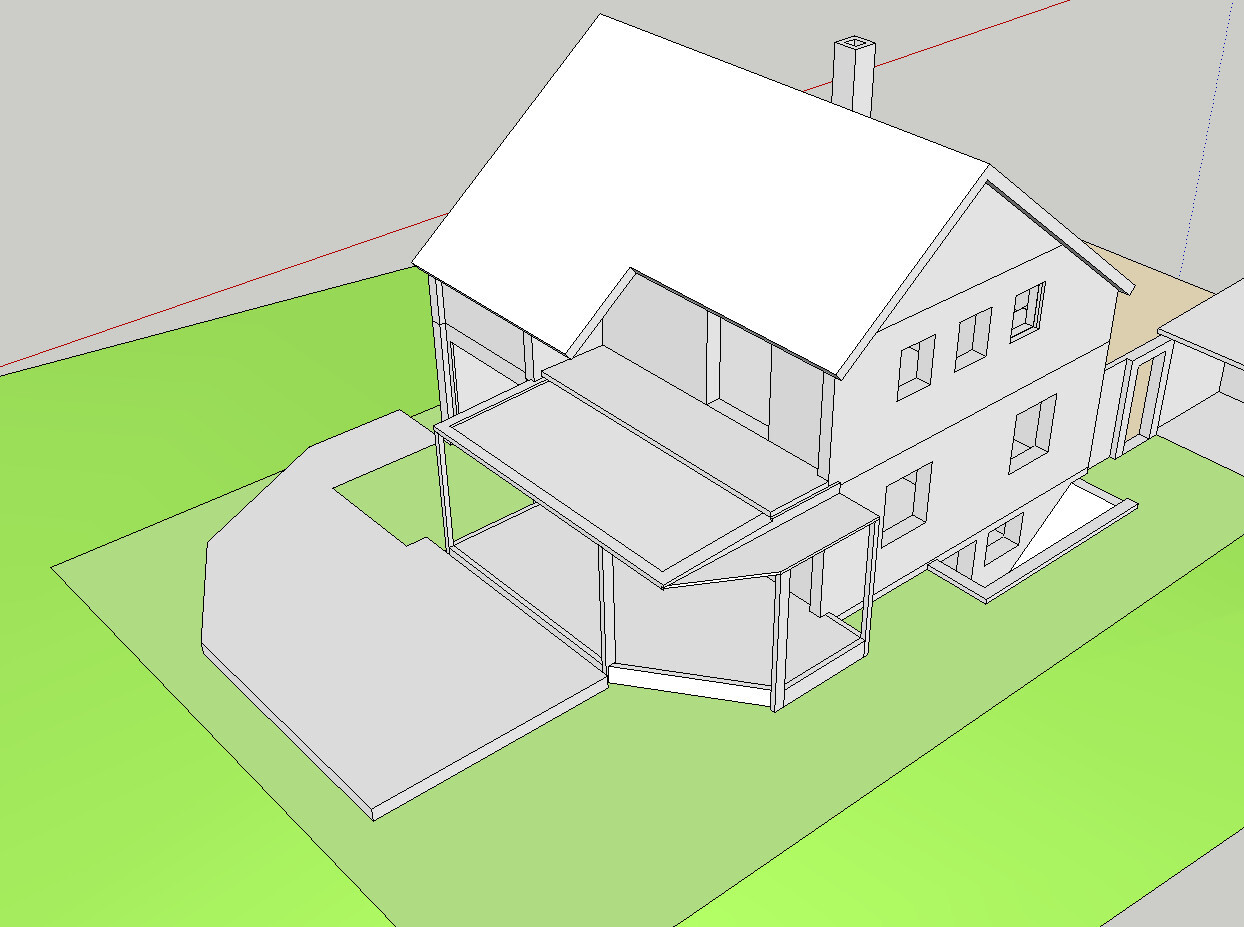
(dark green lawn = building window)
As mentioned at the beginning, we are planning to replace the conservatory with a better solution in the medium term.
The goal is to have a room serving a similar function: a bright room with a nice view of the garden, for example through large lift-and-slide doors. However, it should also meet the requirements of a living space (proper thermal insulation, solid walls instead of aluminum frames, adequate heating, tight roof).
We are still uncertain about some fundamental aspects:
Option 1:
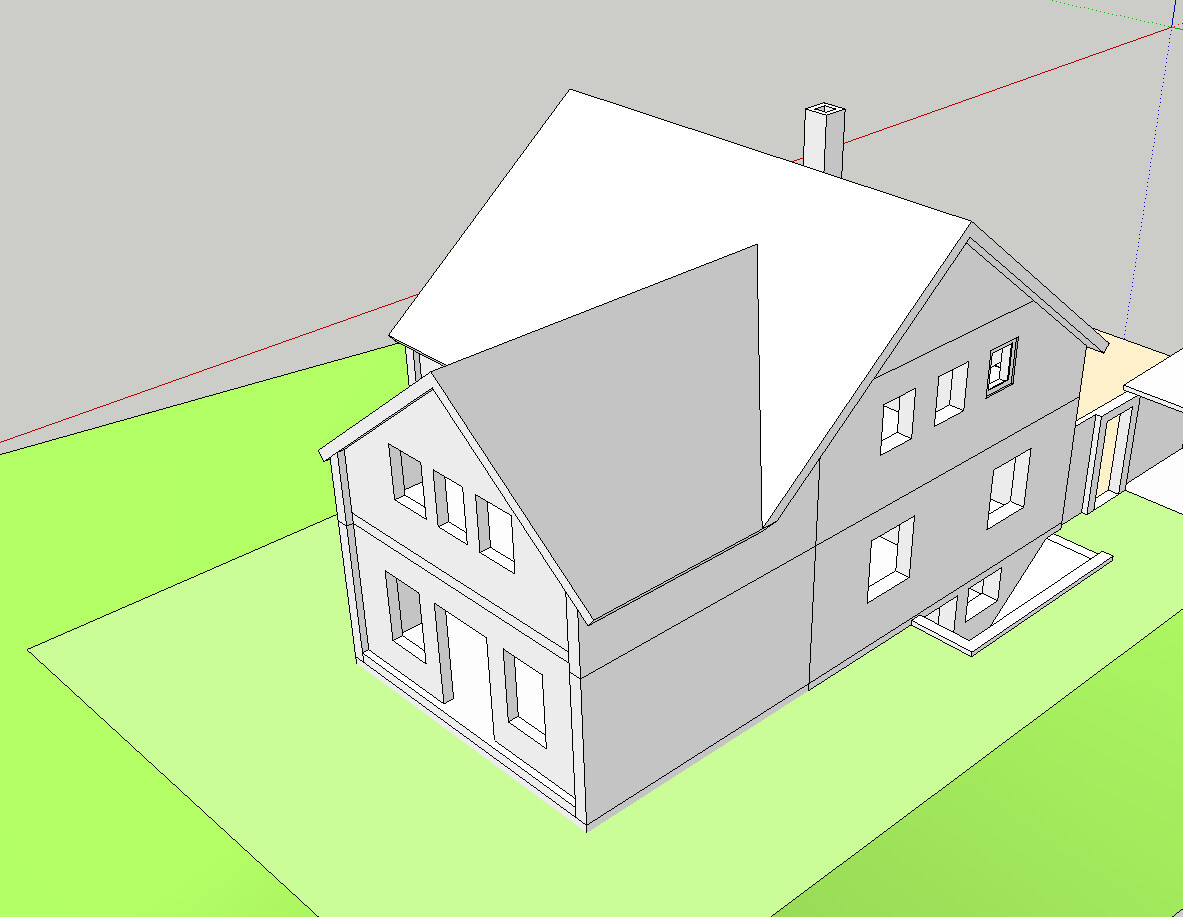
Option 2:
(Image in next post)
Option 3:
(Image in next post)
Current use:
The upper floor bedroom is used exactly for this purpose. It does not need to be larger as we spend most of the time elsewhere. A walk-in closet is unnecessary, as is a large bathroom. The bathroom size is sufficient; after renovation it will easily fit shower + bathtub + toilet + washbasin. The extra shower will be removed and converted into a storage room – possibly the toilet will be relocated there from the bathroom.
The other room is used as an office and guest room. It now seems likely that we will have children, so it could become a child’s room soon. Guests can easily sleep in the living room and mobile working from home could be done elsewhere (it is occasional and no external assignments).
It would be interesting to hear what an extension generally offers in terms of getting more out of the ground floor. I am reluctant to move the kitchen as it currently has new electrics, water and waste pipes and just needs renovation and refitting. Its size is sufficient and we prefer a closed kitchen.
There might be a completely different or complementary option:
According to the development plan, this plot is the only one where the garage area belongs to the building window. This means that residential development may apparently be possible here as well. However, the corner is somewhat shaded by neighbouring buildings, so the ground floor would hardly be suitable for living purposes (but perhaps garage with office/guest room on the upper floor).
Which option would you prefer, or am I missing the big picture?
How much might an extension like this (fully basemented!) roughly cost?
Thanks in advance to everyone and I am happy to answer any questions.
we are planning to replace the existing conservatory at our house with a new extension in the medium term. We already have some ideas but still have some time. However, we want to keep the goal in mind in order to complete necessary preliminary work or avoid blocking future options.
For the introduction, I am using the questionnaire for standard floor plan planning as far as possible, although many answers naturally reflect the current situation:
Development Plan / Restrictions
- Plot size: 787m² (8,472 sq ft)
- Slope: no, just a slight incline
- Site coverage ratio: 0.2
- Floor area ratio: 0.3
- Building window, building line and boundary: see development plan, the north side of the building is the building line, otherwise approximately double the current area may still be built
- Development plan (1st amendment) (colored)
- Development plan (2nd amendment) (changes not relevant but more readable, black and white)
- Extract from development plan (oriented north):
- Edge development: generally not, but the entire garage/outdoor seating area is within the building window according to the development plan and may be fully built upon as inner development
- Number of parking spaces: Current: driveway accommodates 2x2 cars and 1 garage; desired: 2 parking spaces (in double garage)
- Number of storeys: 1 (inner development)
- Roof type: gable roof, knee wall 108cm (43 inches)
- Architectural style: original elements of regional style, modified standard model from Niedersächsische Heimstätte in improved design/quality
- Orientation: balcony/terrace facing south
- Maximum heights/limits: no specifications
- Other requirements: development plan imposes no restrictions
Client Requirements
- Basement, floors: 1 basement, 1 ground floor, 1 upper floor (partly sloped ceilings), 1 attic
- Number of occupants, ages: 2 (35 + 37)
- Space requirements on ground and upper floors
- Office: home office + guest room
- Guest stays per year: 4 times, 2-3 people each
- Closed architecture
- Conservative construction style with modern elements (fitting the house type)
- Closed kitchen
- Number of dining seats: breakfast area in kitchen, dining area in living room
- Fireplace: planned for living room
- Music/stereo wall: TV with 7.1 surround sound system available
- Balcony: exists but unnecessary
- Roof terrace: no
- Garage: exists, too small; goal: double garage
- Carport: no
- Utility garden: yes
- Greenhouse: no
House Design
- Designer:
- Original design is a standard house from Niedersächsische Heimstätte
- Built in Wolfsburg for the middle class in the 1960s
- Modified compared to standard (bathroom with bidet [instead of a child’s room], additional shower on upper floor [instead of bathroom], extra WC on ground floor, only one flue due to district heating, real wood parquet flooring)
- Around 1995 a conservatory was added to the terrace (balcony was extended with a bitumen roof)
- Outdoor seating roof was extended and front closed with sliding glass doors
- Brick slips on two sides of the house, external thermal insulation composite system (ETICS) on the other two sides
- What do you particularly like? Why? Compact and not too large, still some 1960s charm but not outdated
- What don’t you like? Why? Living room is too dark due to conservatory, partly too narrow for practical furnishing
- Price estimate by architect/planner: n/a
- Personal price limit for house including fittings: n/a
- Preferred heating technology: currently district heating for heating (high pressure, direct without heat exchanger), instant water heater/boiler for hot water. Planned: district heating for heating and hot water with buffer storage and connection options for additional alternative energy sources (solar thermal, geothermal [only shallow foundation allowed]). Air source heat pump probably unsuitable due to no underfloor heating, possibly after renovation in bathroom/kitchen.
Order: basement, ground floor, upper floor, cross-section
Exterior views:
3D drawing comparing original (with old terrace) and conservatory extension (including new terrace):
(dark green lawn = building window)
As mentioned at the beginning, we are planning to replace the conservatory with a better solution in the medium term.
The goal is to have a room serving a similar function: a bright room with a nice view of the garden, for example through large lift-and-slide doors. However, it should also meet the requirements of a living space (proper thermal insulation, solid walls instead of aluminum frames, adequate heating, tight roof).
We are still uncertain about some fundamental aspects:
- Separate room or large opening to living room (and possibly a partition there – essentially a "rotation of the living room")
- What happens with the bedroom (balcony not needed, currently no sloped ceiling; will it become a dead space or a walk-through room?)
- Which roof shape (extend existing, new roof with shallower pitch in front, side wing with its own ridge direction; however, no flat roof or cubic shape)
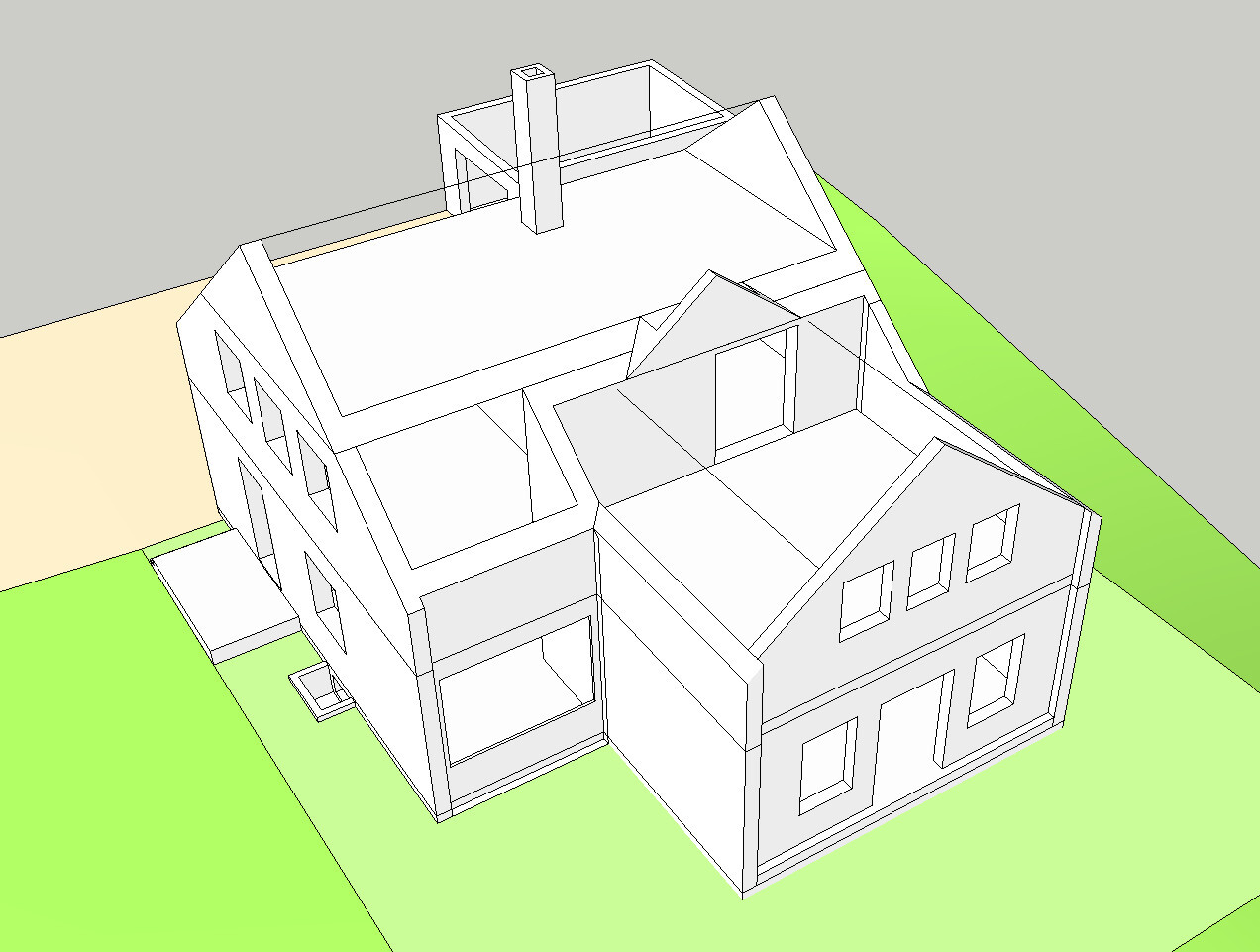
Option 1:
- “Separate” extension with its own ridge
- Advantage: depth variable according to space requirements as long as proportions with main house are acceptable
- Disadvantage: bedroom becomes a walk-through room with little light, and what is the purpose of the additional room on the upper floor (consider 2m (6.5 ft) head height line)?
Option 2:
- Separate roof with a shallower pitch
- Advantage: size still variable, light in bedroom (balcony door becomes window)
- Disadvantage: appearance and proportions, roof too flat
(Image in next post)
Option 3:
- Extension of existing roof,
- Advantage: best visual solution, subtle modern elements possible (e.g., large window), allowing light in bedroom as balcony door remains as floor-to-ceiling window with parapet
- Disadvantage: bedroom window (former balcony door) faces into room, room depth precisely defined by roof intersection
(Image in next post)
Current use:
The upper floor bedroom is used exactly for this purpose. It does not need to be larger as we spend most of the time elsewhere. A walk-in closet is unnecessary, as is a large bathroom. The bathroom size is sufficient; after renovation it will easily fit shower + bathtub + toilet + washbasin. The extra shower will be removed and converted into a storage room – possibly the toilet will be relocated there from the bathroom.
The other room is used as an office and guest room. It now seems likely that we will have children, so it could become a child’s room soon. Guests can easily sleep in the living room and mobile working from home could be done elsewhere (it is occasional and no external assignments).
It would be interesting to hear what an extension generally offers in terms of getting more out of the ground floor. I am reluctant to move the kitchen as it currently has new electrics, water and waste pipes and just needs renovation and refitting. Its size is sufficient and we prefer a closed kitchen.
There might be a completely different or complementary option:
According to the development plan, this plot is the only one where the garage area belongs to the building window. This means that residential development may apparently be possible here as well. However, the corner is somewhat shaded by neighbouring buildings, so the ground floor would hardly be suitable for living purposes (but perhaps garage with office/guest room on the upper floor).
Which option would you prefer, or am I missing the big picture?
How much might an extension like this (fully basemented!) roughly cost?
Thanks in advance to everyone and I am happy to answer any questions.
Yes, I already understood that the conservatory has to go anyway, but at the same time, I thought there would still be more space missing than just the office (wasn't there a second planned child?).
But then it fits, and as I said, I find the solution very coherent and appealing from the outside.
When will this be implemented? When will there be pictures?
But then it fits, and as I said, I find the solution very coherent and appealing from the outside.
When will this be implemented? When will there be pictures?
 LordNibbler26 Feb 2020 10:56
No further planning is active at the moment; if another plan arises, a solution will be found.
For the extension, I am initially looking for information to estimate costs. Before that, the heating system is definitely more important.
The extension will likely be a larger project anyway, including a complete facade renovation and drainage renewal. That will take a few more years.
For the extension, I am initially looking for information to estimate costs. Before that, the heating system is definitely more important.
The extension will likely be a larger project anyway, including a complete facade renovation and drainage renewal. That will take a few more years.
LordNibbler8 Dec 2022 10:16The second child is now 7 months old, and space will become tight at the latest when child #1 starts school in 2026.
We have considered all possible extension options. However, extensions to the south do not fit well with the existing house:
- On the ground floor, there would be no practical pathways for a sensible room layout.
- On the upper floor, it would be necessary to separate a corridor from the master bedroom, which would then barely have enough space for the wardrobe.
Ideally, the extension should not have a flat roof and, of course, everything should be implemented with as few restrictions as possible while the existing house remains occupied.
An extension to the east would be possible within the building envelope, but it would also lead to similar problems (loss of the bathroom, impractical traffic routes).
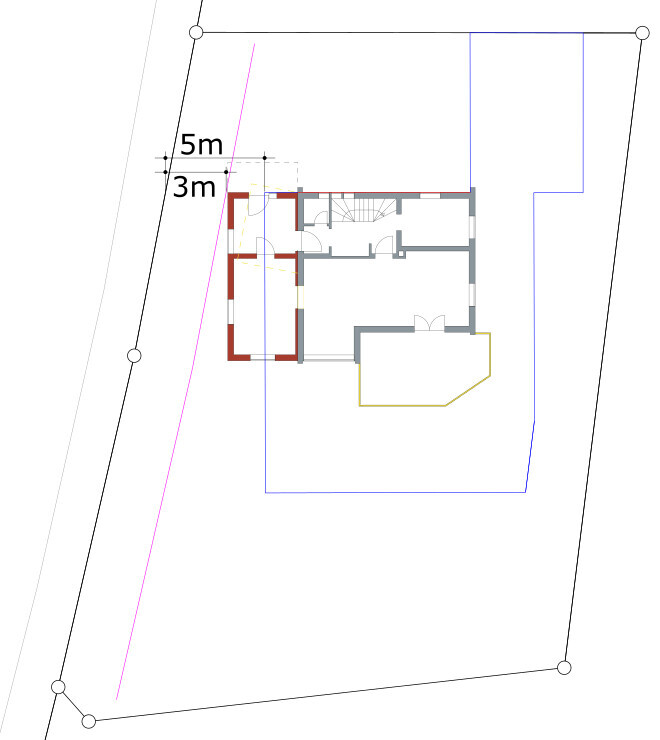
So far, we have not considered an extension to the west since it is outside the building envelope according to the development plan. However, after noticing other buildings with extensions outside the building envelope within the plan’s validity area, I contacted the municipal building office.
In principle, exceptions from the development plan are possible as long as they make urban planning sense. The building envelopes were drawn around existing buildings in the 1960s, plus possible expansion areas, but without closely considering practical feasibility. I was advised to simply send a sketch of the idea, and they could give a rough indication of whether it would be generally possible or not.
Attached is the site plan: the building envelope according to the development plan is marked, as well as the general boundary distance of 3m (10 feet). Setback requirements would be met since the house does not exceed 6m (20 feet) in height up to the 6m (20 feet) gable width (0.5 times the building height setback up to 6m gable width).
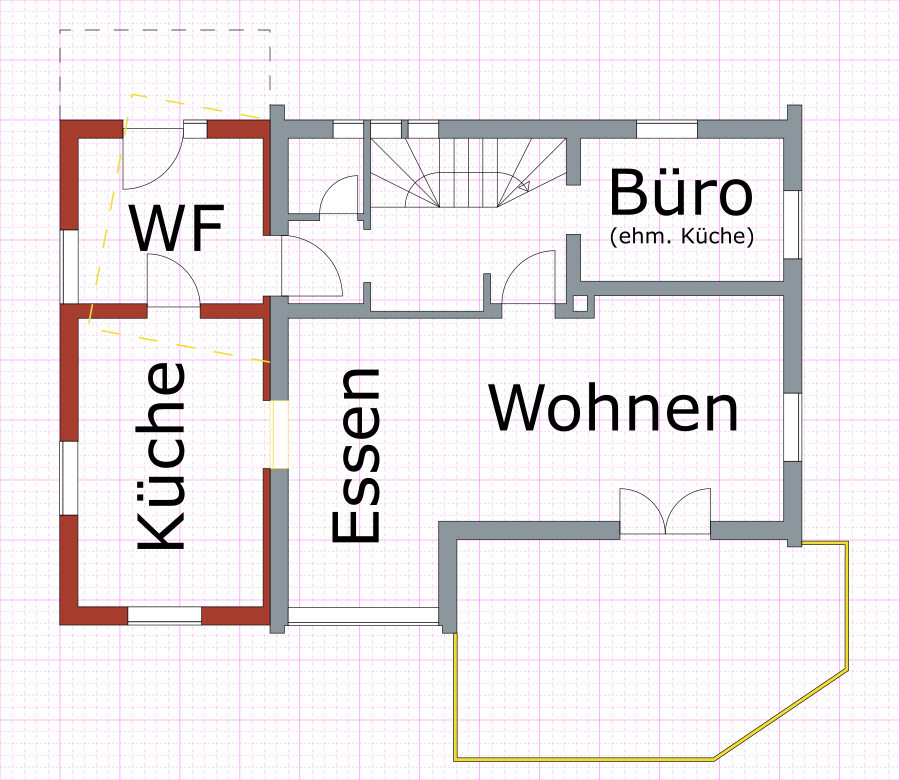
On the ground floor, a new entrance area/vestibule with cloakroom would be created, as the current hallway is too small.
There would also be a new kitchen, directly accessible from the entrance.
The living room and dining room would switch places. Guests could sleep in the living room while the kitchen remains usable.
The conservatory would be removed. A terrace could be reinstated there, possibly with simple glazing.
The old kitchen would become a home office space for two people, possibly also accommodating a guest sofa.
Furniture arrangement still needs to be considered.
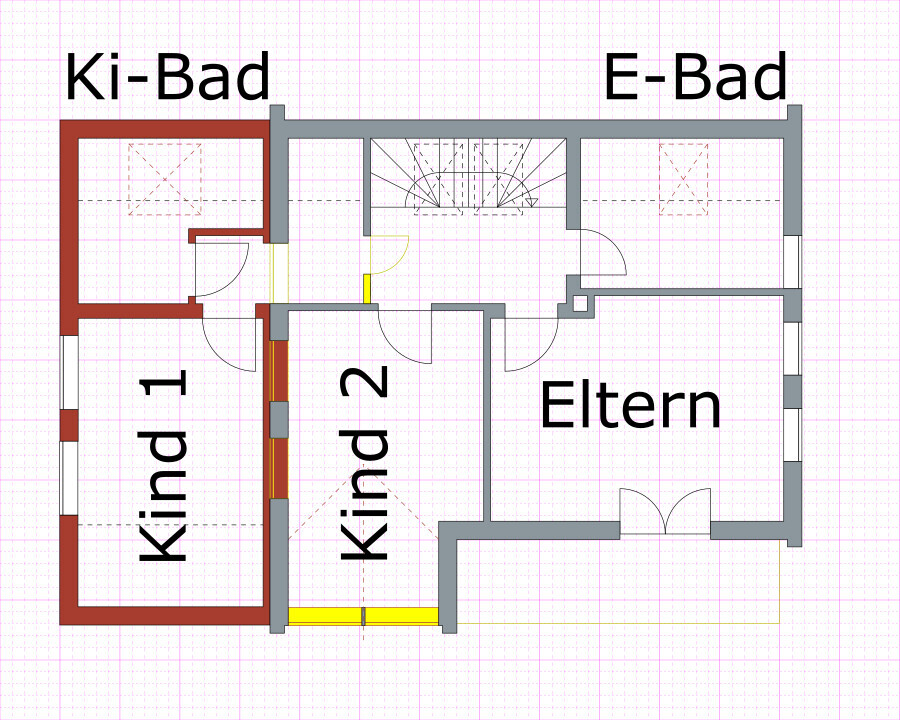
On the upper floor, the small office would be removed and the corridor extended.
Next to it would be a children’s shower room; unfortunately, there is no space for a window in the gable due to the roof slope that necessitates positioning the shower there. Nevertheless, a washbasin and toilet should fit—though just barely. :-/ Instead, a large skylight could provide sufficient light and ventilation.
In the old children’s room, the gable windows would be removed and replaced by a dormer facing south with a large window.
The old balcony in the master bedroom is structurally unsound and would be removed.
The biggest disadvantage of this solution is that almost all house connections (electricity, water, district heating) would need to be relocated since they cannot be built over. (They come into the house from the street side in the west.)
It is also unclear whether the extension should have a basement. Drainage will definitely need to be renewed in that area. Whether building over it makes sense needs to be clarified. Possibly, a basement could help solve the house connection issue.
I welcome any feedback. What do you think of the idea? Could it be optimized?
We have considered all possible extension options. However, extensions to the south do not fit well with the existing house:
- On the ground floor, there would be no practical pathways for a sensible room layout.
- On the upper floor, it would be necessary to separate a corridor from the master bedroom, which would then barely have enough space for the wardrobe.
Ideally, the extension should not have a flat roof and, of course, everything should be implemented with as few restrictions as possible while the existing house remains occupied.
An extension to the east would be possible within the building envelope, but it would also lead to similar problems (loss of the bathroom, impractical traffic routes).
So far, we have not considered an extension to the west since it is outside the building envelope according to the development plan. However, after noticing other buildings with extensions outside the building envelope within the plan’s validity area, I contacted the municipal building office.
In principle, exceptions from the development plan are possible as long as they make urban planning sense. The building envelopes were drawn around existing buildings in the 1960s, plus possible expansion areas, but without closely considering practical feasibility. I was advised to simply send a sketch of the idea, and they could give a rough indication of whether it would be generally possible or not.
Attached is the site plan: the building envelope according to the development plan is marked, as well as the general boundary distance of 3m (10 feet). Setback requirements would be met since the house does not exceed 6m (20 feet) in height up to the 6m (20 feet) gable width (0.5 times the building height setback up to 6m gable width).
On the ground floor, a new entrance area/vestibule with cloakroom would be created, as the current hallway is too small.
There would also be a new kitchen, directly accessible from the entrance.
The living room and dining room would switch places. Guests could sleep in the living room while the kitchen remains usable.
The conservatory would be removed. A terrace could be reinstated there, possibly with simple glazing.
The old kitchen would become a home office space for two people, possibly also accommodating a guest sofa.
Furniture arrangement still needs to be considered.
On the upper floor, the small office would be removed and the corridor extended.
Next to it would be a children’s shower room; unfortunately, there is no space for a window in the gable due to the roof slope that necessitates positioning the shower there. Nevertheless, a washbasin and toilet should fit—though just barely. :-/ Instead, a large skylight could provide sufficient light and ventilation.
In the old children’s room, the gable windows would be removed and replaced by a dormer facing south with a large window.
The old balcony in the master bedroom is structurally unsound and would be removed.
The biggest disadvantage of this solution is that almost all house connections (electricity, water, district heating) would need to be relocated since they cannot be built over. (They come into the house from the street side in the west.)
It is also unclear whether the extension should have a basement. Drainage will definitely need to be renewed in that area. Whether building over it makes sense needs to be clarified. Possibly, a basement could help solve the house connection issue.
I welcome any feedback. What do you think of the idea? Could it be optimized?
LordNibbler schrieb:
The biggest disadvantage of this solution is that almost all utility connections (electricity, water, district heating) would need to be relocated, as they cannot be built over. (they enter the house from the west side facing the street)Where are they located on the plan? They lead to the basement, right? Where is the service shaft or duct for the water supply to the kitchen and the children's bathroom? Have you not implemented any of the ideas so far?
LordNibbler8 Dec 2022 12:50Everything except telephone/fiber optic will enter the basement from the west. Electricity and district heating go into the small boiler room, and electricity also enters the adjacent room to the south.
District heating:
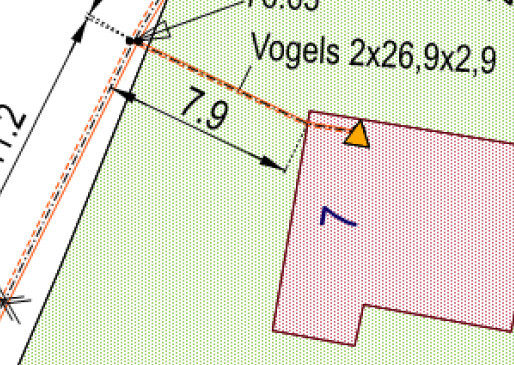
Electricity:
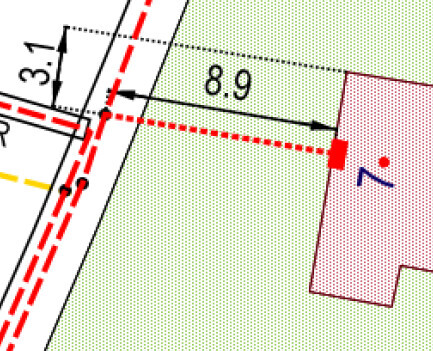
Water:
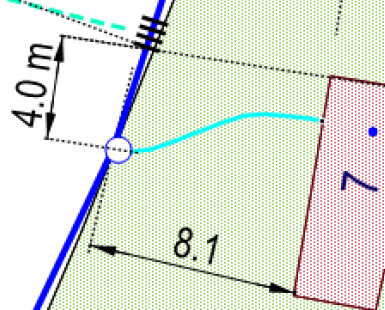
I haven’t given much thought to a utility shaft yet. This is just a rough plan to check buildability and to discuss the concept with our planner. The window positions are also preliminary and will depend on other factors.
In the northwest corner of the building (top left of the plan), there is a soil pipe running up to the upper floor. Part of the new bathroom could be connected to this.
The shower and kitchen will need their own connections, but all could again be linked to the main drain line in the basement. Perhaps the old light well could serve as a pathway for the utility lines to the extension, or alternatively, a basement expansion.
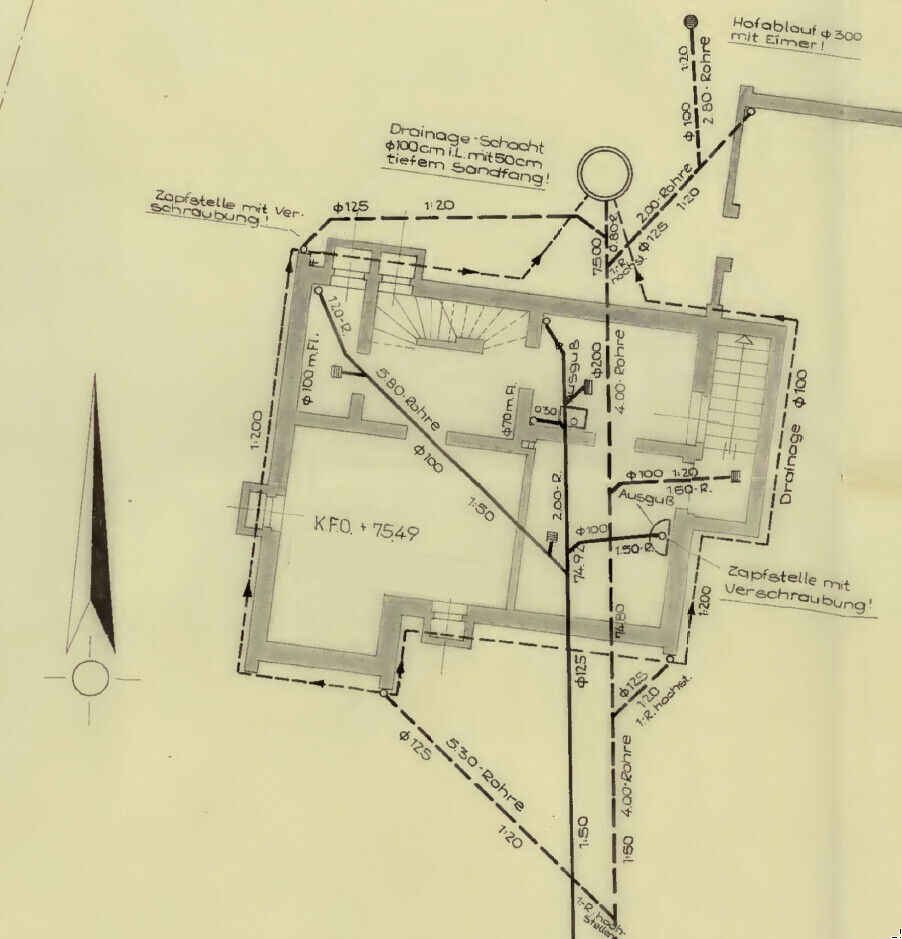
District heating:
Electricity:
Water:
I haven’t given much thought to a utility shaft yet. This is just a rough plan to check buildability and to discuss the concept with our planner. The window positions are also preliminary and will depend on other factors.
In the northwest corner of the building (top left of the plan), there is a soil pipe running up to the upper floor. Part of the new bathroom could be connected to this.
The shower and kitchen will need their own connections, but all could again be linked to the main drain line in the basement. Perhaps the old light well could serve as a pathway for the utility lines to the extension, or alternatively, a basement expansion.
Once again:
You still haven’t implemented any of the ideas from all these years?
You have no clue how much some of these ideas might cost?
Or do you have the conservatory?
What I notice is that there is a flat roof between the patio and the kitchen. What is that? According to the permitted building timeframe (building permit / planning permission), that wouldn’t be possible, right? And why is the permitted building timeframe so …?
Why don’t you want to add a flat roof extension?
Personally, a few pictures of the house, roof ridge orientation, overall impression, and appearance would be helpful. Also, information about neighboring buildings.
Everything depends on the budget.
I just noticed: when I scroll or flip pages, this site goes blank—meaning the forum in my browser. No idea if I will continue here if the problem remains.
You still haven’t implemented any of the ideas from all these years?
You have no clue how much some of these ideas might cost?
Or do you have the conservatory?
What I notice is that there is a flat roof between the patio and the kitchen. What is that? According to the permitted building timeframe (building permit / planning permission), that wouldn’t be possible, right? And why is the permitted building timeframe so …?
Why don’t you want to add a flat roof extension?
Personally, a few pictures of the house, roof ridge orientation, overall impression, and appearance would be helpful. Also, information about neighboring buildings.
Everything depends on the budget.
I just noticed: when I scroll or flip pages, this site goes blank—meaning the forum in my browser. No idea if I will continue here if the problem remains.
Similar topics