
Hello,
we are planning to replace the existing conservatory at our house with a new extension in the medium term. We already have some ideas but still have some time. However, we want to keep the goal in mind in order to complete necessary preliminary work or avoid blocking future options.
For the introduction, I am using the questionnaire for standard floor plan planning as far as possible, although many answers naturally reflect the current situation:
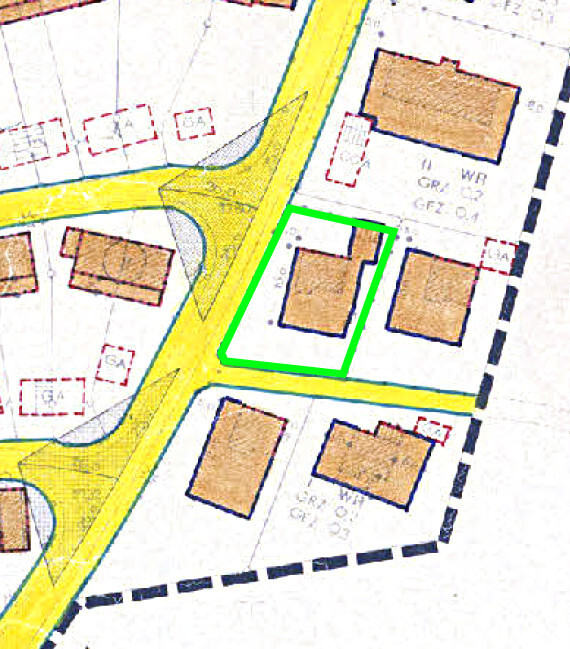
Development Plan / Restrictions
Client Requirements
House Design
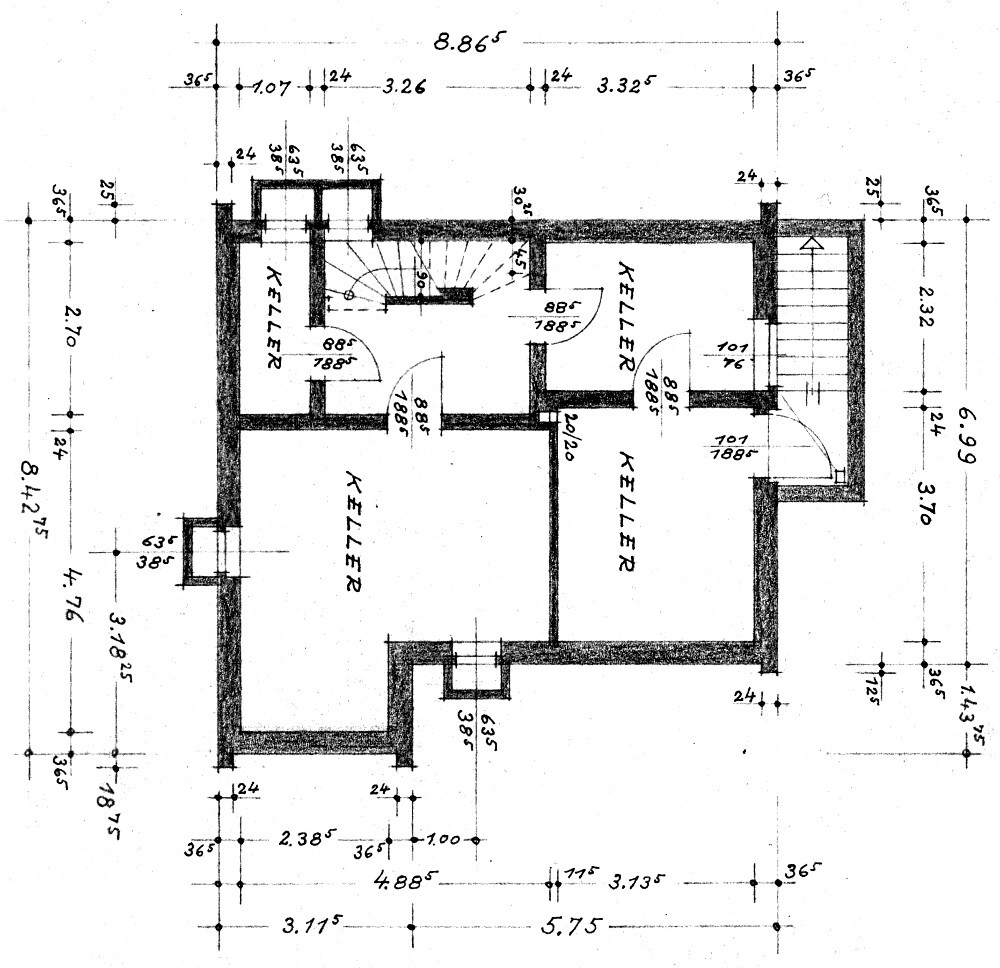
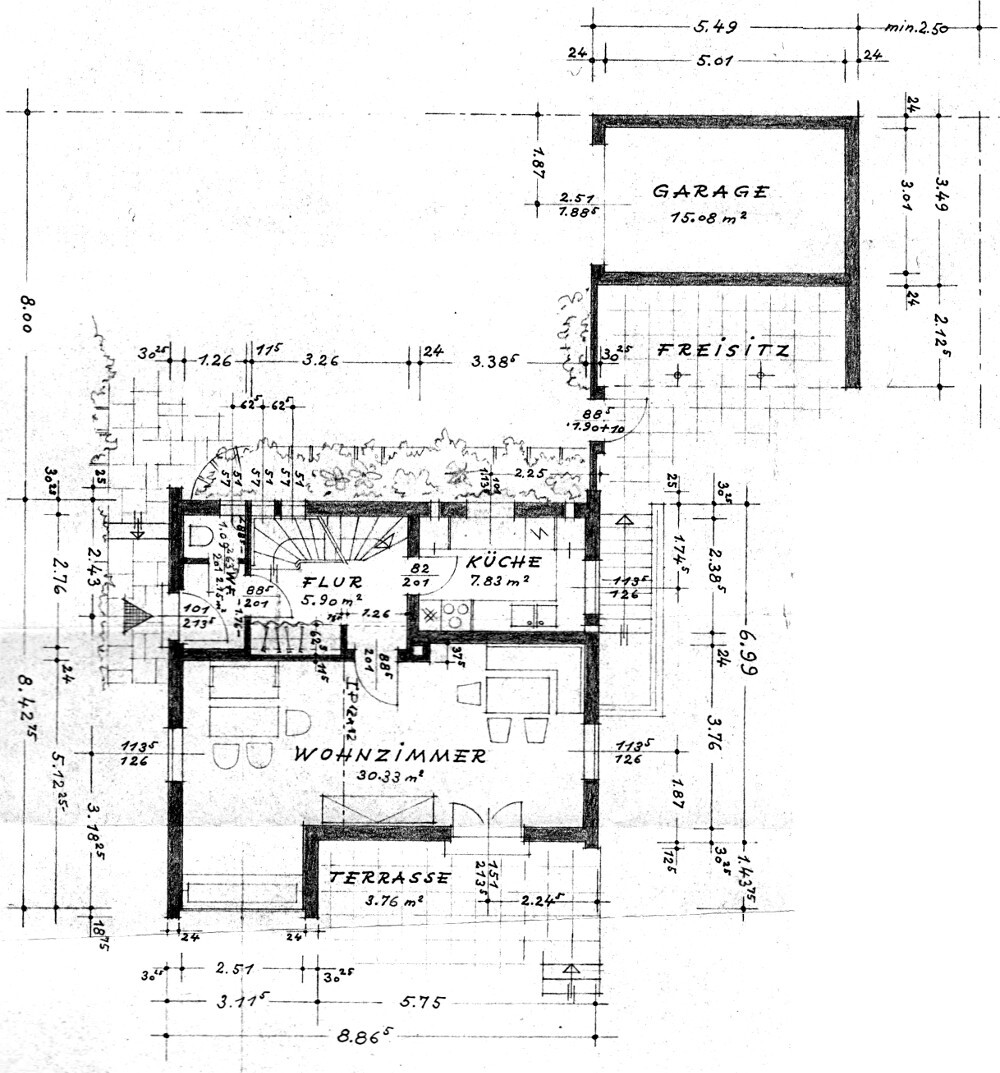
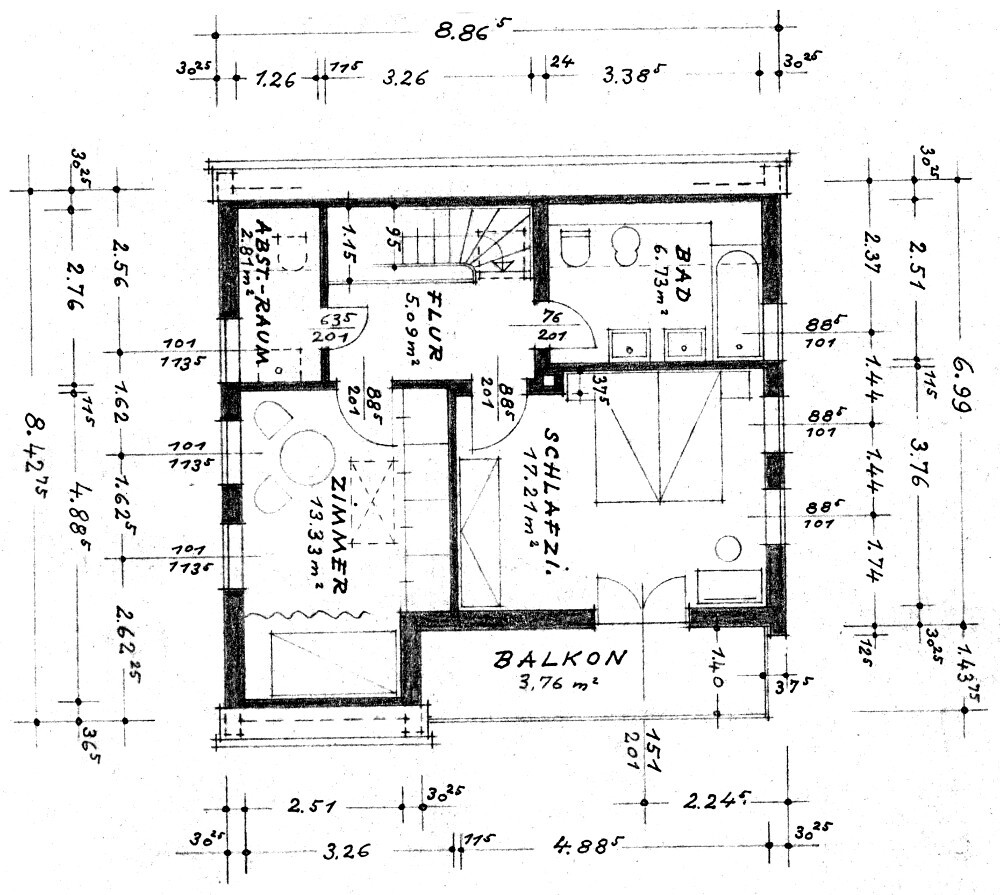
Order: basement, ground floor, upper floor, cross-section
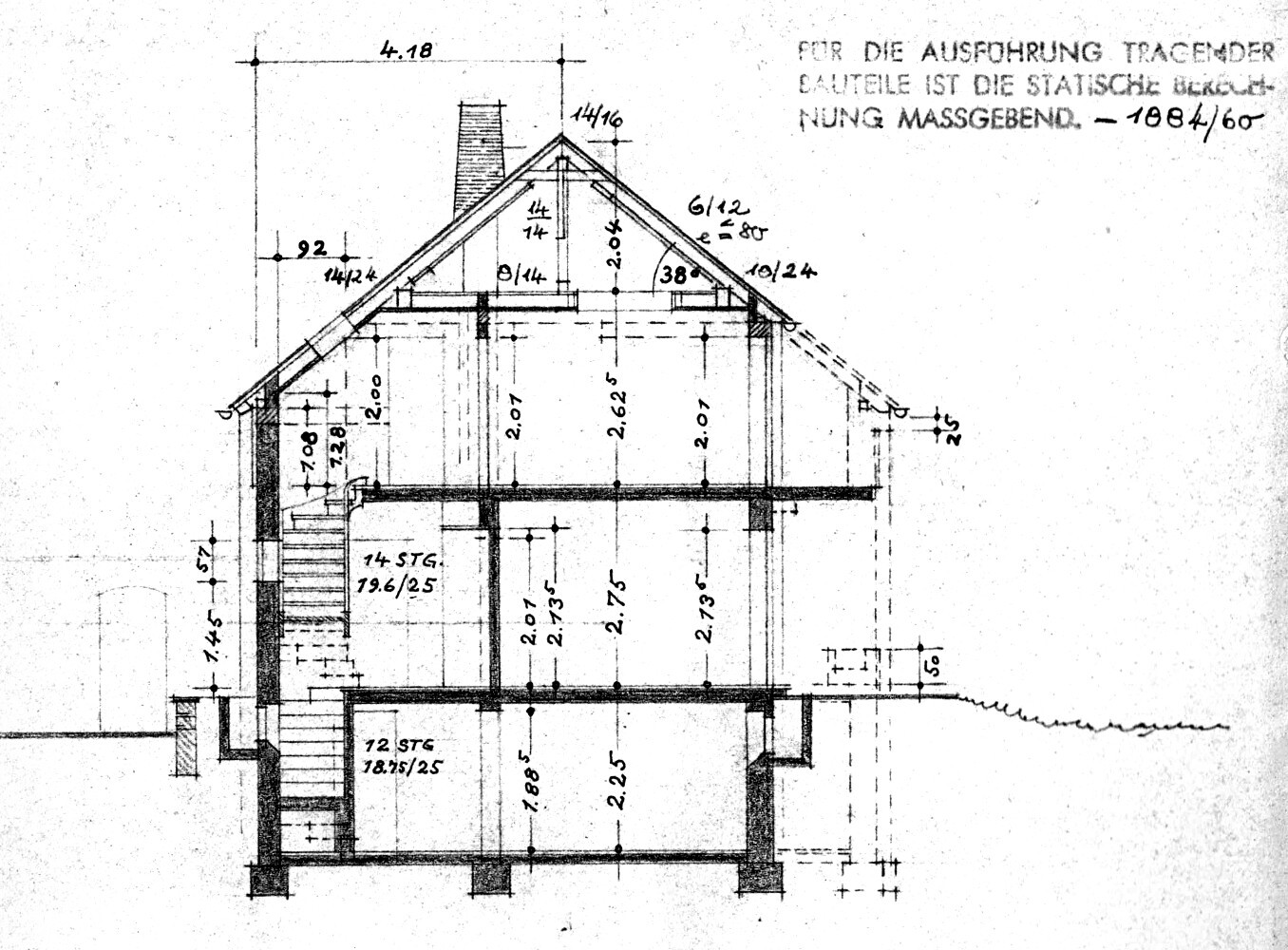
Exterior views:

3D drawing comparing original (with old terrace) and conservatory extension (including new terrace):
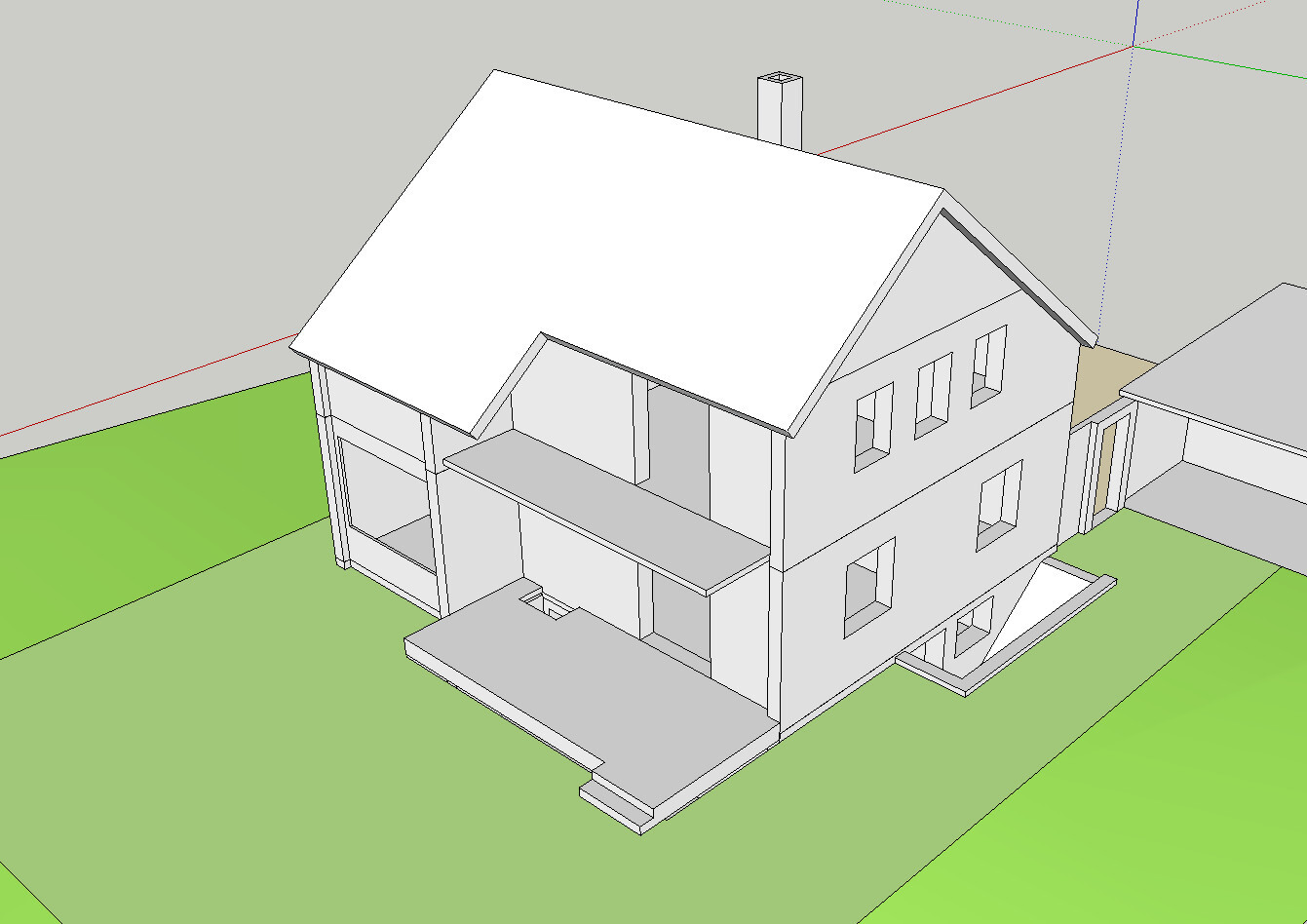
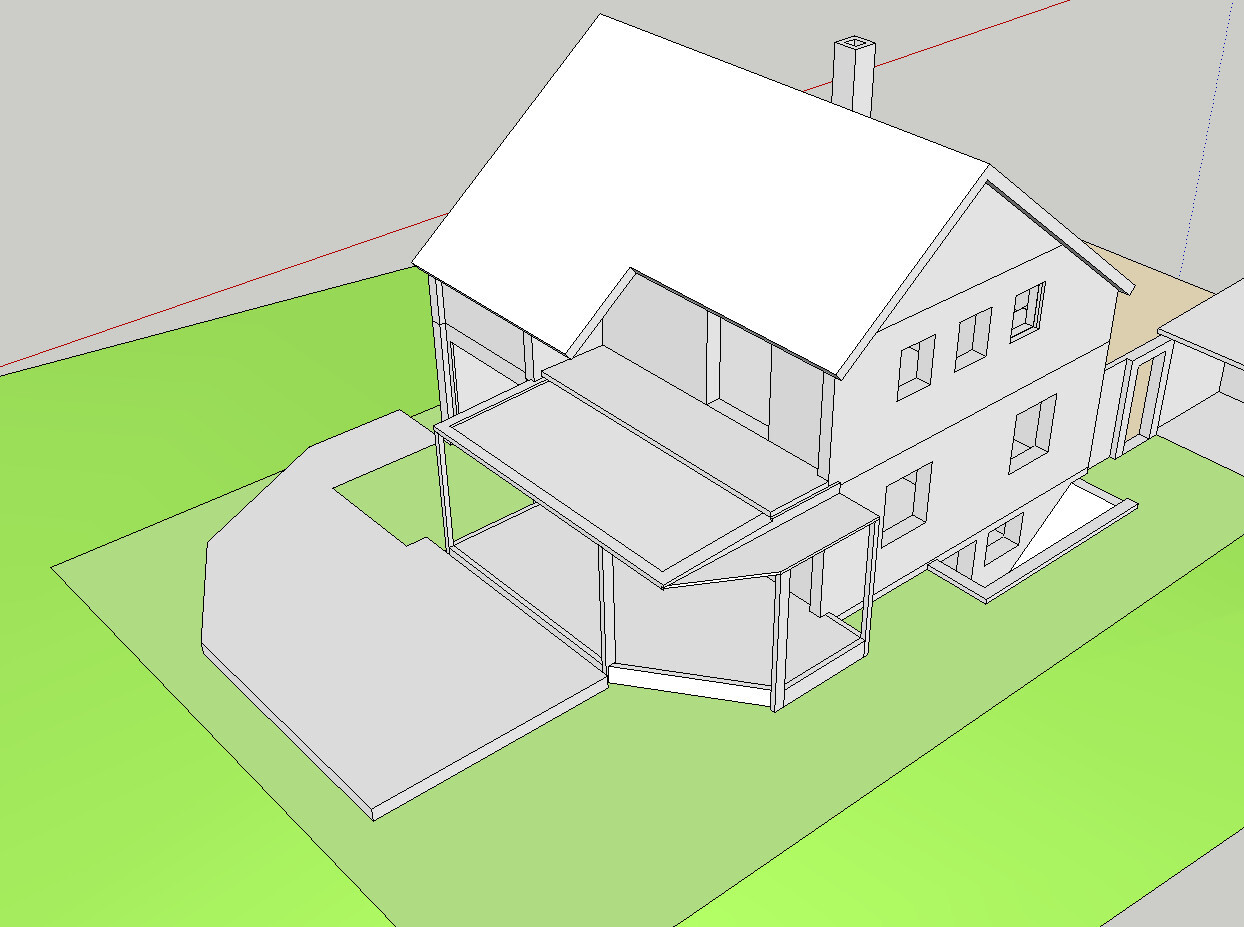
(dark green lawn = building window)
As mentioned at the beginning, we are planning to replace the conservatory with a better solution in the medium term.
The goal is to have a room serving a similar function: a bright room with a nice view of the garden, for example through large lift-and-slide doors. However, it should also meet the requirements of a living space (proper thermal insulation, solid walls instead of aluminum frames, adequate heating, tight roof).
We are still uncertain about some fundamental aspects:
Option 1:
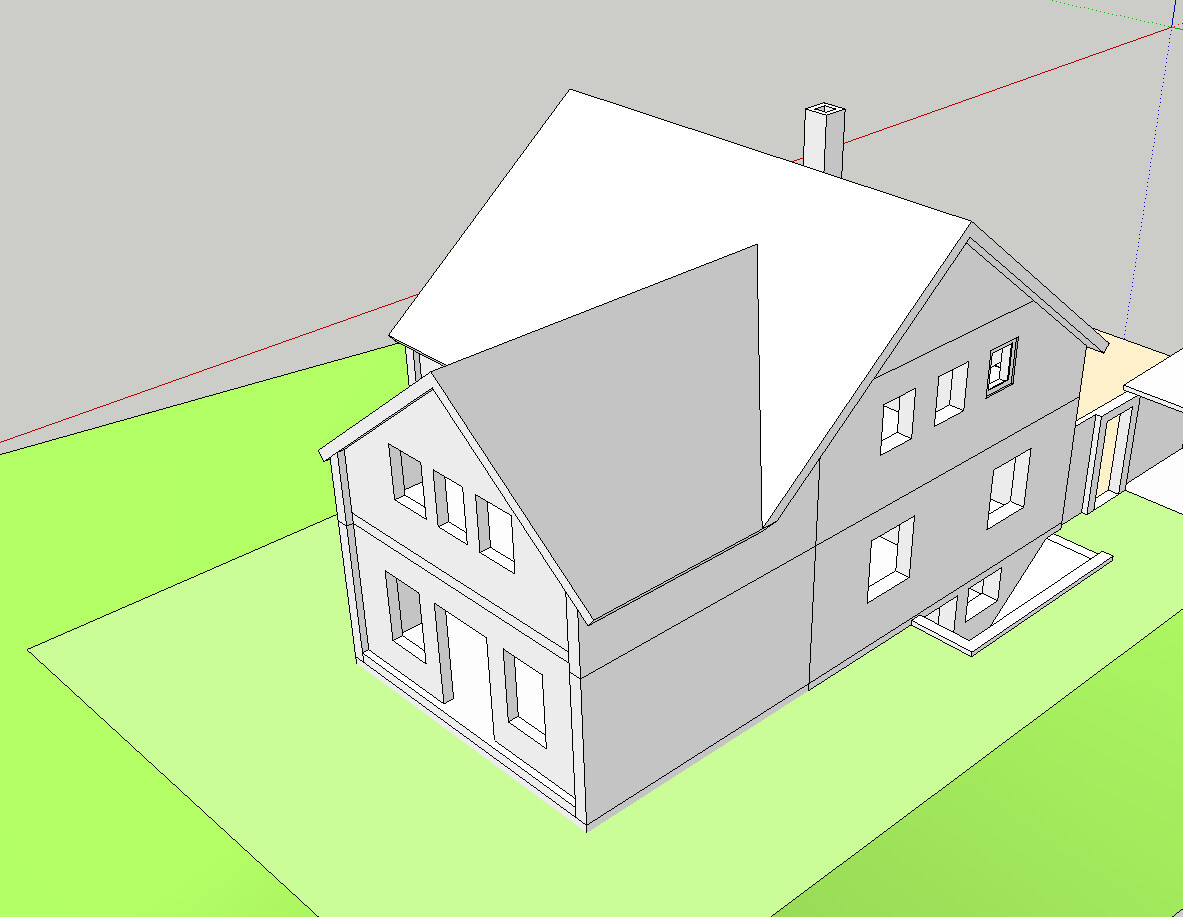
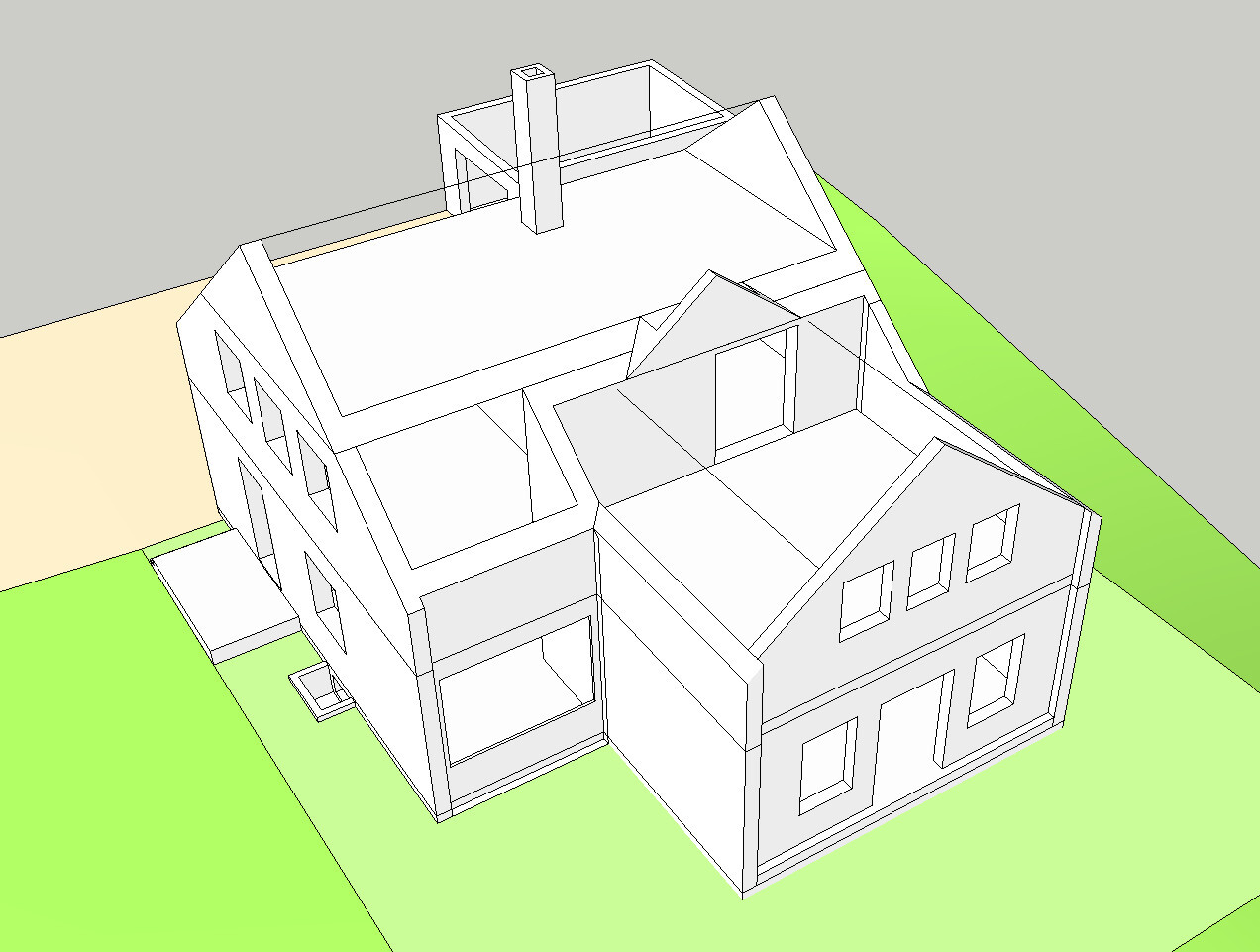
Option 2:
(Image in next post)
Option 3:
(Image in next post)
Current use:
The upper floor bedroom is used exactly for this purpose. It does not need to be larger as we spend most of the time elsewhere. A walk-in closet is unnecessary, as is a large bathroom. The bathroom size is sufficient; after renovation it will easily fit shower + bathtub + toilet + washbasin. The extra shower will be removed and converted into a storage room – possibly the toilet will be relocated there from the bathroom.
The other room is used as an office and guest room. It now seems likely that we will have children, so it could become a child’s room soon. Guests can easily sleep in the living room and mobile working from home could be done elsewhere (it is occasional and no external assignments).
It would be interesting to hear what an extension generally offers in terms of getting more out of the ground floor. I am reluctant to move the kitchen as it currently has new electrics, water and waste pipes and just needs renovation and refitting. Its size is sufficient and we prefer a closed kitchen.
There might be a completely different or complementary option:
According to the development plan, this plot is the only one where the garage area belongs to the building window. This means that residential development may apparently be possible here as well. However, the corner is somewhat shaded by neighbouring buildings, so the ground floor would hardly be suitable for living purposes (but perhaps garage with office/guest room on the upper floor).
Which option would you prefer, or am I missing the big picture?
How much might an extension like this (fully basemented!) roughly cost?
Thanks in advance to everyone and I am happy to answer any questions.
we are planning to replace the existing conservatory at our house with a new extension in the medium term. We already have some ideas but still have some time. However, we want to keep the goal in mind in order to complete necessary preliminary work or avoid blocking future options.
For the introduction, I am using the questionnaire for standard floor plan planning as far as possible, although many answers naturally reflect the current situation:
Development Plan / Restrictions
- Plot size: 787m² (8,472 sq ft)
- Slope: no, just a slight incline
- Site coverage ratio: 0.2
- Floor area ratio: 0.3
- Building window, building line and boundary: see development plan, the north side of the building is the building line, otherwise approximately double the current area may still be built
- Development plan (1st amendment) (colored)
- Development plan (2nd amendment) (changes not relevant but more readable, black and white)
- Extract from development plan (oriented north):
- Edge development: generally not, but the entire garage/outdoor seating area is within the building window according to the development plan and may be fully built upon as inner development
- Number of parking spaces: Current: driveway accommodates 2x2 cars and 1 garage; desired: 2 parking spaces (in double garage)
- Number of storeys: 1 (inner development)
- Roof type: gable roof, knee wall 108cm (43 inches)
- Architectural style: original elements of regional style, modified standard model from Niedersächsische Heimstätte in improved design/quality
- Orientation: balcony/terrace facing south
- Maximum heights/limits: no specifications
- Other requirements: development plan imposes no restrictions
Client Requirements
- Basement, floors: 1 basement, 1 ground floor, 1 upper floor (partly sloped ceilings), 1 attic
- Number of occupants, ages: 2 (35 + 37)
- Space requirements on ground and upper floors
- Office: home office + guest room
- Guest stays per year: 4 times, 2-3 people each
- Closed architecture
- Conservative construction style with modern elements (fitting the house type)
- Closed kitchen
- Number of dining seats: breakfast area in kitchen, dining area in living room
- Fireplace: planned for living room
- Music/stereo wall: TV with 7.1 surround sound system available
- Balcony: exists but unnecessary
- Roof terrace: no
- Garage: exists, too small; goal: double garage
- Carport: no
- Utility garden: yes
- Greenhouse: no
House Design
- Designer:
- Original design is a standard house from Niedersächsische Heimstätte
- Built in Wolfsburg for the middle class in the 1960s
- Modified compared to standard (bathroom with bidet [instead of a child’s room], additional shower on upper floor [instead of bathroom], extra WC on ground floor, only one flue due to district heating, real wood parquet flooring)
- Around 1995 a conservatory was added to the terrace (balcony was extended with a bitumen roof)
- Outdoor seating roof was extended and front closed with sliding glass doors
- Brick slips on two sides of the house, external thermal insulation composite system (ETICS) on the other two sides
- What do you particularly like? Why? Compact and not too large, still some 1960s charm but not outdated
- What don’t you like? Why? Living room is too dark due to conservatory, partly too narrow for practical furnishing
- Price estimate by architect/planner: n/a
- Personal price limit for house including fittings: n/a
- Preferred heating technology: currently district heating for heating (high pressure, direct without heat exchanger), instant water heater/boiler for hot water. Planned: district heating for heating and hot water with buffer storage and connection options for additional alternative energy sources (solar thermal, geothermal [only shallow foundation allowed]). Air source heat pump probably unsuitable due to no underfloor heating, possibly after renovation in bathroom/kitchen.
Order: basement, ground floor, upper floor, cross-section
Exterior views:
3D drawing comparing original (with old terrace) and conservatory extension (including new terrace):
(dark green lawn = building window)
As mentioned at the beginning, we are planning to replace the conservatory with a better solution in the medium term.
The goal is to have a room serving a similar function: a bright room with a nice view of the garden, for example through large lift-and-slide doors. However, it should also meet the requirements of a living space (proper thermal insulation, solid walls instead of aluminum frames, adequate heating, tight roof).
We are still uncertain about some fundamental aspects:
- Separate room or large opening to living room (and possibly a partition there – essentially a "rotation of the living room")
- What happens with the bedroom (balcony not needed, currently no sloped ceiling; will it become a dead space or a walk-through room?)
- Which roof shape (extend existing, new roof with shallower pitch in front, side wing with its own ridge direction; however, no flat roof or cubic shape)
Option 1:
- “Separate” extension with its own ridge
- Advantage: depth variable according to space requirements as long as proportions with main house are acceptable
- Disadvantage: bedroom becomes a walk-through room with little light, and what is the purpose of the additional room on the upper floor (consider 2m (6.5 ft) head height line)?
Option 2:
- Separate roof with a shallower pitch
- Advantage: size still variable, light in bedroom (balcony door becomes window)
- Disadvantage: appearance and proportions, roof too flat
(Image in next post)
Option 3:
- Extension of existing roof,
- Advantage: best visual solution, subtle modern elements possible (e.g., large window), allowing light in bedroom as balcony door remains as floor-to-ceiling window with parapet
- Disadvantage: bedroom window (former balcony door) faces into room, room depth precisely defined by roof intersection
(Image in next post)
Current use:
The upper floor bedroom is used exactly for this purpose. It does not need to be larger as we spend most of the time elsewhere. A walk-in closet is unnecessary, as is a large bathroom. The bathroom size is sufficient; after renovation it will easily fit shower + bathtub + toilet + washbasin. The extra shower will be removed and converted into a storage room – possibly the toilet will be relocated there from the bathroom.
The other room is used as an office and guest room. It now seems likely that we will have children, so it could become a child’s room soon. Guests can easily sleep in the living room and mobile working from home could be done elsewhere (it is occasional and no external assignments).
It would be interesting to hear what an extension generally offers in terms of getting more out of the ground floor. I am reluctant to move the kitchen as it currently has new electrics, water and waste pipes and just needs renovation and refitting. Its size is sufficient and we prefer a closed kitchen.
There might be a completely different or complementary option:
According to the development plan, this plot is the only one where the garage area belongs to the building window. This means that residential development may apparently be possible here as well. However, the corner is somewhat shaded by neighbouring buildings, so the ground floor would hardly be suitable for living purposes (but perhaps garage with office/guest room on the upper floor).
Which option would you prefer, or am I missing the big picture?
How much might an extension like this (fully basemented!) roughly cost?
Thanks in advance to everyone and I am happy to answer any questions.
 HausKaufBayern26 Aug 2024 13:00
Out of curiosity, since we have a house from the 1950s and this will eventually become relevant for us as well:
- Was there drainage back then? Do you have any photos of it?
- How was the foundation wall waterproofed underground? It looks like the soil was directly against the bricks. Or was there already a bitumen layer or something similar?
- Was there drainage back then? Do you have any photos of it?
- How was the foundation wall waterproofed underground? It looks like the soil was directly against the bricks. Or was there already a bitumen layer or something similar?
 LordNibbler26 Aug 2024 13:23
There was already a drainage system: loosely laid clay pipes placed one after another in a gravel bed. Additionally, there was a black coating (presumably bitumen).
In the visible base area, there are facing bricks, while in the ground, there are calcium silicate bricks.
It is likely that the clay soil was reintroduced, and only in a narrow strip around the house is permeable soil present.
During the renovation, the soil and stones (e.g., basement stairs) were clearly damp, whereas the drainage inside remained dry.
We hope that a new drainage system combined with waterproofing against hydrostatic pressure will make a significant difference in the basement.
In the visible base area, there are facing bricks, while in the ground, there are calcium silicate bricks.
It is likely that the clay soil was reintroduced, and only in a narrow strip around the house is permeable soil present.
During the renovation, the soil and stones (e.g., basement stairs) were clearly damp, whereas the drainage inside remained dry.
We hope that a new drainage system combined with waterproofing against hydrostatic pressure will make a significant difference in the basement.
LordNibbler26 Aug 2024 13:27hanghaus2023 schrieb:
So you have no windows left in the living room, then. I don’t quite understand that sentence.
The current living and dining room still has three windows; only the door to the old conservatory has been bricked up.
The new living room will also have three window or door openings—just none facing the immediate neighbor (east).
The new kitchen will have one window facing east but open to the dining area, which has a window facing west and is open to the living area.
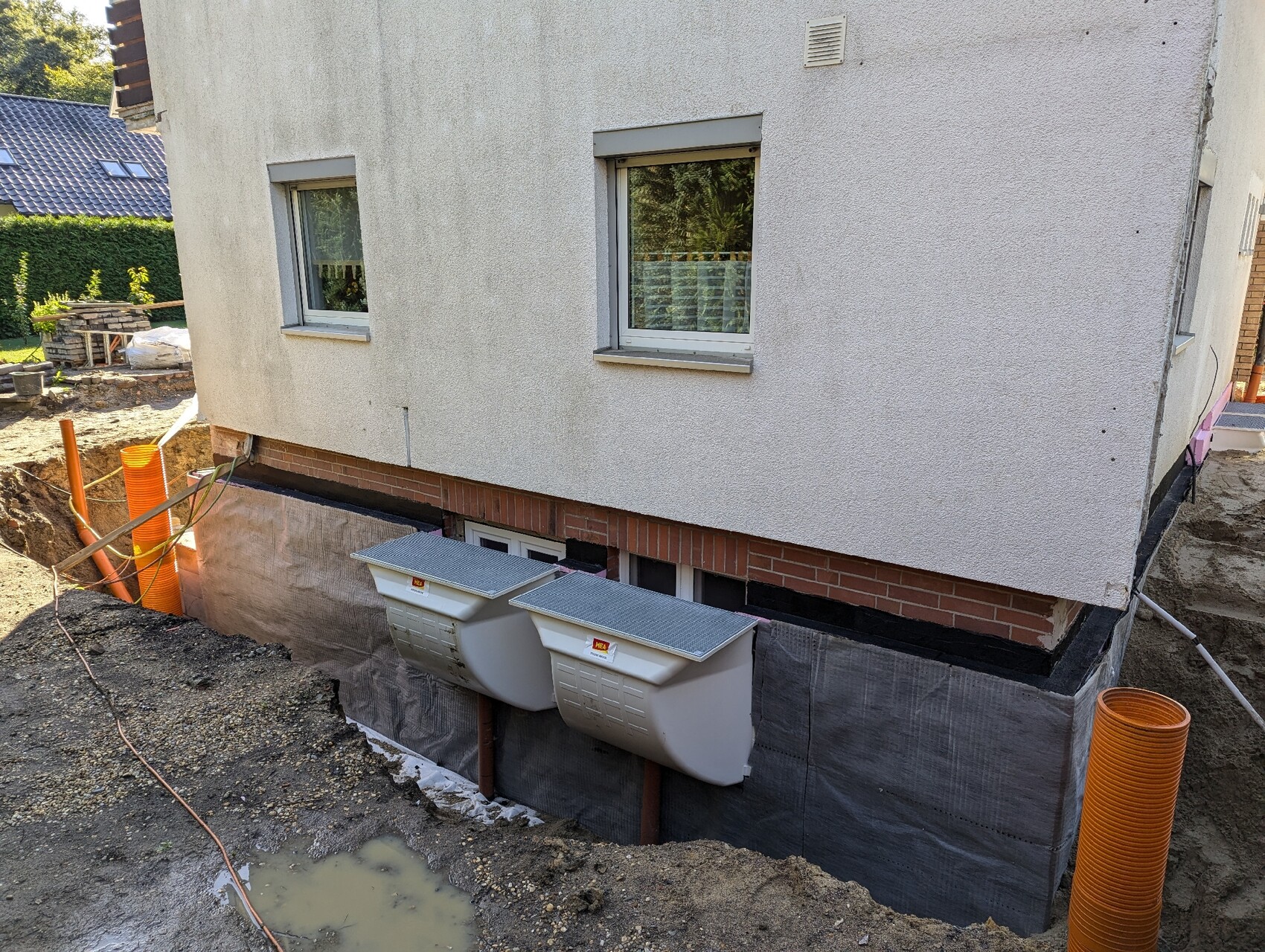
LordNibbler3 Oct 2024 00:19By now, a trench has been dug all around the house.
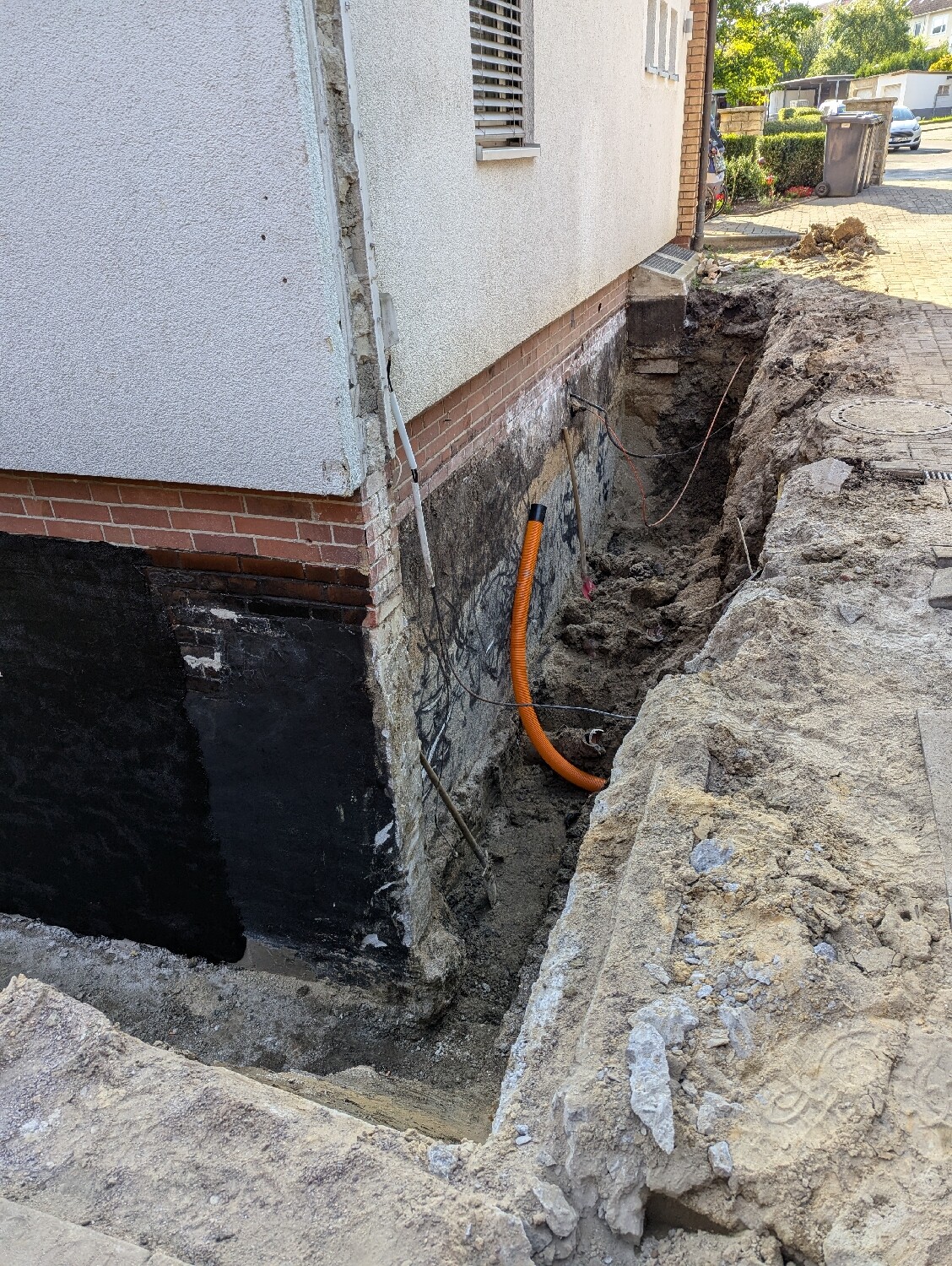
Then, the basement was newly waterproofed and insulated.
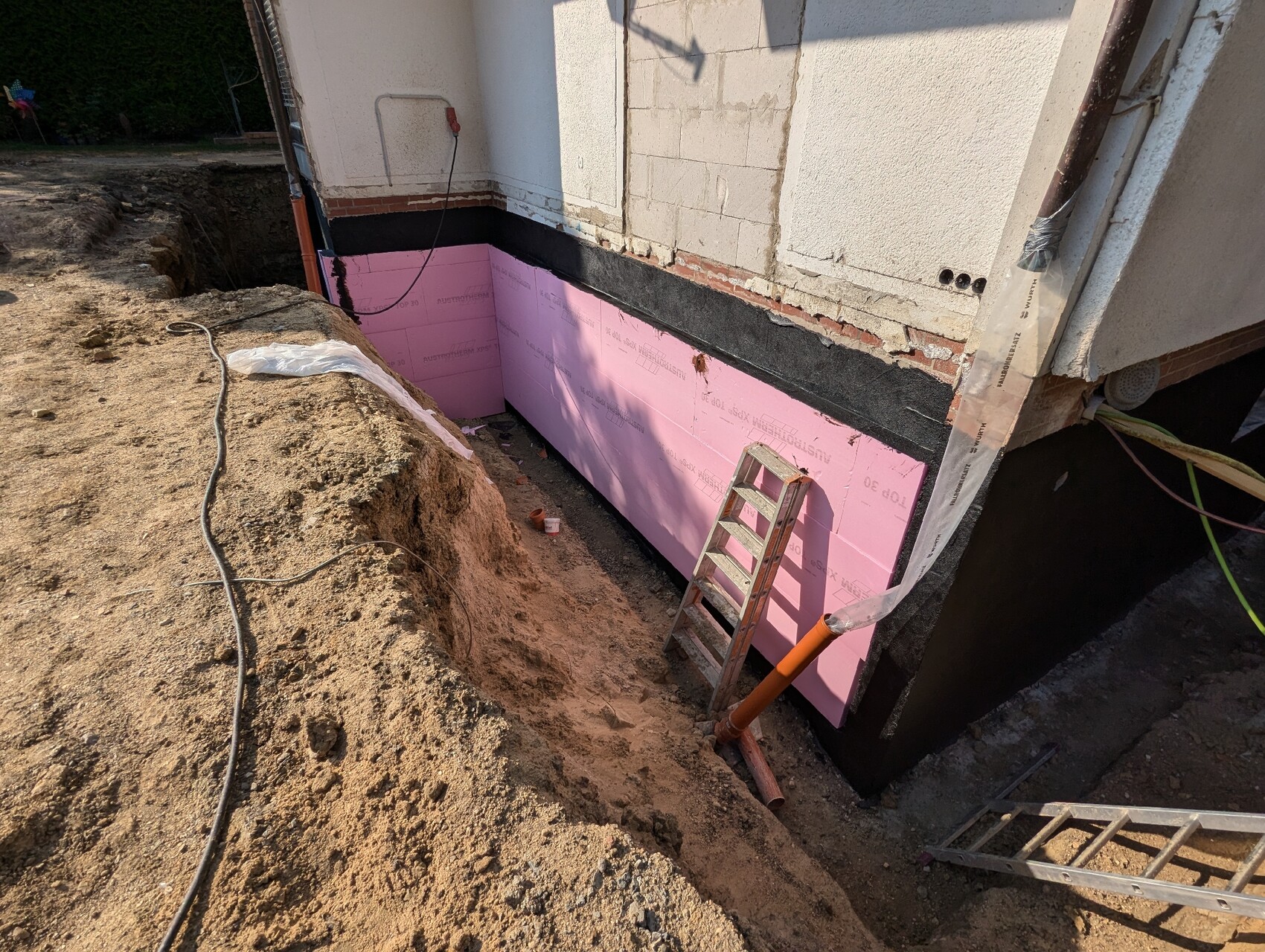
The drainage system was replaced and everything backfilled again.
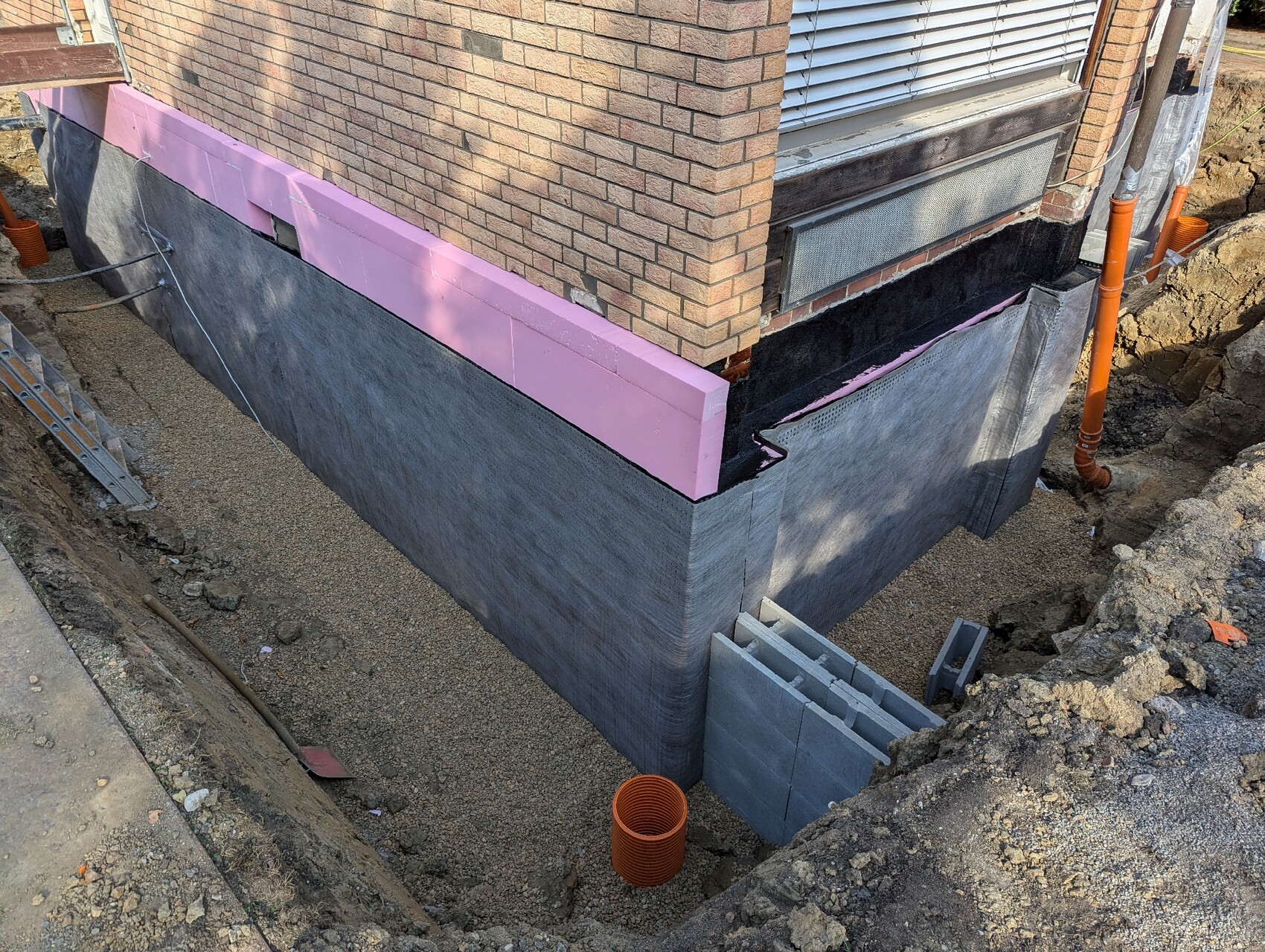
New light wells were also necessary.
For the extension, a frost protection strip (frost board) was installed.
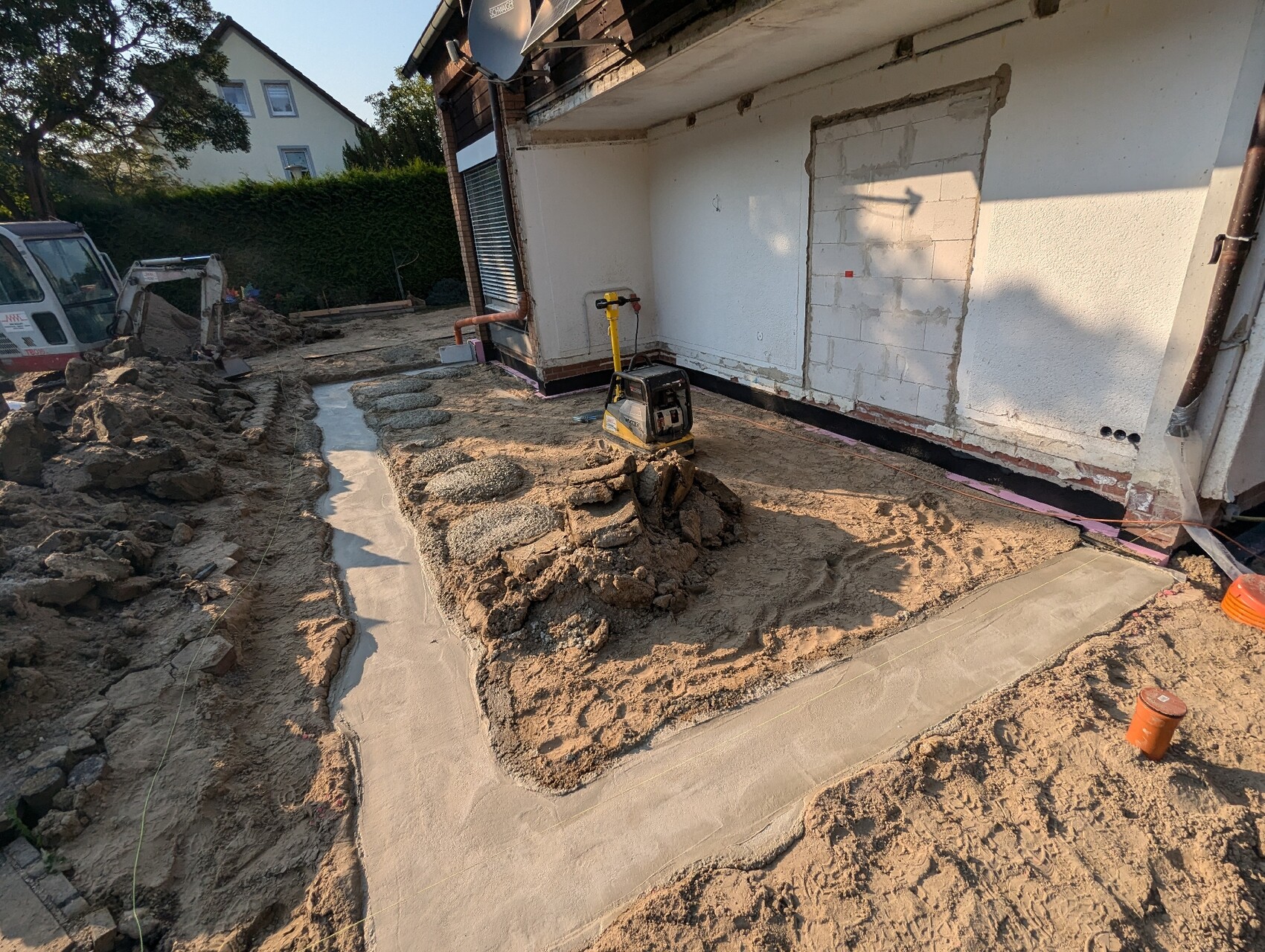
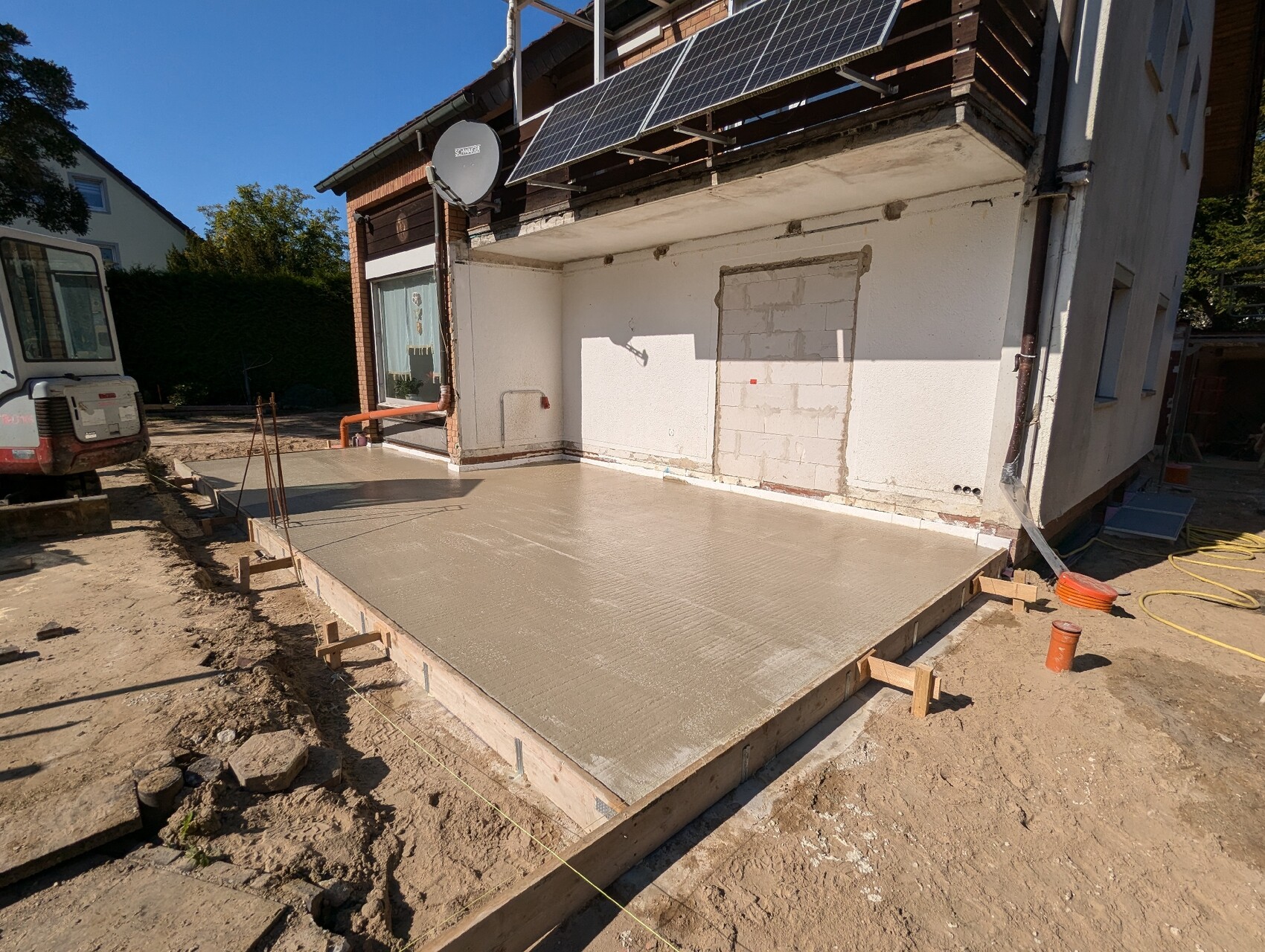
And the ground slab.
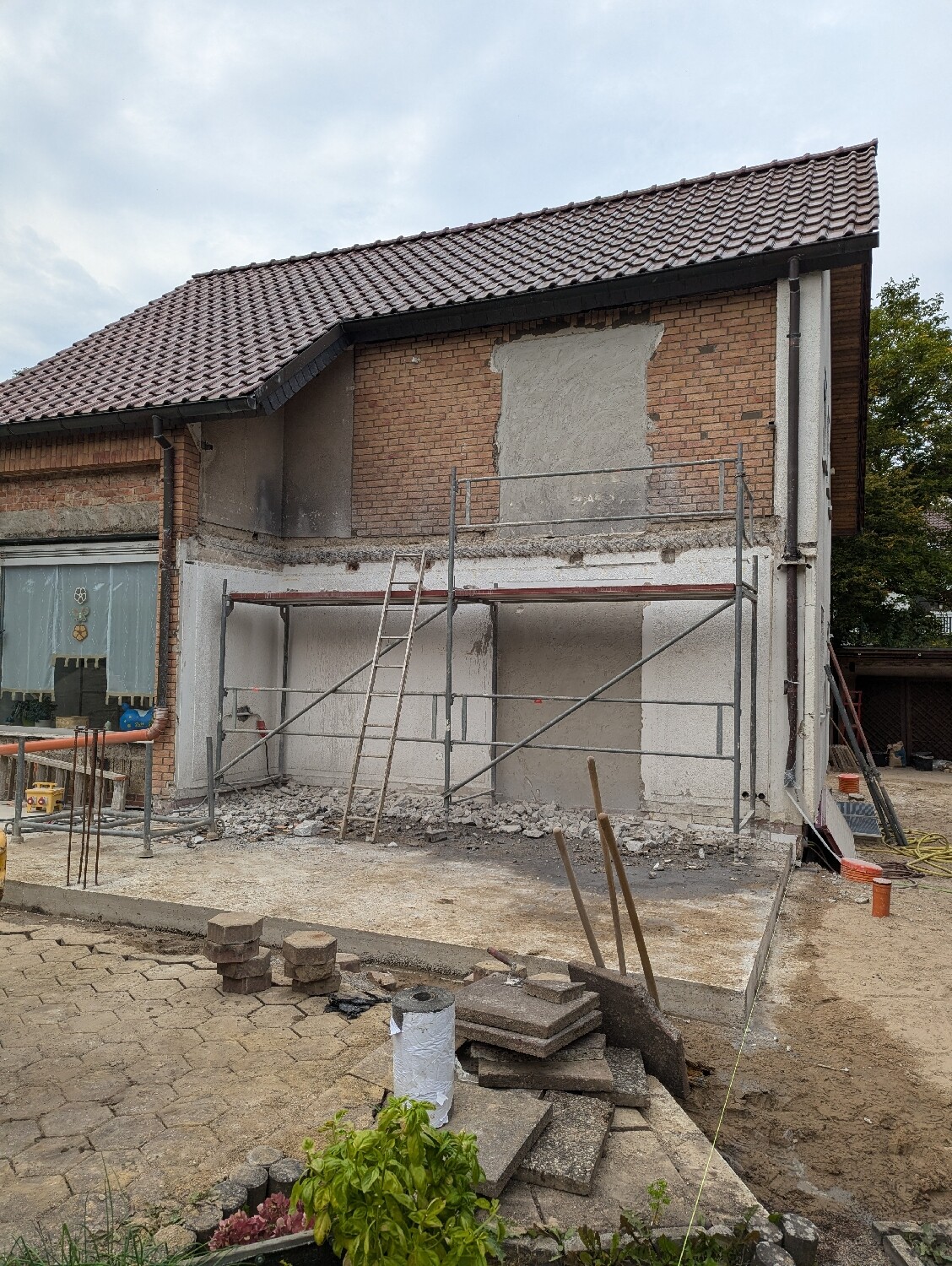
Then, the balcony slab was demolished.
And the ground floor of the extension was built with masonry.
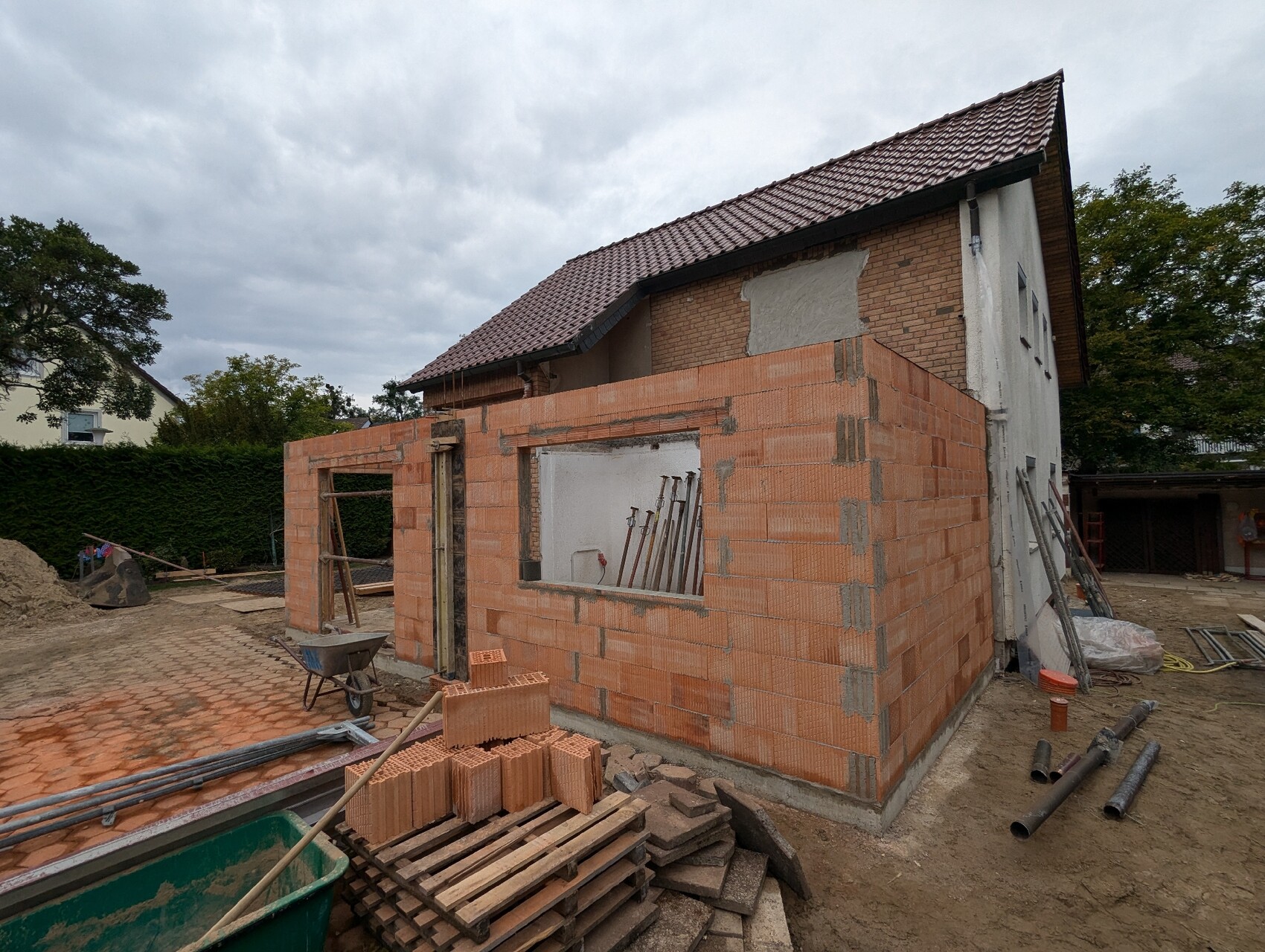
This was followed by formwork and reinforcement for the upper floor slab.
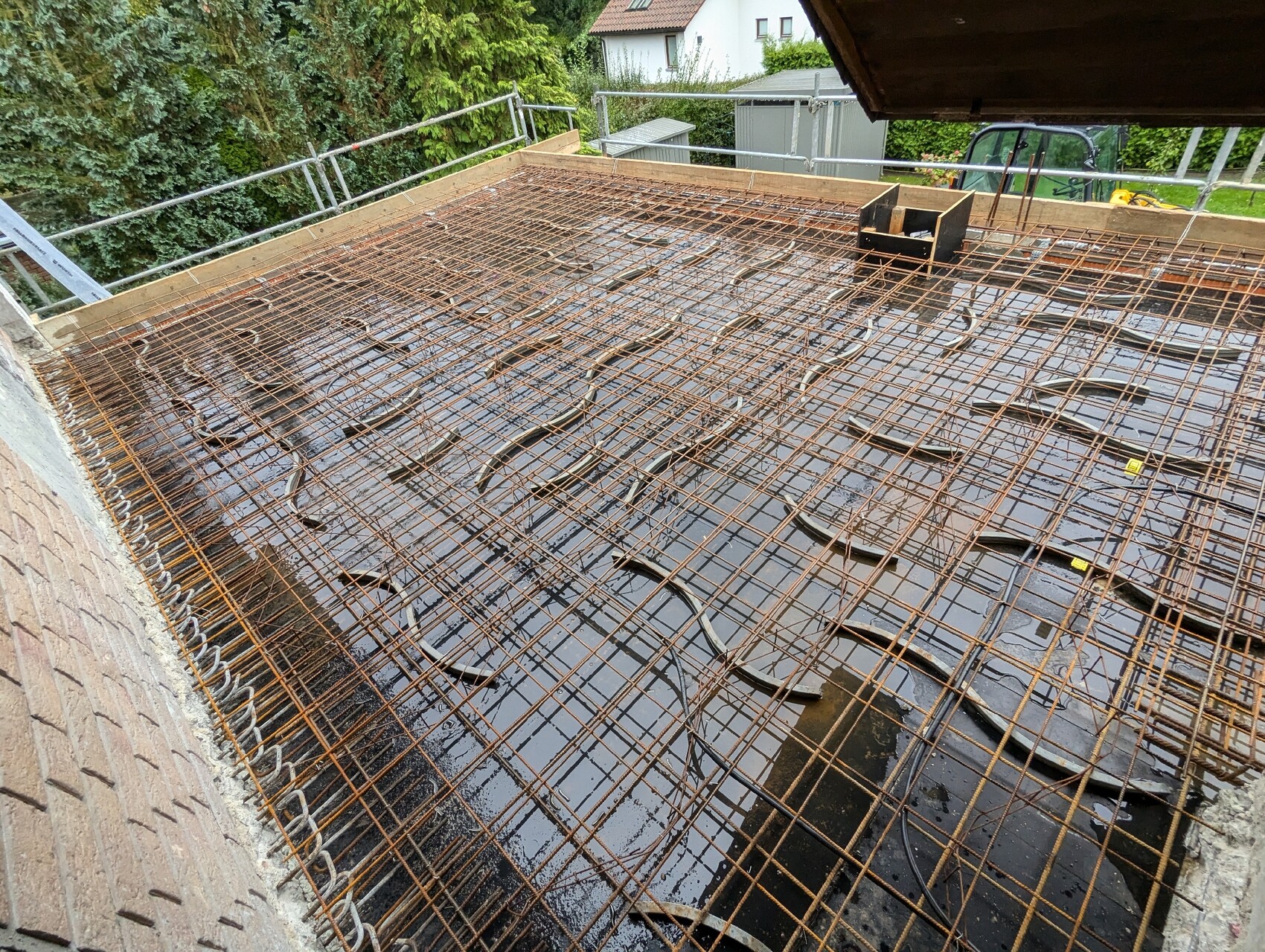
Which was freshly concreted today.
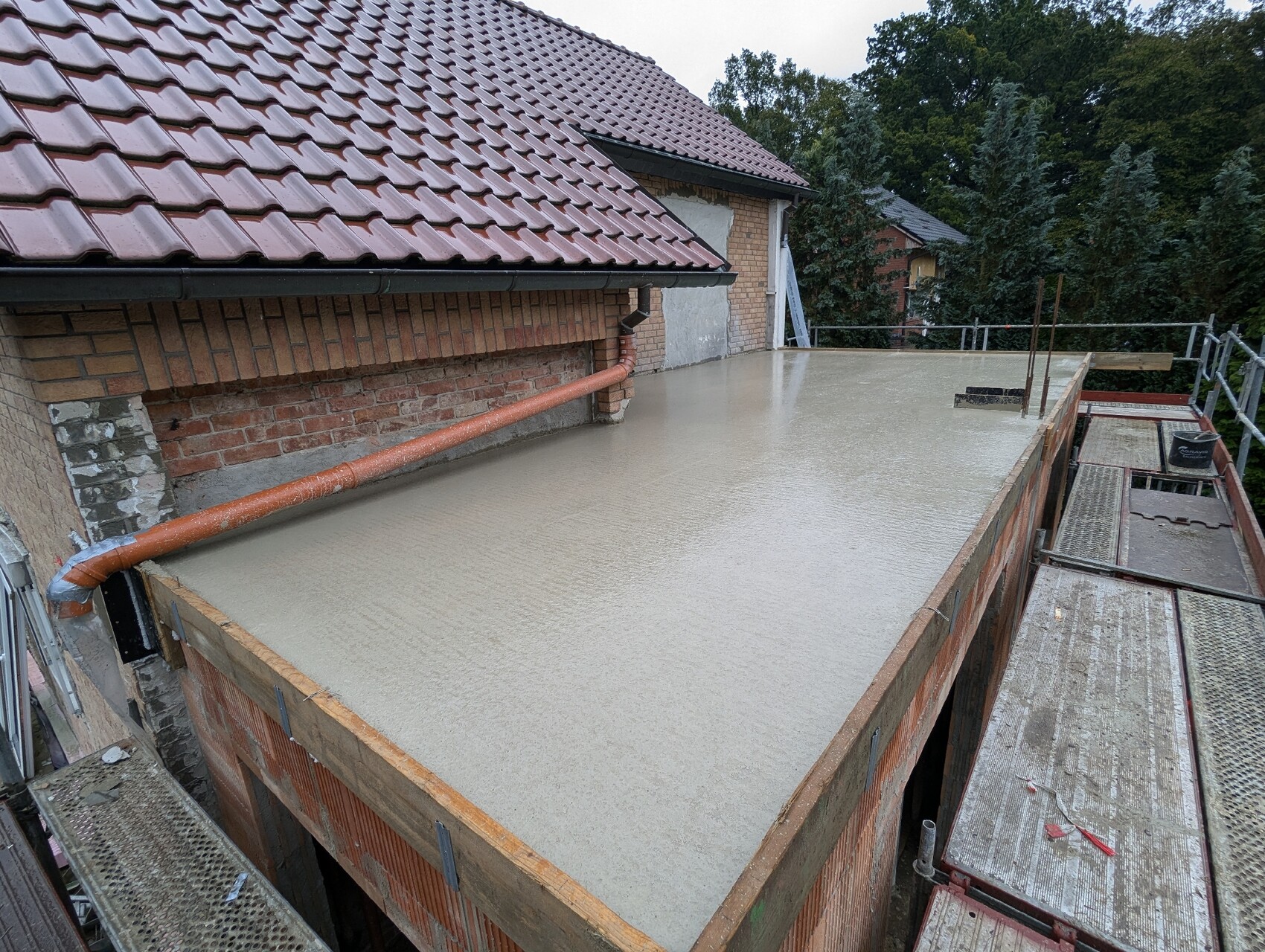
Next week, the upper floor will be built, allowing the carpenter to start with the roof soon.
Then, the basement was newly waterproofed and insulated.
The drainage system was replaced and everything backfilled again.
New light wells were also necessary.
For the extension, a frost protection strip (frost board) was installed.
And the ground slab.
Then, the balcony slab was demolished.
And the ground floor of the extension was built with masonry.
This was followed by formwork and reinforcement for the upper floor slab.
Which was freshly concreted today.
Next week, the upper floor will be built, allowing the carpenter to start with the roof soon.
LordNibbler13 Nov 2024 23:24A section was separated in the old children’s room for the extension.
The upper floor is expanding.
The roof structure is being installed.
Gable wall fully built.
And a new chimney.
Back view of the first picture. The overhang was removed here.
LordNibbler5 Dec 2024 23:31The roof of the extension is covered, all windows in the existing building have been replaced and installed in the extension.
The facade specialist has insulated the extension and is now working on the existing building.
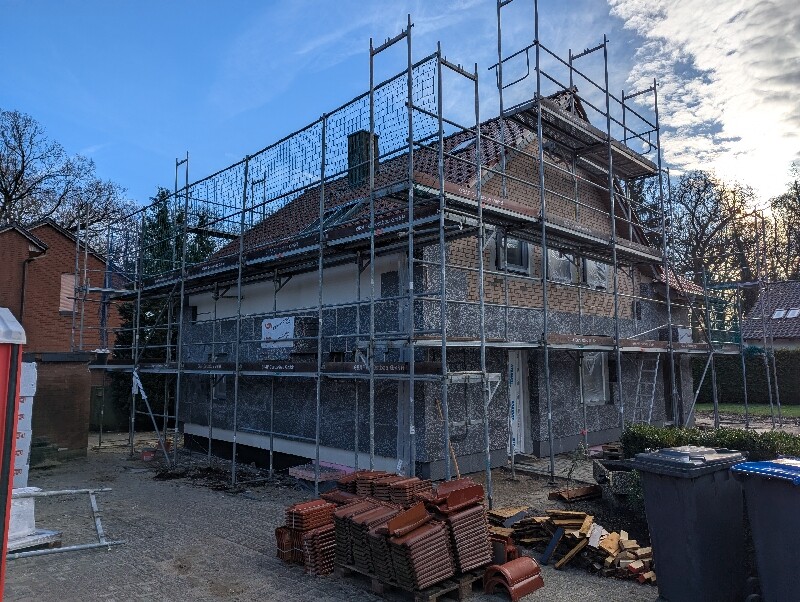
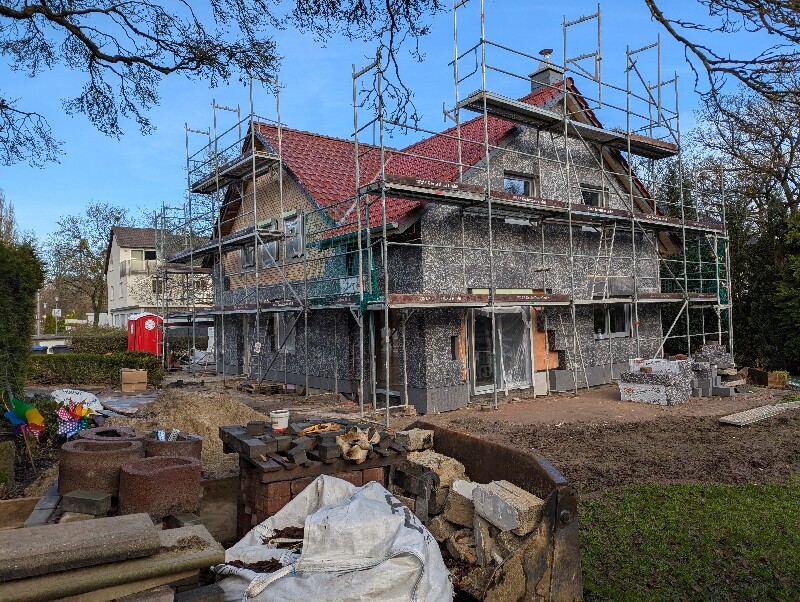
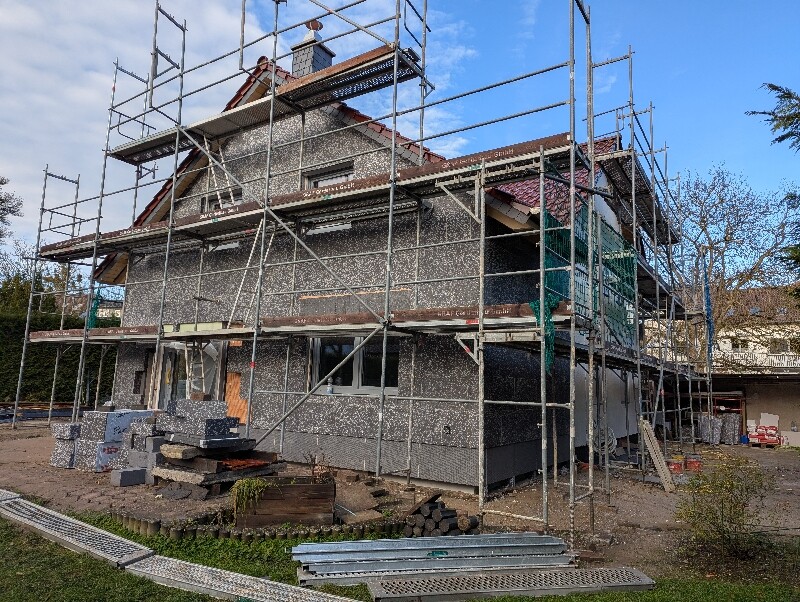
The facade specialist has insulated the extension and is now working on the existing building.
Similar topics