
ᐅ Extension of a single-story house in bungalow style with a 30-degree hipped roof
Created on: 29 Dec 2022 13:28
M
monty99
Hello,
We built a single-story L-shaped house in 2016 in a bungalow style, meeting the KFW70 standard. The house has approximately 170 m² (1,830 sq ft) of living space, features a reinforced concrete ceiling, and the roof is a hipped roof construction with an extension made of glued laminated timber at a 30-degree pitch.
Originally, the attic was intended only as a storage area, and its height was sufficient for that purpose. Now, however, we want to convert the attic into a living space, which was not planned for originally, but unfortunately, the height is inadequate.
We have considered two solutions so far: a hydraulic roof lift (which is not an option for us) or increasing the knee wall height. (Currently, there is no knee wall.) At the moment, there is a foldable loft ladder, but we have already planned a larger opening in the reinforced concrete ceiling for a proper staircase (now covered).
Since I am not an expert, I was hoping to find some advice and tips here.
In the first few years, the house developed some settlement cracks in the plaster. Because of this, I would like to have the foundation’s strength checked independently from any structural calculations before we even start planning the extension. How is this possible, and what costs should we expect?
The idea is to "remove" the roof and later reuse the usable parts (wooden beams, tiles, etc.). Then, build up the walls to a height of 1.2–1.4 m (4–4.5 ft) (At what point would this count as a second floor?). After that, the roof would be reinstalled as before. If possible, expansions like large roof windows and a photovoltaic system could be added during this process.
The development plan allows for a second floor, but of course, we would submit a building inquiry/planning permission request beforehand.
If it helps, here are some details about the house:
30 cm (12 inches) gravel filter layer under the base slab, delivered, installed, and compacted.
Base slab made of reinforced concrete C 20/25, 20 cm (8 inches) thick, reinforced with 2 layers Q257 plus necessary additions, on existing gravel sub-base including edge formwork and vapor barrier; delivered and installed.
Ceiling 20 cm (8 inches), complete.
Beams B/H 30/25 cm (12x10 inches) reinforced concrete beams including formwork up to 2.5 m (8 ft) height and reinforcement (150 kg/m³).
Reinforced concrete columns B/H 25/25 cm (10x10 inches), C25/30 concrete including formwork (height below 2.6 m / 8.5 ft) and reinforcement (140 kg/m³).
Aerated concrete masonry 36.5 cm (14 inches) GB 2.
Calcium silicate masonry 17.5 cm (7 inches) thick.
Calcium silicate masonry 11.5 cm (4.5 inches) thick.
Flat lintels made of aerated concrete, 17.5 cm (7 inches) thick.
Precast calcium silicate lintels 17.5/11.5 cm.
Details on the roof construction are as follows:
- Delivery, assembly, and raising of a hipped roof structure with an extension made of glued laminated timber.
- Roof pitch 30 degrees.
- Roof overhang 60 cm (24 inches).
- Supply and installation of galvanized metal fittings.
- Use of a mobile crane during roof assembly.
- Tongue-and-groove boarding 19.5 x 121 mm (¾ x 4¾ inches) installed as a cornice box including substructure, extending to the terrace area.
- Terrace beam made of laminated timber.
We plan to carry out the conversion within 1–3 years with a budget of 120,000 to 150,000 euros. Depending on the possibilities, we would like to add 1–2 large windows with access and possibly a photovoltaic system up to 10 kW peak. (An 18 kW peak system is already installed on a second building.)
We already have a brine geothermal heat pump that provides sufficient performance for the ground floor area. The floor will be equipped with full-surface underfloor heating like the ground floor.
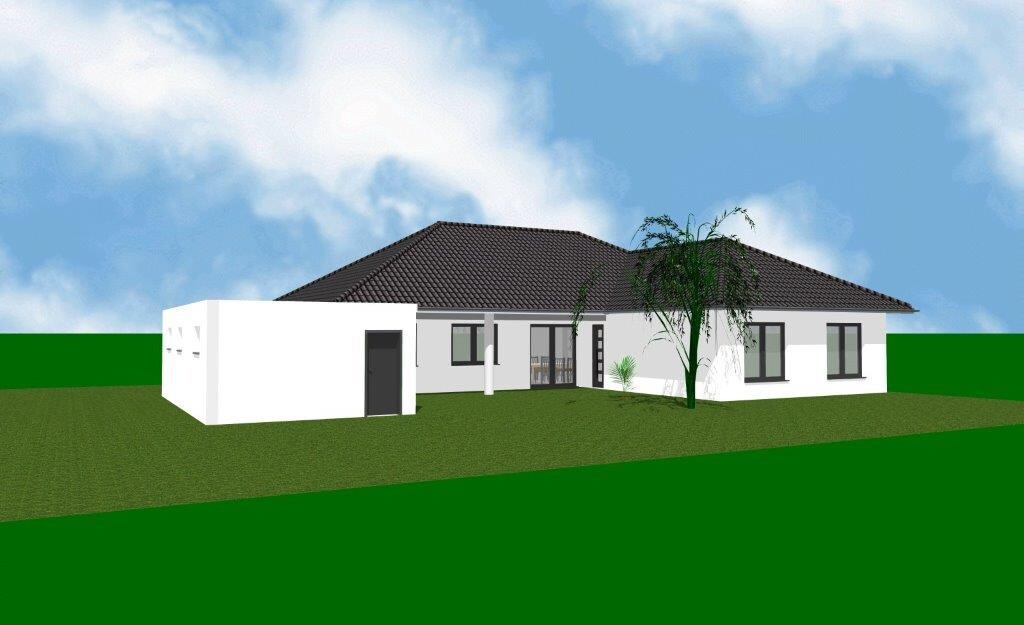
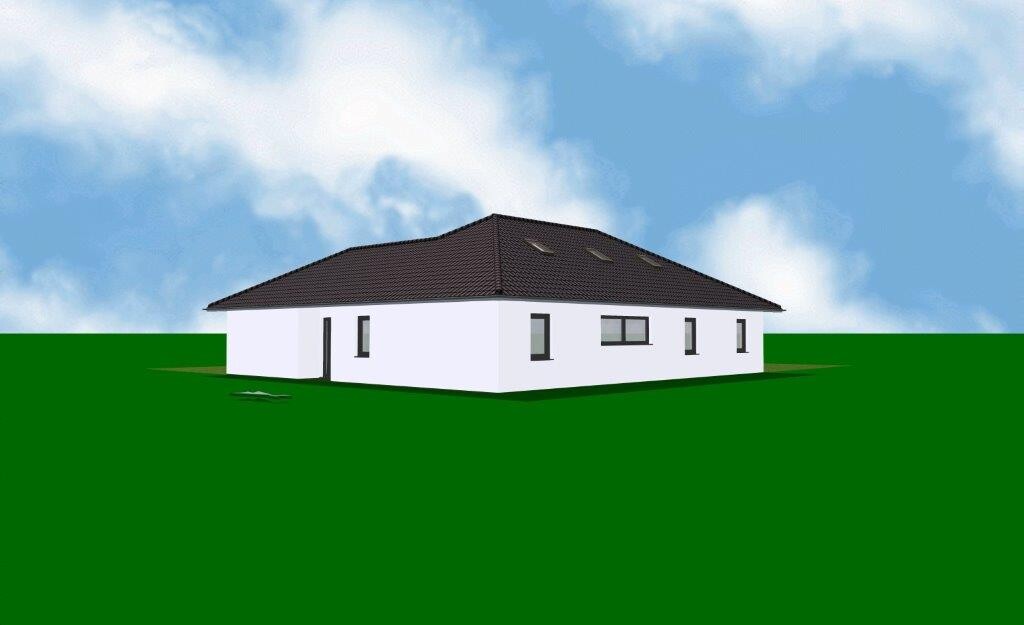
I have attached two pictures. The black-and-white photo shows the terrace and the garage on the left side.
Is our plan feasible? Is the budget roughly sufficient? How can we have the current foundation checked independently of a structural engineer?
Thank you very much for your advice!
We built a single-story L-shaped house in 2016 in a bungalow style, meeting the KFW70 standard. The house has approximately 170 m² (1,830 sq ft) of living space, features a reinforced concrete ceiling, and the roof is a hipped roof construction with an extension made of glued laminated timber at a 30-degree pitch.
Originally, the attic was intended only as a storage area, and its height was sufficient for that purpose. Now, however, we want to convert the attic into a living space, which was not planned for originally, but unfortunately, the height is inadequate.
We have considered two solutions so far: a hydraulic roof lift (which is not an option for us) or increasing the knee wall height. (Currently, there is no knee wall.) At the moment, there is a foldable loft ladder, but we have already planned a larger opening in the reinforced concrete ceiling for a proper staircase (now covered).
Since I am not an expert, I was hoping to find some advice and tips here.
In the first few years, the house developed some settlement cracks in the plaster. Because of this, I would like to have the foundation’s strength checked independently from any structural calculations before we even start planning the extension. How is this possible, and what costs should we expect?
The idea is to "remove" the roof and later reuse the usable parts (wooden beams, tiles, etc.). Then, build up the walls to a height of 1.2–1.4 m (4–4.5 ft) (At what point would this count as a second floor?). After that, the roof would be reinstalled as before. If possible, expansions like large roof windows and a photovoltaic system could be added during this process.
The development plan allows for a second floor, but of course, we would submit a building inquiry/planning permission request beforehand.
If it helps, here are some details about the house:
30 cm (12 inches) gravel filter layer under the base slab, delivered, installed, and compacted.
Base slab made of reinforced concrete C 20/25, 20 cm (8 inches) thick, reinforced with 2 layers Q257 plus necessary additions, on existing gravel sub-base including edge formwork and vapor barrier; delivered and installed.
Ceiling 20 cm (8 inches), complete.
Beams B/H 30/25 cm (12x10 inches) reinforced concrete beams including formwork up to 2.5 m (8 ft) height and reinforcement (150 kg/m³).
Reinforced concrete columns B/H 25/25 cm (10x10 inches), C25/30 concrete including formwork (height below 2.6 m / 8.5 ft) and reinforcement (140 kg/m³).
Aerated concrete masonry 36.5 cm (14 inches) GB 2.
Calcium silicate masonry 17.5 cm (7 inches) thick.
Calcium silicate masonry 11.5 cm (4.5 inches) thick.
Flat lintels made of aerated concrete, 17.5 cm (7 inches) thick.
Precast calcium silicate lintels 17.5/11.5 cm.
Details on the roof construction are as follows:
- Delivery, assembly, and raising of a hipped roof structure with an extension made of glued laminated timber.
- Roof pitch 30 degrees.
- Roof overhang 60 cm (24 inches).
- Supply and installation of galvanized metal fittings.
- Use of a mobile crane during roof assembly.
- Tongue-and-groove boarding 19.5 x 121 mm (¾ x 4¾ inches) installed as a cornice box including substructure, extending to the terrace area.
- Terrace beam made of laminated timber.
We plan to carry out the conversion within 1–3 years with a budget of 120,000 to 150,000 euros. Depending on the possibilities, we would like to add 1–2 large windows with access and possibly a photovoltaic system up to 10 kW peak. (An 18 kW peak system is already installed on a second building.)
We already have a brine geothermal heat pump that provides sufficient performance for the ground floor area. The floor will be equipped with full-surface underfloor heating like the ground floor.
I have attached two pictures. The black-and-white photo shows the terrace and the garage on the left side.
Is our plan feasible? Is the budget roughly sufficient? How can we have the current foundation checked independently of a structural engineer?
Thank you very much for your advice!
monty99 schrieb:
Hello,
I had mentioned that earlier in the text:Sorry, I missed the information about the heating system.

monty99 schrieb:
So far, there is a folding attic ladder, but we have already planned a larger opening in the reinforced concrete ceiling for a proper staircase (which is now covered).
Since I'm not an expert, I was hoping to find some advice and tips here. Then feed the experts here (with the completed questionnaire, floor plan, and sections of the existing house) and explain your wishes or motivation: are you becoming less mobile and want to create space for a caregiver, or on the contrary, have you unexpectedly been blessed with triplets?
By the way, I can generally imagine it being quite sensible to only add an extension to the main wing of the L-shaped building. However, my first choice would probably be to consider changing the property; a bungalow built in 2016 with a still perfectly adequate 170 m (187 square yards) is in demand on the market.
https://www.instagram.com/11antgmxde/
https://www.linkedin.com/company/bauen-jetzt/
Cronos86 schrieb:
Could you provide some data from the soil report (soil composition)?
Is the foundation only on 30 cm (12 inches) of gravel? I didn’t see anything mentioned about strip footings.
From what you describe, the bearing pressures might not be sufficient. It is a full slab foundation (not a strip footing).
Gravel filter layer thickness = 30 cm (12 inches); gravel filter layer beneath the slab, supply, install, and compact.
Reinforced concrete slab C 20/25, thickness = 20 cm (8 inches).
Reinforced concrete slab C 20/25, reinforced with 2 layers of Q257 steel plus required allowances,
on existing gravel sub-base including edge formwork portion and membrane; supply and construct.
The soil report includes the following data:
Soil type (DIN 1054): organic soil up to 0.70 m (28 inches) below ground level, then coarse-grained, non-cohesive soil.
Soil classes (DIN 18300): 1, 3, 4.
Groundwater and layer water: At the time of drilling, groundwater was encountered at 1.60 m (63 inches) below ground level.
Soil density (DIN 1054): dense packing (0.5 ≤ D < 1.0).
Permissible average soil pressure at 1.00 m (39 inches) & 0.50 m (20 inches) foundation width (DIN 1054 Table 1): 270 kN/m².
Design value σR,d of the bearing resistance for 1.00 m (39 inches) embedment depth & 0.50 m (20 inches) foundation width (DIN 1054:2010-12 Table A 6.1): 380 kN/m².
Stiffness modulus calculated ES (EAU): 25 MN/m².
Bearing modulus ks: 20,000 kN/m³.
Permeability coefficient kf: 1.3·10⁻⁴ m/s to 1.0·10⁻⁵ m/s.
The house will be built without a basement.
At the time of drilling, groundwater was found at 1.60 m (63 inches) below ground level. It may rise to 0.90–1.00 m (35–39 inches) below ground level during flood events of the nearby river (Fe++ deposits).
The detected subsoil conditions on site are ideal for constructing a single-family house without a basement. The existing gravel-sand to medium sand, gravelly to very gravelly soil is dense to very dense and required drilling no deeper than 3.00 m (10 feet).
The report requires a foundation depth of up to 1 meter (3.3 feet) to fully penetrate the organic layers down to 0.7 meters (2.3 feet).
As an alternative, a soil replacement of at least 0.7 meters (2.3 feet) would have been necessary. So 0.3 meters (1 foot) is clearly insufficient.
This would also explain the cracks in the existing structure.
If the foundation was actually constructed this way, it is already inadequate for the existing building. An additional storey should then not be added...
As an alternative, a soil replacement of at least 0.7 meters (2.3 feet) would have been necessary. So 0.3 meters (1 foot) is clearly insufficient.
This would also explain the cracks in the existing structure.
If the foundation was actually constructed this way, it is already inadequate for the existing building. An additional storey should then not be added...

Is it really possible nowadays, with the widespread conservative safety margins of structural engineers, to so significantly under-dimension a foundation? And then for the next trade (shell construction) to just ignore this? I find it hard to imagine. The potential damage is enormous, and someone has to take responsibility for it... Do you have any photos from the construction phase, especially of the excavation and building permit/inspection documents, etc.?
Similar topics