
Hello everyone,
I am currently planning our tiny house – well, it’s more like a garden shed on a boat trailer. It will be approximately 6 m (20 feet) long, 2.5 m (8 feet) wide, and 2.8 m (9 feet) high. There won’t be a sleeping loft, just two interior walls to create three rooms (bathroom/living area/bedroom). The house is not intended for permanent living; it will mainly be used as a guest room for weekends.
Since I’m mostly working on the construction by myself, I want to keep the design as simple as possible and was thinking about a custom-made log cabin style. I would have the logs prefabricated by a suitable manufacturer. The logs weigh about 550 kg (1,210 lbs), and the trailer has a payload capacity of 3,200 kg (7,050 lbs). For insulation, I would like to use natural materials and avoid vapor barriers as much as possible.
My wall assembly from inside to outside is as follows:
34 mm (1.3 inches) spruce log
50 mm (2 inches) STEICO Flex
22 mm (0.9 inches) STEICO Universal
20 mm (0.8 inches) battens and ventilation gap
21 mm (0.8 inches) tongue and groove larch boards or tongue and groove cladding
What do you think of the log cabin idea in general? Maybe someone has experience with a similar construction method. Would this wall assembly work, or would I still need to include a vapor barrier?
Another concern is the natural movement of the logs. Assuming a change in humidity of 15% from summer to winter and a shrinkage factor of 0.33% for spruce, I estimate around 100 mm (4 inches) of expansion or shrinkage over a 2 m (6.5 feet) height. That could cause real problems for the insulation, which might develop gaps of up to 10 cm (4 inches) in extreme cases.
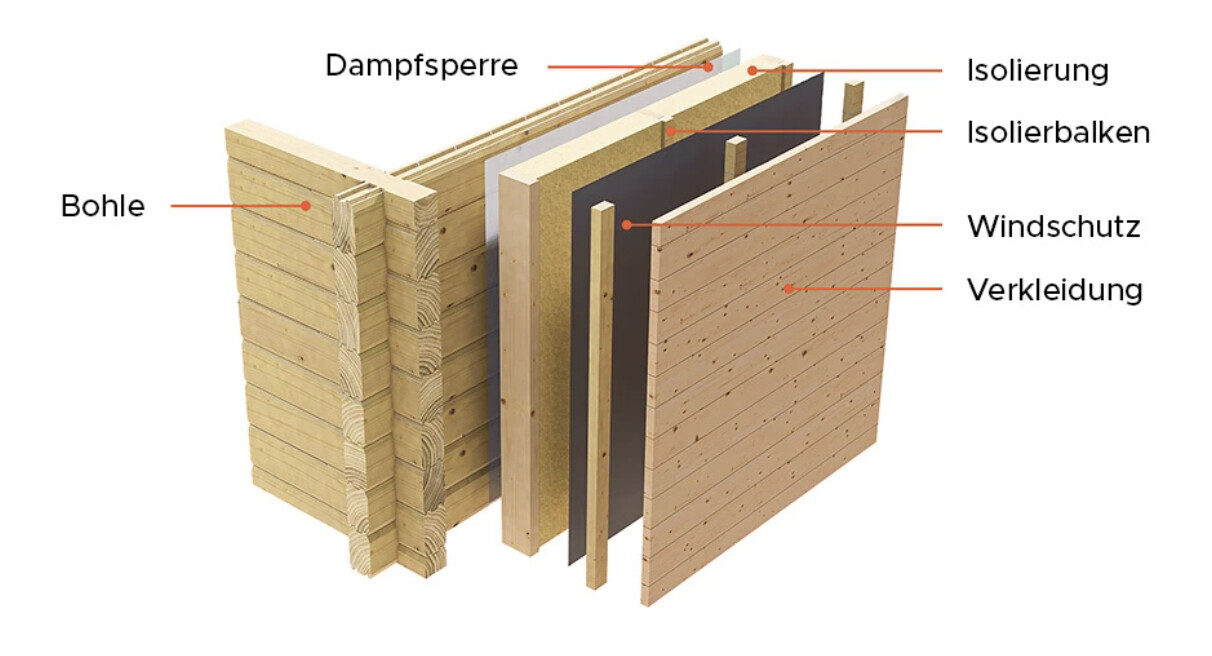
Here is a photo of the approximate wall assembly; note that I would like to omit the vapor barriers. That’s why I am using diffusion-open insulation with wood fiber and the STEICO Universal as a wind protection layer.
I look forward to your feedback.
Best regards, Björn
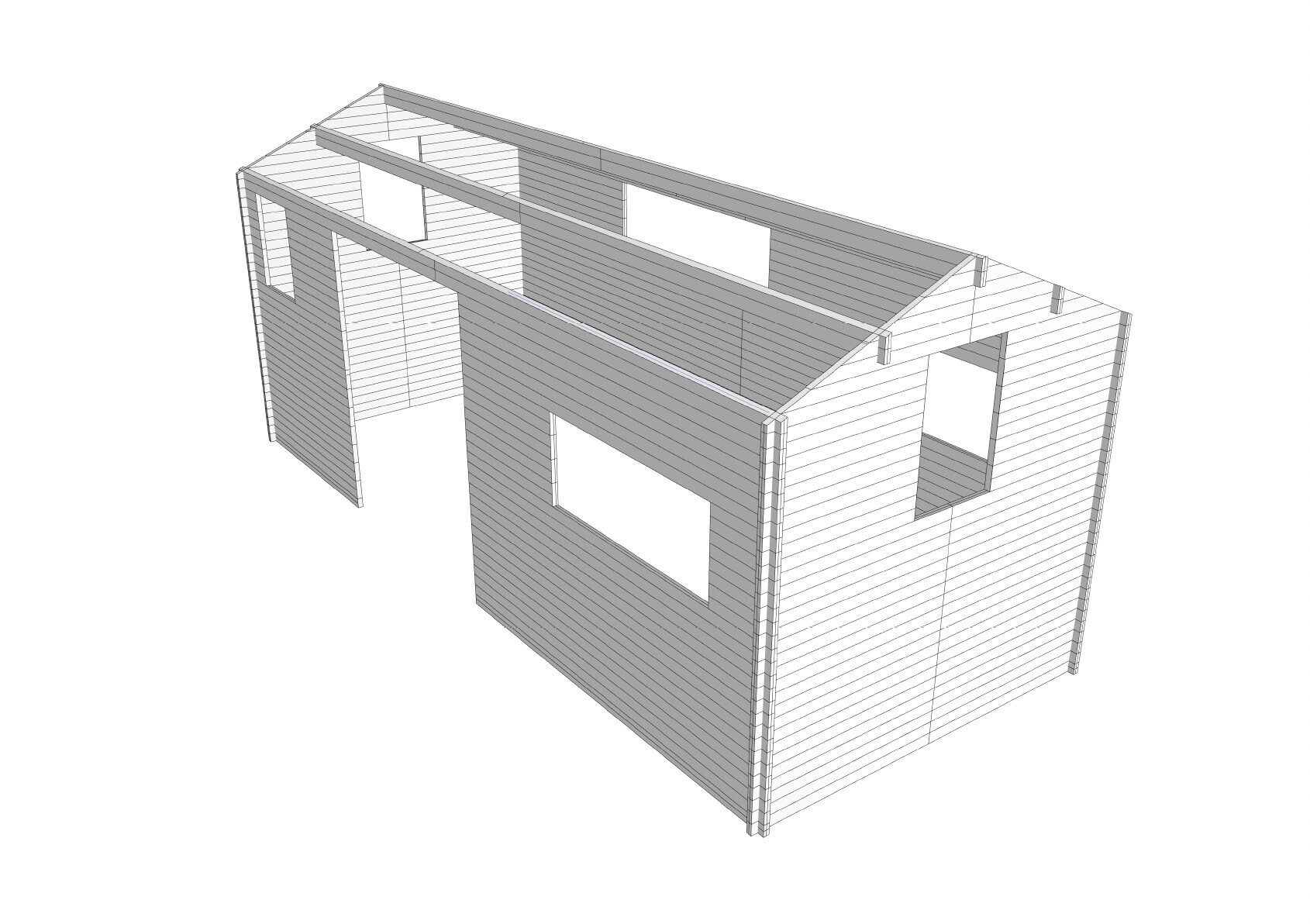
I am currently planning our tiny house – well, it’s more like a garden shed on a boat trailer. It will be approximately 6 m (20 feet) long, 2.5 m (8 feet) wide, and 2.8 m (9 feet) high. There won’t be a sleeping loft, just two interior walls to create three rooms (bathroom/living area/bedroom). The house is not intended for permanent living; it will mainly be used as a guest room for weekends.
Since I’m mostly working on the construction by myself, I want to keep the design as simple as possible and was thinking about a custom-made log cabin style. I would have the logs prefabricated by a suitable manufacturer. The logs weigh about 550 kg (1,210 lbs), and the trailer has a payload capacity of 3,200 kg (7,050 lbs). For insulation, I would like to use natural materials and avoid vapor barriers as much as possible.
My wall assembly from inside to outside is as follows:
34 mm (1.3 inches) spruce log
50 mm (2 inches) STEICO Flex
22 mm (0.9 inches) STEICO Universal
20 mm (0.8 inches) battens and ventilation gap
21 mm (0.8 inches) tongue and groove larch boards or tongue and groove cladding
What do you think of the log cabin idea in general? Maybe someone has experience with a similar construction method. Would this wall assembly work, or would I still need to include a vapor barrier?
Another concern is the natural movement of the logs. Assuming a change in humidity of 15% from summer to winter and a shrinkage factor of 0.33% for spruce, I estimate around 100 mm (4 inches) of expansion or shrinkage over a 2 m (6.5 feet) height. That could cause real problems for the insulation, which might develop gaps of up to 10 cm (4 inches) in extreme cases.
Here is a photo of the approximate wall assembly; note that I would like to omit the vapor barriers. That’s why I am using diffusion-open insulation with wood fiber and the STEICO Universal as a wind protection layer.
I look forward to your feedback.
Best regards, Björn
W
WilderSueden1 Feb 2023 08:48How often will this be used during the cold season? If it is not very frequent, I would generally recommend a thicker board (e.g., 68mm (2.7 inches)) and leave out everything else.

You can find thousands of extremely helpful videos online about building tiny houses on trailers. I watched dozens of them when this trend started here in Germany and I was considering buying (or building) one myself.
I think the design you have chosen is too heavy and energy inefficient. Tiny houses (especially the "rolling tiny house" type) originate from carpentry traditions and are therefore often built with wood frame construction. The base insulation is usually XPS or polystyrene, with walls and ceilings insulated using mineral wool. The exterior cladding is often made of thermally modified wood (because it is lightweight and rot-resistant). Affordable options include thin spruce or fir tongue-and-groove boards. Cedar is great but quite expensive (my outdoor sauna is made of red cedar ;-)
Some builders who have considered legal approval for use as a primary residence—and the necessary building permits/planning permissions involved—have occasionally constructed and insulated walls and ceilings using steel or aluminum frames with XPS or similar insulation. At that time, there were special simplified regulations if the total area was below 50m² (540ft²). This approach is also more stable during transport (more torsion-resistant), and it saves space since the walls are thinner.
I spent a weekend in such a tiny house (the provider had one available for trial living near Leipzig). With a very small pellet stove, it was cozy and warm within minutes.
On a leased plot owned by my brother there is a tiny house (quite securely approved with a building permit/planning permission as a primary residence). It is heated by an air-water heat pump or an air-to-air heat pump. This tiny house was a shell-and-core build, also constructed using wood frame.
I would advise against inventing something completely new.
Good luck—and don’t forget to share photos here in the forum when it’s finished ;-)
I think the design you have chosen is too heavy and energy inefficient. Tiny houses (especially the "rolling tiny house" type) originate from carpentry traditions and are therefore often built with wood frame construction. The base insulation is usually XPS or polystyrene, with walls and ceilings insulated using mineral wool. The exterior cladding is often made of thermally modified wood (because it is lightweight and rot-resistant). Affordable options include thin spruce or fir tongue-and-groove boards. Cedar is great but quite expensive (my outdoor sauna is made of red cedar ;-)
Some builders who have considered legal approval for use as a primary residence—and the necessary building permits/planning permissions involved—have occasionally constructed and insulated walls and ceilings using steel or aluminum frames with XPS or similar insulation. At that time, there were special simplified regulations if the total area was below 50m² (540ft²). This approach is also more stable during transport (more torsion-resistant), and it saves space since the walls are thinner.
I spent a weekend in such a tiny house (the provider had one available for trial living near Leipzig). With a very small pellet stove, it was cozy and warm within minutes.
On a leased plot owned by my brother there is a tiny house (quite securely approved with a building permit/planning permission as a primary residence). It is heated by an air-water heat pump or an air-to-air heat pump. This tiny house was a shell-and-core build, also constructed using wood frame.
I would advise against inventing something completely new.
Good luck—and don’t forget to share photos here in the forum when it’s finished ;-)
Thank you very much for your detailed and knowledgeable feedback.
I will probably go with a timber frame construction and follow this build-up:
Floor, from inside to outside:
Would this construction sequence be correct?
I will probably go with a timber frame construction and follow this build-up:
Floor, from inside to outside:
- Floor covering
- 12 mm OSB 3 (Do I still need a vapor retarder?)
- 4x16 KVH with 16 cm (6 inches) Styrofoam insulation
- 12 mm OSB 3
- 13 mm spruce three-layer board
- Vapor retarder (Is this necessary?)
- 4x6 KVH with 6 cm (2.4 inches) stone wool insulation
- Vapor barrier
- 20 mm (0.8 inches) vertical battens (ventilation cavity)
- 20 mm (0.8 inches) rhombus profile cladding
- 13 mm spruce three-layer board
- Vapor retarder (Is this necessary?)
- 4x20 KVH with 20 cm (8 inches) stone wool insulation
- Vapor barrier
- 20 mm (0.8 inches) vertical battens (ventilation cavity)
- Roof made of trapezoidal sheet metal
Would this construction sequence be correct?
Similar topics