
Hello everyone,
We urgently need some help.
We have a question about the placement of the expansion joint.
Since we are not experts in construction, we wanted to ask here.
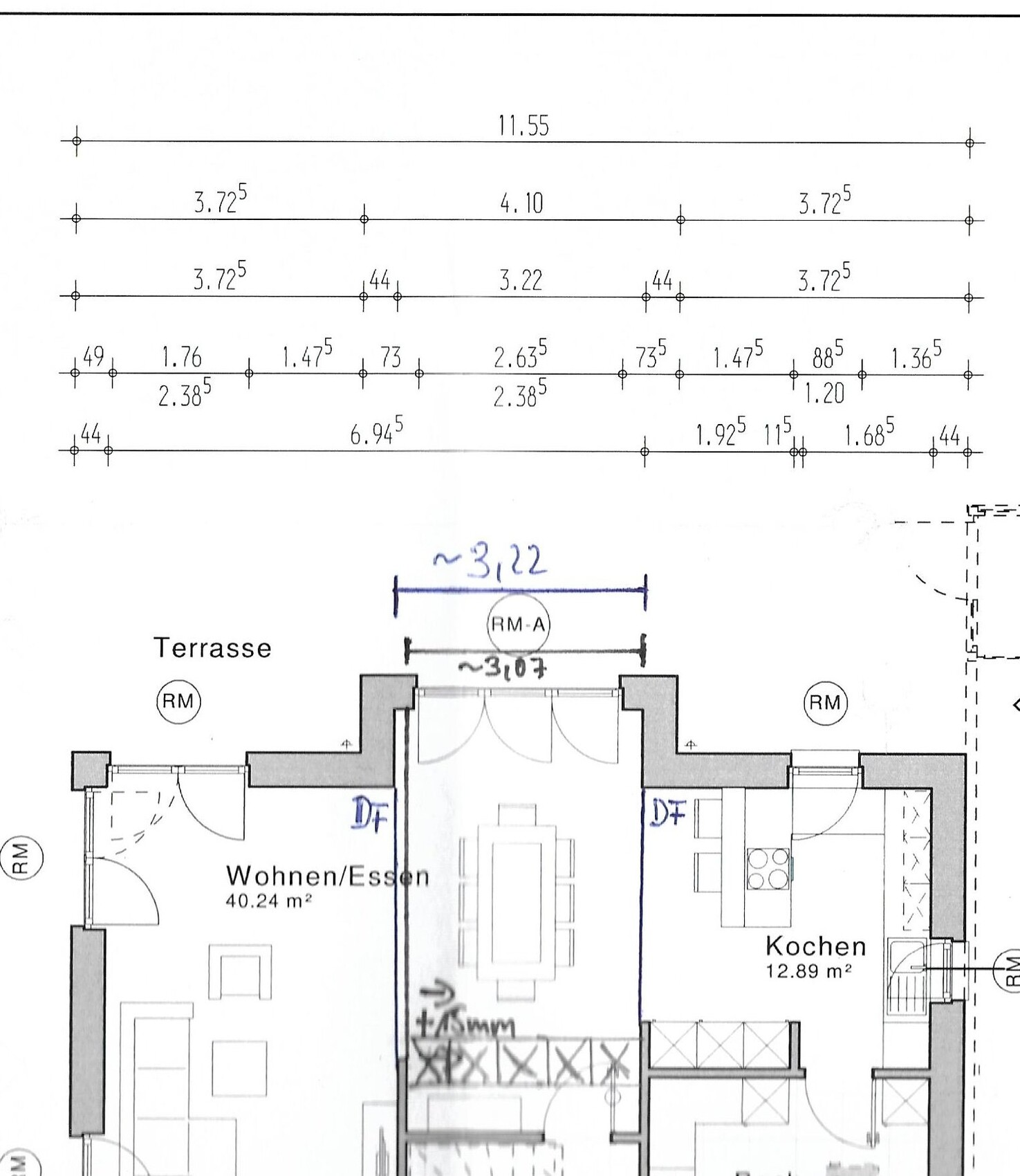
As the saying goes, a picture is worth a thousand words, so we have attached a sketch.
We hope this makes the situation clearer.
The expansion joints are marked with blue lines, showing how the screed installer would like to proceed.
However, with this setup, the distance between expansion joints would be about 3.22m (10 ft 7 in), and we would have to cut the sixth full 60x60cm (24x24 inch) tile.
Aesthetically, we think this looks completely wrong.
Therefore, we would like to move the expansion joint forward by 15mm (0.6 inch) (see the second black line).
This would reduce the distance to about 3.07m (10 ft 1 in), allowing us to fit five full tiles. That is our current idea.
Now for the main question: Are there any strict rules regarding the placement of expansion joints that would oppose this approach?
We are not talking about practical issues like the joint becoming longer, but about valid technical reasons why we should not do it this way.
Thank you very much for your help.
Best regards,
Nicole & Marcel
P.S. For cost reasons, we would like to avoid using uncoupling mats, and cutting an expansion joint into the screed later on is probably not possible due to the underfloor heating (pipe layout), right?
We urgently need some help.
We have a question about the placement of the expansion joint.
Since we are not experts in construction, we wanted to ask here.
As the saying goes, a picture is worth a thousand words, so we have attached a sketch.
We hope this makes the situation clearer.
The expansion joints are marked with blue lines, showing how the screed installer would like to proceed.
However, with this setup, the distance between expansion joints would be about 3.22m (10 ft 7 in), and we would have to cut the sixth full 60x60cm (24x24 inch) tile.
Aesthetically, we think this looks completely wrong.
Therefore, we would like to move the expansion joint forward by 15mm (0.6 inch) (see the second black line).
This would reduce the distance to about 3.07m (10 ft 1 in), allowing us to fit five full tiles. That is our current idea.
Now for the main question: Are there any strict rules regarding the placement of expansion joints that would oppose this approach?
We are not talking about practical issues like the joint becoming longer, but about valid technical reasons why we should not do it this way.
Thank you very much for your help.
Best regards,
Nicole & Marcel
P.S. For cost reasons, we would like to avoid using uncoupling mats, and cutting an expansion joint into the screed later on is probably not possible due to the underfloor heating (pipe layout), right?
H
hemali20037 Apr 2019 10:38Bookstar schrieb:
But he is talking about 15mm (0.6 inches), right? If it were 15cm (6 inches), I wouldn’t do anything at all; that’s more than enough for a quarter tile and not a very narrow piece…Take a look at the drawing – it’s not supposed to be 15 mm (0.6 inches). I can understand that they don’t want a cut tile right in the middle. It’s certainly possible to avoid, but not the way it’s shown in the drawing. It’s best to discuss this with the screed installer, who will probably have a good idea.

It’s about centimeters (307 vs. 322 cm), and I would "make a virtue out of necessity" by changing the direction of the flooring in the dining area: a deliberate separation line is less noticeable than an accidental one.
https://www.instagram.com/11antgmxde/
https://www.linkedin.com/company/bauen-jetzt/
https://www.instagram.com/11antgmxde/
https://www.linkedin.com/company/bauen-jetzt/