
ᐅ Drainage for patio doors and exterior window sills for floor-to-ceiling windows
Created on: 27 May 2023 17:35
W
WilderSueden
I need your help regarding exterior access points. On the ground floor, we have four floor-to-ceiling units. Two of them are patio doors with fixed glazing, and the other two have no doors. Currently, there is only a liquid waterproofing membrane applied at the bottom, but no window sill yet. The plasterer came by today and asked how I plan to proceed and by when, so he can finish the topcoat accordingly. Fortunately, I had already given it some thought last week.
There is 13cm (5 inches) of space under the roller shutter rail. I am considering using 8cm (3 inches) of XPS insulation, a 3cm (1 inch) granite slab on the units with doors (2cm (0.8 inches) on those without doors), and the rest for foam/mortar/slope. Does this make sense, or is this too tight?
At the moment, I am also unsure if, as a non-professional, it is better to use expanding foam or mortar. Foam has the advantage that excess can simply be trimmed off, while mortar might make it easier to create the correct slope. It is important to me that no water is absorbed there, which is why I am leaning towards expanding foam.
As far as I can tell, the window sills over about 2m (6.5 feet) are generally supplied in multiple parts anyway. The units with doors are very wide—one is 3m (10 feet) and the other 3.5m (11.5 feet). Does it make sense to combine pieces with 2cm (0.8 inches) and 3cm (1 inch) thickness, or would that just become a complicated hassle to save around 50€?
One more question about the surface finish: some stones are only available polished. Is that a serious problem during winter or when wet, or should we only choose flamed and brushed finishes?
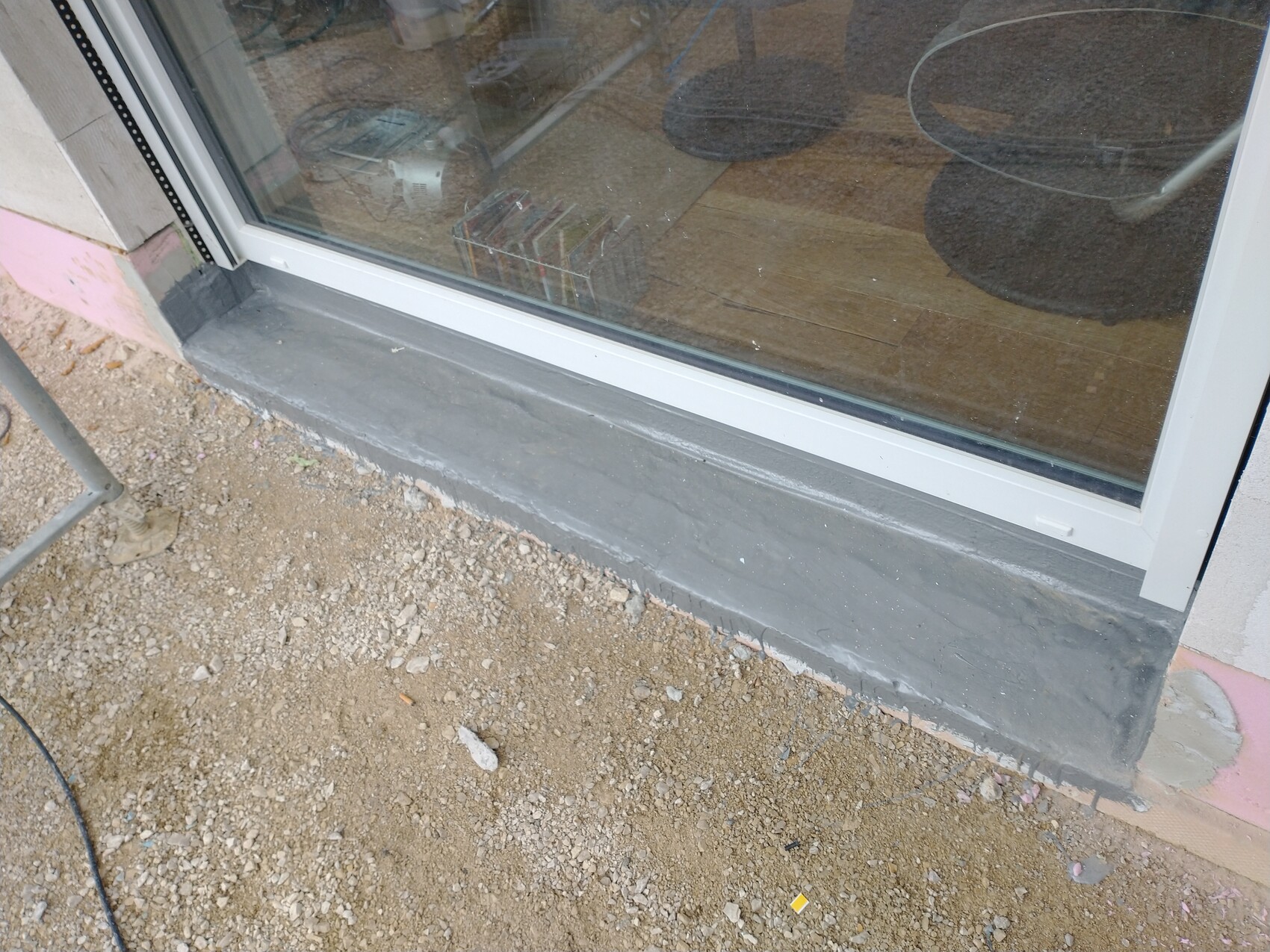
There is 13cm (5 inches) of space under the roller shutter rail. I am considering using 8cm (3 inches) of XPS insulation, a 3cm (1 inch) granite slab on the units with doors (2cm (0.8 inches) on those without doors), and the rest for foam/mortar/slope. Does this make sense, or is this too tight?
At the moment, I am also unsure if, as a non-professional, it is better to use expanding foam or mortar. Foam has the advantage that excess can simply be trimmed off, while mortar might make it easier to create the correct slope. It is important to me that no water is absorbed there, which is why I am leaning towards expanding foam.
As far as I can tell, the window sills over about 2m (6.5 feet) are generally supplied in multiple parts anyway. The units with doors are very wide—one is 3m (10 feet) and the other 3.5m (11.5 feet). Does it make sense to combine pieces with 2cm (0.8 inches) and 3cm (1 inch) thickness, or would that just become a complicated hassle to save around 50€?
One more question about the surface finish: some stones are only available polished. Is that a serious problem during winter or when wet, or should we only choose flamed and brushed finishes?
 bauenmk202028 May 2023 11:15
Please make a simple sketch (cross-section) of your plan.
With granite slabs, you usually have ones with drainage grooves on the left and right sides and a continuous groove along the bottom as a drip edge. We also have such slabs. These are installed with a slight slope.
I’m attaching two of my pictures. Unfortunately, I don’t have a photo from before the exterior plaster was applied showing the step fully installed. In my pictures, you can still see an aluminum strip running lengthwise, against which the granite slab is butted from below. You would also need that for your project.
Definitely do not use polished benches! The exit steps also need to maintain a minimum distance between the finished façade and the outer edge—meaning they should not protrude too far.
Can the plasterer not take care of this?
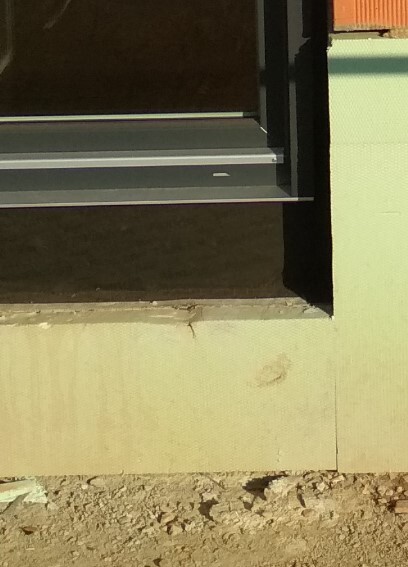
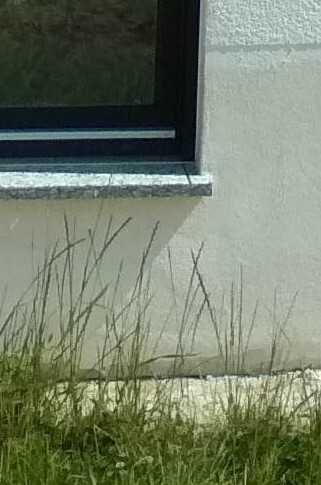
With granite slabs, you usually have ones with drainage grooves on the left and right sides and a continuous groove along the bottom as a drip edge. We also have such slabs. These are installed with a slight slope.
I’m attaching two of my pictures. Unfortunately, I don’t have a photo from before the exterior plaster was applied showing the step fully installed. In my pictures, you can still see an aluminum strip running lengthwise, against which the granite slab is butted from below. You would also need that for your project.
Definitely do not use polished benches! The exit steps also need to maintain a minimum distance between the finished façade and the outer edge—meaning they should not protrude too far.
Can the plasterer not take care of this?
WilderSueden schrieb:
the other two don’t have doors. So, basically fixed as well.
WilderSueden schrieb:
Two of them are patio doors with fixed glazing, I would either pave right up to the patio doors with fixed glazing or place the mentioned granite blocks there.
For the fixed sections, I would recommend matching the material you plan to use nearby (path, gravel, or lawn) or installing a window sill accordingly.
Of course, everything should be done so that nothing rubs (dimpled membrane, etc.). With exposure to rainwater, a drainage strip might also be necessary at the paved area?!
bauenmk202028 May 2023 11:3315cm (6 inches) gap without a channel. With a channel, I believe the norm is 5cm (2 inches). We are installing a channel in front of the exit step. Since we don’t have threshold-free floor-to-ceiling windows, we end up with about 5cm (2 inches) between the top edge of the frame profile and the top edge of the terrace.
I would also recommend using the same risers everywhere, with a thickness starting from 3cm (1 inch).
If the terrace is supposed to be lower, then the 15cm (6 inches) block step would be appropriate.
I would also recommend using the same risers everywhere, with a thickness starting from 3cm (1 inch).
If the terrace is supposed to be lower, then the 15cm (6 inches) block step would be appropriate.
M
motorradsilke28 May 2023 11:38WilderSueden schrieb:
The plasterer would then finish it with plaster. Before that, a dry bed will be installed as a drainage strip.
At first, I thought I would do it after the plasterer was done. But if they plaster it right away, that’s even better, and I don’t have to worry about the transition. However, that only works with fixed glazing. You can’t install a bed in front of doors.
I think a kind of windowsill, as you plan, is too small for doors. You need a minimum tread depth of 30cm (12 inches), preferably more. Then you would have less than half of that resting on it. I’d be concerned that it might break off forward. Or am I misunderstanding your plan?
I would rather choose steps like Nida35a; with those, you don’t need plastering, and you get a good step surface.
That’s what we have.

WilderSueden schrieb:
everything sealed with liquid membraneWhat on earth is meant by "liquid membrane"? The word "membrane" suggests a material in a solid state to me.https://www.instagram.com/11antgmxde/
https://www.linkedin.com/company/bauen-jetzt/

Similar topics