
ᐅ Installation using spacer mounting for the base plate of a steel column
Created on: 9 Apr 2026 08:50
F
FlrmnoHello everyone,
I hope this is the right subforum, as I couldn’t find a more suitable one. Otherwise, please feel free to correct me 🙂
I’m facing the following issue: for a wall demolition and subsequent support with a beam, the structural engineer has specified a steel column. He planned the installation using Fischer FAZ II plus 12/30 anchors set into the raw concrete and a backing with dry-pack mortar:
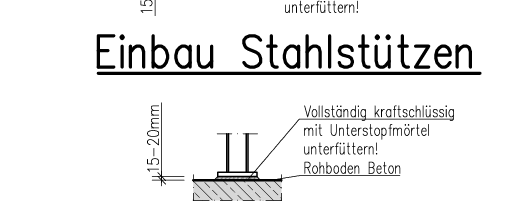
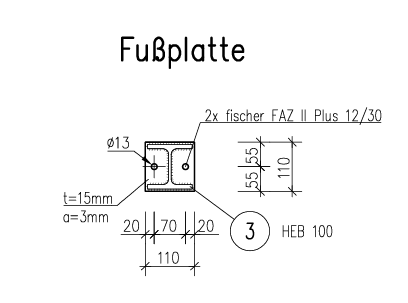
The steelworker measured on site and accounted for a 15 mm (0.6 inch) gap, resulting in the column being made slightly shorter. So now I need to install the column with a 15 mm (0.6 inch) clearance above the raw floor and provide backing underneath.
For exterior stairs or similar, I have seen solutions where the anchor bolt is fixed to the raw floor using a washer and nut, and then the base plate is adjusted and secured higher up with two more nuts. Unfortunately, my 15 mm (0.6 inch) gap is not enough for this method.
How would you approach this? Possibly by using spacers or washers between the floor and the base plate?
Alternatively, I could shim the base plate up to 15 mm (0.6 inch) with steel wedges, tighten the anchor bolt with the required torque, pack underneath with mortar, and then remove the wedges after the mortar has dried. Until the mortar is fully cured, the whole assembly would of course be supported by temporary shoring.
I would appreciate any opinions or ideas on how to proceed 🙂
I hope this is the right subforum, as I couldn’t find a more suitable one. Otherwise, please feel free to correct me 🙂
I’m facing the following issue: for a wall demolition and subsequent support with a beam, the structural engineer has specified a steel column. He planned the installation using Fischer FAZ II plus 12/30 anchors set into the raw concrete and a backing with dry-pack mortar:
The steelworker measured on site and accounted for a 15 mm (0.6 inch) gap, resulting in the column being made slightly shorter. So now I need to install the column with a 15 mm (0.6 inch) clearance above the raw floor and provide backing underneath.
For exterior stairs or similar, I have seen solutions where the anchor bolt is fixed to the raw floor using a washer and nut, and then the base plate is adjusted and secured higher up with two more nuts. Unfortunately, my 15 mm (0.6 inch) gap is not enough for this method.
How would you approach this? Possibly by using spacers or washers between the floor and the base plate?
Alternatively, I could shim the base plate up to 15 mm (0.6 inch) with steel wedges, tighten the anchor bolt with the required torque, pack underneath with mortar, and then remove the wedges after the mortar has dried. Until the mortar is fully cured, the whole assembly would of course be supported by temporary shoring.
I would appreciate any opinions or ideas on how to proceed 🙂
S
Simon-1899 Apr 2026 10:45Alternatively, I could shim the baseplate with steel up to 15 mm (0.6 inches), fix the anchor with the required installation torque, pack underneath, and after the mortar has dried, remove the shims. Until the mortar is fully cured, the entire structure will of course be supported by temporary props. Hello,
this is usually handled in a similar way. Pry the prop tight under the ceiling (for such small and "light" props, a crowbar usually works well) and shim it in the middle between the anchors with metal strips 30-40 mm (1.2-1.6 inches) wide, filling the air gap between the baseplate and the reinforced concrete beam as tightly as possible. Then install both anchors and pack the "remaining" gap firmly with expansive mortar.
Another option for the expansive mortar would be to arrange two additional drill holes in the baseplates of the prop (or drill them yourself if the prop is already in place). Shim and fasten the prop as described above, then form a formwork around the baseplate or support it somehow, and pour flowing grout through the two additional drill holes from above into the cavity. This grout is a very fluid concrete that fills all corners nicely.
Either way, I would ask the steel fabricator if they can supply metal strips for shimming. Shim plates in 10 mm, 5 mm, 3 mm, 2 mm (0.4, 0.2, 0.1, 0.08 inches). This way you can easily test what fits into the gap.
Best regards, Simon
That already reassures me since my idea matches practical experience, thanks!
Pressing under the ceiling is not that simple because a) I want to fix and align the support without the beam on it, and b) there must also be a gap between the beam and ceiling for packing mortar.
So first I'll check from below to reach the 15mm (0.6 inches) and then see how to proceed from above.
I think for the small base plate (11x11 cm / 4.3x4.3 inches), the extra drilling and a sack of Pagel is a bit over the top; I already have the parts here. I got P&T Eurogrout Plast 04, which I plan to use to fill all the gaps.
But I will definitely ask the steel fabricator to provide the plates so I can work more precisely. So far, I only had two 15 mm (0.6 inches) profiles delivered.
Best regards
Flo
Pressing under the ceiling is not that simple because a) I want to fix and align the support without the beam on it, and b) there must also be a gap between the beam and ceiling for packing mortar.
So first I'll check from below to reach the 15mm (0.6 inches) and then see how to proceed from above.
I think for the small base plate (11x11 cm / 4.3x4.3 inches), the extra drilling and a sack of Pagel is a bit over the top; I already have the parts here. I got P&T Eurogrout Plast 04, which I plan to use to fill all the gaps.
But I will definitely ask the steel fabricator to provide the plates so I can work more precisely. So far, I only had two 15 mm (0.6 inches) profiles delivered.
Best regards
Flo