
Hello everyone,
I plan to build a garden shed next year (see attachments). All building limits and regulations are being followed. I am keeping the volume under 75m³ (2,650 cubic feet) to avoid requiring a building permit / planning permission (Lower Saxony). No living space is planned, and I am observing the required setback distances.
For the construction, I will pour a concrete slab, build a 10x10cm (4x4 inch) base frame, and erect a stud frame at the corners with 10x10cm (4x4 inch) timber, while using 10x6cm (4x2 inch) timber elsewhere. I will also use 10x10cm (4x4 inch) timber as a support for the roof. The rafters are planned to be 6x18cm (2.5x7 inch) spaced at 50cm (20 inches). I want to create a slight roof pitch of 4 degrees at the 3.30m (11 foot) deep side. The less deep side will be proportionally higher to ensure a continuous roof slope. The roof edge will be finished all around with a parapet to keep the appearance straight.
I have roughly sketched the side walls. They are to be 2.20m (7 foot 3 inches) high, with two 10x10cm (4x4 inch) beams and, as pure stud framing, 2-meter (6.5 foot) beams in between.
What is the best way to design the support or rafters so they rest properly at an angle of about 4 degrees on the bearing surface? How should I proceed here? Ideally, I want to cut as little as possible on the rafters. I could use a wedge board at the front (but this usually doesn’t match the intended slope) and/or leave the back slightly lower. However, in that case, the rafters would not rest flush but at an angle.
Our current photovoltaic system will run for another 15 years. The shed has a perfect south-facing orientation, and I am considering installing a system on it as well. That is why I have planned the stud frame and rafters to be somewhat more robust.
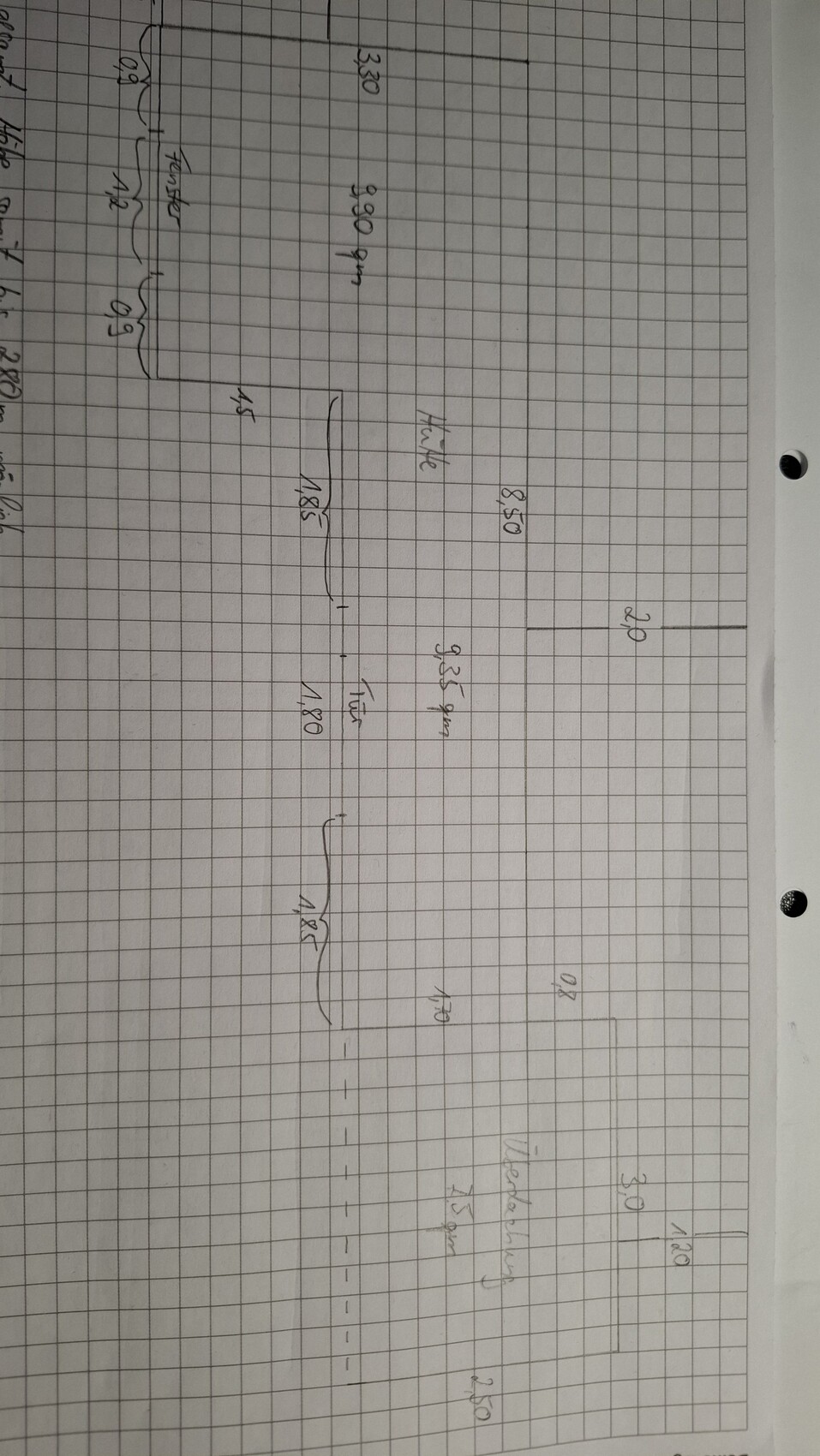
I plan to build a garden shed next year (see attachments). All building limits and regulations are being followed. I am keeping the volume under 75m³ (2,650 cubic feet) to avoid requiring a building permit / planning permission (Lower Saxony). No living space is planned, and I am observing the required setback distances.
For the construction, I will pour a concrete slab, build a 10x10cm (4x4 inch) base frame, and erect a stud frame at the corners with 10x10cm (4x4 inch) timber, while using 10x6cm (4x2 inch) timber elsewhere. I will also use 10x10cm (4x4 inch) timber as a support for the roof. The rafters are planned to be 6x18cm (2.5x7 inch) spaced at 50cm (20 inches). I want to create a slight roof pitch of 4 degrees at the 3.30m (11 foot) deep side. The less deep side will be proportionally higher to ensure a continuous roof slope. The roof edge will be finished all around with a parapet to keep the appearance straight.
I have roughly sketched the side walls. They are to be 2.20m (7 foot 3 inches) high, with two 10x10cm (4x4 inch) beams and, as pure stud framing, 2-meter (6.5 foot) beams in between.
What is the best way to design the support or rafters so they rest properly at an angle of about 4 degrees on the bearing surface? How should I proceed here? Ideally, I want to cut as little as possible on the rafters. I could use a wedge board at the front (but this usually doesn’t match the intended slope) and/or leave the back slightly lower. However, in that case, the rafters would not rest flush but at an angle.
Our current photovoltaic system will run for another 15 years. The shed has a perfect south-facing orientation, and I am considering installing a system on it as well. That is why I have planned the stud frame and rafters to be somewhat more robust.
Similar topics