
ᐅ Construction Details: Gap Between Ring Beam and Timber Flat Roof
Created on: 23 Nov 2025 20:21
T
tenspoplin5sT
tenspoplin5s23 Nov 2025 20:21Hi,
I was advised that I might get better help here in this forum.
We are having our roof constructed by a carpentry company. It is a warm roof with 25mm OSB4 as the sheathing, followed by a vapor barrier (approved bitumen membrane with sd > 100m), then 140mm aluminum-coated PIR insulation, 1.5mm EPDM membrane, and a green roof on top.
The masonry is 425mm aerated concrete, with a ring beam around it. On the outside is 100mm XPS insulation, and on the inside 325mm reinforced concrete.
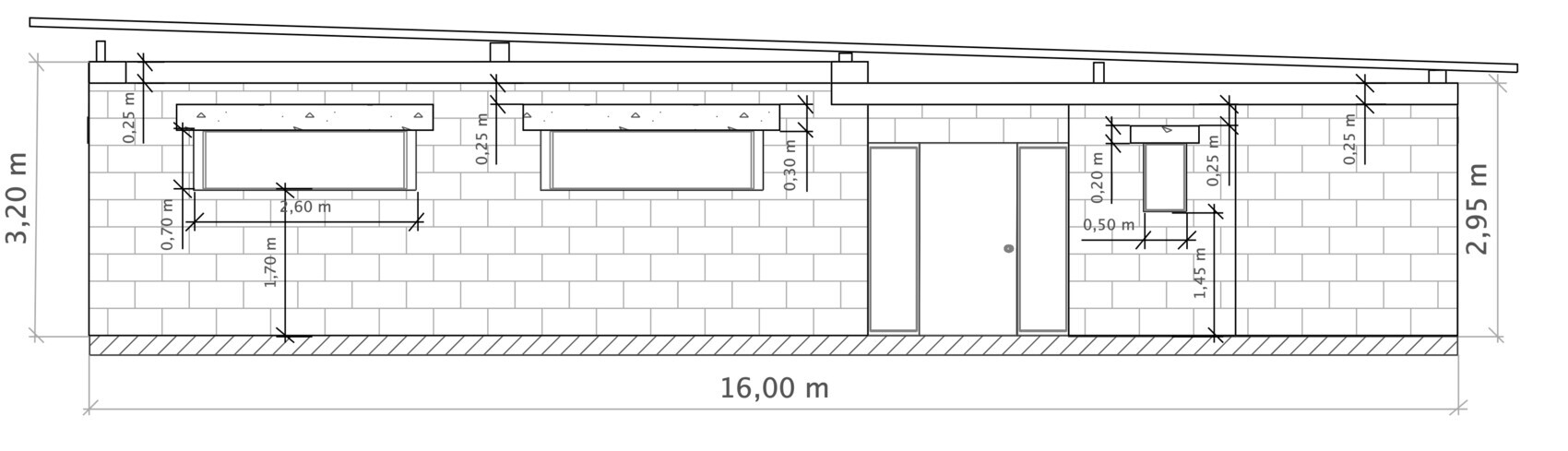
The ring beam runs continuously and horizontally, without any slope. The roof is pitched with a 2% slope over 16m along the rafters. Due to the building’s depth of almost 16m, trapezoidal cavities form between the ring beam and the roof sheathing, which need to be filled somehow. From the outside, you can basically look directly into these spaces. Here is a side view showing the basic situation:
And here is a detailed view for the construction method:
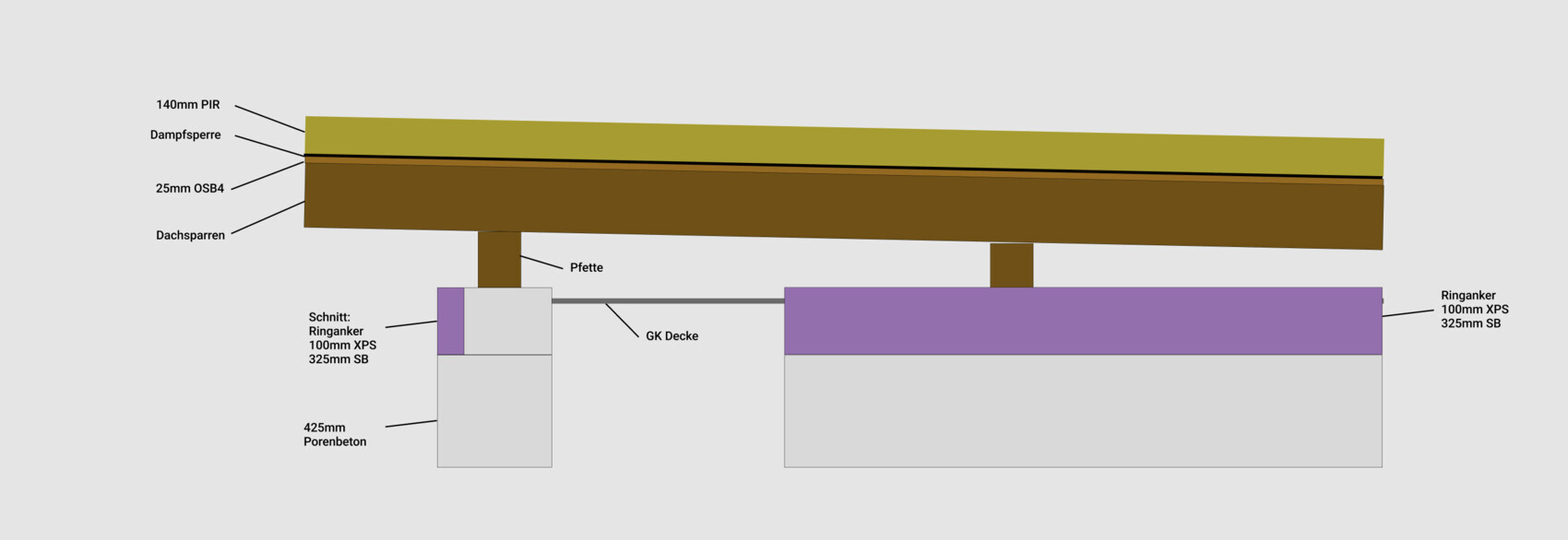
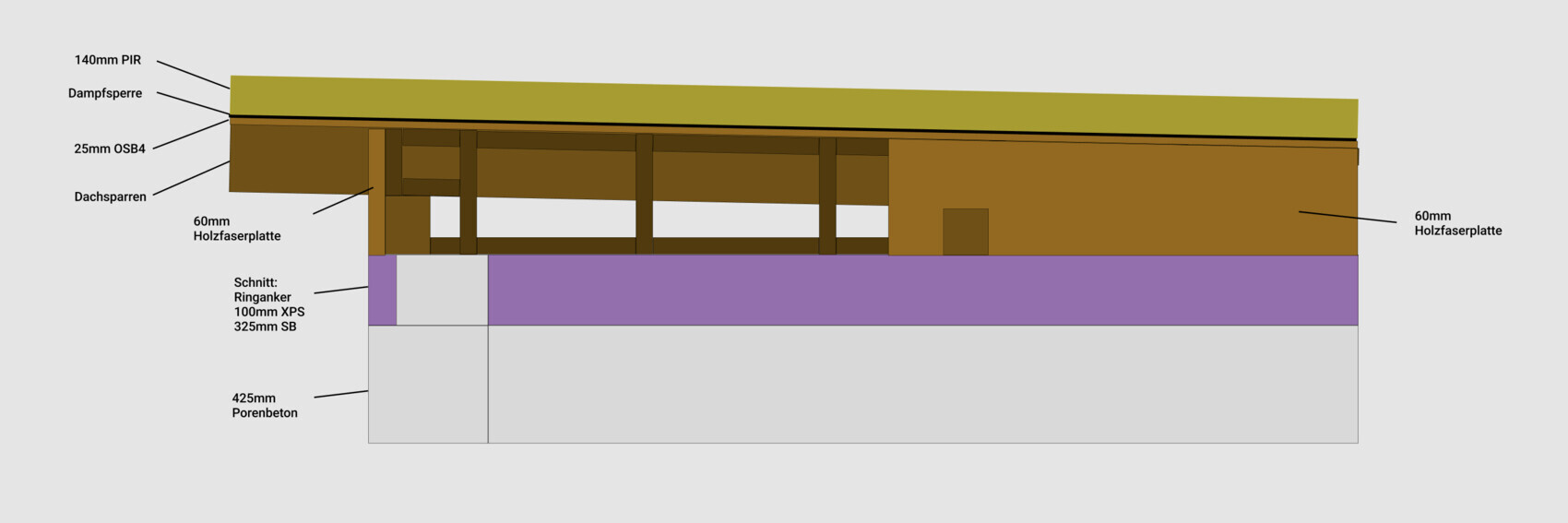
The carpentry company wants to fill these spaces with timber frame construction and install a 60mm wood fiberboard as a plaster base on top. Then, from the outside, a ventilated wooden facade and plaster will be applied in some areas.
Front view:
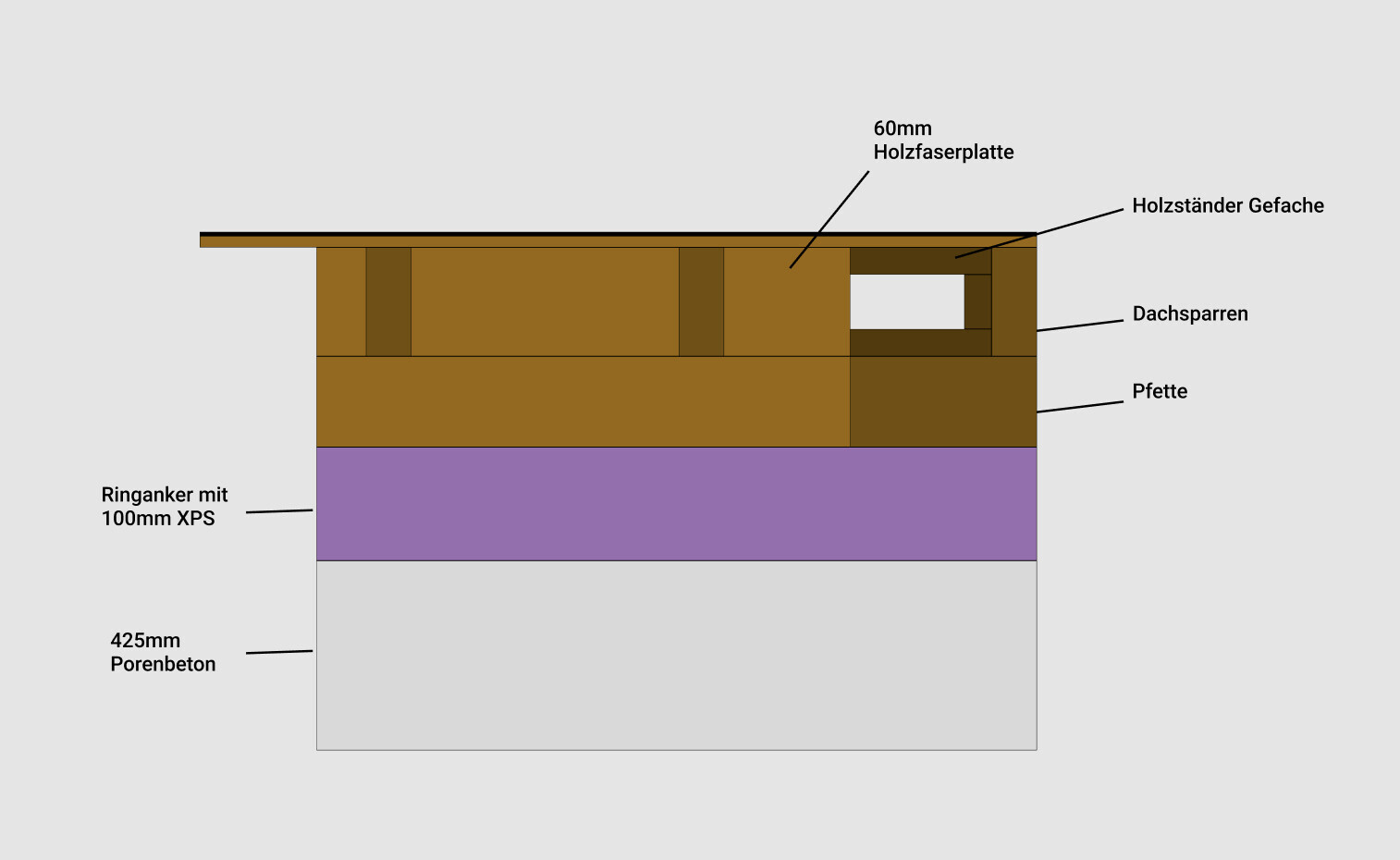
Now there have been discussions that all these small “stud frame” sections would need to be insulated, since the 60mm wood fiberboard on its own does not provide sufficient insulation.
Because there are dozens of these small frame sections, this would be a tedious job, and filling them with mineral wool, blown-in insulation, or spraying with polyurethane foam would all be cumbersome and potentially unreliable. This could result in uneven insulation and gaps.
So I came up with the following idea: instead of the 60mm wood fiberboard, use a 25mm OSB4 sheathing with 140mm XPS insulation applied on top. This would place the entire wooden structure on the warm side, similar to the roof assembly.
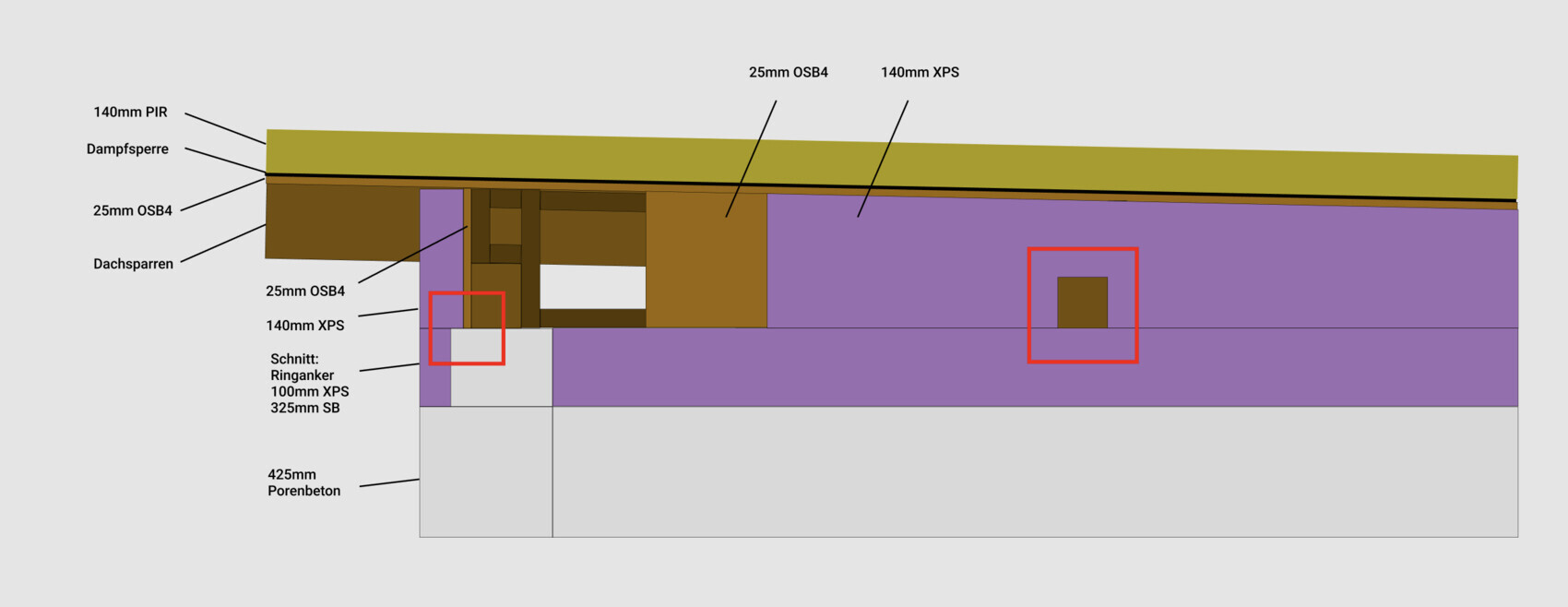
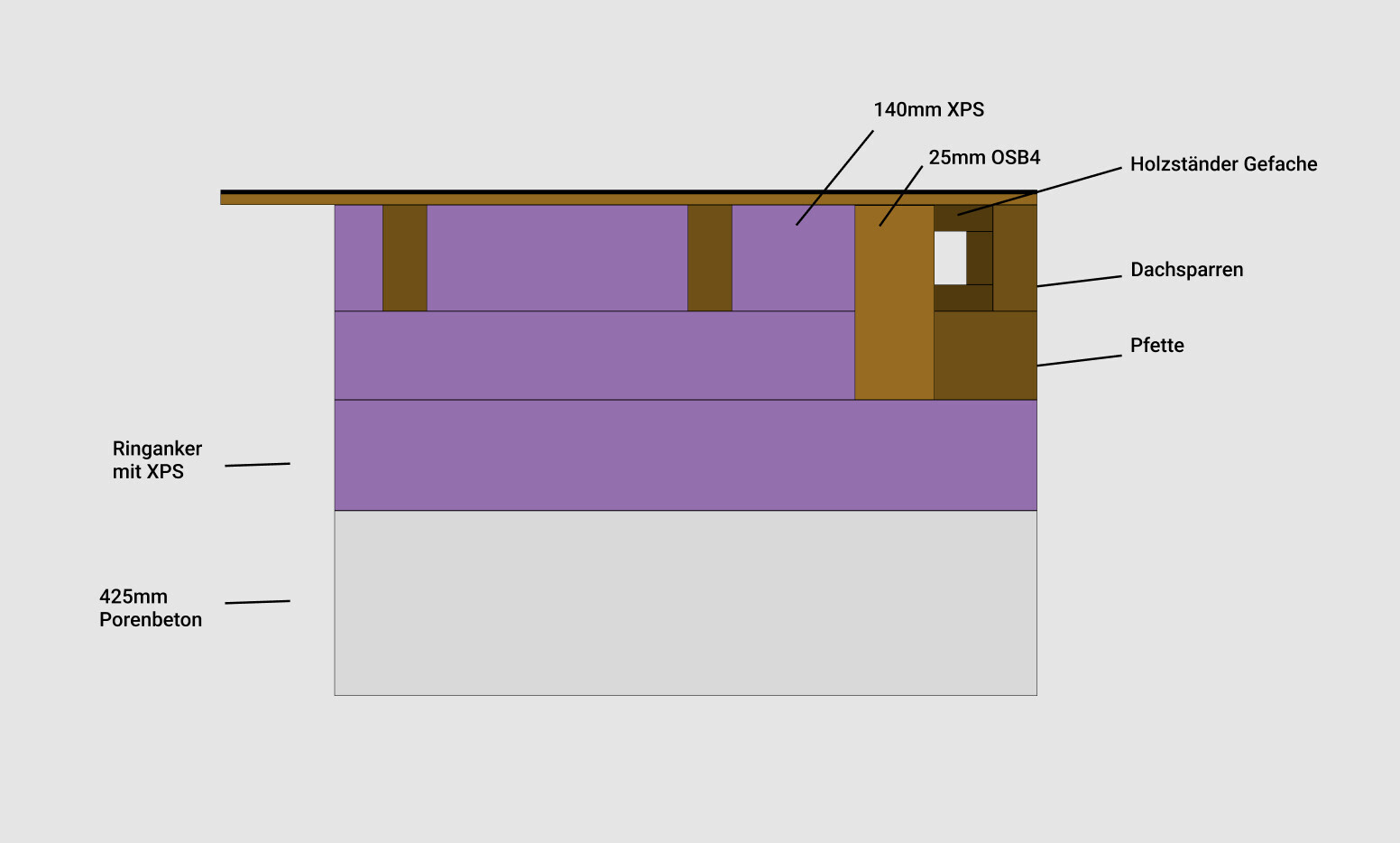
If the insulation is installed properly (no air leakage from outside to inside, joints and gaps foamed), I assume there will be no condensation in the wood areas, since the dew point even under extreme conditions (inside 20°C (68°F), outside -10°C (14°F)) will remain within the insulation layer. In the end, it is the same situation as on the roof, except that the vapor barrier is missing here and implicitly replaced by the XPS.
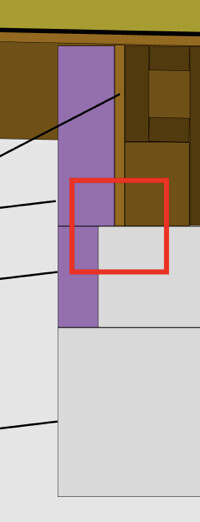
I see critical points marked in red.
Here, the insulation on the ring beam is only 100mm thick, so the reinforced concrete will be colder and might be within the dew point range in extreme scenarios.
At locations where beam ends (for example due to roof overhang) protrude to the outside, the insulation is interrupted. The beams will be colder inside than the insulation itself. Is there a risk of condensation forming?
Could you please give me your assessment on whether my approach could work and where you see potential risks?
An alternative would be to increase the wood fiberboard thickness to about 140mm instead of 60mm. In this case, these cavities would be slightly less insulated but remain vapor permeable, allowing any moisture to dry outwards if it occurs.
I was advised that I might get better help here in this forum.
We are having our roof constructed by a carpentry company. It is a warm roof with 25mm OSB4 as the sheathing, followed by a vapor barrier (approved bitumen membrane with sd > 100m), then 140mm aluminum-coated PIR insulation, 1.5mm EPDM membrane, and a green roof on top.
The masonry is 425mm aerated concrete, with a ring beam around it. On the outside is 100mm XPS insulation, and on the inside 325mm reinforced concrete.
The ring beam runs continuously and horizontally, without any slope. The roof is pitched with a 2% slope over 16m along the rafters. Due to the building’s depth of almost 16m, trapezoidal cavities form between the ring beam and the roof sheathing, which need to be filled somehow. From the outside, you can basically look directly into these spaces. Here is a side view showing the basic situation:
And here is a detailed view for the construction method:
The carpentry company wants to fill these spaces with timber frame construction and install a 60mm wood fiberboard as a plaster base on top. Then, from the outside, a ventilated wooden facade and plaster will be applied in some areas.
Front view:
Now there have been discussions that all these small “stud frame” sections would need to be insulated, since the 60mm wood fiberboard on its own does not provide sufficient insulation.
Because there are dozens of these small frame sections, this would be a tedious job, and filling them with mineral wool, blown-in insulation, or spraying with polyurethane foam would all be cumbersome and potentially unreliable. This could result in uneven insulation and gaps.
So I came up with the following idea: instead of the 60mm wood fiberboard, use a 25mm OSB4 sheathing with 140mm XPS insulation applied on top. This would place the entire wooden structure on the warm side, similar to the roof assembly.
If the insulation is installed properly (no air leakage from outside to inside, joints and gaps foamed), I assume there will be no condensation in the wood areas, since the dew point even under extreme conditions (inside 20°C (68°F), outside -10°C (14°F)) will remain within the insulation layer. In the end, it is the same situation as on the roof, except that the vapor barrier is missing here and implicitly replaced by the XPS.
I see critical points marked in red.
Here, the insulation on the ring beam is only 100mm thick, so the reinforced concrete will be colder and might be within the dew point range in extreme scenarios.
At locations where beam ends (for example due to roof overhang) protrude to the outside, the insulation is interrupted. The beams will be colder inside than the insulation itself. Is there a risk of condensation forming?
Could you please give me your assessment on whether my approach could work and where you see potential risks?
An alternative would be to increase the wood fiberboard thickness to about 140mm instead of 60mm. In this case, these cavities would be slightly less insulated but remain vapor permeable, allowing any moisture to dry outwards if it occurs.
T
tenspoplin5s23 Nov 2025 20:33Alternative: Could one use 160mm (6.3 inches) thick WLS 036 wood fiber insulation instead of the 140mm (5.5 inches) XPS? This way, the insulation would be vapor permeable, which the XPS is not.
Hi,
your approach is definitely feasible, but you are treading on thin ice in a few areas. If the airtightness at the junction between the rafters and the OSB is not done properly, the dew point will shift to exactly where you least want it. The many small sections don’t make things easier either, because any inaccuracy there immediately becomes a cold spot. Wouldn’t a continuous cladding with uniform insulation thickness be a more straightforward solution?
Also, the ring beam insulated with only 100 mm XPS (4 inches) remains an area with little thermal margin. Have you had this checked in a compliance calculation, or are you relying on intuition?
Good luck!
your approach is definitely feasible, but you are treading on thin ice in a few areas. If the airtightness at the junction between the rafters and the OSB is not done properly, the dew point will shift to exactly where you least want it. The many small sections don’t make things easier either, because any inaccuracy there immediately becomes a cold spot. Wouldn’t a continuous cladding with uniform insulation thickness be a more straightforward solution?
Also, the ring beam insulated with only 100 mm XPS (4 inches) remains an area with little thermal margin. Have you had this checked in a compliance calculation, or are you relying on intuition?
Good luck!
T
tenspoplin5s23 Nov 2025 20:46Wouldn’t a continuous stud wall with a uniform insulation thickness be the more straightforward solution?
I have this:
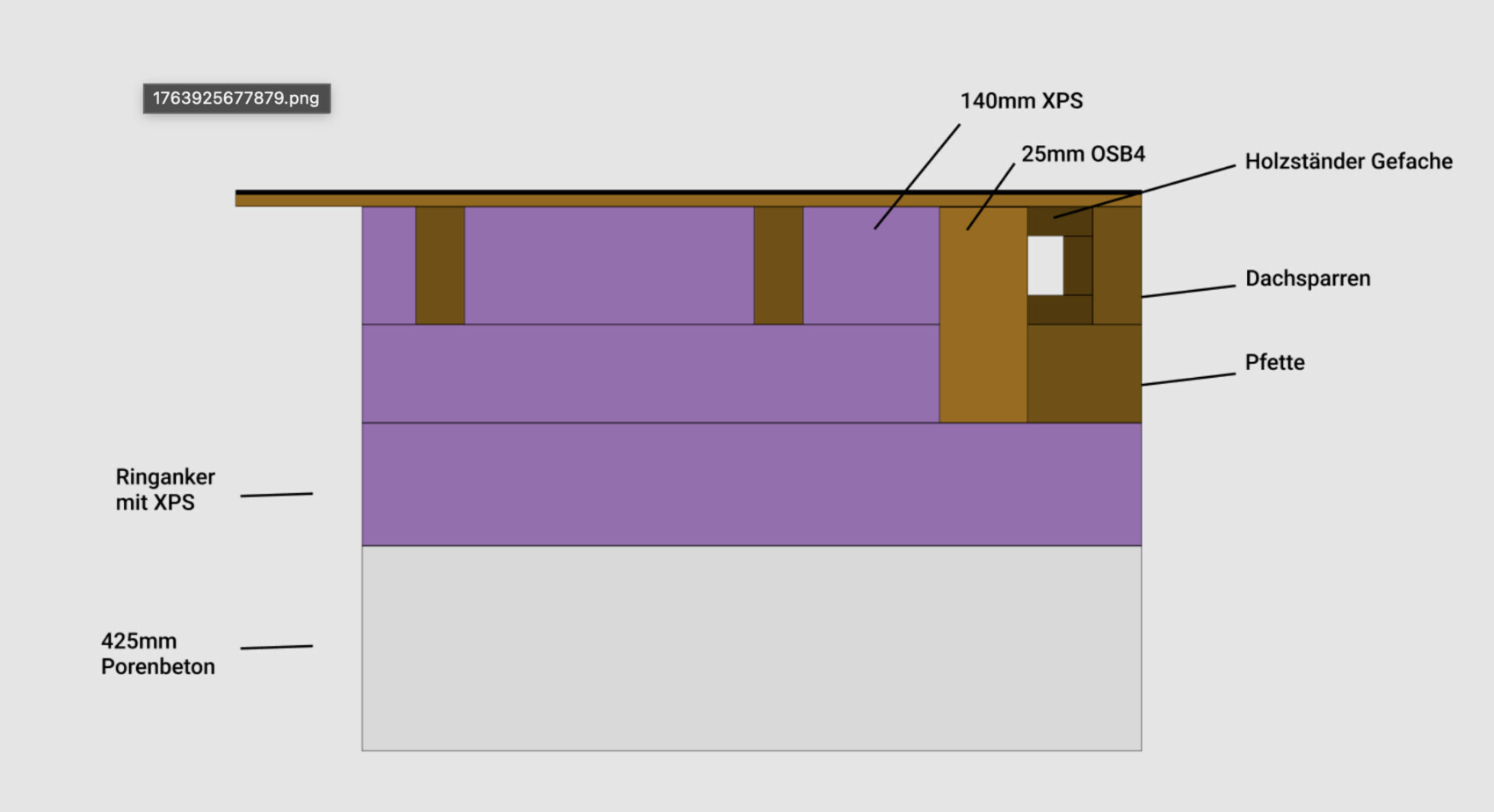
I have this:
Of course, you have a cavity wall, but only where your XPS runs continuously. The problem is exactly in the red-marked area: the wooden studs are partially within the plane, but they are not properly integrated thermally. This results in no truly homogeneous insulation layer, but rather a small temperature cycle. The question is whether you are sure that this zone is continuously insulated with compressive strength and not just visually closed.
T
tenspoplin5s23 Nov 2025 21:26How would you insulate this wedge area?
Similar topics