
Hello everyone,
I would appreciate your assessment on the following matter:
Basement dimensions: 8.16 x 9.99 meters (let’s say 8.20 x 10)
Excavation depth (see section): approximately 3 meters (10 feet)
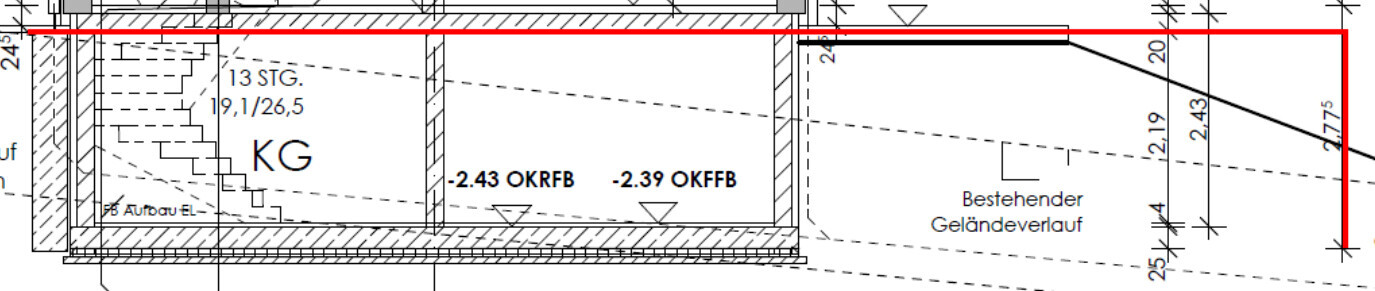
In addition, the slope situation: I would say the basement extends about 1/3 above the existing ground level
Workspace allowance: 60 cm (2.4 inches)
Slope angle: According to the soil report, I assumed 60° (recommended between 60° and 80°)
All in all, I calculated an excavation volume of approximately 303 m³ (10,700 cubic feet). Are you getting similar numbers? Did I make a mistake somewhere?
I ask because our excavation contractor has quoted a solid 520 m³ (18,350 cubic feet). Unfortunately, I wasn’t able to reach him today to ask where this figure comes from.
Either I have made a significant error somewhere (which is why I am asking for your opinion) or there is something wrong with the quote.
Many thanks in advance!
I would appreciate your assessment on the following matter:
Basement dimensions: 8.16 x 9.99 meters (let’s say 8.20 x 10)
Excavation depth (see section): approximately 3 meters (10 feet)
In addition, the slope situation: I would say the basement extends about 1/3 above the existing ground level
Workspace allowance: 60 cm (2.4 inches)
Slope angle: According to the soil report, I assumed 60° (recommended between 60° and 80°)
All in all, I calculated an excavation volume of approximately 303 m³ (10,700 cubic feet). Are you getting similar numbers? Did I make a mistake somewhere?
I ask because our excavation contractor has quoted a solid 520 m³ (18,350 cubic feet). Unfortunately, I wasn’t able to reach him today to ask where this figure comes from.
Either I have made a significant error somewhere (which is why I am asking for your opinion) or there is something wrong with the quote.
Many thanks in advance!
The remaining area, about 230 m² (terrace, paths, carport, and driveway), will be filled and compacted using excavated material, then layered with 25 cm (10 inches) of crushed stone concrete and compacted. This costs €6700 gross. This means you will need to subtract at least 25 cm (10 inches) everywhere. Where the garden is planned, 25 cm (10 inches) of topsoil will be added. In areas that need to be stable, 25 cm (10 inches) of crushed stone concrete plus 5 cm (2 inches) of gravel will be applied. You also need to account for the thickness of the surface covering.
Therefore, I am having trouble estimating the approximate volume of excavated material that will be refilled.
EDIT:
Of course, this is all still without retaining walls.
Therefore, I am having trouble estimating the approximate volume of excavated material that will be refilled.
EDIT:
Of course, this is all still without retaining walls.

Backfilling and placing are carried out as follows:
I am also a bit unclear about the two items regarding backfilling the working space. Both items are included in the final price.
EDIT: We do not want to have things like the terrace, driveway, or other external secondary landscaping done by this earthworks contractor.
- Refilling the perimeter working space and the area between the strip foundations with gravel sand = 1240€
- (Additional, not sure why) Contingency item: Refilling the working space with compactible/permeable excavated material = 3100€
- Creating the rough grading around the site using the excavated material available on the property. The application of topsoil is not included = 1120€
I am also a bit unclear about the two items regarding backfilling the working space. Both items are included in the final price.
EDIT: We do not want to have things like the terrace, driveway, or other external secondary landscaping done by this earthworks contractor.
Okay, after nearly an hour on the phone with the civil engineer, here is a brief update:
Overall, we expect to save around 10,000 EUR if we continue with soil removal. If not, the price will decrease by an additional 5,000 EUR.
- All items refer to a larger scope of work than originally planned. Driveway, terrace, or other ancillary structures are not to be included in the offer. This means the price will decrease accordingly.
- Completely omitting soil removal will be difficult: Our plot may be too small to handle the excavation material and simultaneously carry out other work on it. It would likely be necessary to store the soil on neighboring properties. We are currently working on clarifying this.
Overall, we expect to save around 10,000 EUR if we continue with soil removal. If not, the price will decrease by an additional 5,000 EUR.
Wissi schrieb:
Completely omitting the removal of the excavated soil will be difficult: Our lot is probably too small to accommodate the excavation material while also carrying out further work on it. Most likely, it would have to be stored on neighboring properties. We are currently trying to clarify this. That’s true! No sugarcoating there.
At our site, the soil is excavated and loaded directly onto the truck. From a certain point onward, excavation and backfilling happen simultaneously.
So there is no need for on-site storage???
Don’t get me wrong: I’m not accusing anyone of talking nonsense. But at the same time, I’m honest enough to say about some things: “Wow, I didn’t expect or plan for that.”
Removing the spoil was initially just a cost issue for us. The idea was, “If we leave the soil on-site for now, we save 9,000 euros in one go.” Of course, any excess material would have to be removed eventually anyway.
When I think about it, the material goes straight from the excavation pit into the truck, and at some point, it will be used for backfilling. Somehow, I feel it should be the other way around: keep backfilling until you reach the desired subgrade level, and THEN transport the rest off-site.
Removing the spoil was initially just a cost issue for us. The idea was, “If we leave the soil on-site for now, we save 9,000 euros in one go.” Of course, any excess material would have to be removed eventually anyway.
When I think about it, the material goes straight from the excavation pit into the truck, and at some point, it will be used for backfilling. Somehow, I feel it should be the other way around: keep backfilling until you reach the desired subgrade level, and THEN transport the rest off-site.
Wissi schrieb:
Don’t get me wrong: I’m not accusing anyone of talking nonsense. But at the same time, I’m honest enough to say about some things: “Phew, I didn’t expect or plan for that.”
Removing the excavated material was initially just a cost issue for us. The idea was “If the soil stays on-site for now, we save 9,000 euros all at once.” Of course, any excess would have had to be removed later anyway.
When I think about it, the material goes straight from the pit into the truck, and at some point it’s used for backfilling. Somehow, I feel it should be the other way around: keep backfilling until the subgrade is at the desired level and THEN remove the rest. Maybe I didn’t explain it clearly. Only the part that is not needed for backfilling is excavated and removed for good. The rest is excavated and then used for backfilling. It doesn’t matter whether it is excavated and backfilled first and then the rest is excavated and transported away. It should just not be excavated and stored next to the site. Then the amount required for backfilling can be determined and the rest transported off-site. An extra work step plus the idle time for excavators and trucks also cost money.
Similar topics