
ᐅ Evaluation of floor plan for approximately 145 sqm single-family house with basement, ground floor, and upper floor
Created on: 14 Oct 2021 12:44
A
Arango18
Hello everyone,
Zoning plan/restrictions: Zoning plan and restrictions considered by the architect
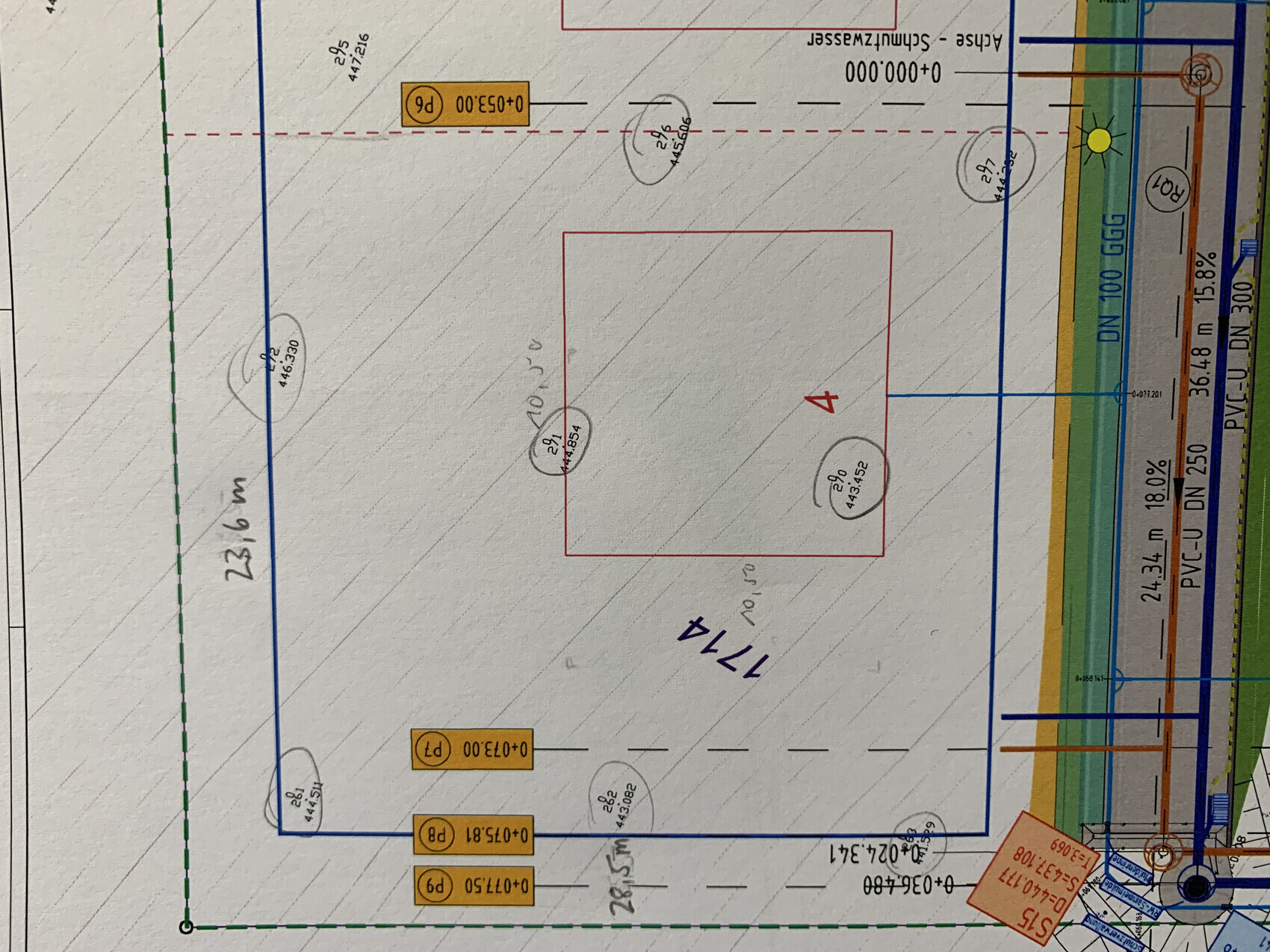
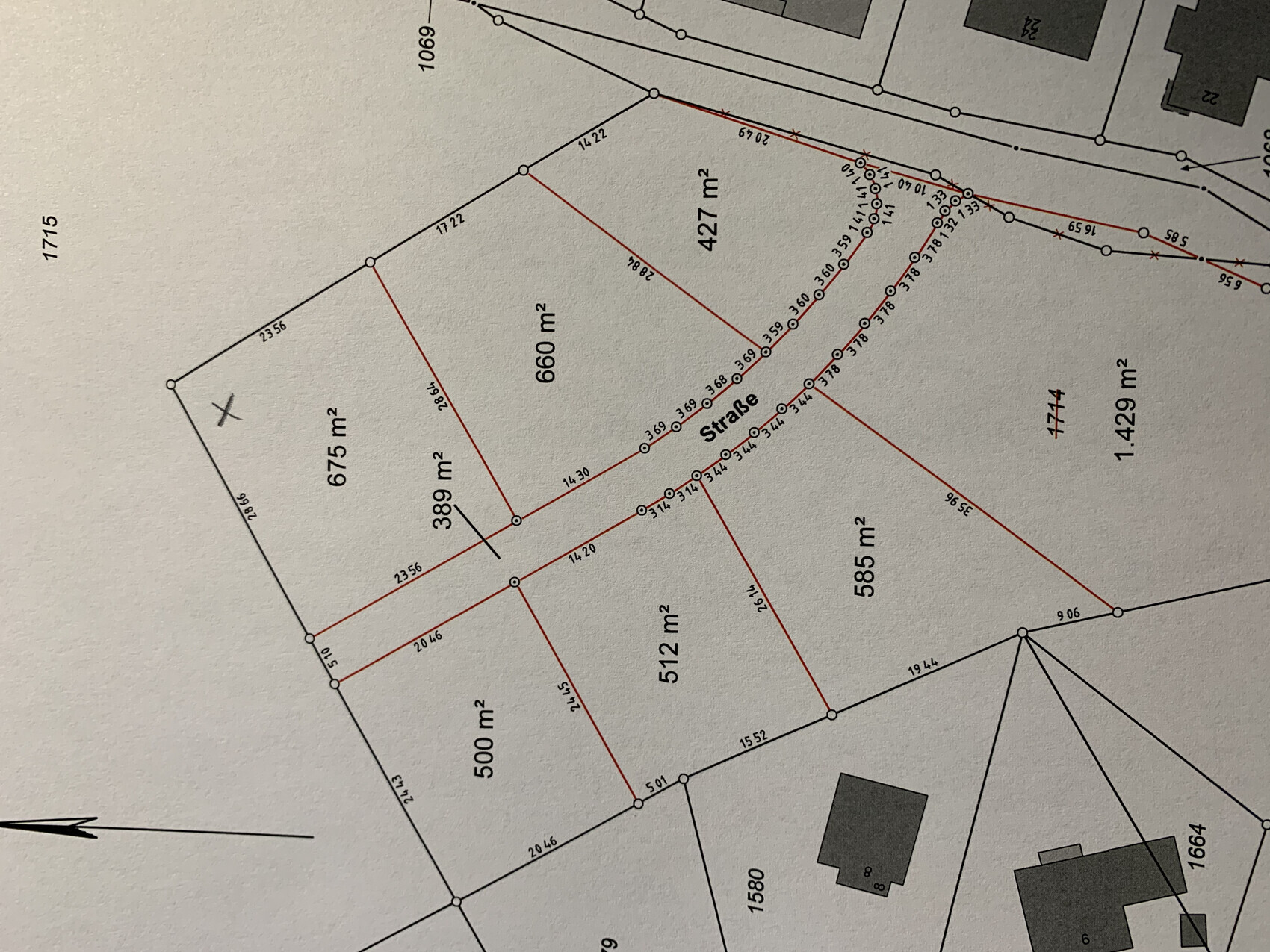
Plot size: 675m² (7260 sq ft)
Slope: yes, running diagonally across the plot (see elevation plan)
Building window, building line and boundary: 3 m (10 feet) on all sides
Edge development: yes, neighbor to the southeast
Number of parking spaces: 2 in garage and 2 in front of garage
Number of floors: 2.5
Roof type: gable roof, 36 degrees
Architectural style: simple
Orientation: southwest
Maximum heights/limits: same as neighboring buildings, sufficiently high
Other requirements: none
Street: cul-de-sac; our house is at the end, with neighbors on one side and open view of forest, meadow, and valley on the other
Owners’ requirements
Style, roof type, building type: interior as open and straightforward as possible, exterior simple
Basement, floors: basement, ground floor (GF) and upper floor (UF)
Number and age of occupants: currently 2 (both 28 years old), planning 1-2 children
Space requirements for GF, UF: approx. 140 m² (1507 sq ft) of living space
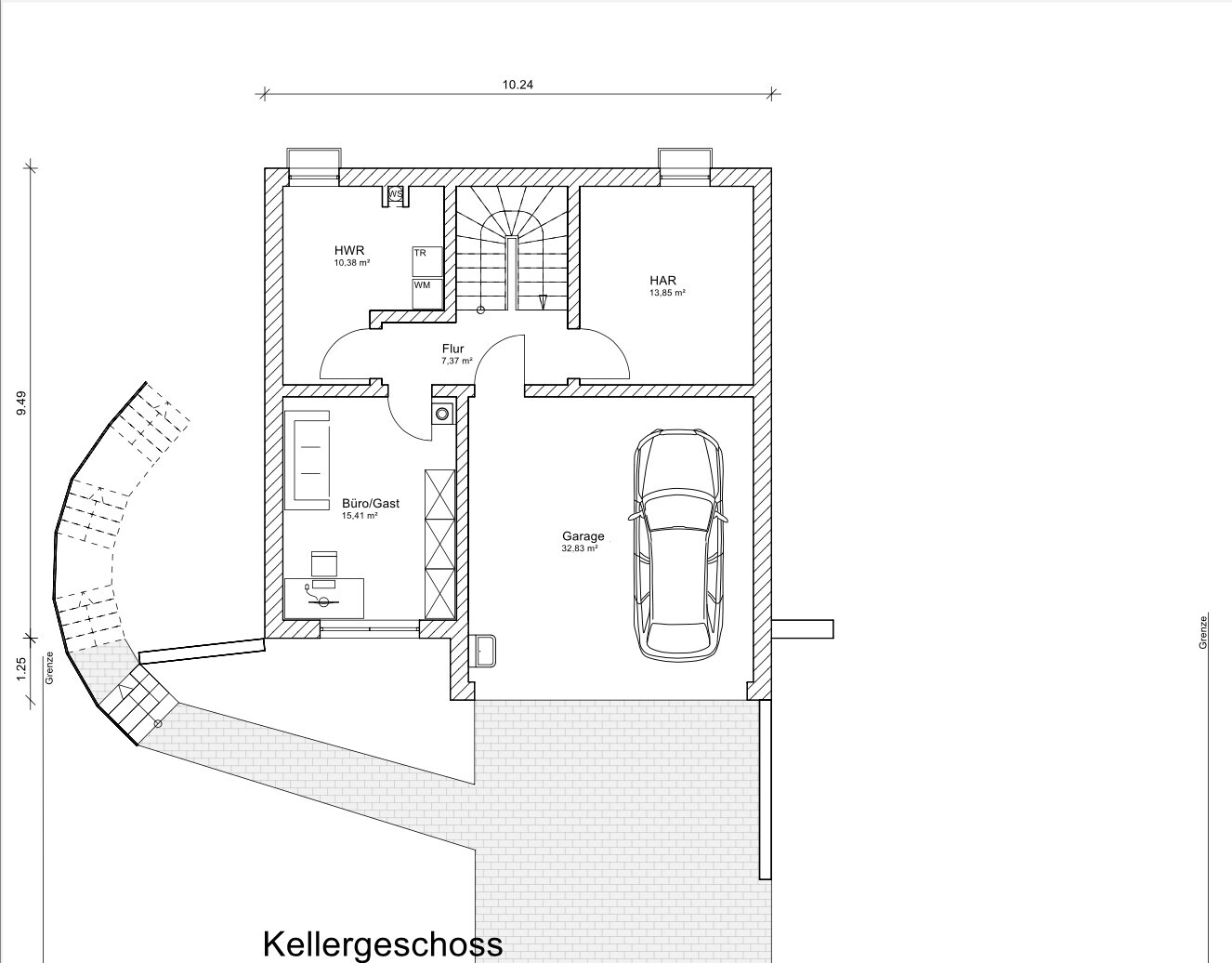
Office: absolutely necessary due to 80% remote work
Guest bedrooms: very rare use
Open or closed layout: open
Conservative or modern construction: conservative (mostly because it’s usually more affordable)
Open kitchen, cooking island: open kitchen with bar or island (due to space and layout, more likely a bar)
Dining seats: 4-6
Fireplace: planned but not mandatory
Music/stereo wall: standard TV wall
Balcony, roof terrace: small terrace on the slightly extended garage towards southwest, terrace towards southeast
Garage, carport: double garage with a single door
Utility garden, greenhouse: standard
Other wishes/notes/daily routine, including reasons why some things are wanted or not: a small shower in the guest WC is very important to us, as well as a small room for the home office. Since I work from home 80% of the time, this is essential. Also, a small storage room for vacuum cleaner etc.
House design
Who designed it: architect
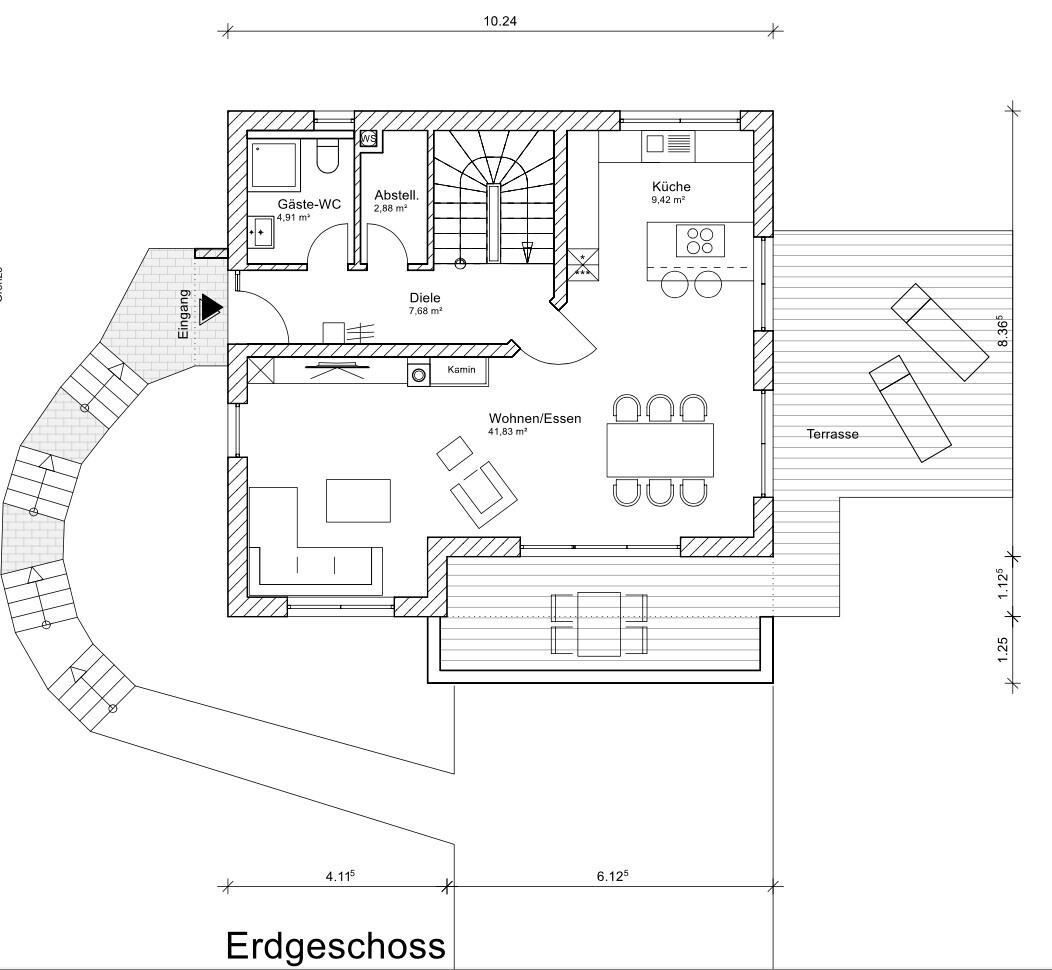
What do you particularly like? The dining and living area looks bright and cozy in our opinion. Not too big and not too small with a great view.
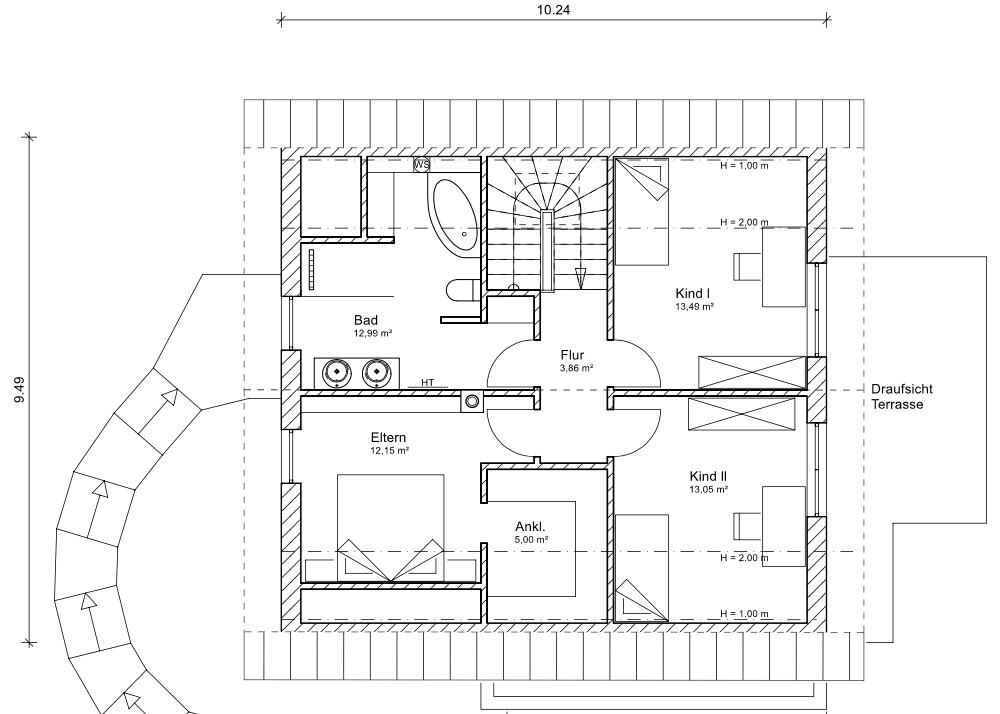
What don’t you like? Why? Bathroom layout feels too tight and awkward, hallway in the upper floor too narrow?
Preferred heating system: air source heat pump
If you had to give up some features, which ones?
Fireplace
Why did the design end up like it is now?
The original design was larger and included more details such as corner and roof windows, but it was optimized for cost.
However, the room layout and overall room concept basically remained unchanged.
What is the most important/basic question about the floor plan summarized in 130 characters?
I would appreciate further suggestions, especially regarding the aspects we don’t like. Overall, we are quite happy with it. Do you see any major “no-gos”?
If any information is incomplete or unclear, I’m happy to check it again.
Zoning plan/restrictions: Zoning plan and restrictions considered by the architect
Plot size: 675m² (7260 sq ft)
Slope: yes, running diagonally across the plot (see elevation plan)
Building window, building line and boundary: 3 m (10 feet) on all sides
Edge development: yes, neighbor to the southeast
Number of parking spaces: 2 in garage and 2 in front of garage
Number of floors: 2.5
Roof type: gable roof, 36 degrees
Architectural style: simple
Orientation: southwest
Maximum heights/limits: same as neighboring buildings, sufficiently high
Other requirements: none
Street: cul-de-sac; our house is at the end, with neighbors on one side and open view of forest, meadow, and valley on the other
Owners’ requirements
Style, roof type, building type: interior as open and straightforward as possible, exterior simple
Basement, floors: basement, ground floor (GF) and upper floor (UF)
Number and age of occupants: currently 2 (both 28 years old), planning 1-2 children
Space requirements for GF, UF: approx. 140 m² (1507 sq ft) of living space
Office: absolutely necessary due to 80% remote work
Guest bedrooms: very rare use
Open or closed layout: open
Conservative or modern construction: conservative (mostly because it’s usually more affordable)
Open kitchen, cooking island: open kitchen with bar or island (due to space and layout, more likely a bar)
Dining seats: 4-6
Fireplace: planned but not mandatory
Music/stereo wall: standard TV wall
Balcony, roof terrace: small terrace on the slightly extended garage towards southwest, terrace towards southeast
Garage, carport: double garage with a single door
Utility garden, greenhouse: standard
Other wishes/notes/daily routine, including reasons why some things are wanted or not: a small shower in the guest WC is very important to us, as well as a small room for the home office. Since I work from home 80% of the time, this is essential. Also, a small storage room for vacuum cleaner etc.
House design
Who designed it: architect
What do you particularly like? The dining and living area looks bright and cozy in our opinion. Not too big and not too small with a great view.
What don’t you like? Why? Bathroom layout feels too tight and awkward, hallway in the upper floor too narrow?
Preferred heating system: air source heat pump
If you had to give up some features, which ones?
Fireplace
Why did the design end up like it is now?
The original design was larger and included more details such as corner and roof windows, but it was optimized for cost.
However, the room layout and overall room concept basically remained unchanged.
What is the most important/basic question about the floor plan summarized in 130 characters?
I would appreciate further suggestions, especially regarding the aspects we don’t like. Overall, we are quite happy with it. Do you see any major “no-gos”?
If any information is incomplete or unclear, I’m happy to check it again.

Arango18 schrieb:
Certainly not sloppy, I can assure you, I’m sure you were fully committed. However, the fact that a room—which was ultimately unnecessary (and only included to integrate the basement into the thermal envelope)—was still part of the plan when the design was created suggests that design phases 1 and 2 were not thoroughly completed as formal process steps.
https://www.instagram.com/11antgmxde/
https://www.linkedin.com/company/bauen-jetzt/

Arango18 schrieb:
It is very certain that one side will remain free. The municipality will not develop any additional building plots / lots.Enviable... a priceless plot of land. Please accept this gift.
11ant schrieb:
I’m sure you were fully committed. But the fact that a room—which is ultimately optional and is the sole reason for including the basement in the thermal envelope—is still part of the plan when the design is done suggests that design phases 1 and 2 were not thoroughly completed as part of the process.Yes, but in that case, I have to say that if this had such an impact on construction costs, I would rather see it as the architect’s responsibility (with all due respect) to point this out to us.
So basically, would my idea to move the office out of the basement make sense?
Could you briefly explain what changes this would bring to the construction? I think I basically understand it, but I don’t want to come across as half-informed and get criticized again ;-)
Arango18 schrieb:
Yes, but if it really had such an impact on the construction costs, I think it is actually the responsibility of our architect (with all due respect) to point that out to us. Exactly. I see that in the seventh part of my five-part series "A Homebuilding Roadmap, for You Too: the HOAI Phase Model," I will need to address which expectations homeowners should have for their architect. Many thanks for your hint about this shortcoming!
Arango18 schrieb:
So, would my idea of relocating the office out of the basement generally make sense?
Could you briefly describe what would change in the construction? I think I basically understand it, but I don’t want to speak with half-knowledge and get into trouble again ;-) Here, our intention is only to build walls—not to get anyone into trouble. A lack of knowledge is a layperson’s prerogative and nothing to be ashamed of. Only resistance to advice (from others in other threads: fundamental rejection of architects; here, possibly rejection of a cloakroom recess) might be a problem. I assume you have an experienced architect—though one who probably doesn’t fully involve the clients in the planning process and likely comes from pre-energy-saving regulation times. In brief, relocating the office out of the basement would allow the basement to be excluded from the thermal envelope, meaning that only one boundary of the basement—the ceiling between the basement and the ground floor—would need to be insulated instead of five surfaces here: the foundation slab instead of the floor slab plus the four perimeter walls.
https://www.instagram.com/11antgmxde/
https://www.linkedin.com/company/bauen-jetzt/
11ant schrieb:
In brief, removing the office from the basement means it is possible to exclude the basement from the thermal envelope, so that only one boundary surface of the basement—namely the ceiling between the basement and the ground floor—needs to be insulated instead of five surfaces here: the foundation slab instead of the floor slab plus the four enclosing walls.Theoretically correct, but in practice there is still the staircase, which creates a connection to the thermal envelope. This can be solved technically, but it requires effort and is not very elegant. Additionally, this leaves an entire floor as unfinished usable space. It can be done, but it is expensive, makes the house excessively bulky, and therefore does not seem sensible for a site on a slope with valley-side access.
In this case, it really seems better to move the parking spaces out of the house and use the basement/cellar instead. The only disadvantage is that it has to be redesigned.
Hangman schrieb:
Theoretically correct, practically [...] I have an entire floor of unfinished usable space. Thanks for pointing out that what I left unsaid could be misunderstood. I only wanted to explain to the original poster what they had asked. Unfortunately, this can easily be misinterpreted as a confirmation to stick with this building concept and only “redesign” the thermal insulation. But of course, a complete change is the better solution here: using the basement for living space, in my opinion best also with an entrance at street level instead of “upstairs,” resulting in a two-story layout with basement plus upper floor. And as always, I’m firmly against the idea of simply using whatever space is left over for a parking spot, treating it as an afterthought. The parking area should be properly integrated and not placed at the “kids’ table.” Hangman schrieb:
The only drawback: it requires a new design. A major advantage for the client: it requires a new design. The only disadvantage I see is the architect’s need to explain the changes.https://www.instagram.com/11antgmxde/
https://www.linkedin.com/company/bauen-jetzt/
Similar topics