
ᐅ Evaluating the Proposal and Technology of a Photovoltaic System
Created on: 30 Jan 2023 12:00
H
hanghaus2023
Hello,
I am planning to equip my house with a photovoltaic system.
Electricity consumption: 7100 kWh per year
Southwest orientation, roof pitch 45 degrees
Most affordable photovoltaic offer:
23 * modules
Jolywood JW-HD108N-420W (frame: black, backsheet: glass)
- Best price-performance ratio: high nominal power of 420 W per module and an efficiency of 21.51%.
- Linear power warranty for 30 years (minimum 87.4% after this period).
- 25 years product warranty from the manufacturer.
- Half-cut cells: two separate cell areas connected in series reduce shading losses.
- Front and back glass with anti-reflective technology.
23 * modules DC installation including scaffolding
1 * Sungrow SBR096 9.6 kWh
- High-voltage lithium iron phosphate battery with multi-level protection concept and comprehensive safety certifications.
- Up to 30A continuous charge and discharge current with high efficiency and 100% usable energy.
- Plug & Play, no wiring required between individual battery modules.
- Of the total price, €4,476.16 net is allocated to the battery storage.
1 * Sungrow Hybrid SH8.0RT
- Three-phase hybrid inverter for residential use.
- Fast charging/discharging to easily manage consumption peaks.
- High self-consumption through optimized integrated energy management system.
- Remote firmware updates and customizable settings.
- Quick and easy installation, commissioning via smartphone.
1 * AC installation for Sungrow SBR096 9.6 kWh battery with Sungrow inverter(s)
According to the provider, the meter cabinet does not incur any additional costs.
Note:
The cost for the required additional electricity meter is not included in the purchase price. Your local grid operator is responsible for installing this meter and will charge you separately for this service.
Net price: €26,192
The provider is relatively new to the market and has 150 ***** reviews on Google.
Previously, I received offers with lower specifications starting above €50,000.
Is there anything to consider regarding taxes?
Honestly, I have no expertise in this area. Is there an expert here who can technically and financially evaluate the most affordable offer for me?
Thank you very much for your help from
hanghaus2023
I am planning to equip my house with a photovoltaic system.
Electricity consumption: 7100 kWh per year
Southwest orientation, roof pitch 45 degrees
Most affordable photovoltaic offer:
23 * modules
Jolywood JW-HD108N-420W (frame: black, backsheet: glass)
- Best price-performance ratio: high nominal power of 420 W per module and an efficiency of 21.51%.
- Linear power warranty for 30 years (minimum 87.4% after this period).
- 25 years product warranty from the manufacturer.
- Half-cut cells: two separate cell areas connected in series reduce shading losses.
- Front and back glass with anti-reflective technology.
23 * modules DC installation including scaffolding
1 * Sungrow SBR096 9.6 kWh
- High-voltage lithium iron phosphate battery with multi-level protection concept and comprehensive safety certifications.
- Up to 30A continuous charge and discharge current with high efficiency and 100% usable energy.
- Plug & Play, no wiring required between individual battery modules.
- Of the total price, €4,476.16 net is allocated to the battery storage.
1 * Sungrow Hybrid SH8.0RT
- Three-phase hybrid inverter for residential use.
- Fast charging/discharging to easily manage consumption peaks.
- High self-consumption through optimized integrated energy management system.
- Remote firmware updates and customizable settings.
- Quick and easy installation, commissioning via smartphone.
1 * AC installation for Sungrow SBR096 9.6 kWh battery with Sungrow inverter(s)
According to the provider, the meter cabinet does not incur any additional costs.
Note:
The cost for the required additional electricity meter is not included in the purchase price. Your local grid operator is responsible for installing this meter and will charge you separately for this service.
Net price: €26,192
The provider is relatively new to the market and has 150 ***** reviews on Google.
Previously, I received offers with lower specifications starting above €50,000.
Is there anything to consider regarding taxes?
Honestly, I have no expertise in this area. Is there an expert here who can technically and financially evaluate the most affordable offer for me?
Thank you very much for your help from
hanghaus2023

sysrun80 schrieb:
Here is an example – our electricity price today (hourly variable):
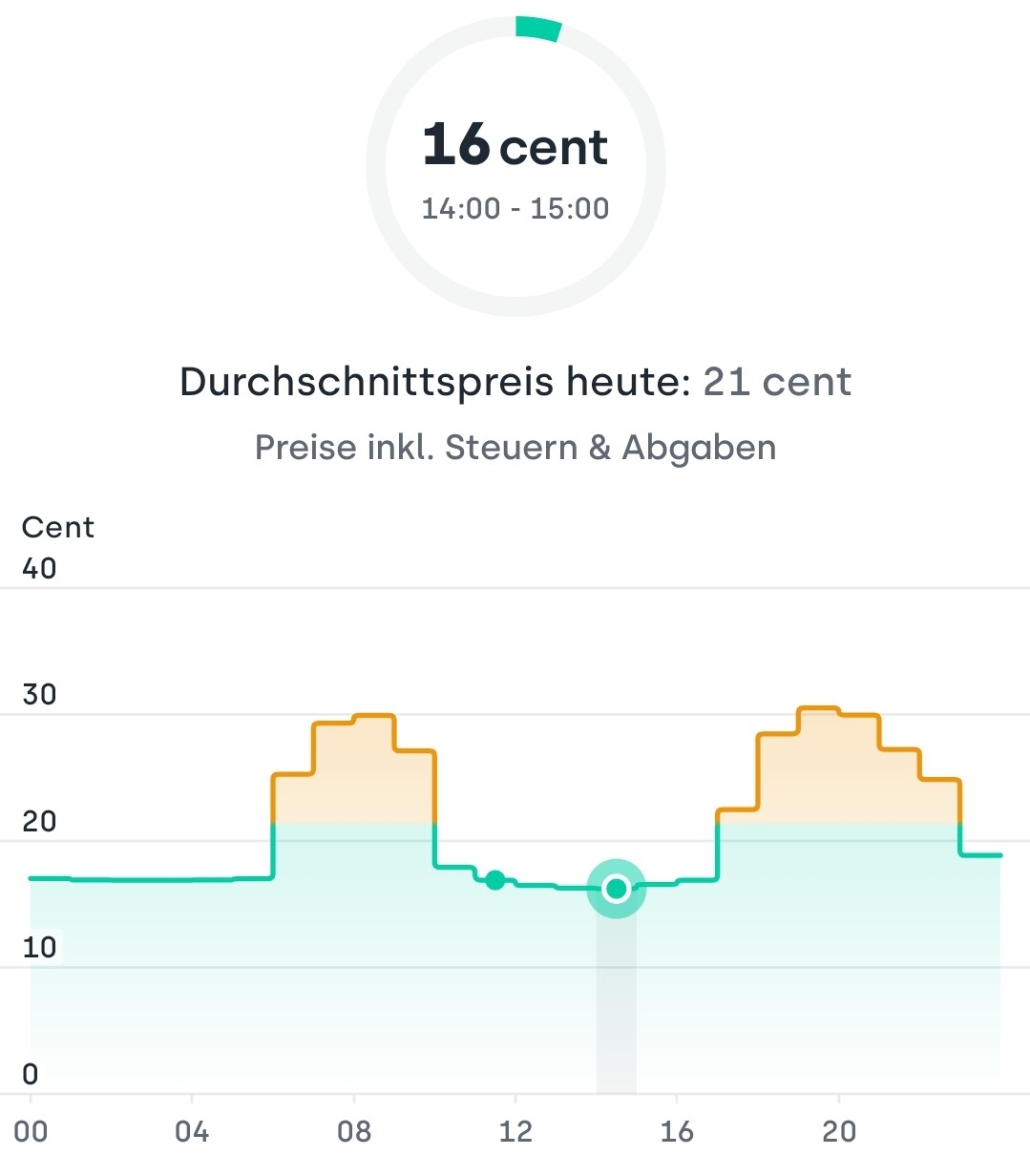
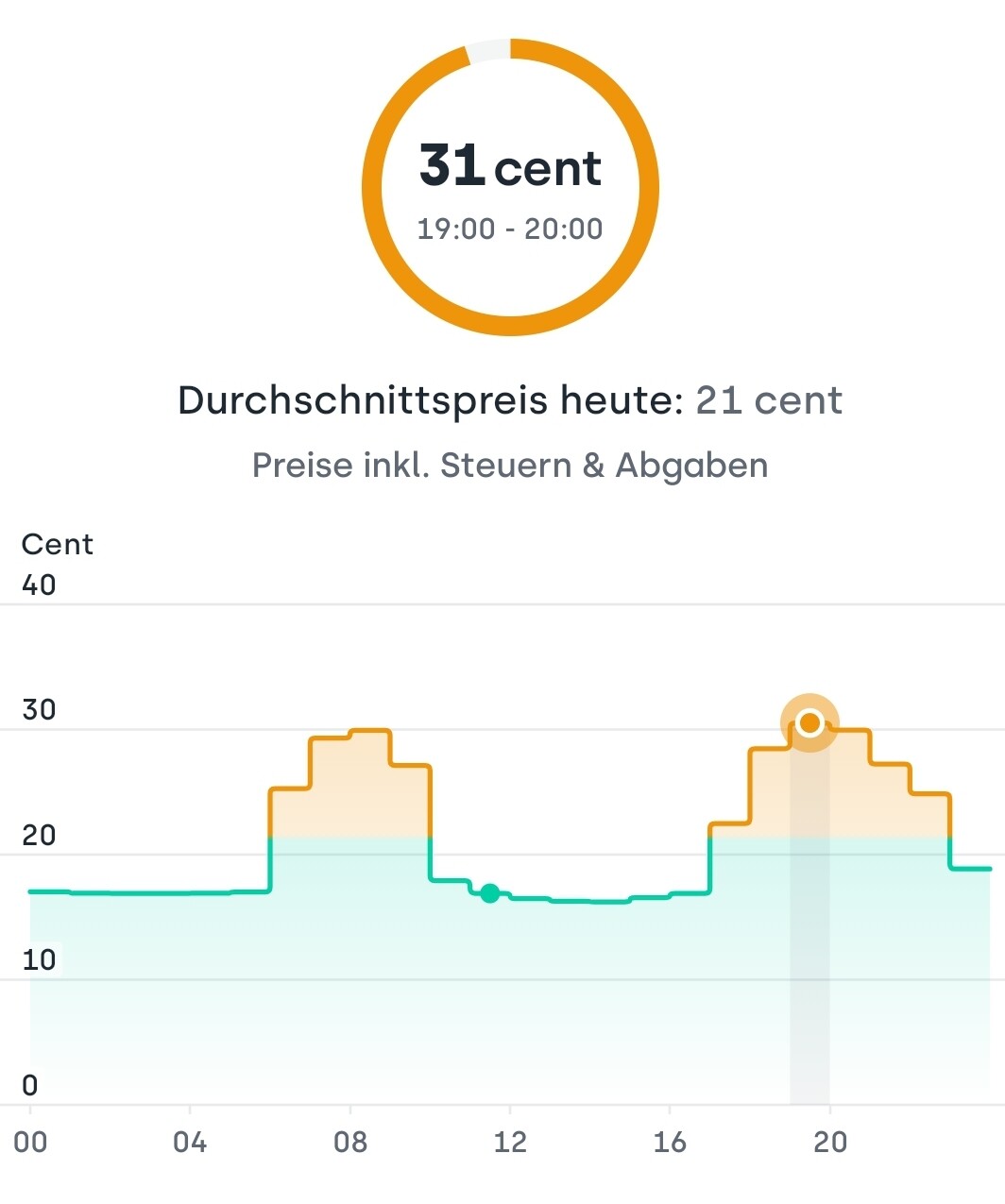
Solar yield is rather poor today – but there is a lot of wind. Difference is 15 cents. Currently, the washing machine and dishwasher are running. Why not charge the home battery from the grid now and avoid the 31 cents this evening?
By the way, the net price is currently 0 cents – the 16 cents are purely charges (taxes, grid fees, etc.) May I ask which provider you get the hourly variable rates from? We are also considering doing that.
sysrun80 schrieb:
Use Tibber. I’ve been using it since it launched in Germany. Never had any problems (even after moving several times). Great support. You just need to check if you can plug the Tibber Pulse onto your electricity meter – that’s the only way to get hourly accurate rates.Yes, the Pulse fits on the meter. But I’m not sure if they understand the billing, since we have a sub-meter. Currently, we are with Bürgerwerke, and my sister reports major issues with their billing. Apparently, they don’t get that you have to subtract the household electricity meter from the total consumption meter to get the heat pump electricity usage. It’s quite straightforward, yet they have been waiting two years for a correct bill.We had that provider before and just signed a contract with them again. But if they don’t get it right, I’m already considering switching to Tibber. Though I doubt whether the billing for the heat pump electricity will be any easier if I pay for the household electricity separately with another provider.
X
xMisterDx19 Sep 2023 13:30kati1337 schrieb:
(...)
I still find the prices acceptable, even if a bit high. But it’s still cheaper than comparable petrol. Plus, you’re quickly back on the road. At home, I charge almost for free, but it takes longer.With the typical electric car speed of 120 km/h (75 mph) on the highway, I drive my Seat Leon ST 150HP diesel at about 5 liters/100 km (47 mpg), or even less.
5 liters of diesel currently cost just under 9 EUR.
What would a comparable electric car use at 120 km/h (75 mph) on the highway? Maybe 20 kWh/100 km? That would cost about 10 EUR at a DC fast charger (50 cents/kWh).
Sure, diesel has higher running costs due to taxes, maintenance, etc. But electric cars are more expensive upfront and you take on the risk related to the battery.
As I said, I looked at the “care instructions” VW provides for the ID.4 to “properly use” the battery. It’s pretty vague—if the manufacturer wants to, they can always find a reason to deny the 8-year warranty in the end.
It gets especially tricky when buying a used electric car. If you don’t have access to the long-term battery data, you have no idea how the previous owner treated the battery… did they, for example, use it as storage and fully discharge it three times a day?
For company cars or new leases where I don’t have to worry about anything, sure, okay. But a 5-year-old used electric car? I’m not so sure...
xMisterDx schrieb:
What would a comparable electric car consume at 120 km/h (75 mph) on the highway? 20 kWh/100 km (20 kWh/62 miles)?No, more like 13-15. I usually drive the MG at around 18 kWh/100 km (18 kWh/62 miles) on the highway, and I don’t use Eco mode.Someone who charges regularly with DC fast charging wouldn’t pay 60 cents per kWh. There are better deals available.
60 cents is currently the most expensive rate at enbw if you charge at third-party stations without a subscription. Charging without a subscription at their own stations costs about 51 cents per kWh. If you commute regularly and charge with DC, you’d choose a plan where your overall cost per kWh easily starts with a 4.

Hello,
With current prices, you’re right. I also can’t find any calculation model that would make a battery storage look profitable right now. But with rising electricity prices in the future, the situation changes. Basically, I would consider a battery storage as a bet on future electricity price increases. This is not unrealistic, actually. A 4% annual increase turns the current roughly 35 cents per kWh into 50 cents in 10 years. The only question is whether you will still be able to buy electricity during the day for 16 cents then!?
In other words, all these calculations have many unknowns, and you just have to trust your own calculation. Whether it was correct, you’ll only know in 20 years.
Best regards,
Andreas
RotorMotor schrieb:
If you should fully charge and discharge a 7kWh battery every day for 10 years,
that's a maximum of 25MWh (which is actually an unrealistically high amount ;-) ). With an initial cost of 5000€, you're already at 20 cents per kWh.
The difference you can actually save is just 16 cents in your example. So it’s not worthwhile.
With current prices, you’re right. I also can’t find any calculation model that would make a battery storage look profitable right now. But with rising electricity prices in the future, the situation changes. Basically, I would consider a battery storage as a bet on future electricity price increases. This is not unrealistic, actually. A 4% annual increase turns the current roughly 35 cents per kWh into 50 cents in 10 years. The only question is whether you will still be able to buy electricity during the day for 16 cents then!?
In other words, all these calculations have many unknowns, and you just have to trust your own calculation. Whether it was correct, you’ll only know in 20 years.
Best regards,
Andreas
Similar topics