
ᐅ Estimated Construction Costs for a Single-Family Home in the Tübingen Area
Created on: 2 Apr 2025 21:54
D
D-Zug88
Hello everyone,
I’ll briefly describe our situation. We have reserved a plot of land for a single-family house. We would like to build a solid (whether Liapor or another type of "masonry," we are not really sure) structure on it. The plot is flat and square, measuring 417 m² (4490 sq ft).
We are allowed to build 2 full stories with SD, PD, FD, although only one SD is an option (maximum ridge height 9.5 m (31 ft), maximum wall height 6.10 m (20 ft)).
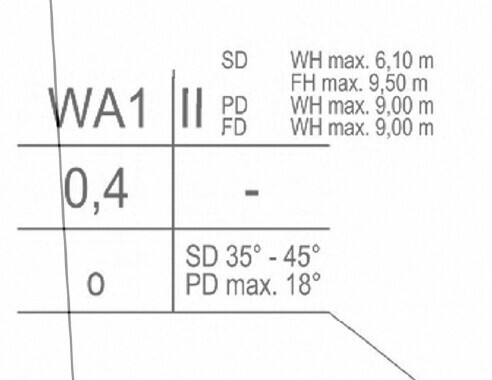
So far, we have received offers ranging from €3500/m² (local large contractor) to €2800/m² from, for example, Fingerhaus (probably excluded due to timber frame).
Now to our dream house:
- KfW 55 standard
- solid construction method (type not clear, will depend on budget; do Liapor and “masonry stone-on-stone” not differ much in cost?)
- 140 m² (1507 sq ft) living area
- 1.5 stories with a “high” knee wall
- basement (utility cellar, which can be finished later, connections for heating and electricity installed)
- house dimensions (determined by room requirements? 11 x 9 m (36 x 30 ft)? 11 x 10 m (36 x 33 ft)? Building area ratio of 0.4 is sufficient)
- including photovoltaic system with battery storage
- turnkey delivery
- Basement: technical room + laundry (15 m² (161 sq ft)) + large hobby room (approx. 30 m² (323 sq ft)) + fitness room (15 m² (161 sq ft)) + cellar (10 m² (108 sq ft)?) + hallway / stairs (? m²) = 70 m² (753 sq ft) + x
- Ground floor: living & dining area + kitchen (approx. 45 m² (484 sq ft)) + pantry (3 m² (32 sq ft)?) + guest room (>12 m² (129 sq ft)) + shower bathroom (4 m² (43 sq ft)?) + hallway / stairs (? m²) = 64 m² (689 sq ft) + x
- Upper floor: child 1 (16 m² (172 sq ft)) + child 2 (16 m² (172 sq ft)) + master bedroom + dressing room (20 m² (215 sq ft)) + bathroom (14 m² (151 sq ft)) + hallway + stairs (? m²) = 66 m² (710 sq ft) + x
Calculating room and floor area requirements (without the unknown x for stairs and hallways/entrance) we come to approximately 130 m² (1399 sq ft).
Our specific questions are,
a) Which “solid construction” companies do you generally recommend in the Tübingen area?
b) How much area should roughly be allowed for hallways and entrance / stairs? Yes, it depends on the floor plan, but we would like to estimate the total space requirements.
c) What rough price range should we expect in €/m² (living area) + €/m² (basement) for Liapor or other masonry? We do not want to consider additional costs like kitchen and garage here, but they are naturally included in the overall budget.
We hope you can help us. Please feel free to ask questions—I’ll respond promptly.
Have a nice evening!
I’ll briefly describe our situation. We have reserved a plot of land for a single-family house. We would like to build a solid (whether Liapor or another type of "masonry," we are not really sure) structure on it. The plot is flat and square, measuring 417 m² (4490 sq ft).
We are allowed to build 2 full stories with SD, PD, FD, although only one SD is an option (maximum ridge height 9.5 m (31 ft), maximum wall height 6.10 m (20 ft)).
So far, we have received offers ranging from €3500/m² (local large contractor) to €2800/m² from, for example, Fingerhaus (probably excluded due to timber frame).
Now to our dream house:
- KfW 55 standard
- solid construction method (type not clear, will depend on budget; do Liapor and “masonry stone-on-stone” not differ much in cost?)
- 140 m² (1507 sq ft) living area
- 1.5 stories with a “high” knee wall
- basement (utility cellar, which can be finished later, connections for heating and electricity installed)
- house dimensions (determined by room requirements? 11 x 9 m (36 x 30 ft)? 11 x 10 m (36 x 33 ft)? Building area ratio of 0.4 is sufficient)
- including photovoltaic system with battery storage
- turnkey delivery
- Basement: technical room + laundry (15 m² (161 sq ft)) + large hobby room (approx. 30 m² (323 sq ft)) + fitness room (15 m² (161 sq ft)) + cellar (10 m² (108 sq ft)?) + hallway / stairs (? m²) = 70 m² (753 sq ft) + x
- Ground floor: living & dining area + kitchen (approx. 45 m² (484 sq ft)) + pantry (3 m² (32 sq ft)?) + guest room (>12 m² (129 sq ft)) + shower bathroom (4 m² (43 sq ft)?) + hallway / stairs (? m²) = 64 m² (689 sq ft) + x
- Upper floor: child 1 (16 m² (172 sq ft)) + child 2 (16 m² (172 sq ft)) + master bedroom + dressing room (20 m² (215 sq ft)) + bathroom (14 m² (151 sq ft)) + hallway + stairs (? m²) = 66 m² (710 sq ft) + x
Calculating room and floor area requirements (without the unknown x for stairs and hallways/entrance) we come to approximately 130 m² (1399 sq ft).
Our specific questions are,
a) Which “solid construction” companies do you generally recommend in the Tübingen area?
b) How much area should roughly be allowed for hallways and entrance / stairs? Yes, it depends on the floor plan, but we would like to estimate the total space requirements.
c) What rough price range should we expect in €/m² (living area) + €/m² (basement) for Liapor or other masonry? We do not want to consider additional costs like kitchen and garage here, but they are naturally included in the overall budget.
We hope you can help us. Please feel free to ask questions—I’ll respond promptly.
Have a nice evening!
A
Aloha_Lars3 Apr 2025 17:06D-Zug88 schrieb:
So far, we have received quotes ranging from €3500 per sqm (local large construction company) down to €2800 per sqm from, for example, Fingerhaus (probably excluded due to timber frame construction).
- 140 sqm (1507 sqft) of living space D-Zug88 schrieb:
- House + basement + single garage = max. €430,000 including own work on interior finishing (flooring, painting, etc.) You already have good size estimates. I believe the calculation nowadays is at least €3,000 per sqm.
140 * 3,000 = 420,000; at €3,500 per sqm it would already be €490,000. Without garage.
D-Zug88 schrieb:
- Buffer €10,000 That’s a rather tight contingency...
D-Zug88 schrieb:
- Movable items such as the kitchen, lighting, and furniture are excluded here because they are very individual and already taken into account. Where exactly have these been accounted for?
Your explanations still leave me wondering what is wishful thinking and what is reality here.
D-Zug88 schrieb:
Then I wonder, how many square meters can we afford?As I said before—and I agree with that: 130–150 m² (1400–1600 sq ft), depending on your expectations for the finishes and who you want to build with. Town & Country is cheaper, a somewhat more expensive general contractor might offer higher quality finishes. And here we are—my crystal ball actually works sometimes.
ypg schrieb:
And then the attic as a cellar substitute. Check!N
nordanney3 Apr 2025 19:30D-Zug88 schrieb:
- House + basement + single garage = max. 430,000 including own work on interior finishing (floors, painting, etc.)Then just take a "budget provider" as a reference:This is the house without "builder-provided items," without basement, without additional construction costs, without basement, without garage.
270k house
10k prefab garage
75k basement (about 75 square meters (800 square feet) – easier to calculate) as a simple, basic utility basement
==> total 355k
Then add your client costs and especially your special requests. KfW40 standard? More than the minimum number of power outlets? Nicer staircase? Basement possibly usable with electricity and water connection? Etc.
That adds up quickly and can easily make your "maximum" explode. Feel free to read up on what Town & Country ultimately costs (there are plenty of threads about that here).
Aloha_Lars schrieb:
You already have good sizes. I think nowadays people estimate at least 3,000 euros per square meter.
140 * 3,000 = 420,000; with 3,500 it would be 490,000. Without a garage. Are you calculating the minimum 3,000 to 3,500 including the basement?
11ant schrieb:
Judging from the slight slope of the access road, the 11ant basement rule ("With or without basement: a decision-making tool") suggests that a basement would mainly be “unnecessary” extra cost here.
You should also take Yvonne’s advice seriously and consider utilizing spaces that replace a basement.
The Living Space Regulation is just called that for simplicity—its scope also covers the consideration and calculation of usable and circulation areas. The easiest way to calculate the total area is to add a flat rate VAT twice: once for the proportional circulation areas (hallways, stairs) and once for the wall-defined areas. So, 130 square meters of living space roughly translates to about 180 square meters; the “one-and-a-half-story” house needs about 120, and the ranch-style villa about 90 square meters of building footprint.
That’s why professionals never understand why laypeople get so hung up on building materials, as if that were the key to everything. “Forget the ring, the ring is rubbish, I got it from a gumball machine!” (Mel Brooks in Spaceballs). For this topic (here or with me) search for “stone mantra” and simply build with the wall system that is the bestseller (or second place) among your preferred installers—don’t try to convince them to use some test-winning wall construction. With “Duo Therm,” you’ve hit an exception to my stone mantra recommendation: that is reinforced concrete poured into an insulated form block, and (pun intended) the core of many customer complaints. Among my advisees, that supplier is not in the running.
You should separate your actual house construction from your thirst for knowledge as clearly as you separate work and drinks. When visiting factories, watch how prefabricated walls are made as an interesting fact, but don’t link that to decisions about your real house project. In practical terms, it doesn’t matter whether, for example, a lightweight expanded clay wall has a mortar mesh inside (because it’s made with 45.6-liter macromolecules on-site) or not (because it’s cast in a factory mold). For a visitor, that may be an exciting event, but in practice it’s just a different, equivalent method. Unlike a burger or takeaway coffee, here the VAT rate is the same. Differences between pumice and lightweight clay are minimal, and the difference between Hauser and Dennert solid house manufacturers even less so. With Xella (aerated concrete) you can even “order the same in green,” meaning delivered on pallets either in yellow (Ytong) or orange (Hebel) foil at the site. Brilliant—it’s true inclusion: the difference is literally zero whether you are colorblind or not, not even like the difference between a Kangoo and a Citan. “Wrong! – like the second, that’s quality! – botched and corked...” But it’s amusing for professionals what some laypeople imagine as possible differences, for which they rigorously train themselves to detect. April Fools! (In the next edition of Bild, there will definitely be double-pledge prototype photos of the Wolpertinger—if you’ve smoked enough chemtrails, you can even see them clearly without 3D glasses). No, there are only two concepts for stone houses here: Large blocks unloaded with the 7.5-ton truck crane and laid in layers with mortar, or large blocks unloaded with a separate crane from the low-loader and mortared only at the building corners. In both, the target thermal transmittance value can be achieved monolithically, with external thermal insulation composite system (ETICS / WDVS) or with insulated dry wall systems (IDWS / WDIS). The variety of wooden wall constructions is only slightly less complex. There are also modular room cells, if someone wants their walls even more 3D. None of this is magic!
140 to 150 square meters times 3,000 equals 420,000 to 450,000 total. You still have a wide range of highly recommended suppliers in that budget. Just make a decision during the “resting phase of the dough” (mental break), either with an independent consultant like me (I regularly mention colleagues here too) or on your own. You have a need, and anyone who can control their FOMO doesn’t have to want “more.” A normal family with two adults and two kids needs about 110 to 120 square meters, excluding a home office. “Resting phase of the dough” sounds good, but I am definitely not calm—with such a flood of information, it’s overwhelming.
I’ll be honest about how we arrived at 140 square meters—which makes me laugh when reading it:
- Look at floor plans from other projects (what kind of spatial feel results theoretically?)
- Browse house catalogs—check the living area and think, well, it probably needs to be at least that big?
- Adopt the dimensions of the houses from the catalogs?
But somehow, that feels wrong—how do you determine what’s enough? You can’t derive that from comparing apples to oranges.
So we wrote down the minimum size each room must have so we are happy with each individual room—considered one by one. Then we said, okay, our living area is important, and we want the option to set up a long dining table, for example. So the house must be longer and wider to ensure the hallways don’t feel too narrow.
Is that wrong?
We have clear ideas of how we want to live in the house. Would it not be advisable to invest in an independent architect, use this wishlist to approach builders who fit the budget, and then compare quotes that are consistent in content?
11ant schrieb:
Judging from the slight slope of the access road, the 11ant basement rule (“With or without basement: a decision-making tool”) suggests that Oh, I’ve seen that before, but I was wondering where the water from our house (wastewater and sewage) would flow? I probably need to educate myself on drainage. Can I find information in the development plan that helps evaluate this?
The written requirements mention the necessity of a cistern. Is that related to the slope?
11ant schrieb:
Judging from the slight slope of the access road, the 11ant basement rule Or do we need a pump station?
D-Zug88 schrieb:
So, we wrote down the minimum requirements each room must meet, D-Zug88 schrieb:
Is that wrong? Yes. Sort of yes. But you’re not the only one making that mistake.
D-Zug88 schrieb:
We have clear ideas about how we want to live in the house, And that is exactly what you should tell or write down for the architect. Avoid specifying square meters; instead, say that the dining area should comfortably accommodate four people daily, but also needs to fit a longer table several times a year. That way, the architect knows not to design narrow rooms around corners.
If you say you enjoy bathing, the architect will include a nice bathtub. If you say you work from home three times a week, they will plan an office of at least 8sqm (86 sq ft). If you add that you have relatives visiting three times a year, the office can be expanded to fit a pull-out sofa and a wardrobe. If your wife collects shoes and needs them easily accessible, they will design a larger wardrobe than usual. And so on.
D-Zug88 schrieb:
I had already wondered: where does the water from our house flow to (wastewater and sewage)? There is a drainage plan for that.
D-Zug88 schrieb:
Can I get information from the development plan that helps assess this issue?
The textual regulations mention the necessity of a cistern. That relates partly to the permeability of the soil but also to how much of the area is sealed.
D-Zug88 schrieb:
Is that connected to the slope? No.
D-Zug88 schrieb:
Or do we need a sewage lifting system? No.
As long as you mess around on your own, you’ll waste a lot of time.
Visit show homes and model villages, bring a tape measure and a notebook, talk to experts at trade fairs.
Look at standard house types that fit the house you want and your needs.
What you must not do is sign anything just because there is supposedly a 5 or 10% discount.

D-Zug88 schrieb:
Dough resting sounds good, but I’m definitely not calm – with this flood of information, it’s really overwhelming.Dough resting is not meant as a remedy for information overload, but rather a phase in my homebuilding schedule. It sits between “Module A,” completed with an independent architect, and the further planning stage, where either the preliminary draft developed with the architect matures into a final design or an alternative building proposal—found during a key decision phase and again not driven by any sales interests—is adapted.D-Zug88 schrieb:
I’m honest here, how we arrive at 140 sqm (square meters) is a bit funny when reading:
– Looking at floor plans from other projects (what kind of spatial feeling would you theoretically get?)
– Checking house catalogs – looking at living areas and saying, “Well, it must be at least this much.”
– Taking the house dimensions from those catalog houses?
But somehow, this feels wrong. What is enough? You can’t derive that from comparing apples to oranges.That’s exactly why I started “Bauen jetzt” (more precisely my partner and I), and together we published the guide “A Homebuilding Roadmap, for You Too: the HOAI Phase Model!” and have since added around forty foundational articles. The homebuilding roadmap explains how to use the HOAI phase model as a planning guideline—regardless of which phases involve architects, engineers, or similar professional expertise. One of the most important phases—inserted between HOAI service phases 2 and 3—is an active pause, for which I borrowed the term dough resting from baking. During this, an independent building consultant can expertly help set the course. This can also be done by any of my colleagues, or—though at the cost of losing much of its therapeutic effect—by the future homeowners themselves.Your approach is not “wrong” per se. Regarding the steps you mentioned, in detail:
1. The selection of these other projects is crucial since transposing ideas directly (for example, trying to apply concepts from a flat plot to a hillside) usually doesn’t work well.
2. When looking at house catalogs, focus less on the houses and more on the people shown. Are they living in circumstances similar to yours now, or maybe with two or three pay raises more? Are they living based on needs or more for representation? Anyone who looks at a house catalog like a travel brochure—vacation by the sea or in the mountains—risks leading themselves astray.
3. Using house dimensions as a guide works only to an extent. If the number of rooms doesn’t fit (for instance, due to a third child or a second home office, or because a hillside plot requires different room placements), you will need expert advice to transpose a violin solo into a piano concerto. What you can reliably conclude is that shrinking a functional house design proportionally to your own budget compared to the listed house price tends to fail.
D-Zug88 schrieb:
We have clear ideas about how we want to live in the house. Would it be wise to invest money in a freelance architect, create a plan based on our wishes, then ask builders within our budget to bid, and compare them on the same basis?Wow, just two lines, but so spicy that they require serious attention. What my roadmap calls Module A is essential in any case and will always cost you—although many providers offer a stripped-down version as “necessary architect services” at an apparently low price or even “included” (meaning the cost is not separately itemized). Never try to “have it all with extra toppings” just because a lender says it’s affordable. Your children’s high school grades won’t improve because of the nineteenth square meter (208 square feet) in their bedroom. Go to an independent architect with a list of needs and wishes, never with a sketch of how the dream house should look. I also recommend (this is covered under “services” on my site and can be done DIY following the same recipe) requesting offers from builders in two stages—partly to take advantage of the dough resting and course-setting phase.D-Zug88 schrieb:
Oh, I’ve seen that before. I was already wondering where the water from our house goes (wastewater and sewage). I probably need to learn more about drainage. Can I get any useful info from the development plan to assess this topic?I already pointed out in your private road thread that you shouldn’t be passive about clarifying this, unlike how the municipality views the role of a private dead-end street regarding technical infrastructure, especially supply and drainage.D-Zug88 schrieb:
The detailed regulations mention the necessity of a cistern. Does that have to do with the slope?
[+] Or do we need a lifting station?A requirement for a cistern (and/or soakaway) has other reasons. I would consider a lifting station necessary only if you plan, despite a flat plot, to build an underground basement and possibly equip it with its own toilet.https://www.instagram.com/11antgmxde/
https://www.linkedin.com/company/bauen-jetzt/
Similar topics