
ᐅ Estimated Construction Costs for a Single-Family Home in the Tübingen Area
Created on: 2 Apr 2025 21:54
D
D-Zug88
Hello everyone,
I’ll briefly describe our situation. We have reserved a plot of land for a single-family house. We would like to build a solid (whether Liapor or another type of "masonry," we are not really sure) structure on it. The plot is flat and square, measuring 417 m² (4490 sq ft).
We are allowed to build 2 full stories with SD, PD, FD, although only one SD is an option (maximum ridge height 9.5 m (31 ft), maximum wall height 6.10 m (20 ft)).
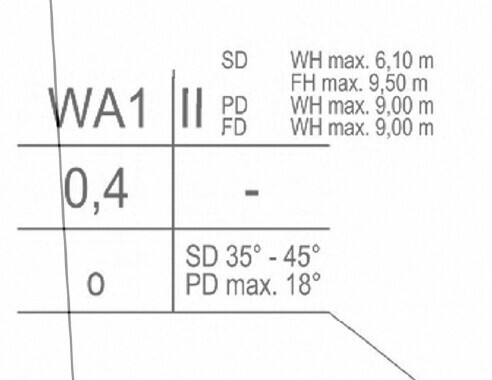
So far, we have received offers ranging from €3500/m² (local large contractor) to €2800/m² from, for example, Fingerhaus (probably excluded due to timber frame).
Now to our dream house:
- KfW 55 standard
- solid construction method (type not clear, will depend on budget; do Liapor and “masonry stone-on-stone” not differ much in cost?)
- 140 m² (1507 sq ft) living area
- 1.5 stories with a “high” knee wall
- basement (utility cellar, which can be finished later, connections for heating and electricity installed)
- house dimensions (determined by room requirements? 11 x 9 m (36 x 30 ft)? 11 x 10 m (36 x 33 ft)? Building area ratio of 0.4 is sufficient)
- including photovoltaic system with battery storage
- turnkey delivery
- Basement: technical room + laundry (15 m² (161 sq ft)) + large hobby room (approx. 30 m² (323 sq ft)) + fitness room (15 m² (161 sq ft)) + cellar (10 m² (108 sq ft)?) + hallway / stairs (? m²) = 70 m² (753 sq ft) + x
- Ground floor: living & dining area + kitchen (approx. 45 m² (484 sq ft)) + pantry (3 m² (32 sq ft)?) + guest room (>12 m² (129 sq ft)) + shower bathroom (4 m² (43 sq ft)?) + hallway / stairs (? m²) = 64 m² (689 sq ft) + x
- Upper floor: child 1 (16 m² (172 sq ft)) + child 2 (16 m² (172 sq ft)) + master bedroom + dressing room (20 m² (215 sq ft)) + bathroom (14 m² (151 sq ft)) + hallway + stairs (? m²) = 66 m² (710 sq ft) + x
Calculating room and floor area requirements (without the unknown x for stairs and hallways/entrance) we come to approximately 130 m² (1399 sq ft).
Our specific questions are,
a) Which “solid construction” companies do you generally recommend in the Tübingen area?
b) How much area should roughly be allowed for hallways and entrance / stairs? Yes, it depends on the floor plan, but we would like to estimate the total space requirements.
c) What rough price range should we expect in €/m² (living area) + €/m² (basement) for Liapor or other masonry? We do not want to consider additional costs like kitchen and garage here, but they are naturally included in the overall budget.
We hope you can help us. Please feel free to ask questions—I’ll respond promptly.
Have a nice evening!
I’ll briefly describe our situation. We have reserved a plot of land for a single-family house. We would like to build a solid (whether Liapor or another type of "masonry," we are not really sure) structure on it. The plot is flat and square, measuring 417 m² (4490 sq ft).
We are allowed to build 2 full stories with SD, PD, FD, although only one SD is an option (maximum ridge height 9.5 m (31 ft), maximum wall height 6.10 m (20 ft)).
So far, we have received offers ranging from €3500/m² (local large contractor) to €2800/m² from, for example, Fingerhaus (probably excluded due to timber frame).
Now to our dream house:
- KfW 55 standard
- solid construction method (type not clear, will depend on budget; do Liapor and “masonry stone-on-stone” not differ much in cost?)
- 140 m² (1507 sq ft) living area
- 1.5 stories with a “high” knee wall
- basement (utility cellar, which can be finished later, connections for heating and electricity installed)
- house dimensions (determined by room requirements? 11 x 9 m (36 x 30 ft)? 11 x 10 m (36 x 33 ft)? Building area ratio of 0.4 is sufficient)
- including photovoltaic system with battery storage
- turnkey delivery
- Basement: technical room + laundry (15 m² (161 sq ft)) + large hobby room (approx. 30 m² (323 sq ft)) + fitness room (15 m² (161 sq ft)) + cellar (10 m² (108 sq ft)?) + hallway / stairs (? m²) = 70 m² (753 sq ft) + x
- Ground floor: living & dining area + kitchen (approx. 45 m² (484 sq ft)) + pantry (3 m² (32 sq ft)?) + guest room (>12 m² (129 sq ft)) + shower bathroom (4 m² (43 sq ft)?) + hallway / stairs (? m²) = 64 m² (689 sq ft) + x
- Upper floor: child 1 (16 m² (172 sq ft)) + child 2 (16 m² (172 sq ft)) + master bedroom + dressing room (20 m² (215 sq ft)) + bathroom (14 m² (151 sq ft)) + hallway + stairs (? m²) = 66 m² (710 sq ft) + x
Calculating room and floor area requirements (without the unknown x for stairs and hallways/entrance) we come to approximately 130 m² (1399 sq ft).
Our specific questions are,
a) Which “solid construction” companies do you generally recommend in the Tübingen area?
b) How much area should roughly be allowed for hallways and entrance / stairs? Yes, it depends on the floor plan, but we would like to estimate the total space requirements.
c) What rough price range should we expect in €/m² (living area) + €/m² (basement) for Liapor or other masonry? We do not want to consider additional costs like kitchen and garage here, but they are naturally included in the overall budget.
We hope you can help us. Please feel free to ask questions—I’ll respond promptly.
Have a nice evening!
N
nordanney3 Apr 2025 07:31D-Zug88 schrieb:
how can I compare a wall like this to a "classic" solid wall houseYou can't really compare them directly, as every wall structure serves the same purpose and only differs in cost depending on the order: external thermal insulation composite system (ETICS), monolithic, and cavity wall, with timber frame construction falling in between. Otherwise, every wall keeps you warm and dry.D-Zug88 schrieb:
That is a different plot – ? It is the same as here:
https://www.hausbau-forum.de/threads/b-plan-private-strasse-rechte-und-pflichten.48963/
D-Zug88 schrieb:
I just wanted to find out what the exterior dimensions of a house should be, You can only estimate this roughly. What matters is always the house design, which is created based on the available plot and its conditions (building envelope, building permit / planning permission, floor area ratio, parking regulations). Everything else is just theory. The room sizes also need to be more or less flexible.
Regarding the construction method and type of brick or block, you use the material your general contractor or builder offers you. Comparisons are made according to the building energy act and personal preferences. The latter can increase your construction costs if you choose a building method that is not commonly available in your region.
ypg schrieb:
? It’s the same as here:
https://www.hausbau-forum.de/threads/b-plan-private-strasse-rechte-und-pflichten.48963/
You can only make a rough estimate. The house design is what matters—it is created based on the existing plot and its conditions (building envelope, zoning plan/planning permission, floor area ratio, parking regulations). Everything else is just theoretical. Room sizes also need to be more or less flexible.
Regarding construction type and which bricks to use, you simply take the materials your general contractor or builder offers you. Comparisons should be made according to the building energy regulations and personal preferences. The latter can increase the cost of your house if you choose a construction type that is not commonly available in your region. Right, sorry. I should have added that there, my mistake.
A
Aloha_Lars3 Apr 2025 13:31What is your actual financial scope? I only see many expensive wishes in a very costly region. To me, it seems like you're putting the cart before the horse.
Regards
Regards
Aloha_Lars schrieb:
What is your actual financial scope? I only see a lot of expensive wishes in a very pricey area.
To me, it seems like you’re putting the cart before the horse...
Greetings from the Reutlingen districtHello, that’s exactly the question we’re asking ourselves right now. How much does 140sqm (1500 sqft) with a basement cost? We were given prices ranging from 2800 to 3600 per sqm (260 to 335 per sqft). Of course, the building specifications and scope of work are crucial, but the overall framework has to be realistic.
Our budget for the following items is:
- House + basement + single garage = max. 430,000 including own work on interior finishes (flooring, painting, etc.)
- Additional construction costs (excavation, landfill fees, cistern, structural engineer, soil report, electricity, water, internet, building permit / planning permission, construction fence — I won’t list everything) + outdoor areas (also partly DIY) = max. 80,000
- Movable items like kitchen, lighting, and furniture I’m leaving out here since they are very individual and already considered.
- Contingency fund 10,000
Total of 520,000 for a desirable 140-150sqm (1500-1600 sqft).
Is this completely unrealistic? Which companies operate within this price range? Are there even reasonably reliable and good-quality companies in this segment?
D-Zug88 schrieb:
Hello, that’s exactly the question we’re asking ourselves right now. How much does 140sqm (1500 sqft) with a basement cost? We were given prices ranging from 2800 to 3600 per sqm (260 to 335 per sqft). Of course, the building specifications and scope of work are crucial, but the overall framework has to be realistic.
Our budget for the following items is:
- House + basement + single garage = max. 430,000 including own work on interior finishes (flooring, painting, etc.)
- Additional construction costs (excavation, landfill fees, cistern, structural engineer, soil report, electricity, water, internet, building permit / planning permission, construction fence — I won’t list everything) + outdoor areas (also partly DIY) = max. 80,000
- Movable items like kitchen, lighting, and furniture I’m leaving out here since they are very individual and already considered.
- Contingency fund 10,000
Total of 520,000 for a desirable 140-150sqm (1500-1600 sqft).
Is this completely unrealistic? Which companies operate within this price range? Are there even reasonably reliable and good-quality companies in this segment?I’m probably going to be proven wrong soon? Then I wonder how many square meters (sqft) we can actually afford?

D-Zug88 schrieb:
Of course, I am aware that a basement costs money?! Judging by the slight slope of the side street, the 11ant basement rule ("With or without basement: a rule as a decision tool") suggests that a basement here mainly costs "unnecessary" money, for that reason.
D-Zug88 schrieb:
No, not a basement substitute. I clearly stated that we want to build with a basement. You should also take Yvonne’s advice to heart about making use of potential basement substitute space.
D-Zug88 schrieb:
That is why I consciously distinguished between "living area, meaning ground floor and upper floor" plus "basement area."
130 --> the room sizes added up (is that wrong, or do I misunderstand the living space regulations??) -
Basically, I just wanted to find out what exterior dimensions a house would need to cover the space requirements we would like, a living and utility area... The “living space regulations” are named that way simply to avoid a longer title. They definitely include rules on how utility and circulation spaces are counted. The simplest general approach to the sum of all rooms is to roughly multiply by two “value-added factors”: once for shared circulation areas (hallways, stairs), and once for surfaces enclosed by walls. So, 130 sqm (square meters) of living space roughly correspond to about 180 sqm, meaning that a one-and-a-half-story house would need around 120 sqm, and the substitute villa about 90 sqm of building footprint.
D-Zug88 schrieb:
I want to better understand blanket statements like "brick and mortar" is too expensive but have hardly found anything so far. One person builds with a specially developed block called "Duo Therm," another chooses aerated concrete, another calcium silicate brick. As a layperson, you just can’t compare that, right? That’s why professionals never quite understand why laypersons attach such importance to building material philosophy, as if it were a magic formula. “Forget the ring, the ring is junk, I got it from a gumball machine!” (Mel Brooks in "Spaceballs"). For more on this, search for the keyword "stone mantra" (here or with me) and simply build with the wall material that is a bestseller (or at least second best) with your chosen contractor—don’t try to convince them to use a so-called test winner wall system. With “Duo Therm,” you’ve hit the exception to my stone mantra: it’s reinforced concrete poured into an insulated formwork block, and (pun intended) the root of many customer complaints. This supplier does not appear among my recommended providers.
D-Zug88 schrieb:
I’m quite familiar with different “stone” types—I find the approach of companies like Hauser interesting but have no experience with expanded clay prefab walls. [...] What’s new to me are, as I said, the Liapor walls from companies like Hauser. I find the concept interesting, but how can I compare such a wall to a “classic” solid masonry house? Everyone promises a lot. You should separate your actual home building from your thirst for building knowledge as strictly as you separate work and drinking. When visiting production sites, observe how prefabricated wall elements are made as a “mouse-level” factual experience, but don’t let it influence decisions on your real home project. In practical use, it makes no difference if, for example, the expanded clay wall contains a mortar mesh (because it was made on-site from 45.6-liter macromolecules) or not (because it was cast into a custom mold in a factory). For visitors, this may be exciting, but in practice, it’s just another equivalent approach. Unlike a burger or takeaway coffee, the value-added tax rate here is the same. Differences between pumice and expanded clay are minor, and those between Hauser and Dennert solid masonry houses even smaller. With Xella (aerated concrete), you can even choose the same product in yellow (Ytong) or orange (Hebel) packaging on site. Brilliant—finally real inclusion: the difference is (simply because it is zero) completely irrelevant, whether you are colorblind or not; it’s not even like comparing a Kangoo with a Citan van. “Wrong! – The second one, that’s quality! – botched and screwy…” But it is entertaining for professionals to see what fictional differences some laypeople insist they can expertly distinguish. April fool! (The next edition of Bild will surely have double-secret prototype photos of the Wolpertinger—if you’ve smoked enough chemtrails, you can even see them clearly without 3D glasses.) No, there are basically only two concepts for masonry houses: large blocks unloaded with a 7.5-ton truck crane, then mortared layer by layer; or large blocks unloaded with a separate crane from a low-loader, then mortared only at the house corners. For both, you can achieve your target thermal transmittance value with monolithic construction, external thermal insulation composite systems (ETICS / WDVS), or internal insulation systems (WDIS). The variety in timber wall assemblies is only slightly less clear-cut. There are also room modules if 3D isn’t enough for someone. None of this is rocket science!
D-Zug88 schrieb:
Total estimate 520k for the desired 140-150 sqm.
Is that totally out of reality? Which companies operate in this range? Are there even reasonably reliable and quality firms in this segment?
[+] I’ll probably get shot down for this question? Then I wonder, how many square meters can we afford? 140 to 150 sqm times $3,000 per sqm (square meter) equals 420 to 450k total. You will still find a generous selection of recommended providers in that range. Simply make a calm decision at the “resting phase” with an independent consultant like me (I often mention colleagues here as well), or on your own. You do have a need, and those who can control their FOMO don’t need to “indulge” more. A typical family of two adults and two children (2E2K) needs about 110 to 120 sqm excluding a home office.
https://www.instagram.com/11antgmxde/
https://www.linkedin.com/company/bauen-jetzt/
Similar topics