
ᐅ Estimated Construction Costs for a Single-Family Home in the Tübingen Area
Created on: 2 Apr 2025 21:54
D
D-Zug88
Hello everyone,
I’ll briefly describe our situation. We have reserved a plot of land for a single-family house. We would like to build a solid (whether Liapor or another type of "masonry," we are not really sure) structure on it. The plot is flat and square, measuring 417 m² (4490 sq ft).
We are allowed to build 2 full stories with SD, PD, FD, although only one SD is an option (maximum ridge height 9.5 m (31 ft), maximum wall height 6.10 m (20 ft)).
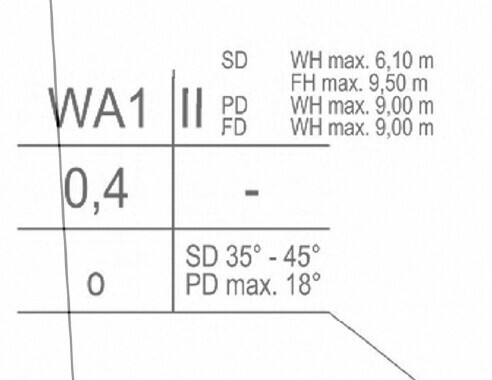
So far, we have received offers ranging from €3500/m² (local large contractor) to €2800/m² from, for example, Fingerhaus (probably excluded due to timber frame).
Now to our dream house:
- KfW 55 standard
- solid construction method (type not clear, will depend on budget; do Liapor and “masonry stone-on-stone” not differ much in cost?)
- 140 m² (1507 sq ft) living area
- 1.5 stories with a “high” knee wall
- basement (utility cellar, which can be finished later, connections for heating and electricity installed)
- house dimensions (determined by room requirements? 11 x 9 m (36 x 30 ft)? 11 x 10 m (36 x 33 ft)? Building area ratio of 0.4 is sufficient)
- including photovoltaic system with battery storage
- turnkey delivery
- Basement: technical room + laundry (15 m² (161 sq ft)) + large hobby room (approx. 30 m² (323 sq ft)) + fitness room (15 m² (161 sq ft)) + cellar (10 m² (108 sq ft)?) + hallway / stairs (? m²) = 70 m² (753 sq ft) + x
- Ground floor: living & dining area + kitchen (approx. 45 m² (484 sq ft)) + pantry (3 m² (32 sq ft)?) + guest room (>12 m² (129 sq ft)) + shower bathroom (4 m² (43 sq ft)?) + hallway / stairs (? m²) = 64 m² (689 sq ft) + x
- Upper floor: child 1 (16 m² (172 sq ft)) + child 2 (16 m² (172 sq ft)) + master bedroom + dressing room (20 m² (215 sq ft)) + bathroom (14 m² (151 sq ft)) + hallway + stairs (? m²) = 66 m² (710 sq ft) + x
Calculating room and floor area requirements (without the unknown x for stairs and hallways/entrance) we come to approximately 130 m² (1399 sq ft).
Our specific questions are,
a) Which “solid construction” companies do you generally recommend in the Tübingen area?
b) How much area should roughly be allowed for hallways and entrance / stairs? Yes, it depends on the floor plan, but we would like to estimate the total space requirements.
c) What rough price range should we expect in €/m² (living area) + €/m² (basement) for Liapor or other masonry? We do not want to consider additional costs like kitchen and garage here, but they are naturally included in the overall budget.
We hope you can help us. Please feel free to ask questions—I’ll respond promptly.
Have a nice evening!
I’ll briefly describe our situation. We have reserved a plot of land for a single-family house. We would like to build a solid (whether Liapor or another type of "masonry," we are not really sure) structure on it. The plot is flat and square, measuring 417 m² (4490 sq ft).
We are allowed to build 2 full stories with SD, PD, FD, although only one SD is an option (maximum ridge height 9.5 m (31 ft), maximum wall height 6.10 m (20 ft)).
So far, we have received offers ranging from €3500/m² (local large contractor) to €2800/m² from, for example, Fingerhaus (probably excluded due to timber frame).
Now to our dream house:
- KfW 55 standard
- solid construction method (type not clear, will depend on budget; do Liapor and “masonry stone-on-stone” not differ much in cost?)
- 140 m² (1507 sq ft) living area
- 1.5 stories with a “high” knee wall
- basement (utility cellar, which can be finished later, connections for heating and electricity installed)
- house dimensions (determined by room requirements? 11 x 9 m (36 x 30 ft)? 11 x 10 m (36 x 33 ft)? Building area ratio of 0.4 is sufficient)
- including photovoltaic system with battery storage
- turnkey delivery
- Basement: technical room + laundry (15 m² (161 sq ft)) + large hobby room (approx. 30 m² (323 sq ft)) + fitness room (15 m² (161 sq ft)) + cellar (10 m² (108 sq ft)?) + hallway / stairs (? m²) = 70 m² (753 sq ft) + x
- Ground floor: living & dining area + kitchen (approx. 45 m² (484 sq ft)) + pantry (3 m² (32 sq ft)?) + guest room (>12 m² (129 sq ft)) + shower bathroom (4 m² (43 sq ft)?) + hallway / stairs (? m²) = 64 m² (689 sq ft) + x
- Upper floor: child 1 (16 m² (172 sq ft)) + child 2 (16 m² (172 sq ft)) + master bedroom + dressing room (20 m² (215 sq ft)) + bathroom (14 m² (151 sq ft)) + hallway + stairs (? m²) = 66 m² (710 sq ft) + x
Calculating room and floor area requirements (without the unknown x for stairs and hallways/entrance) we come to approximately 130 m² (1399 sq ft).
Our specific questions are,
a) Which “solid construction” companies do you generally recommend in the Tübingen area?
b) How much area should roughly be allowed for hallways and entrance / stairs? Yes, it depends on the floor plan, but we would like to estimate the total space requirements.
c) What rough price range should we expect in €/m² (living area) + €/m² (basement) for Liapor or other masonry? We do not want to consider additional costs like kitchen and garage here, but they are naturally included in the overall budget.
We hope you can help us. Please feel free to ask questions—I’ll respond promptly.
Have a nice evening!
M
motorradsilke6 Apr 2025 08:49The splash guard around the house can be installed by any reasonably strong person. Landscaping can be done as well.
D-Zug88 schrieb:
We understand that we want a lot, but simply cannot afford it given the current interest rates and construction costs. Well, this reads as if you think you are one of those who cannot afford a house. That’s not the case. You are one of many who can afford a house, but just not, in a sense, golden faucets. Nothing “has to” be done; it should be a “can.”
Let’s see whether quotation marks are still allowed here or if they’ll be deleted.
I also have trouble with fluctuating amounts and numbers that change from post to post.
However, the mentioned 80,000 can very well be sufficient. I don’t see incidental construction costs as that high either, and later on, you can see what is left over. That should be enough for a terrace and parking space. You don’t need a construction fence, and a flowering shrub planting can replace many other plants instead of a fence. You can also get a garden shed for 3,000€ (approx. $3,300), and have a gravel driveway. If there is more left over, then you have more.
I would budget 450,000€ (approx. $495,000) for a nice house and avoid searching in the expensive areas. Then you can show the scope of work or have the expert who supports you review it.
We can also help with floor plans by modifying a standard house design.
K a t j a schrieb:
Excavation is probably included in the house price, provided the basement stays as planned and there are no surprises with the soil report. It is almost always specified as 20 or 30cm (8 or 12 inches), which is not sufficient for a frost-proof foundation.
K a t j a schrieb:
I’m confused. What is actually correct?
You’re buying the plot from the city, right? That means all utilities are connected. The development only extends up to the house. Also, it’s flat and looks straightforward at first glance. Is that the case?
If so, you could certainly spend 80,000€ on outdoor landscaping, but I think that would be quite excessive. Most home builders start with just one parking space. For lawnmowers and such, a small shed that you build yourself is sufficient.
I would budget for utility connections, patio, main entrance, eaves strip, and paths. The latter can initially be just gravel paths if necessary. Excavation will most likely be included in the house price as long as the basement is omitted and there are no surprises in the soil report.
For this plot size, 40,000 to 50,000€ should be enough, provided costs in Tübingen don’t get out of hand.
That leaves 460,000€ for the house, which corresponds to about 150 sqm (1,615 sq ft). Some of the more ambitious ideas may have to be dropped from the wishlist, but that is a very nice house size. You can also live very well in 130 sqm (1,399 sq ft) if you want a bit of a financial buffer.
I hope not. Now the real work is just beginning. Or am I misunderstanding, and will we be discussing financing and floor plans soon? Alright then, I’m happy to clarify—I didn’t want to annoy you with all the confusion. Here are the numbers broken down by every single item on my working list:
Maximum possible total budget: 680,000€
+ Plot 191,000€
= 310,000€ (without contingency; I hope the figures are well chosen and no item was forgotten. The basis was reference values / estimates / online research, no firm offers). We’re taking all furniture with us since it’s in very good condition and can continue to be used with good planning.
680,000 - 310,000 = 370,000 (house + garage or carport)
If I assume a garage at 15,000€, that leaves 355,000 / 3,000 = 118.3 sqm (1,275 sq ft) living space.
With a carport at 8,000€, that leaves 362,000 / 3,000 = 120.7 sqm (1,301 sq ft) living space.
Adjustable factor is the price per sqm; we want solid construction that can be used by future generations... as mentioned, the premise is a masonry build.
Fire away.
D-Zug88 schrieb:
Alright, happy to do so. I just didn’t want to bother you with the confusion any longer and am detailing the numbers down to every single item in my working list:
Maximum possible total budget: 680,000
We had to adjust our total budget in the past few days, which is why less remains for the house—hence the confusion.
Aside from the fact that some items do not exist or will not be needed when working with a general contractor, some of the amounts are also somewhat unexplainable.
Besides, the order of the items is chosen incorrectly as well (garden later, incidental construction costs at the beginning, just because it has to be that way).
But I definitely cannot arrive at 310,000 € by roughly calculating.
102,000 plus 18,000 equals 120,000
There remain 650,000 (680,000 minus 30,000 buffer) minus 120,000
530,000 €
Besides, the order of the items is chosen incorrectly as well (garden later, incidental construction costs at the beginning, just because it has to be that way).
D-Zug88 schrieb:
= 310,000 €
But I definitely cannot arrive at 310,000 € by roughly calculating.
102,000 plus 18,000 equals 120,000
There remain 650,000 (680,000 minus 30,000 buffer) minus 120,000
530,000 €
ypg schrieb:
Setting aside that some items do not exist or will not be present when working with a general contractor, and that some amounts don’t seem to make sense at all.
Also, the order of the items is chosen incorrectly (garden later, additional construction costs at the beginning, just because).
But I definitely don’t get to €310,000 (euros) by rough calculation.
102,000 plus 18,000 equals 120,000
Remaining from €650,000 (680,000 minus a €30,000 buffer) minus 120,000
530,000€ (euros) €310,000 (euros) including land – as I said, I’m no expert and just searched the internet and wrote down whatever I found. €680,000 (euros) is the potential budget.
ypg schrieb:
So this reads as if you think you are one of those who cannot afford a house. Yes, I think so, or I’m calculating wrong, see last post.
I think there is still a lot of “radicalism” behind this at the moment. Of course, there are points where you have to say no, but a house project is too important in life to decide too quickly in one direction or the other.
It is already very helpful that you openly share your thoughts here, because that is what this forum is for, and now you are also presenting your numbers. This way, you gain even more clarity from collective knowledge, which can only be positive for the decision-making process.
In fact, I would consciously detach myself from what the people around me show me and present as the (only possible) reality. Of course, you might end up with a house similar to your acquaintances, but the path to get there, the key parameters along the way, and the result can differ—and you will have reached the goal in your own way. Situations are usually not comparable because of different financial circumstances, different willingness (tolerance), varying expectations of future family life, and so on—even though everything seems almost the same when you stand in front of the individual houses.
Why should that bother anyone? On the contrary, it shows that you are already seriously and carefully dealing with the subject; it’s not a problem if something doesn’t fit, is missing, or is too much. I have had several projects in my life and couldn’t come close to doing this as well off the cuff.
On some points, I want to say that you probably got them from a brochure or the internet, but many of these things can certainly be done quite differently or much cheaper; for some, it’s enough to do them later, even if you then stand out below the exemplary neighbor.
Cistern: Do you need one? If yes, then the question is what it is supposed to do, as there are also cheaper options here.
Internet: It cost us €700 (about $750) from Telekom, but at the same time, there was a credit of about €700 (about $750).
Outdoor area: Why do you need a fence or an expensive driveway? I have a large area here and had a nice gravel surface laid for €500 (about $540) in one day—that’s it. You can build a fence yourself step by step if you really want one, otherwise, inexpensive plants also work. Do you need a “chain-link/fence mesh”? Have you ever seen a picket fence? It costs almost “nothing” and you only have to set a post occasionally. You can do that alone, and if something is a little crooked, you simply straighten it again.
At my first house, my then-wife and I built a terrace ourselves without any prior knowledge. You can get shown how or find instructions online. Ask the excavator driver if he can prepare something during the excavation—then you can fill the foundations yourselves later, put wooden beams on top, screw unplaned boards from the timber yard on top, and the special terrace is done for little money. The same goes for the entrance: a gravel path, maybe a few large slabs simply laid in, and a small platform in front of the house can also be concreted alone. It’s not rocket science and can be done almost without machines, or you build a wooden platform based on railroad ties or pallets. I wouldn’t let such a thing make or break the house project if it was really important to me. You have to find out what you can best handle yourselves and what can be obtained most easily and cheaply in your area—and that’s how it will work. That is called sustainable nowadays!
We had sandstone rocks in abundance back then, cheaply or even free, collected from fields by farmers. From these, we made boundaries and small walls—not from the catalog in the hardware store.
Kitchen: Why should the house project fail because of kitchen costs? In our first house, we bought a used kitchen; this is much easier now with online classifieds. With imagination (not money), you buy individual pieces as modules or something nice and then combine/add other things. In the end, you have an individual, functional kitchen, and if you ever have the money, you can buy the kind of kitchen people think you need.
Moving: I have moved very often, but at your age it shouldn’t cost €2,000 (about $2,150). Rent a van for a day, find 6–8 people, prepare everything, and the move is done by evening for about €300 (about $320).
As I said, maybe in the end it really doesn’t make sense for you, but before I got there, I would consider how to fight my way there without going under, and take a big step away from the rather boring, widespread, and expensive standard that has partly taken hold.
It is already very helpful that you openly share your thoughts here, because that is what this forum is for, and now you are also presenting your numbers. This way, you gain even more clarity from collective knowledge, which can only be positive for the decision-making process.
In fact, I would consciously detach myself from what the people around me show me and present as the (only possible) reality. Of course, you might end up with a house similar to your acquaintances, but the path to get there, the key parameters along the way, and the result can differ—and you will have reached the goal in your own way. Situations are usually not comparable because of different financial circumstances, different willingness (tolerance), varying expectations of future family life, and so on—even though everything seems almost the same when you stand in front of the individual houses.
D-Zug88 schrieb:
Well, sure, I just didn’t want to bother you with the confusion anymore and will specify the numbers down to every single item in my work list:
Why should that bother anyone? On the contrary, it shows that you are already seriously and carefully dealing with the subject; it’s not a problem if something doesn’t fit, is missing, or is too much. I have had several projects in my life and couldn’t come close to doing this as well off the cuff.
On some points, I want to say that you probably got them from a brochure or the internet, but many of these things can certainly be done quite differently or much cheaper; for some, it’s enough to do them later, even if you then stand out below the exemplary neighbor.
Cistern: Do you need one? If yes, then the question is what it is supposed to do, as there are also cheaper options here.
Internet: It cost us €700 (about $750) from Telekom, but at the same time, there was a credit of about €700 (about $750).
Outdoor area: Why do you need a fence or an expensive driveway? I have a large area here and had a nice gravel surface laid for €500 (about $540) in one day—that’s it. You can build a fence yourself step by step if you really want one, otherwise, inexpensive plants also work. Do you need a “chain-link/fence mesh”? Have you ever seen a picket fence? It costs almost “nothing” and you only have to set a post occasionally. You can do that alone, and if something is a little crooked, you simply straighten it again.
At my first house, my then-wife and I built a terrace ourselves without any prior knowledge. You can get shown how or find instructions online. Ask the excavator driver if he can prepare something during the excavation—then you can fill the foundations yourselves later, put wooden beams on top, screw unplaned boards from the timber yard on top, and the special terrace is done for little money. The same goes for the entrance: a gravel path, maybe a few large slabs simply laid in, and a small platform in front of the house can also be concreted alone. It’s not rocket science and can be done almost without machines, or you build a wooden platform based on railroad ties or pallets. I wouldn’t let such a thing make or break the house project if it was really important to me. You have to find out what you can best handle yourselves and what can be obtained most easily and cheaply in your area—and that’s how it will work. That is called sustainable nowadays!
We had sandstone rocks in abundance back then, cheaply or even free, collected from fields by farmers. From these, we made boundaries and small walls—not from the catalog in the hardware store.
Kitchen: Why should the house project fail because of kitchen costs? In our first house, we bought a used kitchen; this is much easier now with online classifieds. With imagination (not money), you buy individual pieces as modules or something nice and then combine/add other things. In the end, you have an individual, functional kitchen, and if you ever have the money, you can buy the kind of kitchen people think you need.
Moving: I have moved very often, but at your age it shouldn’t cost €2,000 (about $2,150). Rent a van for a day, find 6–8 people, prepare everything, and the move is done by evening for about €300 (about $320).
As I said, maybe in the end it really doesn’t make sense for you, but before I got there, I would consider how to fight my way there without going under, and take a big step away from the rather boring, widespread, and expensive standard that has partly taken hold.
Similar topics