
Hello,
we are planning to build soon, and I am currently looking into the heating system.
I have tried to estimate how much electricity our air-to-water heat pump might consume.
Am I correct in understanding that the final energy demand is the amount of energy I need to put into the house for heating and hot water?
And this can be provided by oil, gas, or a heat pump?
If so, how does the COP work in this context?
I am trying to explain it with a very simple, hypothetical example:
A house with 200 sqm (2153 sq ft) and a calculated final energy demand of 10 kWh/sqm/year.
I understand this to mean that 2000 kWh of heating energy is needed annually.
An air-to-water heat pump with a theoretical COP of 2 converts 1 kW of electricity to 2 kW of heat.
Does that mean that with such a heat pump, only 1000 kWh of electricity is needed for heating and hot water?
I hope I am not making too many mistakes, but primary energy, final energy, COP, efficiency, and performance are all new and quite confusing to me.
Thanks in advance
Anja
we are planning to build soon, and I am currently looking into the heating system.
I have tried to estimate how much electricity our air-to-water heat pump might consume.
Am I correct in understanding that the final energy demand is the amount of energy I need to put into the house for heating and hot water?
And this can be provided by oil, gas, or a heat pump?
If so, how does the COP work in this context?
I am trying to explain it with a very simple, hypothetical example:
A house with 200 sqm (2153 sq ft) and a calculated final energy demand of 10 kWh/sqm/year.
I understand this to mean that 2000 kWh of heating energy is needed annually.
An air-to-water heat pump with a theoretical COP of 2 converts 1 kW of electricity to 2 kW of heat.
Does that mean that with such a heat pump, only 1000 kWh of electricity is needed for heating and hot water?
I hope I am not making too many mistakes, but primary energy, final energy, COP, efficiency, and performance are all new and quite confusing to me.
Thanks in advance
Anja
WilderSueden schrieb:
I have read this three times now and have to admit that it confuses me more than it helps. Does this mean that the same building envelope is classified very differently for final energy demand, depending on whether I generate heat with gas (~1:1) or a heat pump (1:3.6)? The factors for primary energy demand adjust this somewhat, but in the example, gas would still be 1.1 and the heat pump 0.5 kWh primary energy per kWh of heat? The certificate does not evaluate the envelope alone but the entire house including the technical systems.
Final energy demand indicates how many kWh of the energy source used are “delivered” to the building. You can use heating oil, electricity, natural gas, wood pellets, etc. The primary energy factor then takes into account the environmental impact or renewable share of the energy source – that’s why the factor can be less than 1. For example, wood is assessed as 100% renewable but still incurs about 20% of its energy content in additional effort for transport and processing. It is correct that heat pumps cause some shifts here, while for gas and oil the final and primary energy demands differ only slightly.
For permits, subsidies, and similar purposes, the primary energy demand is always considered because it reflects both the building envelope, the technical systems, and the climate impact of the energy source used. This makes sense because the goal is to achieve a low overall value, and a particularly high insulation standard may then allow for somewhat less efficient heating, such as direct electric heating in passive house standards.
For estimating operating costs for buyers, the final energy demand is relevant again. The certificate always includes the usable floor area of the building to which the values refer, allowing the determination of absolute values.
W
WilderSueden24 May 2023 10:29dertill schrieb:
The certificate does not assess the building envelope alone, but the entire house including the technology.The question is, who understands the difference if they are not an energy consultant? This thread shows that even interested laypeople often do not. Ninety-nine percent probably equate final energy demand with heating demand. The energy performance certificate lacks a clear indication of the pure heating demand because different energy sources have varying costs. A final energy demand of 50 kWh/m² (5.2 kWh/ft²) with gas is entirely different from the same final energy demand with a heat pump. However, the certificate suggests that both houses are comparable.WilderSueden schrieb:
The energy certificate lacks a clear indication of the pure heat demand without dilution, since different energy sources are not equally expensive. A final energy demand of 50 kWh/m² (16,000 BTU/ft²) using gas is a completely different matter than the same final energy demand using a heat pump. However, the energy certificate suggests that both houses are comparable. The energy source used for the calculation is always indicated (only in the photo provided by the questioner, this part is not shown).
The certificate clearly states (example values):
Final energy demand: 10 kWh/m²a (3,200 BTU/ft² per year)
Energy source used: electricity
Net floor area: 200 m² (2,150 ft²)
How much heat is generated from the respective energy source is irrelevant for the user who wants to know the operating costs.
The second value is relevant for official assessment but less important for the user.
The individual values (heat demand for heating, heat demand for hot water, useful heat demand, solar heat gains, possibly accounting for photovoltaic systems, etc.) can be output separately by the calculation software but are not part of the energy certificate (because THAT would confuse 99% of readers). Upon request, however, any reputable energy consultant can provide these as a short report (easily generated with one click).
Therefore, both values make sense. Determining the values is not easy to understand, but in the end, both make buildings comparable with respect to energy efficiency and expected operating costs.
W
WilderSueden24 May 2023 11:19That is all correct once you understand that final energy has little to do with the heating demand. I just spent some time browsing the internet. In some cases, the information is incorrect (for example, “Final energy value: How much thermal energy do you need to supply the building with heating and domestic hot water?”). The rest is so vague about the exact meaning of final energy that you have to know the definition beforehand; otherwise, as a layperson, you might assume it refers to the heating demand. I get the impression that even consumer advice centers themselves do not fully understand the difference.
R
Radfahrer30 Sep 2023 14:20Very interesting, but somehow I still don’t fully understand it, at least since I dug out my old energy performance certificate from 2003/2004. According to that, I would have an annual heating energy demand of 15,560 kWh/a.
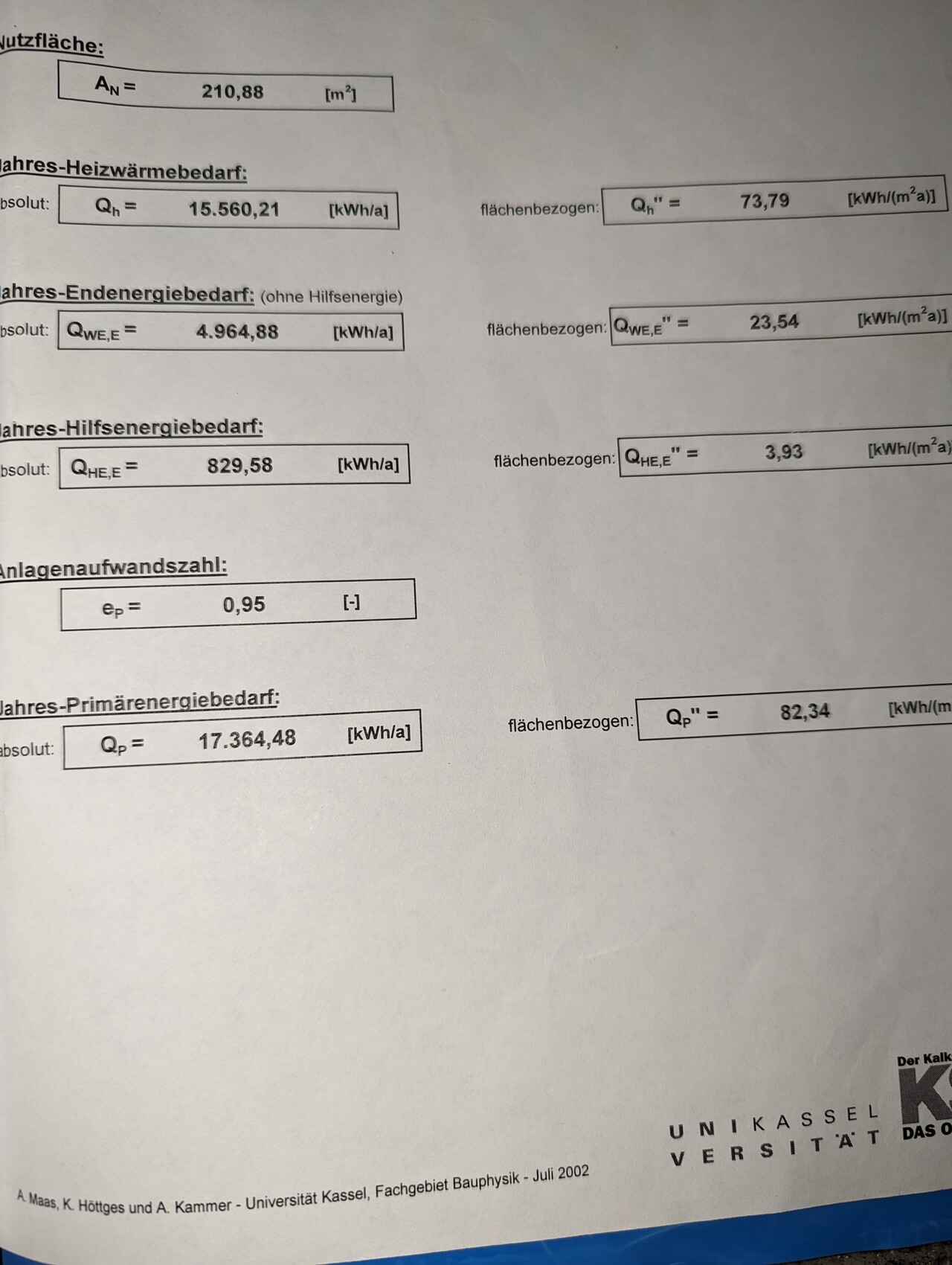
Here, a ground source heat pump was assumed. Installed was an air source heat pump. But why is the annual primary energy demand as high as 17,364.48 kWh/a?
Here, a ground source heat pump was assumed. Installed was an air source heat pump. But why is the annual primary energy demand as high as 17,364.48 kWh/a?
Radfahrer schrieb:
According to this, I would have an annual heating demand of 15,560 kWh/year.
An earth source heat pump was assumed here.
A air source heat pump was installed.
But why is the annual primary energy demand at 17,364.48 kWh/year so high? What is shown here is:
the heating demand of 15.5 MWh (15,500 kWh),
the final energy demand (electricity) of 4.95 MWh (4,950 kWh) plus electricity for the circulation pump (auxiliary energy).
The primary energy demand is, as previously mentioned, calculated using the primary energy factor of the respective energy source.
In your case, from kWh electricity multiplied by the primary energy factor for electricity from 2004.
The primary energy factors are regularly reassessed by the environmental agency and are also politically influenced (lower factor for heat pump electricity, higher factor for electricity credited from combined heat and power plants). In 2004, the primary energy factor for electricity was simply much higher than today, apparently around 3.5.
Today, the primary energy factor for grid electricity according to the building energy regulation is 1.8. In fact, in 2022 it was just above 1.4. As mentioned, this is politically influenced.
Similar topics