
ᐅ Energy Generation and Ideas for a Planned Small Exercise Pool
Created on: 26 Jul 2020 19:00
K
knalltüteK
knalltüte26 Jul 2020 19:00Another one of my “crazy” ideas...
Due to my unfortunate illness, I am supposed to regularly do exercises in warm water (ideally 28-30°C (82-86°F)).
Since this is nearly impossible in our rural village, especially during Corona times, I am planning to build a small exercise pool myself. My new tiny plot of land would probably just barely allow for this.
About 2.5 x 3m (8 x 10 feet) with a depth of around 160cm (63 inches) would be ideal so two people could do exercises there (I am also thinking of other affected people who could use it).
Planning: Have the concrete contractor create the appropriate hole directly, install perimeter insulation underneath, and pour the base slab. Then buy an affordable prefabricated pool shell made of plastic / fiberglass, etc., and insulate thoroughly around it, including underneath. At the edge, add a small strip of WPC or a similar material.
I will build the pool cover (hood) myself using aluminum profiles with 16mm (0.63 inch) double-walled polycarbonate panels to prevent heat loss. I plan to generate energy for this with a photovoltaic off-grid system plus a heat pump and/or a solar absorber pool heater. Does anyone have a rough idea of how much energy would be needed to keep the pool with an estimated 12,000 liters (3,170 gallons) close to 30°C (86°F) all year round?
Only about 8kWp will fit on the main house roof, and that should, of course, primarily power the house heat pump and the new BEV.
Hot water from the house to the pool? Probably too much energy loss due to long piping?
Then a small sand filter system, etc. — done. Is the idea basically feasible?
Due to my unfortunate illness, I am supposed to regularly do exercises in warm water (ideally 28-30°C (82-86°F)).
Since this is nearly impossible in our rural village, especially during Corona times, I am planning to build a small exercise pool myself. My new tiny plot of land would probably just barely allow for this.
About 2.5 x 3m (8 x 10 feet) with a depth of around 160cm (63 inches) would be ideal so two people could do exercises there (I am also thinking of other affected people who could use it).
Planning: Have the concrete contractor create the appropriate hole directly, install perimeter insulation underneath, and pour the base slab. Then buy an affordable prefabricated pool shell made of plastic / fiberglass, etc., and insulate thoroughly around it, including underneath. At the edge, add a small strip of WPC or a similar material.
I will build the pool cover (hood) myself using aluminum profiles with 16mm (0.63 inch) double-walled polycarbonate panels to prevent heat loss. I plan to generate energy for this with a photovoltaic off-grid system plus a heat pump and/or a solar absorber pool heater. Does anyone have a rough idea of how much energy would be needed to keep the pool with an estimated 12,000 liters (3,170 gallons) close to 30°C (86°F) all year round?
Only about 8kWp will fit on the main house roof, and that should, of course, primarily power the house heat pump and the new BEV.
Hot water from the house to the pool? Probably too much energy loss due to long piping?
Then a small sand filter system, etc. — done. Is the idea basically feasible?
K
knalltüte27 Jul 2020 23:11push ... Is this idea too exotic?
Because I need to stay active for health reasons, we bought a swim spa.
this
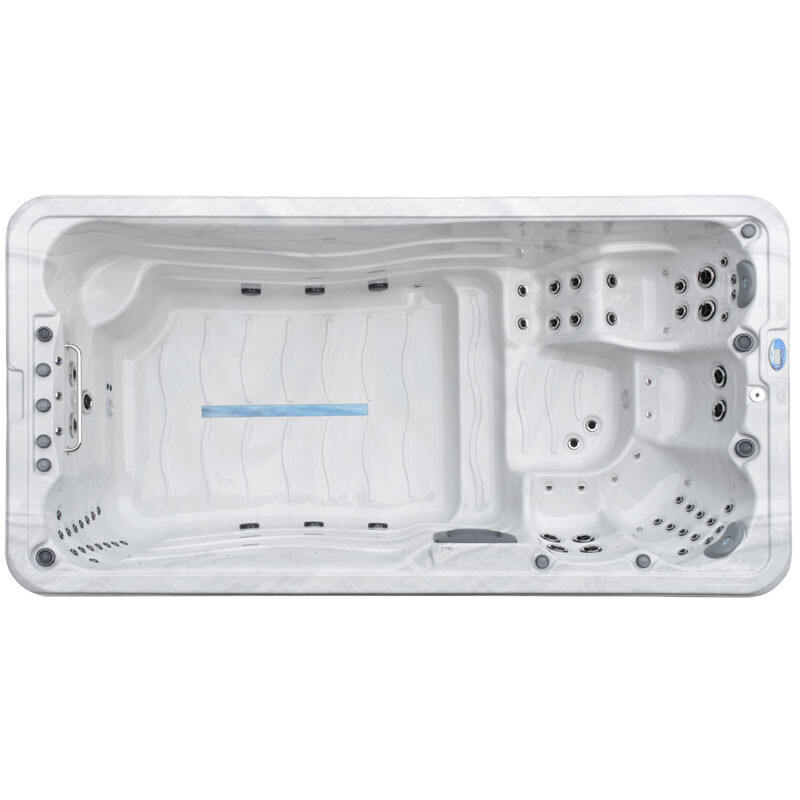
is placed on a concrete slab. It holds 6000 liters (1585 gallons), measuring 4400 x 2250 x 1300 mm (14 ft 5 in x 7 ft 5 in x 4 ft 3 in). We heat it using solar power and a heat pump. 30 degrees Celsius (86°F) is not warm enough for a spa. I’m not sure about the costs, maybe around €50 per month, but higher temperature? It’s in use all year round.
Operating costs are higher than for a pool because of the chemicals.
The problem is the cover (4-piece), which is not very light.
We decided to have something that others in the household can enjoy with the jets, because a “pool only” was not an option for us—it’s too “boring.” You can swim in it or lie on something to enjoy the sun. I can also do the latter in a lounge chair in the garden.
this
is placed on a concrete slab. It holds 6000 liters (1585 gallons), measuring 4400 x 2250 x 1300 mm (14 ft 5 in x 7 ft 5 in x 4 ft 3 in). We heat it using solar power and a heat pump. 30 degrees Celsius (86°F) is not warm enough for a spa. I’m not sure about the costs, maybe around €50 per month, but higher temperature? It’s in use all year round.
Operating costs are higher than for a pool because of the chemicals.
The problem is the cover (4-piece), which is not very light.
We decided to have something that others in the household can enjoy with the jets, because a “pool only” was not an option for us—it’s too “boring.” You can swim in it or lie on something to enjoy the sun. I can also do the latter in a lounge chair in the garden.

@evelinoz Chemicals are also necessary for a pool. The ongoing costs are just higher (with the same water volume) if it is heated more intensely. Choosing between a swim spa, hot tub, or pool is a personal decision. Water features can also be installed in pools. With a length of 4400cm (145 feet), minus the seating area, I would avoid calling it a "swimming" pool. It is more like a large hot tub.
@superzapp
Having it built right away is a great option. Please plan conduit pipes for water, wastewater, electricity, control lines, etc. Your pool would have a water volume of just under 10m³ (2650 gallons). That’s not too much and therefore easier to heat. I’m not familiar with "movement pools," but 1.60m (5 feet 3 inches) depth seems too deep to me. Definitely plan for a counter-current system if you want to swim sometimes. If possible, I would build larger. The price difference is minimal.
Insulation under the pool and on the walls is good, but the most important thing is the pool cover. At night, you can lose 2–3°C (4–5°F) quickly. To heat 1m³ (265 gallons) of water by 1°C (1.8°F), you need 1.16 kW. Now you can calculate how much power you need... With an 8 kWp photovoltaic system, you won’t be able to maintain 28°–30°C (82°–86°F) year-round.
If the house is nearby and you have a good heating system with enough capacity, you could use that to heat the pool. Alternatively, a heat pump or solar thermal collector can be used. For the latter, you need sufficient surface area.
For filtration, it’s best to use a sand filter system rather than cartridge filters. Don’t be misled by specifications from cheap manufacturers (up to 20m³, etc.). Additionally, high water temperatures require more attention to water maintenance (filter times, etc.).
To minimize effort, I would automate water quality monitoring and dosing—meaning monitoring pH, redox potential, and chlorine levels. Control the levels via automated pH and chlorine dosing.
Backwashing the filter can be done manually; automating this is not necessarily required.
@superzapp
Having it built right away is a great option. Please plan conduit pipes for water, wastewater, electricity, control lines, etc. Your pool would have a water volume of just under 10m³ (2650 gallons). That’s not too much and therefore easier to heat. I’m not familiar with "movement pools," but 1.60m (5 feet 3 inches) depth seems too deep to me. Definitely plan for a counter-current system if you want to swim sometimes. If possible, I would build larger. The price difference is minimal.
Insulation under the pool and on the walls is good, but the most important thing is the pool cover. At night, you can lose 2–3°C (4–5°F) quickly. To heat 1m³ (265 gallons) of water by 1°C (1.8°F), you need 1.16 kW. Now you can calculate how much power you need... With an 8 kWp photovoltaic system, you won’t be able to maintain 28°–30°C (82°–86°F) year-round.
If the house is nearby and you have a good heating system with enough capacity, you could use that to heat the pool. Alternatively, a heat pump or solar thermal collector can be used. For the latter, you need sufficient surface area.
For filtration, it’s best to use a sand filter system rather than cartridge filters. Don’t be misled by specifications from cheap manufacturers (up to 20m³, etc.). Additionally, high water temperatures require more attention to water maintenance (filter times, etc.).
To minimize effort, I would automate water quality monitoring and dosing—meaning monitoring pH, redox potential, and chlorine levels. Control the levels via automated pH and chlorine dosing.
Backwashing the filter can be done manually; automating this is not necessarily required.
I know that you need chemicals in a pool. My neighbors (almost everyone here has a pool) use significantly fewer chemicals because their pools are not heated, and the 20kg (44 pounds) of salt or whatever it is costs only a fraction of what you pay just for a spa.
I also think 1.6m (5 feet 3 inches) is quite deep.
I also think 1.6m (5 feet 3 inches) is quite deep.
Similar topics