
ᐅ Raising the ground level of a property in a flood-prone area
Created on: 27 Oct 2025 22:16
T
Tom_bay
Hello everyone,
We are currently considering purchasing a plot of land and would like to hear your assessments and experiences—especially regarding additional costs or risks.
Key details:
“According to the flood hazard map by the Bavarian State Office for the Environment, the development area lies within the HQextrem flood hazard zone.
The soft clay soils of the cohesive upper layer are not suitable for foundation construction without additional measures, as they can cause twisting and tilting due to unfavorable load/settlement behavior.
The at least stiff clays of the cohesive upper layer are generally suitable for foundation construction.
If buildings are constructed without basements, only minor water retention measures are necessary (e.g., sump pumps, drainage pipes).
Waterproofing against groundwater under pressure according to DIN 18195-6 standard must be provided.
Basements are explicitly not recommended.”
Situation:
The plot currently lies about 1.5 m (5 ft) below street level, basically in a kind of “pit.” According to the building plan, the ground must be filled up to street level.
This issue affects all parcels along the planned road—some to a greater extent, some less. There might be an opportunity to collaborate with future homeowners here.
My questions:
Thanks in advance for your opinions and experiences!
[ATTACH alt="IMG_0592.jpeg"]93322[/ATTACH]
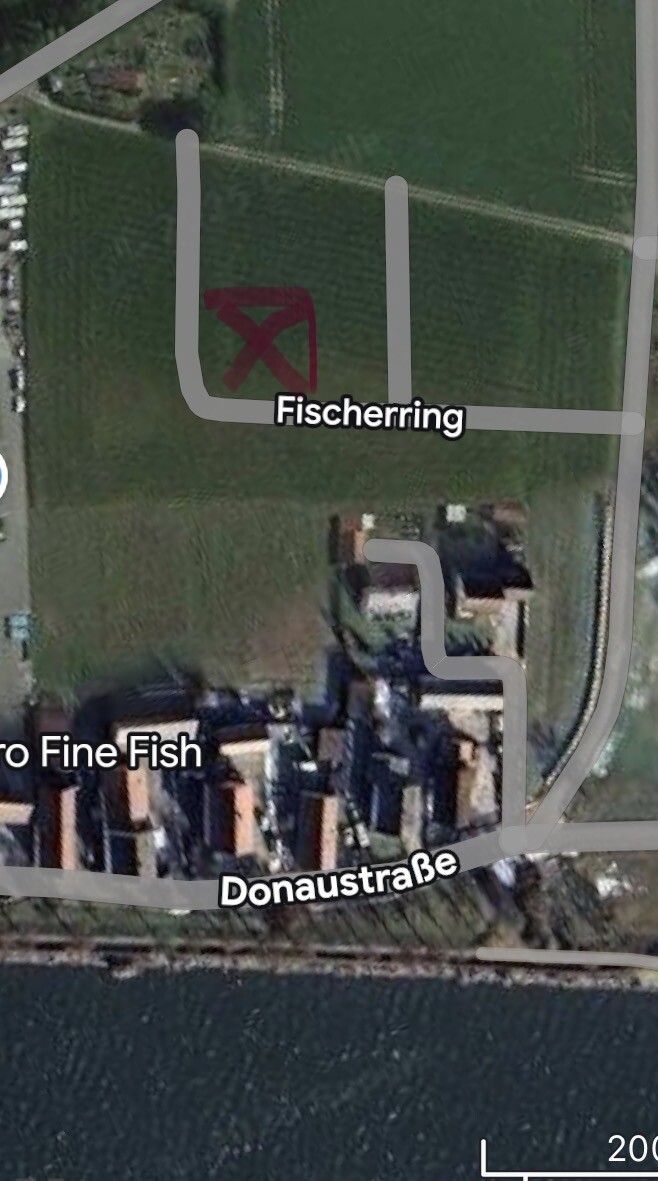

We are currently considering purchasing a plot of land and would like to hear your assessments and experiences—especially regarding additional costs or risks.
Key details:
- Plot size: approx. 576 m² (6,200 sq ft)
- Distance to the Danube River: approx. 150 m (490 ft)
- Location according to flood hazard map: HQextrem (information from the building plan)
- Price: approx. €180,000
- Region: Bavaria, postal code: 93*
“According to the flood hazard map by the Bavarian State Office for the Environment, the development area lies within the HQextrem flood hazard zone.
The soft clay soils of the cohesive upper layer are not suitable for foundation construction without additional measures, as they can cause twisting and tilting due to unfavorable load/settlement behavior.
The at least stiff clays of the cohesive upper layer are generally suitable for foundation construction.
If buildings are constructed without basements, only minor water retention measures are necessary (e.g., sump pumps, drainage pipes).
Waterproofing against groundwater under pressure according to DIN 18195-6 standard must be provided.
Basements are explicitly not recommended.”
Situation:
The plot currently lies about 1.5 m (5 ft) below street level, basically in a kind of “pit.” According to the building plan, the ground must be filled up to street level.
This issue affects all parcels along the planned road—some to a greater extent, some less. There might be an opportunity to collaborate with future homeowners here.
My questions:
- What additional costs could realistically be expected for the necessary ground filling and soil improvement (rough estimates)? Also, what about waterproofing against groundwater under pressure?
- Are there risks or disadvantages associated with the location in the HQextrem zone, even if no basement is planned? According to a neighbor (living there for about 20 years), floodwater was so far well controlled by a dam, but who knows how this will look in the coming years…
- Does anyone have experience with how building permits/planning permissions are handled in such areas (e.g., additional requirements or insurance issues)?
- Would you personally consider buying under these conditions at all?
Thanks in advance for your opinions and experiences!
[ATTACH alt="IMG_0592.jpeg"]93322[/ATTACH]
Thank you for your messages.
At the moment, there are no concrete alternatives, but we are still generally searching. We liked the plot because it is quite rural and the proximity to the Danube has its appeal.
I will look into insurance in more detail soon. A quick check with online providers showed that flood or natural hazard insurance is basically available, with an additional cost of about 300 € (approximately $320) per year. Whether this is sufficient, I cannot say at this time.
Regarding the soil survey: According to the municipality, there is a report that can be viewed at their office. I will take a look on-site when I get the chance and make a copy of an excerpt for tiefblauer/architect.
At the moment, there are no concrete alternatives, but we are still generally searching. We liked the plot because it is quite rural and the proximity to the Danube has its appeal.
I will look into insurance in more detail soon. A quick check with online providers showed that flood or natural hazard insurance is basically available, with an additional cost of about 300 € (approximately $320) per year. Whether this is sufficient, I cannot say at this time.
Regarding the soil survey: According to the municipality, there is a report that can be viewed at their office. I will take a look on-site when I get the chance and make a copy of an excerpt for tiefblauer/architect.
H
hanghaus202328 Oct 2025 10:24For your information.
An HQ extreme (extreme flood event) is a flood with a discharge (Q) that is statistically very rare and can lead to significantly higher water levels than an HQ100 event. An HQ extreme roughly corresponds to an HQ1000. The HQ value is determined or estimated according to uniform standards based on the available data for the watercourse. In an HQ extreme event, flood protection measures are usually no longer effective, as they are not designed for such a scenario. This scenario can therefore also provide indications of areas that could be flooded in the event of a levee breach.
An HQ extreme (extreme flood event) is a flood with a discharge (Q) that is statistically very rare and can lead to significantly higher water levels than an HQ100 event. An HQ extreme roughly corresponds to an HQ1000. The HQ value is determined or estimated according to uniform standards based on the available data for the watercourse. In an HQ extreme event, flood protection measures are usually no longer effective, as they are not designed for such a scenario. This scenario can therefore also provide indications of areas that could be flooded in the event of a levee breach.
H
hanghaus202328 Oct 2025 10:32Has there ever been an extreme HQ event in the last 1000 years?
M
MachsSelbst28 Oct 2025 10:37Yes. You can get lucky... but if you’re unlucky, the house is lost, and whether an insurance company will cover it is uncertain.
Online calculators don’t provide precise information. If you select coverage for natural hazard damage, the insurer will first conduct a detailed review and then offer a customized quote—or simply reject the application. Based on the images from the Ahr valley, I would be hesitant to buy a property like that.
Whether such an event has happened before is not really relevant. Statistically, it occurs once every 1,000 years, but that does not mean it can’t happen three times in ten years. These statistics aren’t very reliable anyway, because climate change is making extreme events much more likely than they were 100 years ago.
The assumption “last year there was a once-in-a-century flood, so I’m safe for the next 100 years” is dangerously wrong.
You will need to bring in about 1,000m³ (1,300 cubic yards), which is roughly 1,500-1,800 tons, depending on the material supplier. That alone means 75-90 truckloads with a 4-axle truck. Then the material has to be installed using an excavator. In this situation, the cost of the material tends to be less important; the price largely depends on where the fill material can be sourced from and how long the transport distances are for the trucks.
For the house foundation, a simple strip foundation will probably no longer be sufficient. Instead, you are more likely to need something involving concrete rings, piles, or similar solutions. It’s best to expect this so you don’t get a shock if the foundation slab alone ends up costing around 100,000 EUR.
Online calculators don’t provide precise information. If you select coverage for natural hazard damage, the insurer will first conduct a detailed review and then offer a customized quote—or simply reject the application. Based on the images from the Ahr valley, I would be hesitant to buy a property like that.
Whether such an event has happened before is not really relevant. Statistically, it occurs once every 1,000 years, but that does not mean it can’t happen three times in ten years. These statistics aren’t very reliable anyway, because climate change is making extreme events much more likely than they were 100 years ago.
The assumption “last year there was a once-in-a-century flood, so I’m safe for the next 100 years” is dangerously wrong.
You will need to bring in about 1,000m³ (1,300 cubic yards), which is roughly 1,500-1,800 tons, depending on the material supplier. That alone means 75-90 truckloads with a 4-axle truck. Then the material has to be installed using an excavator. In this situation, the cost of the material tends to be less important; the price largely depends on where the fill material can be sourced from and how long the transport distances are for the trucks.
For the house foundation, a simple strip foundation will probably no longer be sufficient. Instead, you are more likely to need something involving concrete rings, piles, or similar solutions. It’s best to expect this so you don’t get a shock if the foundation slab alone ends up costing around 100,000 EUR.
H
hanghaus202328 Oct 2025 10:48MachsSelbst schrieb:
You’ll need to fill about 1,000 m³ (1,310 yd³)Why? In my opinion, only the area for the house, (terrace?) and the driveway need to be raised.M
MachsSelbst28 Oct 2025 10:52hanghaus2023 schrieb:
Why? In my opinion, only the area for the house, (terrace?) and the driveway need to be raised. And the rest stays 1.5m (5 feet) below street level? You don’t even have to wait for a flood; every heavy rain fills it up like a swimming pool...