
ᐅ Eliminating Odors and Soot from a House with Clay Plaster – Any Suggestions?
Created on: 7 Apr 2021 19:11
D
danabanana
Hello Forum,
Last year, we bought a house in Hungary and plan to renovate it. The house was probably built around 1950. It is solidly constructed from fired bricks (40cm (16 inches) exterior wall), unplastered on the outside, with walls and ceilings inside fully covered with clay plaster. The floors are tiled, except for two rooms which have wooden floors.
At the time of purchase, the house was unfortunately completely cluttered—sometimes up to 2 meters (6.5 feet) high—and the floors were almost entirely covered with PVC, newspapers, furniture, laundry, carpets, and garbage bags. The walls were completely blocked with cabinets and trash, so there was no ventilation anywhere. In the kitchen, moisture was present under the PVC on the tiles but dried within two weeks. In one of the rooms, the wooden floor partially disintegrated under piles of trash, PVC, and carpets; this floor will be replaced soon. We hope to save the other wooden floor by sanding it. In one room, black moldy marks formed on the exterior walls behind the cupboards. The roof had two major leaks, through which the interior of the house was consistently exposed to moisture 🙁
It is unknown how long the house had been empty before the purchase, but we estimate at least 1–2 years.
We have completely cleared out the house and have now let it dry for eight months. Fortunately, the windows and front door are currently quite drafty, which provides some air exchange. A critical damp spot on an exterior wall was traced back to a faulty gutter and is now dry as well.
Now we have two problems and are unsure how to proceed:
1. In the kitchen, the previous owners heated the room for years with a defective wood stove. The room smells unbearably of smoke, like after a major fire. The ceiling and walls are BLACK!
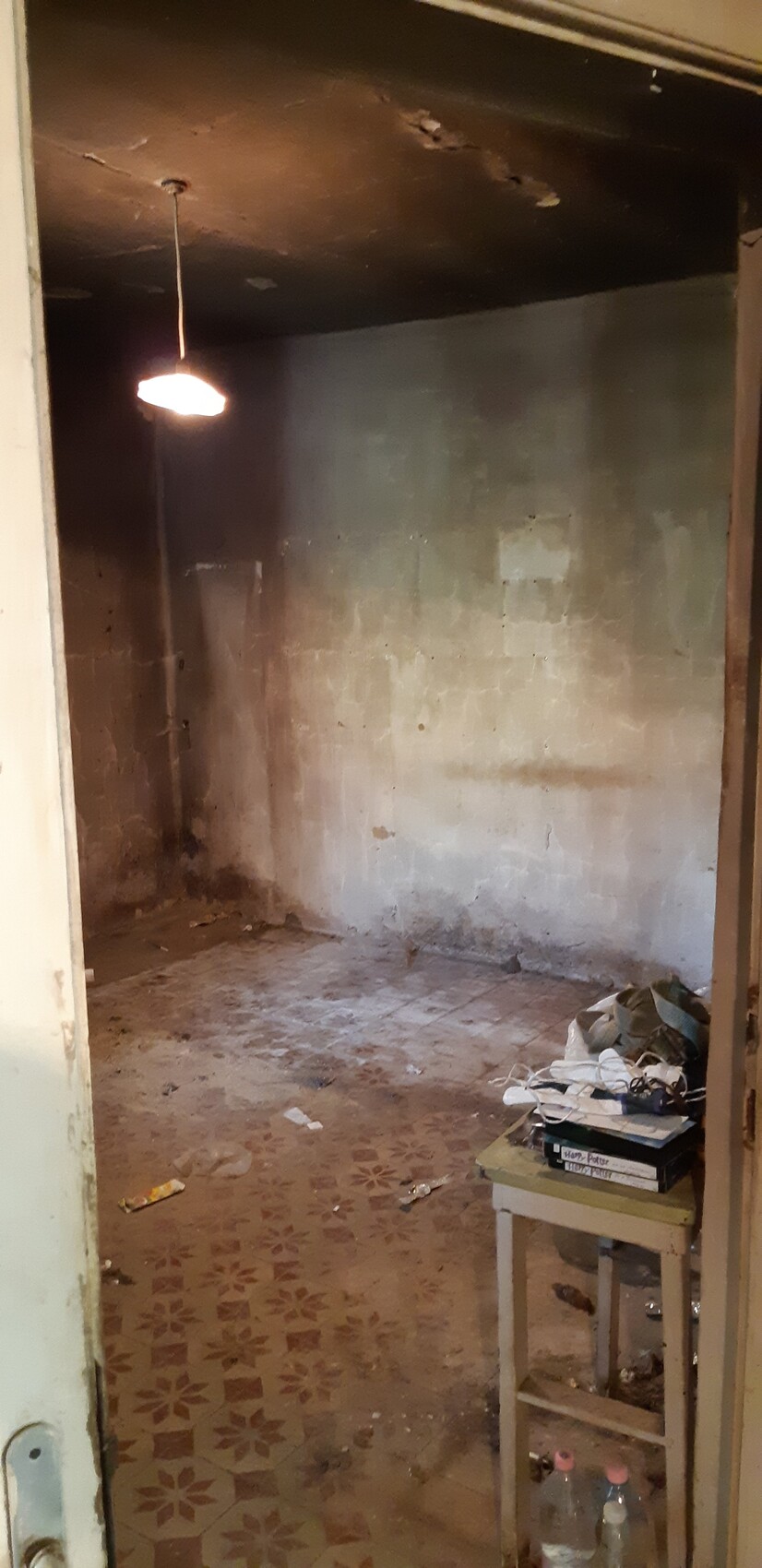
2. The entire house has a very strong musty smell and other unpleasant "leftovers."
Basically, we need to clean all surfaces from dirt, soot, and mold.
For the tiled floors, we plan to use baking soda as an odor absorber and possibly a steam cleaner. Wooden floors, doors, and windows will be sanded. We have also considered an initial ozone treatment to kill mold spores and eliminate some of the odors.
What do you think?
How should we approach the clay plaster on the walls?
We thought about removing the top layer (maybe 2mm (0.08 inches)) with a floor grinder and then applying a new fine clay plaster. The walls will be repainted anyway. However, I worry that sanding will push the mustiness and especially the black soot layer in the kitchen deeper into the plaster (I would like to avoid removing the full 2–3cm (0.8–1.2 inches) of clay plaster). We also considered cleaning with steam, but that would add a lot of moisture to the house...
How would you do it?
Thanks for your tips and suggestions.
Last year, we bought a house in Hungary and plan to renovate it. The house was probably built around 1950. It is solidly constructed from fired bricks (40cm (16 inches) exterior wall), unplastered on the outside, with walls and ceilings inside fully covered with clay plaster. The floors are tiled, except for two rooms which have wooden floors.
At the time of purchase, the house was unfortunately completely cluttered—sometimes up to 2 meters (6.5 feet) high—and the floors were almost entirely covered with PVC, newspapers, furniture, laundry, carpets, and garbage bags. The walls were completely blocked with cabinets and trash, so there was no ventilation anywhere. In the kitchen, moisture was present under the PVC on the tiles but dried within two weeks. In one of the rooms, the wooden floor partially disintegrated under piles of trash, PVC, and carpets; this floor will be replaced soon. We hope to save the other wooden floor by sanding it. In one room, black moldy marks formed on the exterior walls behind the cupboards. The roof had two major leaks, through which the interior of the house was consistently exposed to moisture 🙁
It is unknown how long the house had been empty before the purchase, but we estimate at least 1–2 years.
We have completely cleared out the house and have now let it dry for eight months. Fortunately, the windows and front door are currently quite drafty, which provides some air exchange. A critical damp spot on an exterior wall was traced back to a faulty gutter and is now dry as well.
Now we have two problems and are unsure how to proceed:
1. In the kitchen, the previous owners heated the room for years with a defective wood stove. The room smells unbearably of smoke, like after a major fire. The ceiling and walls are BLACK!
2. The entire house has a very strong musty smell and other unpleasant "leftovers."
Basically, we need to clean all surfaces from dirt, soot, and mold.
For the tiled floors, we plan to use baking soda as an odor absorber and possibly a steam cleaner. Wooden floors, doors, and windows will be sanded. We have also considered an initial ozone treatment to kill mold spores and eliminate some of the odors.
What do you think?
How should we approach the clay plaster on the walls?
We thought about removing the top layer (maybe 2mm (0.08 inches)) with a floor grinder and then applying a new fine clay plaster. The walls will be repainted anyway. However, I worry that sanding will push the mustiness and especially the black soot layer in the kitchen deeper into the plaster (I would like to avoid removing the full 2–3cm (0.8–1.2 inches) of clay plaster). We also considered cleaning with steam, but that would add a lot of moisture to the house...
How would you do it?
Thanks for your tips and suggestions.
N
Nice-Nofret8 Apr 2021 20:07.. mh well, I would just go over it once with an excavator and rebuild... to me, that sounds unhealthy and very complicated to renovate.
D
danabanana16 Apr 2021 10:50Alright, so it looks like a full gutting of the property will be necessary. How would you handle the other rooms that only have a slight musty smell (probably from the general house odor) and, according to recent measurements, are not damp?

I would also gut the place completely. If it smells musty (you really mean musty as in earthy, compost-like, not stale or stuffy?), it’s at best saltpeter, at worst black mold somewhere inside. And even if you use harsh chemicals, after such a long time the smell has penetrated deep. You won’t get rid of it just on the surface.
So tear it down.
So tear it down.
 Winniefred20 Apr 2021 20:36
Also check beneath the floors. If necessary, beams may be damp and the wood could be rotting.