

Hello everyone,
I’m not sure if this is the right subforum, but I couldn’t find a more suitable one.
On a living room wall (plastered and painted), which is at a right angle to a window front, I noticed a small spot in the summer that seems to be caused by moisture. There were efflorescences present (similar to salt deposits).
I suspect it came from pressure washing the terrace, meaning moisture somehow got through.
Two weeks ago, we wiped off the efflorescences with a cloth and repainted the area. Now the spot and the efflorescences have returned. When I touch the area by hand, it feels like it’s not damp. But I might be wrong.
I don’t know where moisture would be coming from. There are definitely no pipes running there. Also, the terrace stays completely dry even in heavy rain because there is an open conservatory above it. It also can’t be coming from above between the conservatory and the wall, because the spot is at the bottom.
Question:
Could the efflorescences have returned because they were possibly not completely removed, similar to mold that regrows?
Or could it only be new moisture?
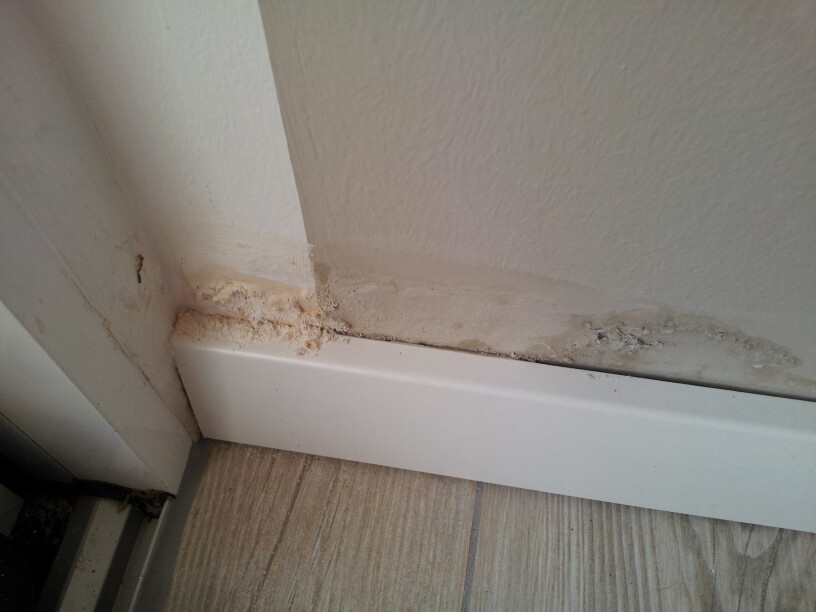
I’m not sure if this is the right subforum, but I couldn’t find a more suitable one.
On a living room wall (plastered and painted), which is at a right angle to a window front, I noticed a small spot in the summer that seems to be caused by moisture. There were efflorescences present (similar to salt deposits).
I suspect it came from pressure washing the terrace, meaning moisture somehow got through.
Two weeks ago, we wiped off the efflorescences with a cloth and repainted the area. Now the spot and the efflorescences have returned. When I touch the area by hand, it feels like it’s not damp. But I might be wrong.
I don’t know where moisture would be coming from. There are definitely no pipes running there. Also, the terrace stays completely dry even in heavy rain because there is an open conservatory above it. It also can’t be coming from above between the conservatory and the wall, because the spot is at the bottom.
Question:
Could the efflorescences have returned because they were possibly not completely removed, similar to mold that regrows?
Or could it only be new moisture?
 blockhauspower29 Nov 2015 18:54
Possibly, the horizontal waterproofing in the masonry is not tight, not properly connected at the T-junction, allowing water to enter the masonry through the base slab.
These are, of course, only assumptions.
I would recommend checking the moisture level in the masonry, possibly also using a film test.
These are, of course, only assumptions.
I would recommend checking the moisture level in the masonry, possibly also using a film test.
Below that is the basement, which is dry. Rain does not come anywhere near it because of the large conservatory.
What I have also noticed is that the stain has not grown larger over the months since I first noticed it.
As far as I know, efflorescence only appears when there is moisture. Could the moisture in the wall paint be the reason the efflorescence has returned?
What I have also noticed is that the stain has not grown larger over the months since I first noticed it.
As far as I know, efflorescence only appears when there is moisture. Could the moisture in the wall paint be the reason the efflorescence has returned?
B
Bauexperte30 Nov 2015 10:06Hello,
Find a specialist with a focus on "masonry and building moisture" and inspect your house together with them. They will be able to tell you quite precisely the cause of the efflorescence and recommend appropriate countermeasures. A little paint or guessing by forum users will not help; even worse, your own guesses and those of others (who don’t know your house and can’t know better) will not solve the problem.
Specialists are not so expensive that you should ignore their expertise! If applicable – for example, if this is a first occupancy – you may be able to pass on the costs of moisture remediation to the warranty provider 😉
Regards, Bauexperte
Volkmann schrieb:You don’t need to know that yourself; after all, you are not an expert. But you must understand that water *always* finds a way. This means the actual cause of the efflorescence might be located somewhere else entirely.
I don’t know where the moisture could be coming from.
Find a specialist with a focus on "masonry and building moisture" and inspect your house together with them. They will be able to tell you quite precisely the cause of the efflorescence and recommend appropriate countermeasures. A little paint or guessing by forum users will not help; even worse, your own guesses and those of others (who don’t know your house and can’t know better) will not solve the problem.
Specialists are not so expensive that you should ignore their expertise! If applicable – for example, if this is a first occupancy – you may be able to pass on the costs of moisture remediation to the warranty provider 😉
Regards, Bauexperte
Similar topics