
ᐅ Efficient and Cost-Effective Heating System for New Construction
Created on: 19 Dec 2023 16:39
W
Wanted2b
Hello everyone,
My name is Tobias, and my wife and I want to build a house with our two children.
I need your support with planning the heating and energy systems in the house and would appreciate a discussion. The house is still in the planning stage, meaning the floor plan is currently being developed. However, I want to consider energy efficiency early on. I am thinking about the roof shape and how the house is positioned on the plot. I lack experience and knowledge about what makes sense and what funding options are available.
Here are the key details:
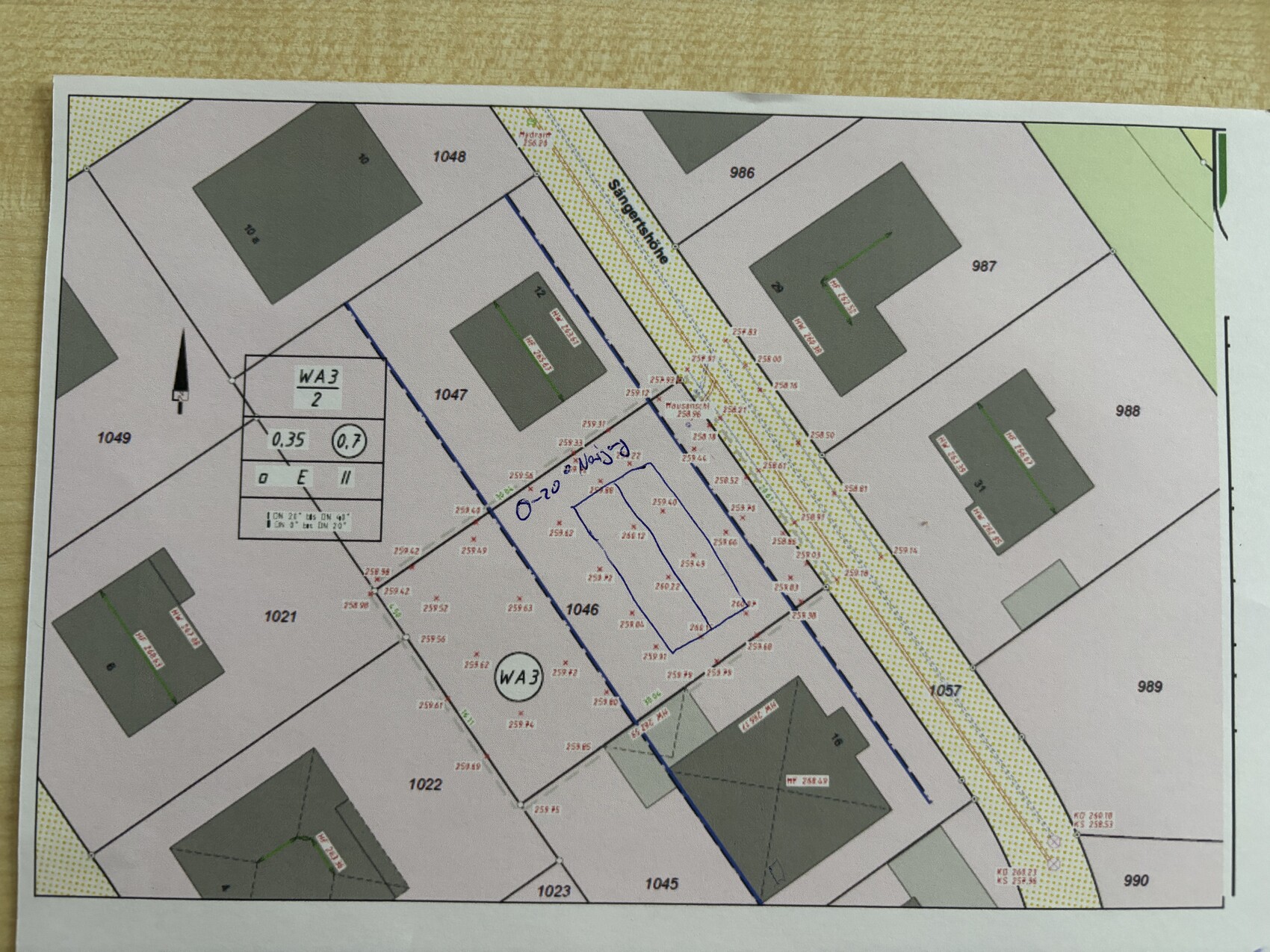
The plot is located in NRW in Nümbrecht. Attached is a picture showing the orientation.
We are building a two-story house, with a roof pitch between 0° and 20°.
It will be a Passive House standard 40 (PH40) with timber frame construction. The provider is not yet decided.
We want underfloor heating.
The house will be about 150–160 square meters (1,615–1,722 square feet), without a basement.
There is the possibility to connect to district heating provided by the municipality.
The goal is to be as economical as possible but also efficient, considering future developments to ensure some degree of independence.
Currently, there is no electric vehicle, but that might change (ideally powered by our own photovoltaic system).
What would you recommend?
I am grateful for any help.
My name is Tobias, and my wife and I want to build a house with our two children.
I need your support with planning the heating and energy systems in the house and would appreciate a discussion. The house is still in the planning stage, meaning the floor plan is currently being developed. However, I want to consider energy efficiency early on. I am thinking about the roof shape and how the house is positioned on the plot. I lack experience and knowledge about what makes sense and what funding options are available.
Here are the key details:
The plot is located in NRW in Nümbrecht. Attached is a picture showing the orientation.
We are building a two-story house, with a roof pitch between 0° and 20°.
It will be a Passive House standard 40 (PH40) with timber frame construction. The provider is not yet decided.
We want underfloor heating.
The house will be about 150–160 square meters (1,615–1,722 square feet), without a basement.
There is the possibility to connect to district heating provided by the municipality.
The goal is to be as economical as possible but also efficient, considering future developments to ensure some degree of independence.
Currently, there is no electric vehicle, but that might change (ideally powered by our own photovoltaic system).
What would you recommend?
- An air-to-water heat pump? Or a ground-source (brine) heat pump?
- With or without a buffer tank or layered storage?
- With or without photovoltaic panels? If yes, what size makes sense?
- With or without a battery storage system? If yes, what size makes sense?
- With or without solar thermal panels on the roof? If yes, what size makes sense?
- What type of roof makes the most sense?
- If using photovoltaic or solar thermal—what roof shape optimizes solar energy capture?
- How do these combinations compare in terms of price-performance ratio? Do these “add-ons” only add a few percent in efficiency compared to a plain air-to-water heat pump with underfloor heating, or are they meaningful and cost-effective upgrades?
I am grateful for any help.
B
Buchsbaum19 Dec 2023 21:43HungrigerHugo schrieb:
For the district heating connection, they often charge 10,000 to 15,000. You could also install a heat pump for that. Don’t take this the wrong way, but that’s complete nonsense. You only need a small transfer station with a heat meter. That’s all. Usually, it doesn’t even cost anything.
Yes, there is a monopoly situation, which is of course a disadvantage. But on the other hand, you don’t need a chimney sweep, no technical system, and no investment in a heat pump or heating system. Heat pumps also break down and usually don’t last even 15 years.
Prices are often fixed for several years. So district heating isn’t that bad. In our area, the neighboring village is supplied to voluntary customers under very favorable conditions. You can’t heat more cheaply than that. They use the waste heat from a biogas plant. It works great.
Unfortunately, the capacity isn’t sufficient to supply our village as well. Otherwise, I would sign up immediately.
Thanks in advance!
I am researching the costs of district heating, as it seems to be the direction we are going.
Otherwise, I have already gathered the following information for my case in another forum:
Air-to-water heat pump + photovoltaic system without battery storage, or ground source heat pump + horizontal trench collector + photovoltaic system.
No buffer tank, no solar thermal system.
Photovoltaic system as large as possible, and a pitched roof with northeast/southwest orientation on the property.
I am researching the costs of district heating, as it seems to be the direction we are going.
Otherwise, I have already gathered the following information for my case in another forum:
Air-to-water heat pump + photovoltaic system without battery storage, or ground source heat pump + horizontal trench collector + photovoltaic system.
No buffer tank, no solar thermal system.
Photovoltaic system as large as possible, and a pitched roof with northeast/southwest orientation on the property.
Buchsbaum schrieb:
Don’t take this the wrong way, but that’s absolute nonsense. You only need a small transfer station with a heat meter. That’s it.
Usually, it doesn’t even cost anything.I even believe Annalena knows that the heat doesn’t come from the transfer station itself, but from a connected pipeline. And that needs to be paid for, just like any other utility line.
Connection fees vary, but a price range between 5,000 and 15,000 is quite realistic. There might be some providers that don’t charge connection fees, but that’s not the norm – most likely, the costs are then included in the fixed fees. Either way, you end up paying.
W
WilderSueden20 Dec 2023 09:16Buchsbaum schrieb:
Don’t be offended, but that’s complete nonsense. You only need a small transfer station with a heat meter. That’s all.
Usually, it doesn’t even cost anything. Funny... recently, a certain Buchsbaum gave completely different figures: https://www.hausbau-forum.de/threads/warum-gehen-die-baupreise-nicht-runter.45529/post-641652
J
jens.knoedel20 Dec 2023 11:11Efficiency and cost-effectiveness consist of two components:
1. Initial investment costs
2. Operating costs over a period X
In a new build, the efficiency of the heat pump as a heating system is almost negligible in terms of operating costs. Whether you pay €38 or €40 per month in heating costs due to lower efficiency is negligible over 30 years of use (saving only €720 in 30 years with better efficiency, e.g., geothermal heat pump instead of air-to-air heat pump). Whether a heat pump breaks down or not depends on the heat pump itself, not on the medium—air, groundwater, or brine.
The question of initial investment costs is naturally more interesting. This is where the key factor lies. You need to decide which heat pump makes sense for you.
Photovoltaics is a topic that is not inherently connected to heating. Photovoltaics are (almost) always worthwhile; a high self-consumption rate through the heat pump (and possibly through a very affordable battery storage) is the icing on the cake.
In my opinion, solar thermal systems are obsolete. In summer, when you can easily produce hot water with the heat pump (ideally powered by photovoltaics), you don’t need solar thermal. In winter, solar thermal delivers no significant output.
1. Initial investment costs
2. Operating costs over a period X
In a new build, the efficiency of the heat pump as a heating system is almost negligible in terms of operating costs. Whether you pay €38 or €40 per month in heating costs due to lower efficiency is negligible over 30 years of use (saving only €720 in 30 years with better efficiency, e.g., geothermal heat pump instead of air-to-air heat pump). Whether a heat pump breaks down or not depends on the heat pump itself, not on the medium—air, groundwater, or brine.
The question of initial investment costs is naturally more interesting. This is where the key factor lies. You need to decide which heat pump makes sense for you.
Photovoltaics is a topic that is not inherently connected to heating. Photovoltaics are (almost) always worthwhile; a high self-consumption rate through the heat pump (and possibly through a very affordable battery storage) is the icing on the cake.
In my opinion, solar thermal systems are obsolete. In summer, when you can easily produce hot water with the heat pump (ideally powered by photovoltaics), you don’t need solar thermal. In winter, solar thermal delivers no significant output.
Similar topics