
ᐅ Effectiveness of Dosing Systems (for Corrosion Control)
Created on: 27 Jun 2019 17:56
K
kleinesHaus83
Hello,
I am a new homeowner with an old plumbing system and would like to get your opinion on dosing systems that are installed in the basement on the main water line after the filter/pressure reducer.
So far, we don’t have any severe issues with rust (the water is not brown unless the main line is turned off). However, small particles accumulate in the aerators, which we need to replace approximately every 2–4 weeks because quite a bit seems to come out. I’m not an expert and don’t really know what is considered a lot or a little.
Replacing the pipes is not an option, so I want to maintain and protect the existing pipes as long as possible. I recently read about dosing systems (phosphate addition).
My question: Do these systems actually help to extend the lifespan of the pipes and reduce the small rust particles in the water? What are your experiences?
Additionally, we plan to install a physical water softening/transformation system at some point, but that is a separate topic.
Key facts:
House built in 1975
Pipes replaced around 1993, probably galvanized steel
Water hardness: "hard" 21dH
Gas heating system
Many thanks and greetings from Bavaria
I am a new homeowner with an old plumbing system and would like to get your opinion on dosing systems that are installed in the basement on the main water line after the filter/pressure reducer.
So far, we don’t have any severe issues with rust (the water is not brown unless the main line is turned off). However, small particles accumulate in the aerators, which we need to replace approximately every 2–4 weeks because quite a bit seems to come out. I’m not an expert and don’t really know what is considered a lot or a little.
Replacing the pipes is not an option, so I want to maintain and protect the existing pipes as long as possible. I recently read about dosing systems (phosphate addition).
My question: Do these systems actually help to extend the lifespan of the pipes and reduce the small rust particles in the water? What are your experiences?
Additionally, we plan to install a physical water softening/transformation system at some point, but that is a separate topic.
Key facts:
House built in 1975
Pipes replaced around 1993, probably galvanized steel
Water hardness: "hard" 21dH
Gas heating system
Many thanks and greetings from Bavaria
D
Draschamne31 Jul 2019 13:20We inherited this type of dosing system from the previous owner.
The water pipes are from 1967, galvanized steel pipes. About 15 years ago, the pipes were apparently so clogged that a “pipe cleaning” was carried out and a dosing system was installed.
Now the pipes are clogged again; when the water sits for a few weeks, it comes out yellow-brown from the tap. At least from the taps where anything still comes out at all.
We have now opened everything up and renewed the pipes; anything else doesn’t make sense. The old pipes looked pretty disgusting on the inside—I’m glad they are out!
Such a dosing system mainly costs a lot of money, and I would rather question its usefulness.
Oh, and by the way;
Our water hardness is medium hard, which I think is also important to know.
The water pipes are from 1967, galvanized steel pipes. About 15 years ago, the pipes were apparently so clogged that a “pipe cleaning” was carried out and a dosing system was installed.
Now the pipes are clogged again; when the water sits for a few weeks, it comes out yellow-brown from the tap. At least from the taps where anything still comes out at all.
We have now opened everything up and renewed the pipes; anything else doesn’t make sense. The old pipes looked pretty disgusting on the inside—I’m glad they are out!
Such a dosing system mainly costs a lot of money, and I would rather question its usefulness.
Oh, and by the way;
Our water hardness is medium hard, which I think is also important to know.
K
kleinesHaus8331 Jul 2019 16:14Thank you for your feedback.
The amount of money is relative; I think a good 1000 EUR (about 1100 USD) needs to be invested once (plus maintenance and dosing agents).
The amount of money is relative; I think a good 1000 EUR (about 1100 USD) needs to be invested once (plus maintenance and dosing agents).
D
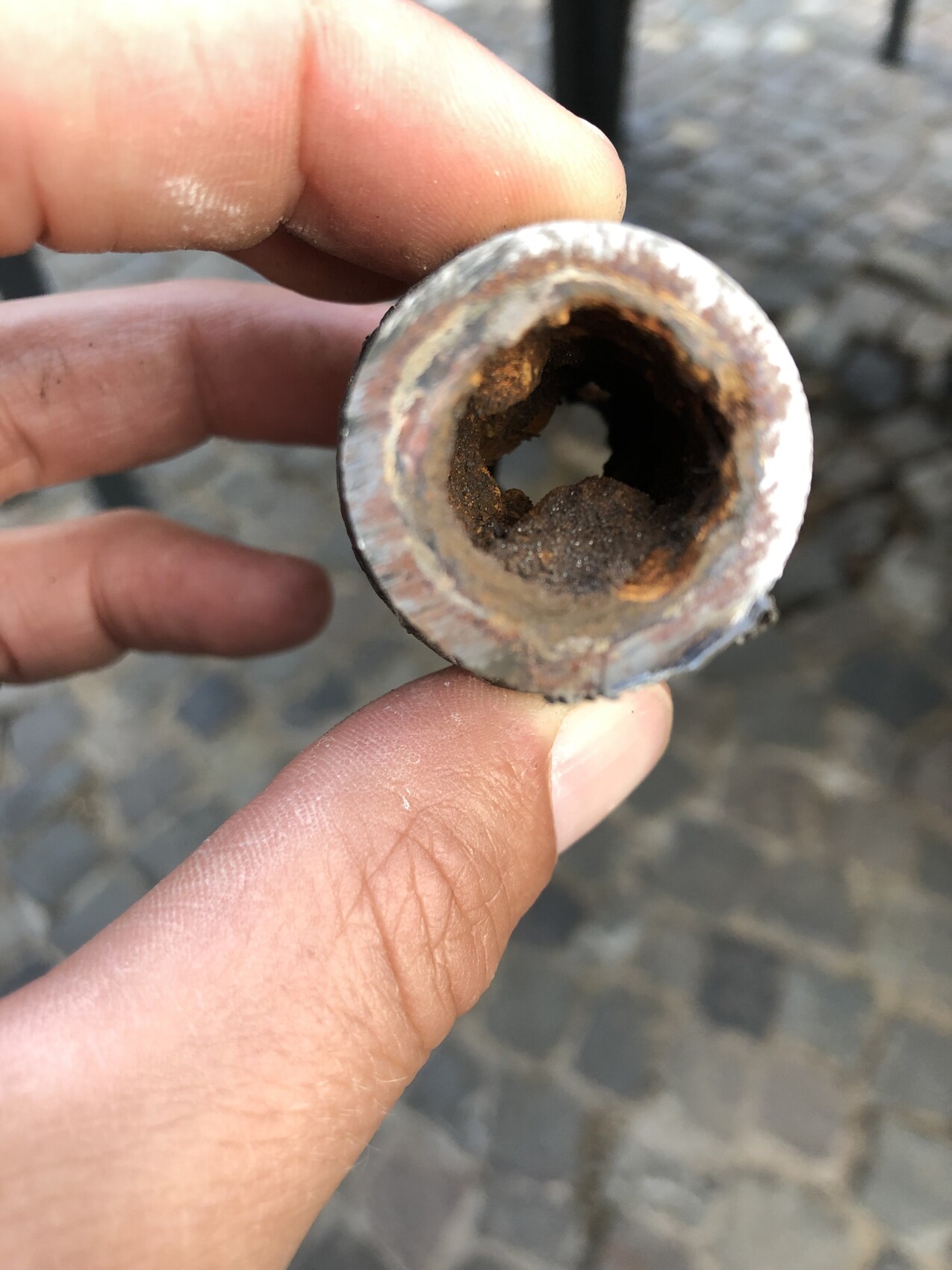
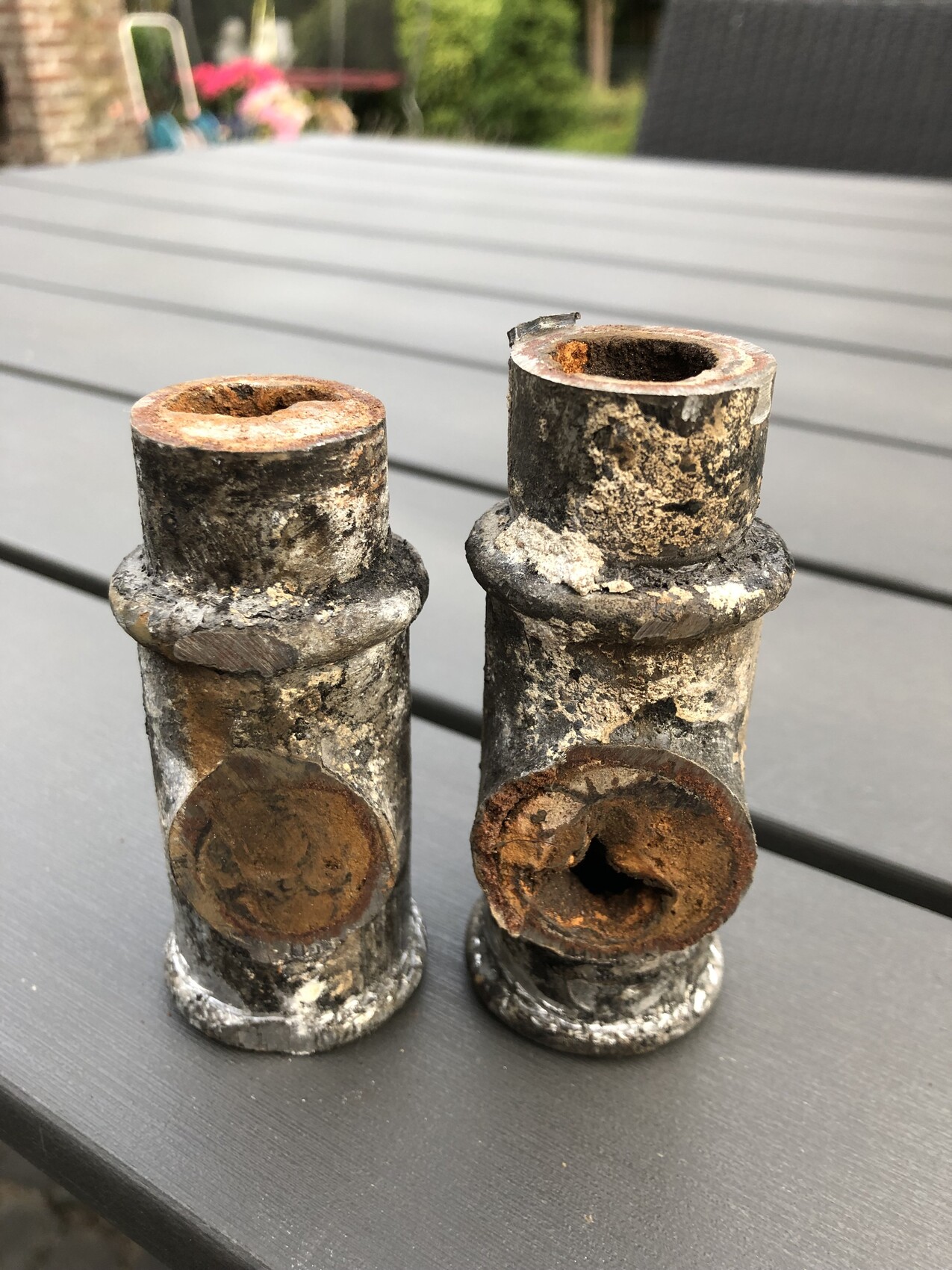
Draschamne31 Jul 2019 17:00Our dosing system uses up a cartridge roughly every two months, which adds up to a considerable amount over time. And as I mentioned, I seriously doubt whether the system provides any measurable benefit at all. I can upload an interior photo of the pipes next week. There is no protective film visible; the walls are just covered in black grime.
D
Draschamne5 Aug 2019 20:30Here are the promised pictures. In the image with the two pipes, these are two T-joints, one of which is completely closed.
The slag is slowly starting to corrode; a few weeks ago it was still black.
As mentioned before, any protective coating is, if at all, only present in the non-visible area.
The slag is slowly starting to corrode; a few weeks ago it was still black.
As mentioned before, any protective coating is, if at all, only present in the non-visible area.
K
kleinesHaus836 Aug 2019 11:49Thank you very much, that looks intense.
I would also prefer to completely renovate and remove all iron/cast pipes, or else live with the buildup as long as everything is functional. I don’t see any health risks in that regard. At my parents’ house, we only recently removed a water softening system. The connecting pipes made of cast iron looked the same.
However, the water hardness there is very high, and the softening system was only installed after two decades of use. I cannot say whether it was already in place before that or what the situation would have been like without the 15 years of the softening system.
The ongoing costs for dosing agents (due to the variety of pipe materials) and descaling tablets, combined with the system-related residual scaling on the fittings, were the factors that led to deciding to remove the system completely again.
However, the water hardness there is very high, and the softening system was only installed after two decades of use. I cannot say whether it was already in place before that or what the situation would have been like without the 15 years of the softening system.
The ongoing costs for dosing agents (due to the variety of pipe materials) and descaling tablets, combined with the system-related residual scaling on the fittings, were the factors that led to deciding to remove the system completely again.
Similar topics