
Hello,
I am currently wondering how it would be practically possible to follow the ideal sequence for building a house in order to maintain the most accurate cost-effectiveness for the various components within the agreed budget.
Many homeowners always ask themselves, "Is this worth it?" But unfortunately, the answer usually comes much later, after the damage has already been done.
For me, the heating load calculation (HLB) provides a key answer regarding the cost-effectiveness of a house or its components. However, this calculation is usually only done once all components are already decided or even built. For prefab home suppliers/general contractors, it is probably even more expensive to maintain this kind of flexibility.
We have about €10,000 (around $11,000) left that we want to invest wisely. The first idea was to improve the masonry from T9 (unfilled) to T7 (filled). This should save real money later on. Assuming we have a quote from the mason with a €4,000 (about $4,400) surcharge compared to the T9. Basically, only the HLB can tell me approximately how many years it will take for the saved heating costs to offset this extra cost. I am aware that this also depends on how efficiently my heating system converts electricity into heat, how cold it will be in the coming years, and so on. But you can still get a rough estimate. Not to forget that the investment will also incur interest costs, which will have a compounding effect over the years of repayment. But all of this can theoretically be calculated.
So, would it be helpful to have the HLB done in advance and analyze different values along with the corresponding costs? Which, incidentally, is not cheap to commission itself... and I believe that is the main reason why this is not usually done in practice, right?
I am currently wondering how it would be practically possible to follow the ideal sequence for building a house in order to maintain the most accurate cost-effectiveness for the various components within the agreed budget.
Many homeowners always ask themselves, "Is this worth it?" But unfortunately, the answer usually comes much later, after the damage has already been done.
For me, the heating load calculation (HLB) provides a key answer regarding the cost-effectiveness of a house or its components. However, this calculation is usually only done once all components are already decided or even built. For prefab home suppliers/general contractors, it is probably even more expensive to maintain this kind of flexibility.
We have about €10,000 (around $11,000) left that we want to invest wisely. The first idea was to improve the masonry from T9 (unfilled) to T7 (filled). This should save real money later on. Assuming we have a quote from the mason with a €4,000 (about $4,400) surcharge compared to the T9. Basically, only the HLB can tell me approximately how many years it will take for the saved heating costs to offset this extra cost. I am aware that this also depends on how efficiently my heating system converts electricity into heat, how cold it will be in the coming years, and so on. But you can still get a rough estimate. Not to forget that the investment will also incur interest costs, which will have a compounding effect over the years of repayment. But all of this can theoretically be calculated.
So, would it be helpful to have the HLB done in advance and analyze different values along with the corresponding costs? Which, incidentally, is not cheap to commission itself... and I believe that is the main reason why this is not usually done in practice, right?

No one is stopping you from hiring an HVAC engineer who can work with your architect to develop your desired concept – but of course, that costs money.
You can also estimate the heating load yourself – simply multiply the exterior wall area in square meters by the U-values and the temperature difference. By the way, the heating load doesn’t necessarily tell you what your actual heating costs will be – it only indicates the maximum load at the design temperature.
If you register your U-values, you can input your building into a heating demand calculator and freely modify the U-values – this way, you can quickly see what benefits what (at least in theory).
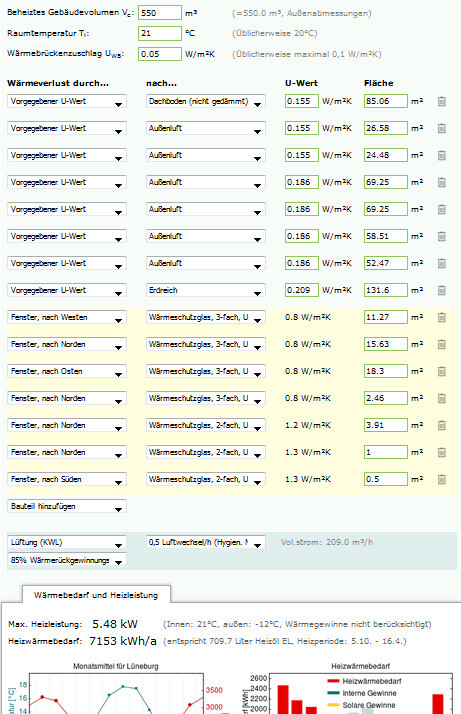
If you have 10,000 euros left over, of course, the alternative is always to not spend the money ;-)
What always works is installing a few kWp on the roof.
You can also estimate the heating load yourself – simply multiply the exterior wall area in square meters by the U-values and the temperature difference. By the way, the heating load doesn’t necessarily tell you what your actual heating costs will be – it only indicates the maximum load at the design temperature.
If you register your U-values, you can input your building into a heating demand calculator and freely modify the U-values – this way, you can quickly see what benefits what (at least in theory).
If you have 10,000 euros left over, of course, the alternative is always to not spend the money ;-)
What always works is installing a few kWp on the roof.
wrobel schrieb:
Hello
I believe people often reflect on cost-effectiveness in this area, and when it comes to fittings and fixtures, it’s intentional that money tends to be spent more freely.
Olli
Why do you have an extra 10,000 euros before you’ve even started?The estimate for the heating system is 10,000 € (about 11,000 USD) higher than the four quotes I have received so far.
BeHaElJa schrieb:
If you have 10,000 euros left over, of course, another option is simply not to spend the money ;-)
One thing you can always do is install a few kWp on the roof.I have thought about that too, but it might make more sense to reduce electricity consumption rather than increase production 😉 Especially since the cost-effectiveness of photovoltaic systems is not really certain.
The problem is that if I insulate too much, I might run into ventilation issues. A controlled mechanical ventilation system is absolutely out of the question!
If your house was built properly, it will be airtight, and without a mechanical ventilation system you might need to ventilate a lot – I would recommend reconsidering that. By the way, insulation doesn’t have much to do with it.
I’d be happy to share my experience with our decentralized mechanical ventilation system once we’ve moved into the house ;-)
I’d be happy to share my experience with our decentralized mechanical ventilation system once we’ve moved into the house ;-)

Tichu78 schrieb:
We have about €10,000 left that we now want to invest wisely.Well, then just start building... I actually think you will need another 10,000 euros... that was at least the case for us and many others here in the forum and elsewhere as well...
There are always unforeseen expenses or bills that come up during the project.
Similar topics