
ᐅ Roof Overhang on a Gable Roof as a Protection for the Building Façade?
Created on: 13 Sep 2016 21:00
B
baschdieh
We are currently building a single-family house. The roof is designed as a gable roof with an 18° pitch and a 30cm (12 inches) eave overhang.
Personally, I think a roof without an overhang looks more modern. However, my architect believes that the eave overhang protects the house from weathering and is more cost-effective because it requires less complex sealing.
I find it hard to imagine that a) a 30cm (12 inches) eave overhang actually protects the facade and b) that the house would require significantly more sealing work and therefore higher costs without it.
What is your opinion on eave overhangs?
Thank you very much and best regards!
Personally, I think a roof without an overhang looks more modern. However, my architect believes that the eave overhang protects the house from weathering and is more cost-effective because it requires less complex sealing.
I find it hard to imagine that a) a 30cm (12 inches) eave overhang actually protects the facade and b) that the house would require significantly more sealing work and therefore higher costs without it.
What is your opinion on eave overhangs?
Thank you very much and best regards!

C
Changeling24 Nov 2017 15:02Okay... if I understand the answers correctly, with today's technology, it is purely a matter of appearance or personal preference.

I would put it this way: with only a 10 cm (4 inch) roof overhang on the verge side (10 cm is relatively modest in this dimension, it almost looks like it’s "folded over"), a 50 cm (20 inch) eaves overhang (which is not unusual as an absolute measure) appears relatively exaggerated in direct contrast.
https://www.instagram.com/11antgmxde/
https://www.linkedin.com/company/bauen-jetzt/
https://www.instagram.com/11antgmxde/
https://www.linkedin.com/company/bauen-jetzt/

Otus11 schrieb:
We have a 30° gable roof without eaves, but with a brick veneer façade.
However, we invested in verge tiles (for Braas Turmalin) and a zinc sheet cladding on the bargeboard to reduce the need for frequent painting.
Everything is warm and dry – and here in the north, rain often comes horizontally.
To protect against rain or sun, an overhang of about 50 cm (20 inches) is probably needed.
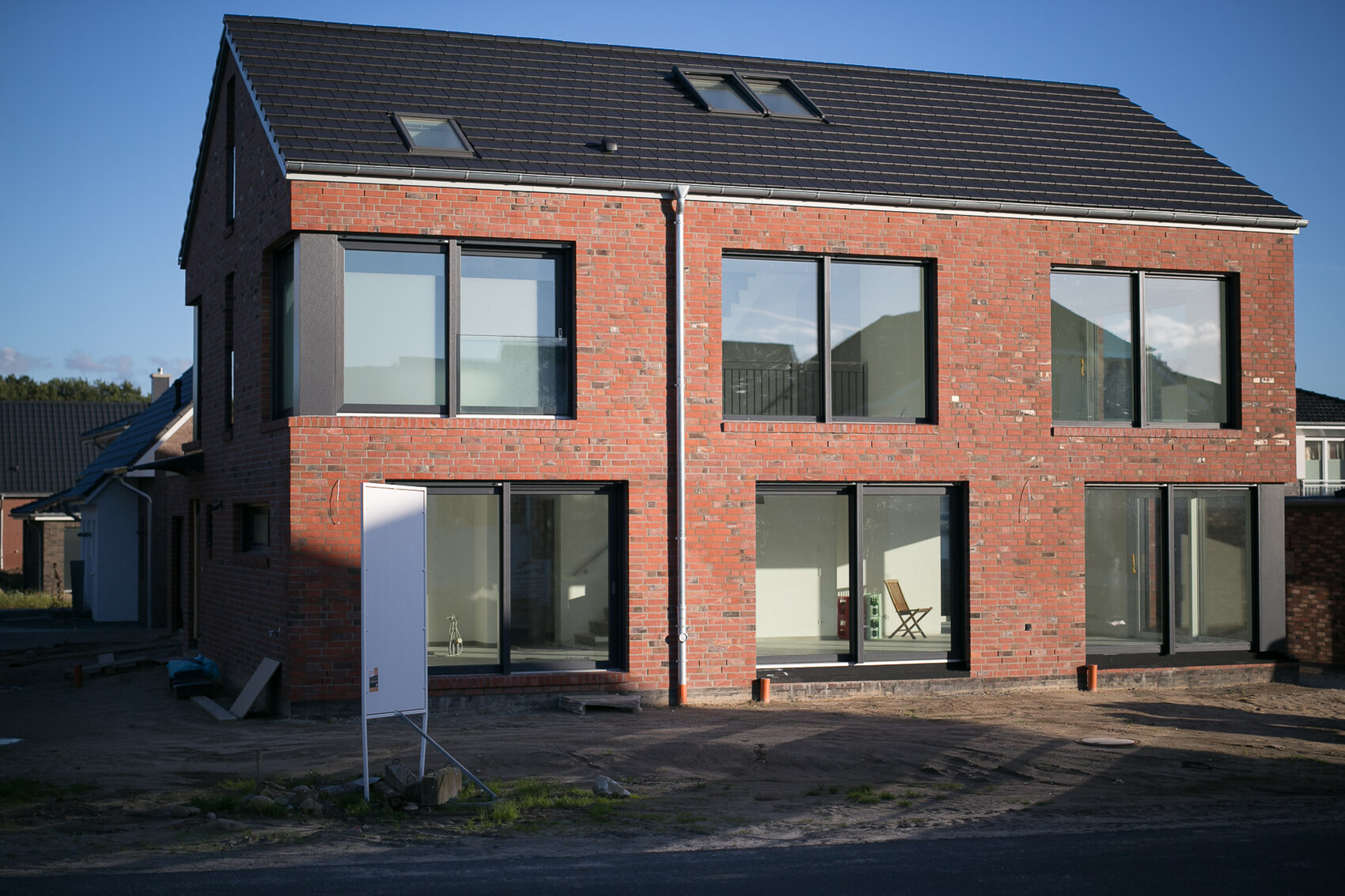
What bothers me much more here are the windows on the upper and ground floors not being aligned vertically.
KingSong schrieb:
What bothers me much more here are the windows on the upper floor and ground floor that are not aligned with each other.However, with @Otus11 you can see a pattern, so it seems intentional. Possibly to deliberately highlight the "different." It’s certainly not to everyone’s taste, but it apparently aims to stand out from the usual boring designs.
K
Knallkörper25 Nov 2017 13:08If the roof overhang is also meant to protect the facade from moisture, a larger overhang would need to be implemented on the gable side than on the eaves side. Ten centimeters (4 inches) already looks somewhat "cheap," and furthermore, I agree with 11ant’s opinion regarding the appearance of uneven dimensions.
Personally, I value the benefits of a larger overhang. Our half-hipped roof has an overhang of 55–60 cm (22–24 inches). The facade only gets wet in heavy rain driven by wind, and the windows mostly remain dry.
Personally, I value the benefits of a larger overhang. Our half-hipped roof has an overhang of 55–60 cm (22–24 inches). The facade only gets wet in heavy rain driven by wind, and the windows mostly remain dry.
Similar topics