
ᐅ Excavation/Foundation Construction in High Groundwater Areas – Experiences?
Created on: 19 Mar 2024 12:01
G
gregman22
Dear community,
We are facing a challenge as our earthworks were actually supposed to start since this/last week. However, our plot is located in a high groundwater area, and the earthworks are complicating things. I haven’t received clear statements from our earthworks contractor, so I would like to hear about your experiences.
Situation:
- Basement floor slab with overhangs needs to be poured
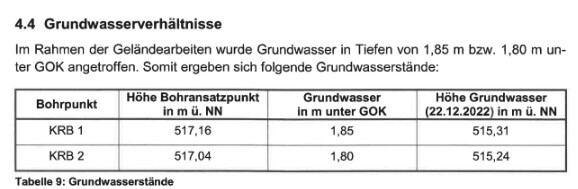
- Groundwater is currently about 1.85 m (6 feet) below the plot surface
- Excavation for the basement floor slab must reach 3.55 m (12 feet) deep → thus, the earthworks will be 1.70 m (5.5 feet) below the groundwater level
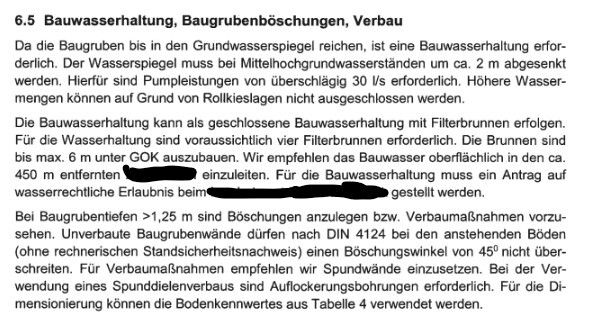
- Planned earthworks measures: 3 boreholes for dewatering; pipeline route to sewer 470 m (1,540 feet), diameter of sewer pipe into which we can discharge: 40 cm (16 inches)
- Additionally: We have installed a soakaway well on the property, reaching a depth of 8 m (26 feet), theoretically allowing further water discharge
- Weather forecast for the next two weeks looks rather positive (2-3 rainy days, otherwise mostly dry); on dry days, the water level drops about 1-2 cm (0.4–0.8 inches) per day
Further info: At the very beginning, sheet piling was considered. However, no clear necessity was explained to me, so I decided against it—mainly due to the risks of damaging neighboring houses.
Currently, our earthworks contractor is installing the pipes and planned to start pumping from Friday.
Now my main question to you: How do you see the situation? How optimistic can I be that it will work out, on a scale from 0 (very pessimistic) to 10 (very optimistic)?
Thank you all.
Best regards
We are facing a challenge as our earthworks were actually supposed to start since this/last week. However, our plot is located in a high groundwater area, and the earthworks are complicating things. I haven’t received clear statements from our earthworks contractor, so I would like to hear about your experiences.
Situation:
- Basement floor slab with overhangs needs to be poured
- Groundwater is currently about 1.85 m (6 feet) below the plot surface
- Excavation for the basement floor slab must reach 3.55 m (12 feet) deep → thus, the earthworks will be 1.70 m (5.5 feet) below the groundwater level
- Planned earthworks measures: 3 boreholes for dewatering; pipeline route to sewer 470 m (1,540 feet), diameter of sewer pipe into which we can discharge: 40 cm (16 inches)
- Additionally: We have installed a soakaway well on the property, reaching a depth of 8 m (26 feet), theoretically allowing further water discharge
- Weather forecast for the next two weeks looks rather positive (2-3 rainy days, otherwise mostly dry); on dry days, the water level drops about 1-2 cm (0.4–0.8 inches) per day
Further info: At the very beginning, sheet piling was considered. However, no clear necessity was explained to me, so I decided against it—mainly due to the risks of damaging neighboring houses.
Currently, our earthworks contractor is installing the pipes and planned to start pumping from Friday.
Now my main question to you: How do you see the situation? How optimistic can I be that it will work out, on a scale from 0 (very pessimistic) to 10 (very optimistic)?
Thank you all.
Best regards
A
Allthewayup20 Mar 2024 17:29When should the pumping start?
G
gregman2220 Mar 2024 17:30Originally, the plan was to start the day after tomorrow (March 22); excavation would begin next week; followed immediately by basement construction starting April 3.
New plan: pumping starts on March 27 -> basement construction begins April 9.
New plan: pumping starts on March 27 -> basement construction begins April 9.
A
Allthewayup20 Mar 2024 17:34I reviewed your table again. I noticed that it only covers data from shallow depths. Does the soil report explicitly include a chapter on groundwater lowering or construction dewatering? I was ultimately unable to make much use of the data from the table.
G
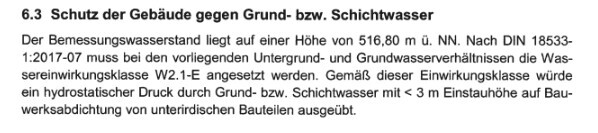
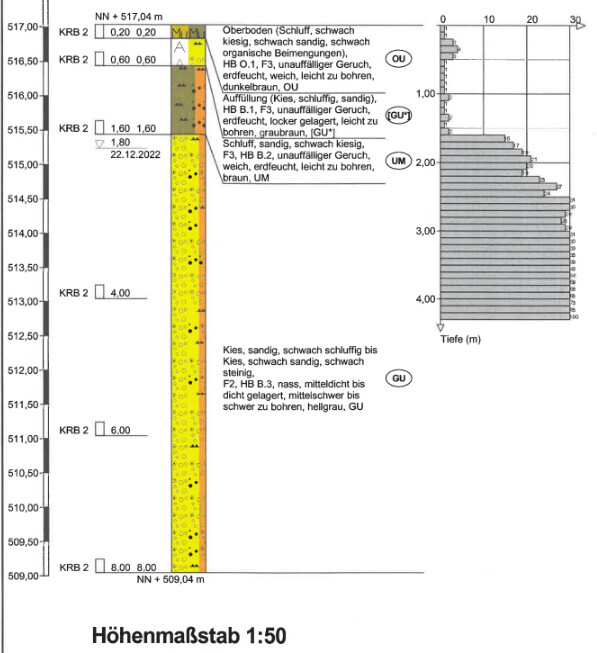
gregman2220 Mar 2024 17:51Here are a few screenshots 🙂 This should provide more context.



A
Allthewayup20 Mar 2024 19:19Finally some useful information!
So, you have soil class GU, which we had as well—that’s good. I would therefore disregard any concerns about subsidence damage to neighboring buildings. Strongly sandy soils tend to shrink when they lose water; for example, look at the surface of dried-up lakes, where a cracked landscape remains. This doesn’t happen if (fine) gravel dries out.
30 liters per second (l/s) is quite substantial. That converts to 2,592,000 liters per 24 hours.
We didn’t even pump a third of that amount.
However, we also didn’t reach the volume I initially calculated but ended up below it. This is simply due to the calculation formula behind that figure, which assumes a linear inflow into the excavation pit. But since a drawdown cone forms around the pump shaft, this water volume decreases noticeably day by day. With today’s knowledge, I would estimate about half of that amount. At first, you’ll even pump more than 30 l/s. On day 7, for example, it might be “only” 18 l/s, and ten days later perhaps just 10 l/s. The pumps ran 24/7 for the first three days and then started switching off more and more frequently—sometimes for up to 30 minutes. Then they’d pump for 5 minutes, and so on.
So, you have soil class GU, which we had as well—that’s good. I would therefore disregard any concerns about subsidence damage to neighboring buildings. Strongly sandy soils tend to shrink when they lose water; for example, look at the surface of dried-up lakes, where a cracked landscape remains. This doesn’t happen if (fine) gravel dries out.
30 liters per second (l/s) is quite substantial. That converts to 2,592,000 liters per 24 hours.
We didn’t even pump a third of that amount.
However, we also didn’t reach the volume I initially calculated but ended up below it. This is simply due to the calculation formula behind that figure, which assumes a linear inflow into the excavation pit. But since a drawdown cone forms around the pump shaft, this water volume decreases noticeably day by day. With today’s knowledge, I would estimate about half of that amount. At first, you’ll even pump more than 30 l/s. On day 7, for example, it might be “only” 18 l/s, and ten days later perhaps just 10 l/s. The pumps ran 24/7 for the first three days and then started switching off more and more frequently—sometimes for up to 30 minutes. Then they’d pump for 5 minutes, and so on.
A
Allthewayup20 Mar 2024 19:27This is what one of the two pump shafts at our site looked like. They are concrete rings with holes. The rings had a diameter of 100cm (39 inches).