
About Earthships
Earthships are buildings constructed using a specific design approach that relies solely on passive solar heat gain and thermal mass storage for heating, as well as natural air circulation for cooling. They are characterized by extensive use of natural and recycled building materials and complete self-sufficiency in terms of heating, electrical power, water, and wastewater management.
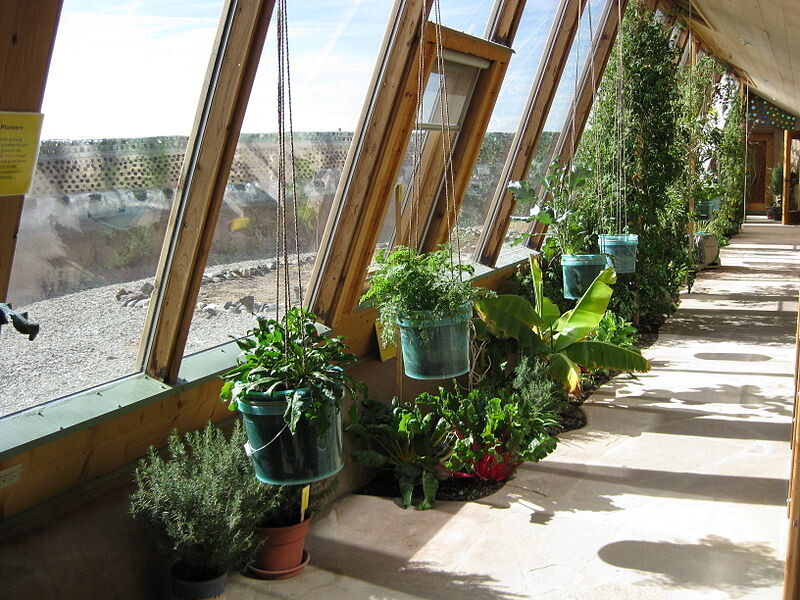
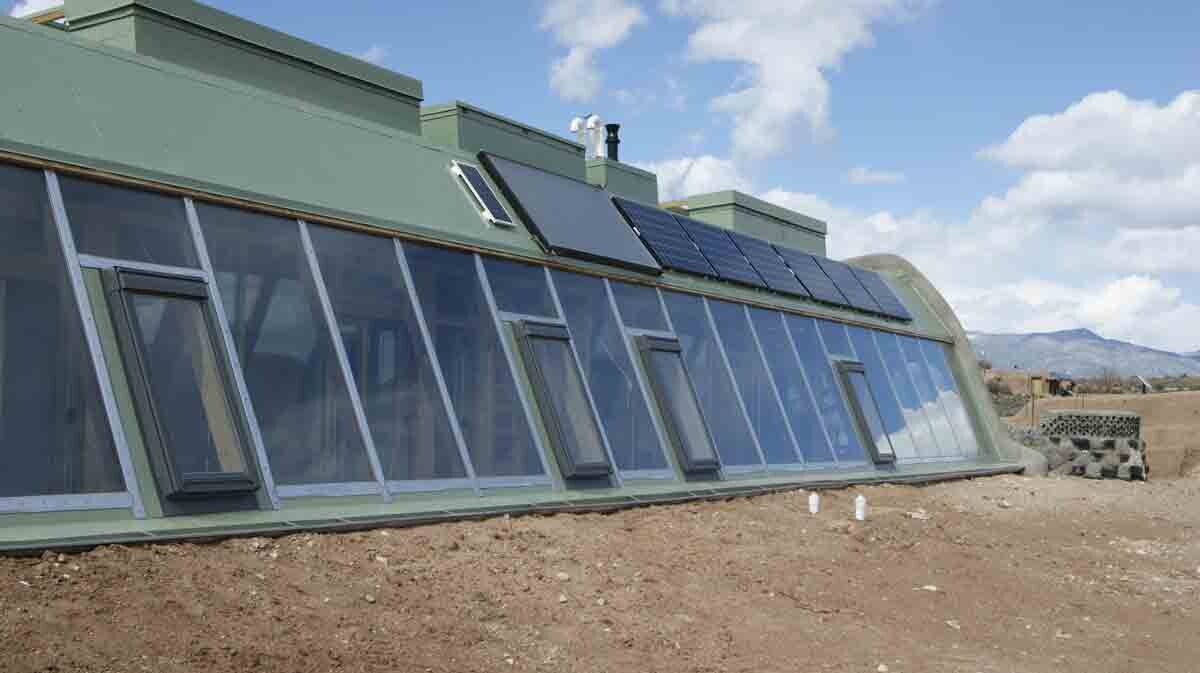
A distinctive feature is the use of waste materials from modern civilization as building components. For example, the sealed north, east, and west walls are almost always made from used car tires. These tires are stacked like bricks and filled with compacted earth. The resulting wall serves as a structural element and, due to its large mass—often weighing several tons—as a thermal storage unit. The south-facing façade, which receives sunlight, is nearly entirely glazed. Solar heat gained here is stored in the massive structure over days and weeks, eliminating the need for conventional heating systems.
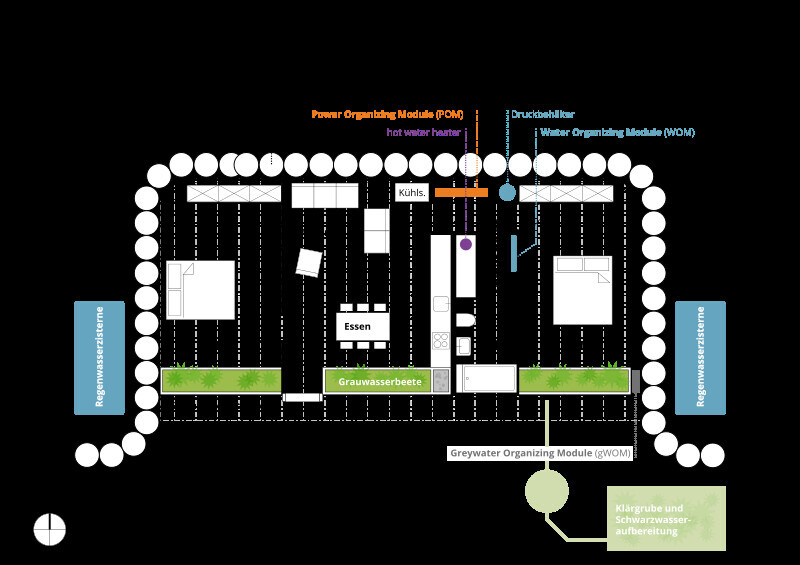
For self-sufficient water supply, rainwater is collected from the roof and stored in cisterns. A sophisticated system allows each drop of water to be reused up to four times. This enables autonomous water supply even in arid regions with very low annual precipitation, without any external water input. The rainwater is filtered and used as drinking water or for flushing. Afterwards, it irrigates an indoor planter bed where it is naturally purified. This treated water is then used for toilet flushing and finally directed through a septic tank to a planted bed next to the house, where remaining impurities are filtered out by plants.
The Earthship concept was developed in the 1970s by American architect Michael Reynolds. Approximately 30 years later, growing awareness of climate protection and sustainable construction methods helped spread the idea beyond the United States. Today, the buildings are designed and marketed by Reynolds’ company Earthship Biotecture in Taos, New Mexico. Besides designing and constructing Earthships, plans and books for self-builders are also offered.
By 2006, about 2,000 Earthships had been built—almost all in the United States except for two exceptions. At least 1,000 other buildings based on the same principles but without involvement from Michael Reynolds or Earthship Biotecture have also been constructed. Since then, projects have appeared in Canada, South America, the Caribbean, India, and Africa. Besides residential buildings, accommodations for natural disaster victims in Haiti and India, as well as a Waldorf school in Sierra Leone, have been built. These structures take into account the distinct climatic conditions of their locations.
In Europe, Earthships have been realized in the Netherlands, Belgium, France, Spain, Portugal, the United Kingdom, Sweden, Iceland, Estonia, and the Czech Republic. The first project in a German-speaking country is planned in the Tempelhof community (Baden-Württemberg, Germany). Construction of the prototype started in late September 2015 and is being scientifically monitored by the University of Stuttgart, especially regarding building physics. To achieve an approvable design, unlike a classic Earthship, the full use of rain and wastewater was omitted. However, all technical systems typical for an Earthship have been installed despite this restriction in water use to allow a complete functional analysis. Additionally, the building, unlike previous Earthships, features a full capillary-breaking subfloor insulation made from foam glass gravel.
Adapting the Earthship principle to the damp, cold climate of Northern Europe has led to technical challenges in early projects, especially concerning condensation. The construction and operation of the Earthship in Brighton (UK) have therefore been scientifically supported and documented by the Centre for Sustainable Construction at the University of Brighton. A bachelor thesis at Denmark’s Via University College addresses the question of how well the building principle can be applied in Denmark’s Nordic climate.
The roofs of Earthships are designed so that all precipitation (rain, snow, dew, and condensation) drains into an underground cistern. First, the water passes through a gravel filter to prevent coarse impurities from entering the cistern. The cisterns are usually positioned in terrain mounded on the north side—approximately at the level of the interior spaces. This elevated position allows water to flow downhill into the indoor “Water Organization Module” (WOM) without the need for additional pumps.
The WOM consists of a direct-current pump and a series of filters. Only water that is intended for drinking passes through all filtration stages. Therefore, each sink is equipped with an additional faucet specifically for drinking water. The pump pressurizes the water into a pressure tank, supplying the household plumbing with standard water pressure. The treated water is used for all domestic applications except the toilet. For the toilet, only previously used water from sinks, showers, or washing machines is used, which has been filtered in “greywater” planter beds beforehand.
*Source: Earthship Deutschland.de
**Images Water Management, Earthship located in Taos N.M, Earthship inside greenhouse + Copyright: Amzi Smith (This file is licensed under the Creative Commons License “Attribution-ShareAlike 3.0 Unported”)
Best regards, Bauexperte
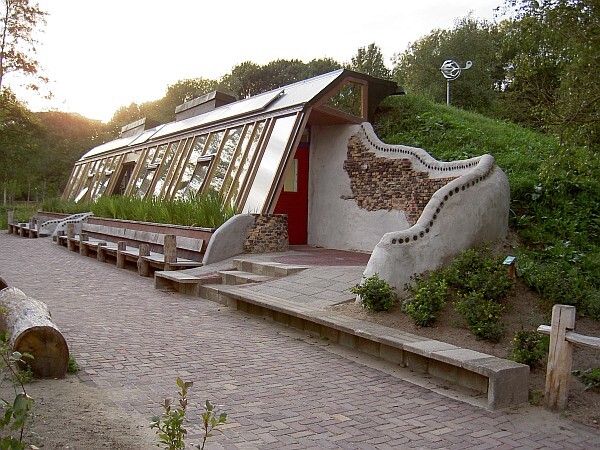
Earthships are buildings constructed using a specific design approach that relies solely on passive solar heat gain and thermal mass storage for heating, as well as natural air circulation for cooling. They are characterized by extensive use of natural and recycled building materials and complete self-sufficiency in terms of heating, electrical power, water, and wastewater management.
A distinctive feature is the use of waste materials from modern civilization as building components. For example, the sealed north, east, and west walls are almost always made from used car tires. These tires are stacked like bricks and filled with compacted earth. The resulting wall serves as a structural element and, due to its large mass—often weighing several tons—as a thermal storage unit. The south-facing façade, which receives sunlight, is nearly entirely glazed. Solar heat gained here is stored in the massive structure over days and weeks, eliminating the need for conventional heating systems.
For self-sufficient water supply, rainwater is collected from the roof and stored in cisterns. A sophisticated system allows each drop of water to be reused up to four times. This enables autonomous water supply even in arid regions with very low annual precipitation, without any external water input. The rainwater is filtered and used as drinking water or for flushing. Afterwards, it irrigates an indoor planter bed where it is naturally purified. This treated water is then used for toilet flushing and finally directed through a septic tank to a planted bed next to the house, where remaining impurities are filtered out by plants.
The Earthship concept was developed in the 1970s by American architect Michael Reynolds. Approximately 30 years later, growing awareness of climate protection and sustainable construction methods helped spread the idea beyond the United States. Today, the buildings are designed and marketed by Reynolds’ company Earthship Biotecture in Taos, New Mexico. Besides designing and constructing Earthships, plans and books for self-builders are also offered.
By 2006, about 2,000 Earthships had been built—almost all in the United States except for two exceptions. At least 1,000 other buildings based on the same principles but without involvement from Michael Reynolds or Earthship Biotecture have also been constructed. Since then, projects have appeared in Canada, South America, the Caribbean, India, and Africa. Besides residential buildings, accommodations for natural disaster victims in Haiti and India, as well as a Waldorf school in Sierra Leone, have been built. These structures take into account the distinct climatic conditions of their locations.
In Europe, Earthships have been realized in the Netherlands, Belgium, France, Spain, Portugal, the United Kingdom, Sweden, Iceland, Estonia, and the Czech Republic. The first project in a German-speaking country is planned in the Tempelhof community (Baden-Württemberg, Germany). Construction of the prototype started in late September 2015 and is being scientifically monitored by the University of Stuttgart, especially regarding building physics. To achieve an approvable design, unlike a classic Earthship, the full use of rain and wastewater was omitted. However, all technical systems typical for an Earthship have been installed despite this restriction in water use to allow a complete functional analysis. Additionally, the building, unlike previous Earthships, features a full capillary-breaking subfloor insulation made from foam glass gravel.
Adapting the Earthship principle to the damp, cold climate of Northern Europe has led to technical challenges in early projects, especially concerning condensation. The construction and operation of the Earthship in Brighton (UK) have therefore been scientifically supported and documented by the Centre for Sustainable Construction at the University of Brighton. A bachelor thesis at Denmark’s Via University College addresses the question of how well the building principle can be applied in Denmark’s Nordic climate.
The roofs of Earthships are designed so that all precipitation (rain, snow, dew, and condensation) drains into an underground cistern. First, the water passes through a gravel filter to prevent coarse impurities from entering the cistern. The cisterns are usually positioned in terrain mounded on the north side—approximately at the level of the interior spaces. This elevated position allows water to flow downhill into the indoor “Water Organization Module” (WOM) without the need for additional pumps.
The WOM consists of a direct-current pump and a series of filters. Only water that is intended for drinking passes through all filtration stages. Therefore, each sink is equipped with an additional faucet specifically for drinking water. The pump pressurizes the water into a pressure tank, supplying the household plumbing with standard water pressure. The treated water is used for all domestic applications except the toilet. For the toilet, only previously used water from sinks, showers, or washing machines is used, which has been filtered in “greywater” planter beds beforehand.
*Source: Earthship Deutschland.de
**Images Water Management, Earthship located in Taos N.M, Earthship inside greenhouse + Copyright: Amzi Smith (This file is licensed under the Creative Commons License “Attribution-ShareAlike 3.0 Unported”)
Best regards, Bauexperte
B
Bauexperte3 Nov 2015 11:59Hello,
xxx.earthship-Tempelhof.de
I have been following this development for a long time and I really like it because it does not just talk about closed-loop systems but consistently pushes them forward despite, and precisely because of, all the underlying objections.
We currently have 2000 sqm (21,528 sq ft) of building land in a very beautiful and green area of Solingen exclusively on the market. On Friday, we will meet on site with our architect to discuss the best possible development; the focus is on between 3 and 4 single-family homes, alternatively bungalow solutions. Since the plot is slightly sloped, I could well imagine one or two Earthships; the width of the land easily allows for that. However, I already know the kind of discussions I would have to have to advance this project. Therefore, I agree with f-pNo that we still need to wait a few years until acceptance of this alternative lifestyle has been established.
Best regards, Bauexperte
SirSydom schrieb:That is not correct. On the grounds of the Stiftung Schloss Tempelhof near Crailsheim, the first Earthship in Germany is currently being built. The project is supported by architect Ralf Müller from the Chair of Building Physics at the University of Stuttgart in cooperation with the Fraunhofer Institute. Those interested can follow the progress in the construction diary:
Such a building method is currently not possible in Germany.
xxx.earthship-Tempelhof.de
SirSydom schrieb:I wouldn’t call it “living like that,” but rather an alternative lifestyle that will surely find its enthusiasts. Furthermore, it is constantly being improved; somewhat like Linux as well.
Maybe I would want to live like that somewhere in the middle of nowhere, but not like this...
I have been following this development for a long time and I really like it because it does not just talk about closed-loop systems but consistently pushes them forward despite, and precisely because of, all the underlying objections.
We currently have 2000 sqm (21,528 sq ft) of building land in a very beautiful and green area of Solingen exclusively on the market. On Friday, we will meet on site with our architect to discuss the best possible development; the focus is on between 3 and 4 single-family homes, alternatively bungalow solutions. Since the plot is slightly sloped, I could well imagine one or two Earthships; the width of the land easily allows for that. However, I already know the kind of discussions I would have to have to advance this project. Therefore, I agree with f-pNo that we still need to wait a few years until acceptance of this alternative lifestyle has been established.
f-pNo schrieb:You just need to visit the Earthship website or feed “Aunt Google” accordingly. Then you can read about how things are developing in Denmark.
I would be interested, for example, in the development/research in Denmark / Sweden regarding cooler climates, since Norway is somewhat my dream country.
Best regards, Bauexperte