
Hello everyone,
Two years ago, we moved into our house, including the basement.
In the basement, we created a large room, which at the moment and in the future is divided into:
One side hobby room
One side storage/pantry room
I would like to visually separate both areas. I want to do this properly and am thinking of using drywall with gypsum board panels.
Now to my questions, or rather, I would like to get some advice here:
1. Does drywall make the most sense in terms of price/performance here?
2. I would ideally like to install panels on both sides, but without insulation – does that make sense? It’s meant purely as a visual separation.
3. Regarding the door opening: Obviously, a passage is needed, but it does not have to be a hinged door – maybe a sliding option could work, or possibly just leaving it open, since the doorway area is a nice feature visually and it could also be practical to keep the passage permanently open. Of course, planning a door makes sense for the future, but maybe someone has another idea?
4. I am open to suggestions or tips to keep everything as cost-effective as possible.
Thank you very much!!
Two years ago, we moved into our house, including the basement.
In the basement, we created a large room, which at the moment and in the future is divided into:
One side hobby room
One side storage/pantry room
I would like to visually separate both areas. I want to do this properly and am thinking of using drywall with gypsum board panels.
Now to my questions, or rather, I would like to get some advice here:
1. Does drywall make the most sense in terms of price/performance here?
2. I would ideally like to install panels on both sides, but without insulation – does that make sense? It’s meant purely as a visual separation.
3. Regarding the door opening: Obviously, a passage is needed, but it does not have to be a hinged door – maybe a sliding option could work, or possibly just leaving it open, since the doorway area is a nice feature visually and it could also be practical to keep the passage permanently open. Of course, planning a door makes sense for the future, but maybe someone has another idea?
4. I am open to suggestions or tips to keep everything as cost-effective as possible.
Thank you very much!!
Hello everyone,
Over the holidays, I revisited the topic more thoroughly and cleared the rooms accordingly so I can start the project in the new year.
I would like to build a drywall partition and cut the laminate flooring at the spot using a plunge saw and a multitool to install the profiles there.
I have already made a small sketch and marked the cuts with the help of a cross-line laser.
The drywall will be made with gypsum boards – without OSB or similar panels, as I won’t be hanging any heavy loads on the walls. It should be fine for loads up to 20 kg (44 lbs).
I have the following question:
I would like to create an area for a door but keep the opening without a door for now because it’s more practical, and the room will only be divided for visual reasons and to gain more usable space. The appearance of the open “doorway” wouldn’t really bother me.
Since I obviously won’t cut the laminate at this spot, I need to know exactly how wide the “clear dimension” between the two rails should be. I want to keep my options open for the future, so that a door can be installed later.
Is it possible to install a door frame without actually fitting the door right away? That shouldn’t be a problem, right?
What would be a practical measurement between the two rails so that a standard-size door can fit later as cost-effectively as possible? Is there any tolerance here, or does the spacing need to be exact? I would really appreciate any guidance!
Second question:
What wall thickness makes sense? Since this is purely a visual room divider, we were thinking about 50 mm (2 inches) studs (standard sizes are 50, 75, 100 mm). With a double-sided single-layer drywall, the total wall thickness would be just over 70 mm (3 inches). Does that even make sense? Are there doors that fit such a thin wall? Or should I rather go for 75 mm (3 inches)?
I’m grateful for any suggestions or tips!
Thanks a lot!
Over the holidays, I revisited the topic more thoroughly and cleared the rooms accordingly so I can start the project in the new year.
I would like to build a drywall partition and cut the laminate flooring at the spot using a plunge saw and a multitool to install the profiles there.
I have already made a small sketch and marked the cuts with the help of a cross-line laser.
The drywall will be made with gypsum boards – without OSB or similar panels, as I won’t be hanging any heavy loads on the walls. It should be fine for loads up to 20 kg (44 lbs).
I have the following question:
I would like to create an area for a door but keep the opening without a door for now because it’s more practical, and the room will only be divided for visual reasons and to gain more usable space. The appearance of the open “doorway” wouldn’t really bother me.
Since I obviously won’t cut the laminate at this spot, I need to know exactly how wide the “clear dimension” between the two rails should be. I want to keep my options open for the future, so that a door can be installed later.
Is it possible to install a door frame without actually fitting the door right away? That shouldn’t be a problem, right?
What would be a practical measurement between the two rails so that a standard-size door can fit later as cost-effectively as possible? Is there any tolerance here, or does the spacing need to be exact? I would really appreciate any guidance!
Second question:
What wall thickness makes sense? Since this is purely a visual room divider, we were thinking about 50 mm (2 inches) studs (standard sizes are 50, 75, 100 mm). With a double-sided single-layer drywall, the total wall thickness would be just over 70 mm (3 inches). Does that even make sense? Are there doors that fit such a thin wall? Or should I rather go for 75 mm (3 inches)?
I’m grateful for any suggestions or tips!
Thanks a lot!
N
nordanney7 Jan 2025 08:19Prager91 schrieb:
What measurement between the two tracks would be practical so that an affordable standard-sized door can be installed? Is there some tolerance here, or does the distance need to be exact? I would really appreciate some guidance! There are also standard rough opening dimensions for standard doors:
Standard door frames from many online suppliers start at 80 mm (3.1 inches) – corresponding to wall thicknesses of about 80 to 95 mm (3.1 to 3.7 inches). It is preferable to choose a 75 mm (3.0 inches) wall plus drywall or cladding.
Stick to the shell dimensions, and you won’t have any problems. Basically, you have enough tolerance and don’t need to work with millimeter precision—but the walls should be straight.
I can’t confirm that doors and frames for thinner wall thicknesses aren’t available at reasonable prices—both 50 (50–65 mm) and 70 (70–85 mm) mm are standard sizes from some online door manufacturers (for example, Tuerenmarkt24). However, if you want more choice between budget options, you’ll need wall thicknesses of 80 mm or more.
The most common drywall (gypsum board) sheets are 12.5 mm thick, so with UW/CW50 profiles you will have a wall thickness of at least 75 mm. Personally, I wouldn’t go any thinner than that with a single layer of drywall, even if you don’t plan to hang anything on the wall.
By the way, gypsum fiber boards and some special drywall types are also available in 15 mm thickness (which corresponds to an 80 mm wall thickness with UW/CW50 profiles), but these are usually not stocked at local hardware stores.
I can’t confirm that doors and frames for thinner wall thicknesses aren’t available at reasonable prices—both 50 (50–65 mm) and 70 (70–85 mm) mm are standard sizes from some online door manufacturers (for example, Tuerenmarkt24). However, if you want more choice between budget options, you’ll need wall thicknesses of 80 mm or more.
The most common drywall (gypsum board) sheets are 12.5 mm thick, so with UW/CW50 profiles you will have a wall thickness of at least 75 mm. Personally, I wouldn’t go any thinner than that with a single layer of drywall, even if you don’t plan to hang anything on the wall.
By the way, gypsum fiber boards and some special drywall types are also available in 15 mm thickness (which corresponds to an 80 mm wall thickness with UW/CW50 profiles), but these are usually not stocked at local hardware stores.
Zubi123 schrieb:
If you actually want to hang something on the basement wall, I recommend reconsidering double layering with drywall or also OSB. For your area, drywall panels won’t cost a fortune, won’t significantly increase the work time, and it will make the construction easier later on.Yes, I have heard this from several people already, and I will think it over again. This way, I could also easily use 2x2 inch (50mm) studs in the end, since with double layering the wall should normally be wide enough for standard door dimensions.
nordanney schrieb:
There are also standard rough opening dimensions for standard doors:
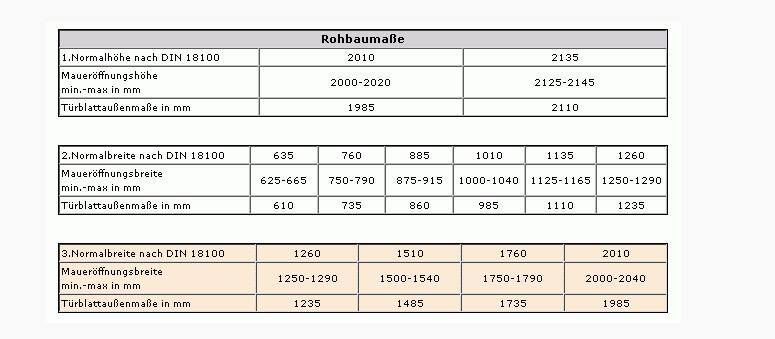
Standard door frames from many online suppliers start at 80mm (3.1 inches) – which corresponds to wall thicknesses of 80–95mm (3.1–3.7 inches). So it’s better to choose a 75mm (3.0 inches) wall plus drywall or other cladding.Am I right in understanding that a rough opening width of 760mm (30 inches) is a safe choice and keeps all options open for a “normal width” door?
Similar topics